
Executive Summary
For a US-backed company weighing its first move into India, India’s corporate tax rules rarely announce themselves as urgent. They surface later, in a board deck that does not reconcile, in a diligence process that stalls over undocumented related-party pricing, or in a cash flow model that never accounted for a minimum tax on book profits. The regulatory environment reflects both India’s federal structure and its scaling ambitions, whatever the entry point.
This guide walks through the six pillars of India tax obligation: corporate income tax, the minimum alternate tax, dividend withholding, TDS, GST, and transfer pricing, closing with the startup incentives available under DPIIT. Treating compliance as a downstream accounting task, rather than an upfront design question, remains among the costlier mistakes founders make.
Designing Compliance Before Expansion into India
Companies tend to treat Indian tax compliance as something the accounting team handles after the fact, discovering its full weight only once it has grown expensive. A more durable approach builds the finance function with India’s requirements in view from the first hire, since retrofitting compliance onto an operating business cost far more than designing it in advance.
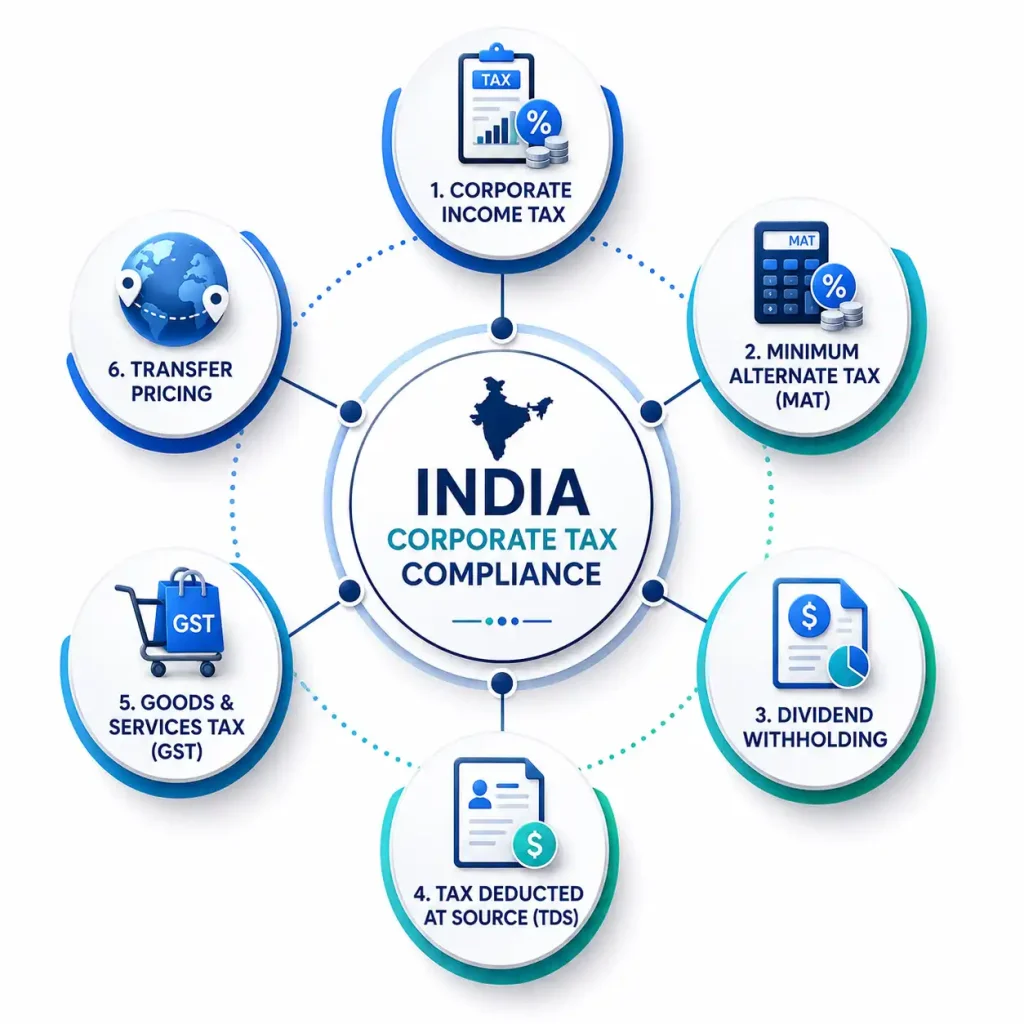
A cybersecurity firm licensing intellectual property into India, a gaming studio running a development center in Pune, and a logistics company managing multi-state supply chains encounter the same underlying structure, whatever the sector. What holds constant is process ownership, documentation discipline, and a finance leader who treats India as its own regulatory environment. The six pillars that shape most conversations about India’s corporate tax rules follow.
- Corporate income tax, including the choice between domestic regimes and the branch structure
- Minimum alternate tax on book profits, arriving ahead of full taxable liability
- Dividend withholding and treaty-dependent taxation at the shareholder level
- Tax deducted at source on salaries, rent, professional fees, and royalties
- Goods and services tax on the supply of goods and services within India
- Transfer pricing documentation for related-party and intercompany transactions
Corporate Income Tax and Regime Choices Under India’s Corporate Tax Rules
Corporate income tax is the most direct obligation an India-incorporated business will face, and its structure forms the foundation for every later stage of planning.
Domestic Regime Options
Domestic private limited companies with turnover below INR 400 crore, roughly $50M, pay a base rate of 25%, rising to an effective rate near 25.17% with surcharge and cess. A concessional 15% regime introduced in 2019 for new manufacturing entities occasionally extends to technology-adjacent operations, while many service-oriented startups instead choose the 22% regime, trading SEZ deductions for simplicity.
Foreign Branch Taxation and Entity Structuring
Foreign companies operating through Indian branches face a base rate of 40% and effective rates above 43% after surcharges and cess, a structural incentive toward incorporating a local subsidiary rather than operating as a branch. The choice of regime shapes valuation conversations and how investors read the balance sheet at exit.
Minimum Alternate Tax and the Book Profit Trap
The minimum alternate tax applies when deductions or exemptions push a company’s taxable income below a set threshold, requiring a minimum payment of 15% on book profits regardless of the taxable figure. Early-stage startups rarely encounter this during loss years, but as book profits appear ahead of full tax liability, MAT often catches founders who assumed profitability meant a lighter cash tax burden. MAT credit carries forward, though this still adds complexity to cash flow modeling. Finance leaders who have built multi-entity architecture spanning the United States, India, and Nepal tend to build MAT into projections from the outset, communicating its mechanics to boards the way they communicate burn rate.
Dividend Taxation After the DDT Shift
Until April 2020, India taxed dividends at the corporate level through the Dividend Distribution Tax, a cascading burden on distributed profits. Its removal shifted taxation to the shareholder level, simplifying corporate planning while introducing new withholding obligations. Non-resident shareholders are now governed by whichever tax treaty applies, and for startups with international cap tables, this reshapes liquidity planning and the structuring of buybacks or secondary transactions.
Tax Deducted at Source: Procedural Discipline at Every Payment
TDS touches nearly every outgoing payment a company makes in India, including salaries, rent, professional fees, royalties, and certain software licenses. The obligation begins almost immediately upon hiring contractors, and non-compliance results in penalties, interest, and disallowance of the expense.
The real difficulty tends to be procedural rather than financial. Monthly deposits, return filings, and certificate issuance demand disciplined systems, and startups most often stumble not because the rates are unclear but because ownership between finance and human resources is not. In one early-stage digital marketing and email technology company, a finance function built from scratch reduced monthly burn from $800K to $200K through this kind of reporting discipline, a reminder that the payoff shows up in reduced audit risk.
Common points of TDS failure worth building controls around include the following.
- Vendor classification errors that apply the wrong withholding rate
- Missed monthly deposit deadlines that trigger interest and penalties
- Certificate issuance delays that complicate a vendor’s own filings
- Disconnected payroll and ERP systems that create reconciliation gaps
Goods and Services Tax and Its Operational Weight
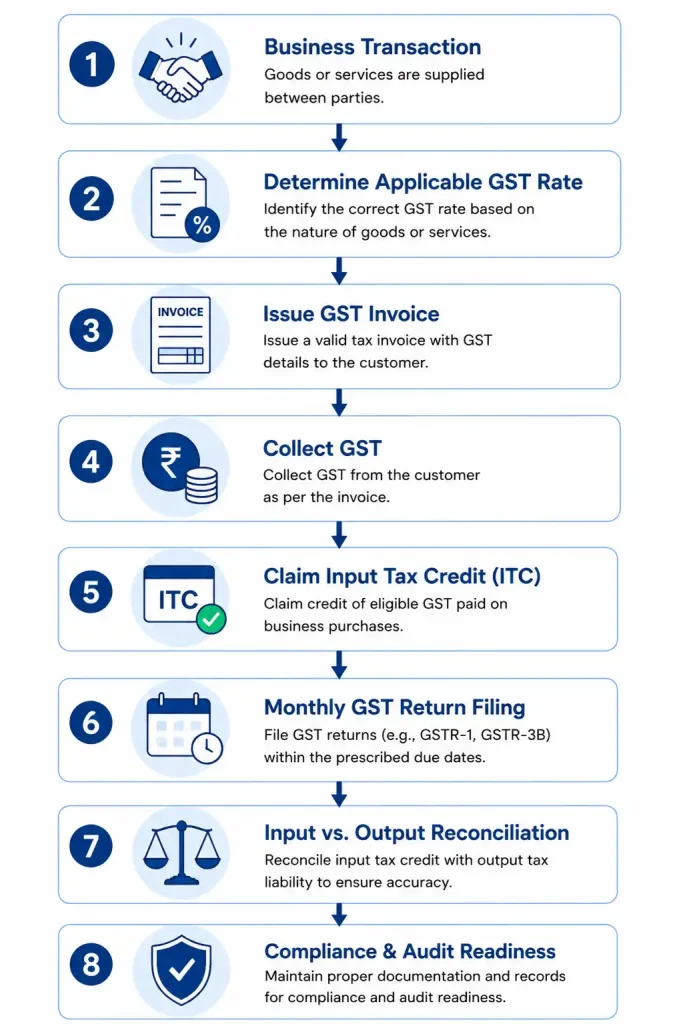
GST unified a previously fragmented indirect tax system and now governs how a business collects, reports, and remits tax on the supply of goods and services within India.
Registration and Filing Cadence
Registration becomes mandatory once turnover exceeds roughly INR 20 lakh in most states, after which a business must charge GST, file monthly returns, and reconcile input tax credit against eligible purchases. Rates range from 5% on essential goods to 18% on most services, including software-as-a-service offerings, up to 28% on luxury categories.
Zero-Rated Exports and Reconciliation
Exported services, including cross-border SaaS revenue, are zero-rated, so a startup can avoid charging GST on foreign sales while claiming credit for input GST paid domestically. Qualifying requires a Letter of Undertaking and documentation proving the export nature of the transaction. The burden sits less in the rate structure and more in the monthly reconciliation between input and output credit, where mismatches trigger audits and lock up working capital. A defensible zero-rated export position generally requires the following.
- An active Letter of Undertaking filed before the export invoice is raised
- Export invoices that clearly document the foreign customer and payment terms
- Bank realization certificates confirming receipt of foreign currency
- Monthly reconciliation of input tax credit against output GST filings
Transfer Pricing for Cross-Border India Operations
Startups with foreign investors, affiliated entities, or intercompany arrangements fall under India’s transfer pricing rules, which require related-party transactions to be priced at arm’s length. A company must maintain documentation, including economic analyses, comparable, and functional profiles, covering royalty payments, intercompany loans, service agreements, and IP licensing between a foreign holding company and an Indian development center.
Because assessments can review up to six years of transactions retroactively, and penalties include a 2% fee on transaction value plus disallowance of deductions, the documentation burden is not optional even for early-stage companies. In cross-border M&A work involving a publicly listed company with operations spanning the United States, France, the United Kingdom, Singapore, and South Korea, incomplete transfer pricing records were among the issues that most reliably delayed deals. Standardizing intercompany agreements early remains the more durable path.
Startup-Specific Incentives Under DPIIT
Startups recognized under the DPIIT, or Department for Promotion of Industry and Internal Trade, framework may access a three-year income tax holiday within their first ten years of incorporation, along with exemption from angel tax. Many eligible companies fail to realize these incentives because of missed filings or a misaligned entity structure, not any lack of underlying eligibility. Aligning shareholder composition with incentive eligibility belongs in the CFO’s office. A DPIIT eligibility review generally covers the following.
- Formal DPIIT recognition application filed through the Startup India portal
- Annual filings and innovation declarations submitted on schedule
- Shareholding structure reviewed for angel tax exemption eligibility
- Entity age and turnover thresholds confirmed against current DPIIT limits
Corporate Tax Landscape at a Glance
The table below summarizes the core obligations above, a quick reference for finance leaders navigating India’s corporate tax rules across multiple entities.
| Tax Category | Typical Rate | Primary Trigger |
| Corporate Income Tax (domestic, turnover below INR 400 crore) | ~25.17% effective | Annual taxable profit |
| Corporate Income Tax (foreign branch) | ~43%+ effective | Branch income in India |
| Concessional Manufacturing Regime | ~17% effective | New manufacturing entity election |
| Minimum Alternate Tax | 15% of book profits | Low taxable income despite book profits |
| Dividend Withholding | Treaty-dependent | Dividend paid to non-resident shareholders |
| GST (standard, SaaS/services) | 18% | Turnover above ~INR 20 lakh |
| Transfer Pricing Penalty | 2% of transaction value | Non-compliant related-party pricing |
Three Key Takeaways
- India’s corporate tax rules reward structure over improvisation, and companies that treat the six pillars of obligation as design questions from the first hire tend to avoid the cash flow surprises and diligence delays that catch everyone else.
- The minimum alternate tax and TDS obligations are less about statutory complexity than procedural discipline, so building reporting systems and role ownership early pays back in audit risk and close speed, not only in the tax line.
- Transfer pricing and DPIIT eligibility both hinge on documentation built ahead of need, and the six-year retroactive window on transfer pricing review means intercompany agreements drafted today are written for a diligence process that has not yet begun.
Disclaimer: This article is intended for informational purposes only and does not constitute legal, tax, or accounting advice. You should consult your own tax advisor or counsel for advice tailored to your specific situation.
Hindol Datta is a four-time CFO and senior finance executive with over 25 years of leadership experience across cybersecurity, SaaS, gaming, logistics, digital marketing, medical devices, consumer products, and nonprofit organizations. He has led more than $120M in fundraising and over $150M in M&A transactions while building the financial and operational systems that let complex businesses scale with confidence. He is the author of seven books in the Systems CFO Series and holds active CPA, CMA, and CIA credentials.
AI-assisted insights, supplemented by 25 years of finance leadership experience.