EXECUTIVE SUMMARY The era of incremental digitization is over. Organizations that spent the last decade moving workflows online and calling it transformation now face a reckoning: a new class of AI-native enterprises is building from a fundamentally different blueprint. Where traditional transformation layered technology onto existing processes, AI-native design begins with intelligence at the architectural core. This shift is not evolutionary; it is structural. Leaders who grasp this distinction will architect durable competitive advantage. Those who do not will find themselves optimizing systems that were obsolete before they were finished.
The Unfinished Promise of Digital Transformation
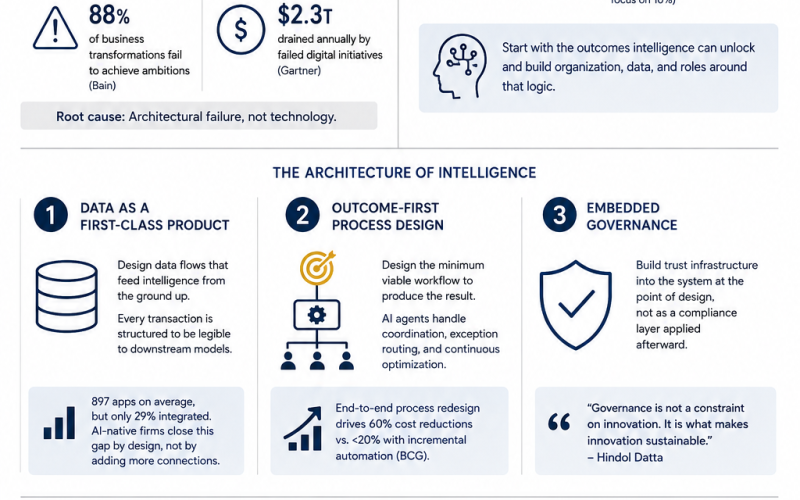
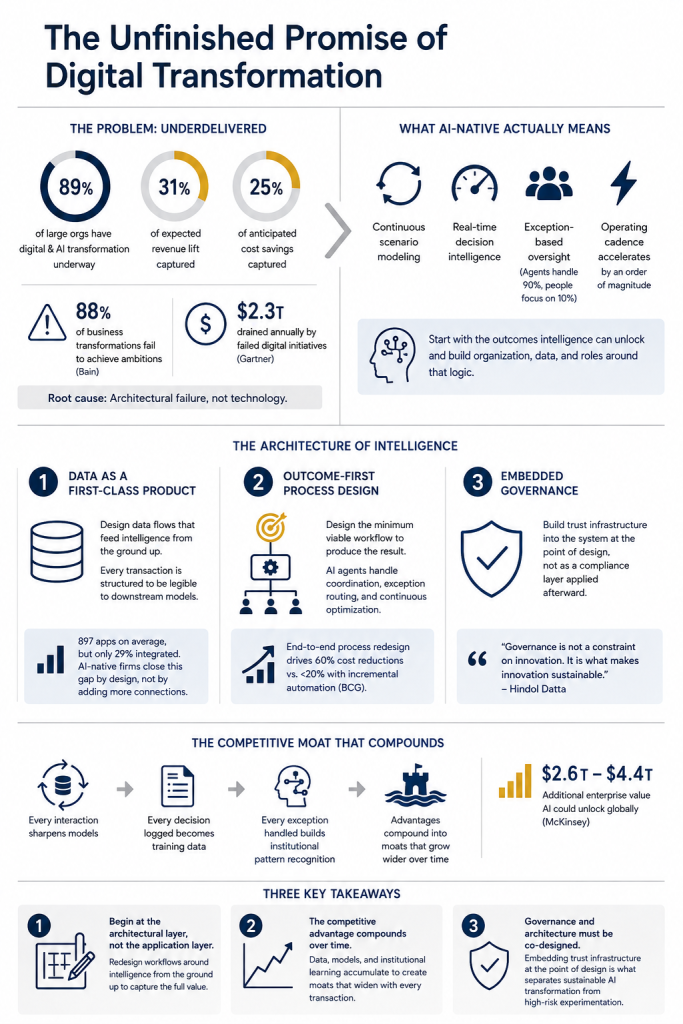
By nearly every measure, the digital transformation era has underdelivered. McKinsey research shows that while 89% of large organizations globally have a digital and AI transformation underway, they have captured only 31% of expected revenue lift and a mere 25% of anticipated cost savings. A Bain study found that 88% of business transformations fail to achieve their original ambitions. The aggregate cost of this failure is staggering: Gartner estimates that failed digital initiatives drain $2.3 trillion from global organizations annually.
The root cause is rarely a failure of technology selection. The failure is architectural. Organizations approached digital transformation as a migration project rather than a reinvention project. They moved spreadsheets into the cloud, automated manual steps in legacy processes, and deployed dashboards over data structures that were never designed to feed them. The underlying operating model, with its departmental silos, sequential workflows, and human-intensive decision loops, remained intact. Intelligence was added as a layer rather than woven into the fabric.
What AI-Native Actually Means
The AI-native enterprise is not one that uses AI tools prolifically. It is one designed around the assumption that intelligence is continuously available, real-time, and embedded in every workflow. As I have explained in The Systems CFO, “the companies that succeeded were those that started with business architecture and worked down to technology. The ones that failed started with technology and tried to force business processes into software constraints.” AI-native design inverts the old paradigm entirely: it starts with the outcomes intelligence can unlock and builds organizational structures, data flows, and human roles around that logic.
In practical terms, this means that planning cycles are replaced by continuous scenario modeling. Reporting cycles give way to real-time decision intelligence. Human review of routine transactions is replaced by exception-based oversight, with agents handling the 90% and people focused on the 10% that requires nuanced judgment. The operating cadence of the enterprise accelerates by an order of magnitude, not because people work faster, but because the system itself thinks faster.
The Architecture of Intelligence
Three structural shifts characterize AI-native enterprises.
First, data is treated as a first-class product rather than a byproduct of transactions. Organizations average 897 applications, but only 29% are integrated, according to MuleSoft. AI-native firms close this gap not by connecting more systems but by designing data flows that feed intelligence from the ground up. Every transaction is structured to be legible to downstream models.
Second, process design is outcome-first. Rather than asking how to automate a current process, AI-native architects ask what result the business requires and design the minimum viable workflow to produce it, with AI agents handling coordination, exception routing, and continuous optimization. BCG research on agentic deployments demonstrates that end-to-end process redesign is what separates organizations achieving 60% cost reductions from those capturing less than 20%.
Third, governance is embedded rather than audited. The AI Operating Framework and Governance perspective articulated in Hindol Datta’s work on AI governance makes clear that “governance is not a constraint on innovation. It is what makes innovation sustainable.” AI-native firms build trust infrastructure into the system at the point of design, not as a compliance layer applied afterward.
The Competitive Moat That Compounds
The competitive logic of AI-native enterprises is that advantages compound in ways legacy organizations cannot replicate through incremental investment. Every interaction the system processes makes the models sharper. Every decision logged becomes training data. Every exception handled builds institutional pattern recognition. McKinsey analysis estimates that AI could unlock $2.6 to $4.4 trillion in additional enterprise value globally, but this value accrues disproportionately to organizations that establish capability early.
The implication for leadership is urgent. Organizations that delay the architectural redesign are not maintaining their current position; they are falling behind at an accelerating rate. The question for boards and executive teams is no longer whether to pursue AI-native design but how to prioritize the transition without destabilizing operations in the process.
THREE KEY TAKEAWAYS
1. AI-native design begins at the architectural layer, not the application layer. Organizations that add AI tools to legacy process structures capture a fraction of the available value compared to those that redesign workflows around intelligence from the ground up.
2. The competitive advantage of AI-native enterprises compounds over time. Data, models, and institutional learning accumulate in ways that create moats that grow wider with every transaction processed.
3. Governance and architecture must be co-designed. Embedding trust infrastructure at the point of system design is what separates sustainable AI transformation from high-risk experimentation.
AI-assisted insights, supplemented by 25 years of finance leadership experience.