Executive Summary
Every finance leader learns eventually that the landed cost formula is not an accounting footnote. It is the difference between a gross margin figure that reflects reality and one that flatters a board deck. The gap quietly misleads everyone in the room. Freight-in charges, customs duties, insurance, and warehousing fees rarely enter the early conversation about pricing strategy or manufacturing efficiency. Yet for companies importing goods, assembling products across geographies, or managing third-party logistics providers, these costs decide something basic. Whether the reported margin is a fact or a story depends on them.
This article walks through what the landed cost formula actually captures. It explains why cost layering and ASC 330 make precision a fiduciary matter and not a preference. It also shows how systems disconnect between logistics and finance turns unit economics into guesswork. Along the way, it works through a landed cost example from practice. It shows when finance teams can capitalize warehousing costs. It also lays out steps finance leaders can put to use this quarter.
Why the Landed Cost Formula Belongs in Every Gross Margin Conversation
Boards asking why margins and actuals disagree tend to land on the same answer: a landed cost the team never fully captured. Pricing strategy, input costs, and manufacturing efficiency dominate the early conversation about gross margin. Freight-in, customs duties, and warehousing fees stay below the radar until a quarter goes sideways. That gap is never a rounding error. Consider a global consumer products business selling across DTC, Amazon, and wholesale, with a supply chain running through China and Vietnam. Ocean freight volatility alone moved its landed cost per unit by double digits within a single season. The businesses that survived were the ones whose finance function had already built the discipline to see it coming.
Product firms misclassify freight charges as SG&A more often than most executives realize, and the effect compounds. The misclassification overstates gross margin and drifts unit economics from reality. It hands stakeholders a narrative that is numerically precise and economically false. Precision in landed cost accounting is not advisable. It is fiduciary.
Defining Landed Cost: What the Landing Cost Formula Actually Includes
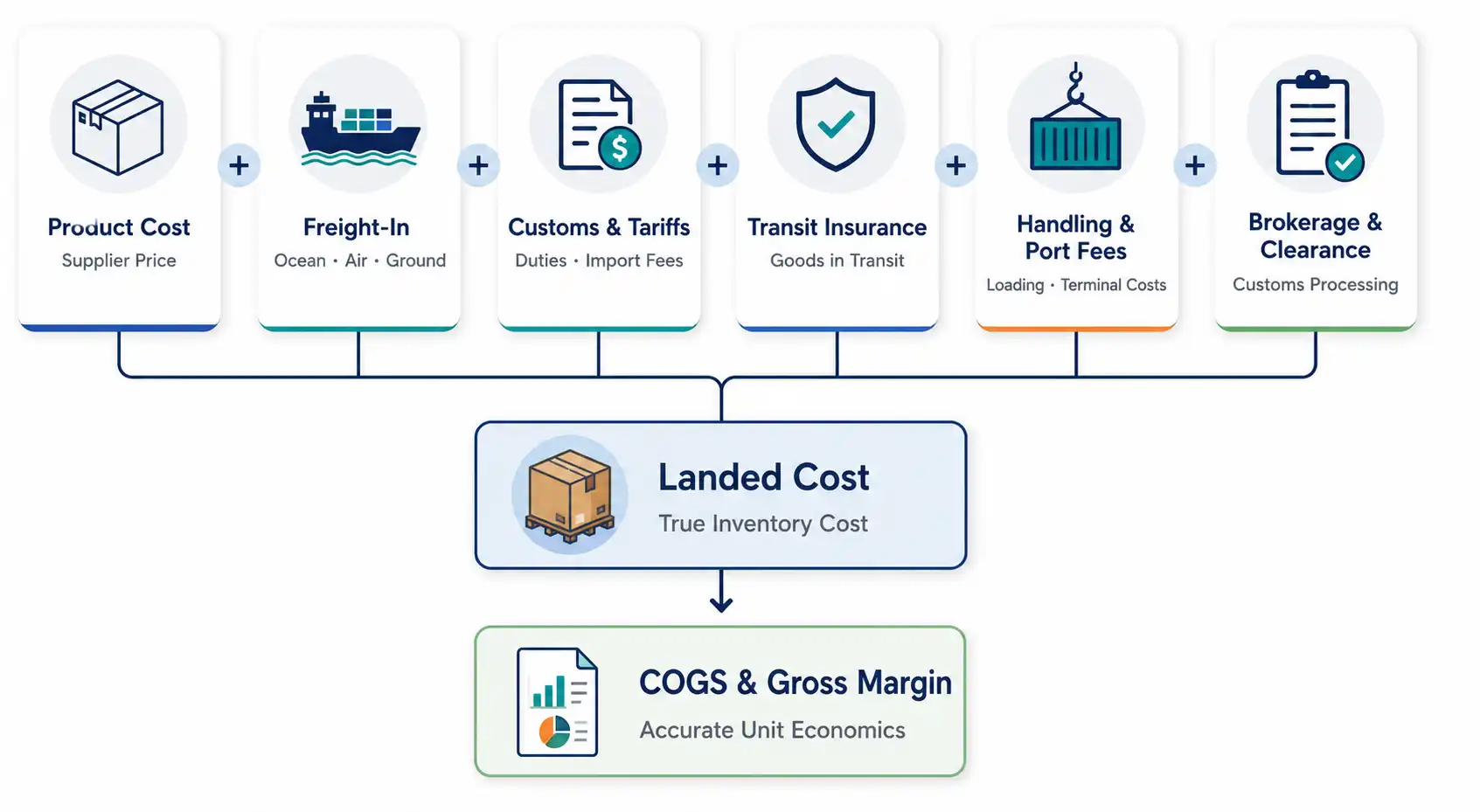
Landed cost captures the full cost of moving inventory from a supplier’s dock to the company’s books. It reaches well beyond the shipping line on an invoice. ASC 330 requires inventory to include every cost necessary to bring goods to their current location and condition. In practice, this means the landed cost formula draws on several distinct inputs working together.
- Freight-in across ocean, air, and ground
- Customs duties and tariffs
- Insurance during transit
- Handling and port fees
- Warehousing at arrival
- Brokerage and clearance charges
The Landing Cost Formula in Its Simplest Form
Stated plainly, the landed cost formula is:
Landed Cost = Product Cost + Freight-In + Customs Duties and Tariffs + Insurance + Handling and Port Fees + Brokerage and Clearance Charges
Some practitioners still call this the landing cost formula. The terminology matters less than whether the landing cost flows through to inventory instead of sitting in an expense account. Early-career FP&A work inside a logistics organization focused on rail and transportation offers a useful grounding here. Freight economics, route profitability, and capacity utilization interact to shape a unit’s true cost, the same interaction a landed cost formula is built to describe. That grounding in asset-heavy operations carries forward into every subsequent engagement touching supply chain finance. Most ERP systems, and more finance teams than one would hope, still fail to route these inputs into cost of goods sold. Instead, they land in a freight expense account or a miscellaneous logistics bucket inside SG&A. What looks like a minor classification choice becomes a genuine distortion of gross margin.
A Landed Cost Example from the Field
Consider a shipment of components carrying a $100K invoice price that incurs $20K in freight and customs, bringing the landed cost to $120K. If only the $100K reaches the balance sheet as inventory while the $20K sits in SG&A, cost of goods sold per unit is understated by twenty percent, and gross margin is overstated by that same amount. Carry that distortion across several quarters and multiple product lines, and a company ends up defending a margin narrative that no longer describes its business.
In one such case, the fix was a rebuilt landed cost engine, integrating freight quotes, customs data, and purchase order matching logic so that every inbound shipment carried its fully burdened cost. Within two quarters, pricing decisions realigned with reality, SKU-level profitability became visible for the first time, and vendor conversations shifted from negotiating unit price alone to attacking the full cost stack, freight lane by freight lane.
When Warehousing Becomes Capitalizable
Warehousing sits in a genuine grey area, and under GAAP, only costs directly attributable to staging, preparing, or storing goods prior to sale qualify for capitalization; ongoing distribution center rent, picking labor, and general inventory storage are typically expensed as incurred. Transitional warehousing, where goods sit staged between customs clearance and internal transport or where inventory requires reconditioning before it is sale-ready, is a different matter and may meet the capitalization test. In a regulated global manufacturing environment spanning plants across three countries, with standard costing and bill of materials discipline built into every unit, this distinction was not academic. Auditors examined it line by line, and the cost layering had to hold up under that scrutiny every single quarter.
Systems Integration: The Hidden Constraint Behind the Landed Cost Formula
The most persistent obstacle across companies at different stages is not a lack of data. It is the disconnect between operational logistics systems and financial systems that were never designed to talk to each other. A freight invoice from a carrier often arrives disconnected from the originating purchase order. Customs brokerage gets paid in a lump sum applied across multiple shipments with no allocation to individual SKUs, and finance ends up coding these costs by hand, relying on allocation assumptions or, in the worst cases, writing the whole charge off to a generic account.
A driver-based forecasting engine and multi-entity finance architecture built for a cybersecurity and identity access management company operating across five countries shows how much a single systems implementation can change this picture. Consolidating financial reporting onto one platform compressed the monthly close from eighteen days to ten and, more to the point for landed cost purposes, created the kind of clean data linkage that allocation-by-hand can never fully replicate. Without that systematic mapping of inbound costs to inventory receipts, the burdened cost per unit is never truly known, and pricing, budgeting, and cost reduction efforts stay speculative by default.
Strategic Implications: Turning Landed Cost Data Into a Strategic Lever
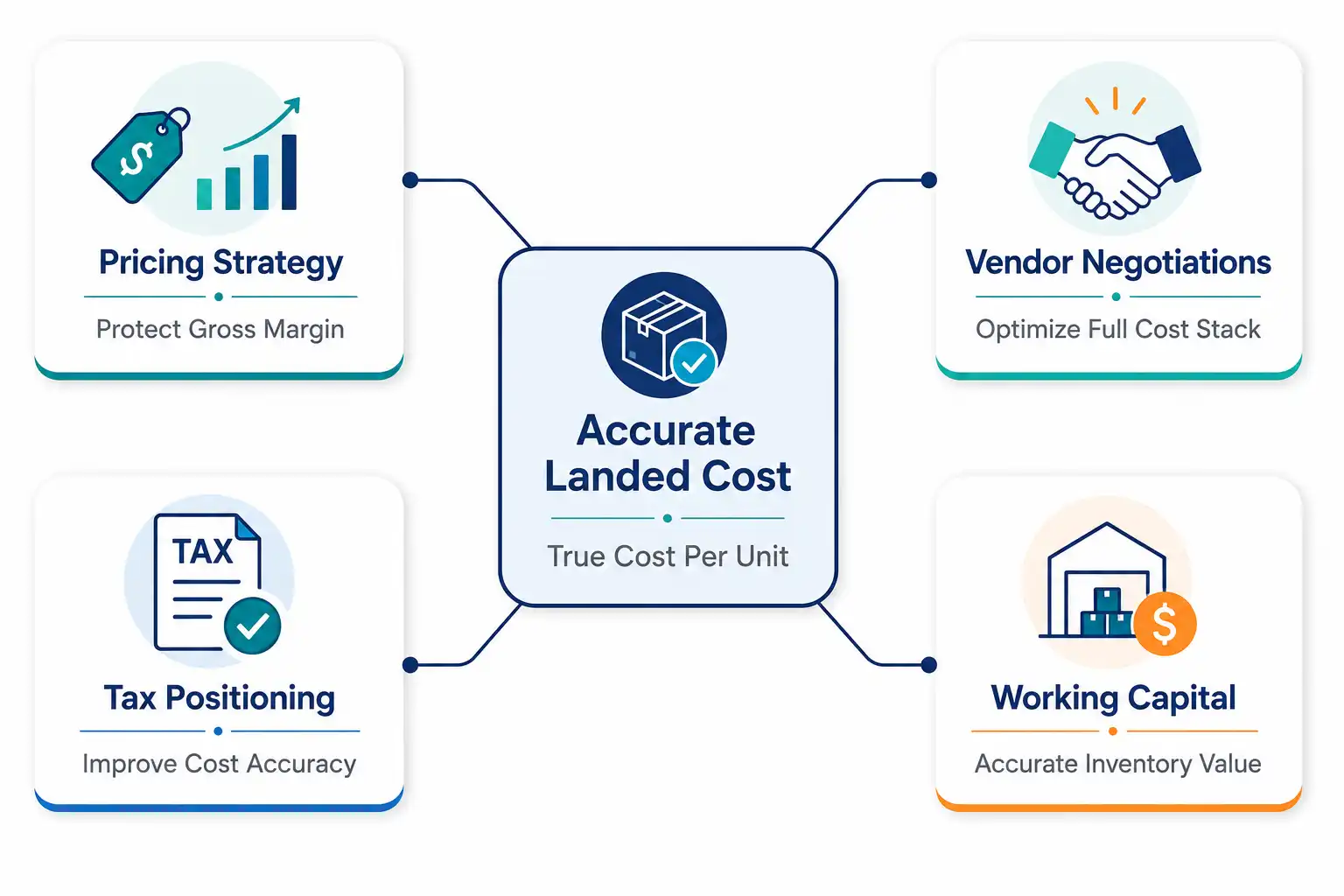
Getting the landed cost formula right is not merely a compliance exercise. It changes what a finance function can actually do with the numbers it produces.
- Pricing strategy: unit cost assumptions that exclude freight produce margins that exist on paper and nowhere else.
- Vendor negotiations: understanding landed cost by supplier lane allows a company to negotiate the entire cost stack instead of unit price in isolation.
- Tax optimization: in certain jurisdictions, over- or under-stated inventory costs affect VAT recoverability and intercompany transfer pricing exposure.
- Working capital: misclassified landed costs distort inventory valuation and can affect borrowing base calculations inside asset-based lending facilities.
Actionable Steps for Finance Leaders
- Audit the chart of accounts so that freight-in, duties, and customs costs route to inventory rather than SG&A.
- Integrate landed cost tracking into the ERP, or build a disciplined manual process for high-volume SKUs and key suppliers where the system falls short.
- Work across logistics, procurement, and accounts payable to establish clear cost attribution at the shipment level.
- Run quarterly landed cost variance reviews comparing actual costs to standard, and use the findings to refine pricing and forecasting assumptions.
- Revisit reserve and obsolescence policies, since a landed cost increase can turn a previously profitable SKU into one that no longer pays for itself.
If gross margin is the lifeblood of a product company, landed cost is its circulatory map. It shows where value gets created, where it gets consumed, and where it leaks out unnoticed, and finance leaders who treat that map with the seriousness it deserves are not acting as auditors. They are acting as partners in operational clarity, and that distinction shapes how much the rest of the organization trusts the numbers finance presents.
Three Key Takeaways
- The landed cost formula only works when every input, freight, duties, insurance, handling, and brokerage, is captured and routed to inventory instead of scattered across SG&A accounts, because a single misclassified category can overstate gross margin by a wide margin within a single quarter.
- Cost layering under ASC 330 is not a theoretical requirement; it demands systems that link purchase orders, carrier invoices, and customs data at the shipment level, and companies that skip this linkage end up pricing, budgeting, and forecasting against numbers that were never true.
- Landed cost discipline pays dividends well beyond the audit, reshaping vendor negotiations, tax positioning, and working capital, so finance leaders should treat a quarterly landed cost variance review as a strategic exercise and not a bookkeeping chore.
Disclaimer: This article is intended for informational purposes only and does not constitute legal, tax, or accounting advice. You should consult your own tax advisor or counsel for advice tailored to your specific situation.
Hindol Datta is a four-time CFO and senior finance executive with over 25 years of leadership experience across cybersecurity, SaaS, gaming, logistics, digital marketing, medical devices, consumer products, and nonprofit organizations. He has led more than $120M in fundraising and over $150M in M&A transactions while building the financial and operational systems that let complex businesses scale with confidence. He is the author of seven books in the Systems CFO Series and holds active CPA, CMA, and CIA credentials.
AI-assisted insights, supplemented by 25 years of finance leadership experience.