
Executive Summary
Performance obligations sit at the center of that question. Getting the classification wrong can turn a strong bookings quarter into a messy audit conversation. This article explains how companies define performance obligations and why the distinction carries strategic weight beyond compliance. It also covers how the concept plays out across common bundled contracts involving software, hardware, warranties, and services.
Finance leaders who master ASC 606 performance obligations move beyond simply following the standard. They actively shape how they communicate revenue, margin, and cash flow to boards and investors. The sections below walk through three things. First, the identification test. Second, the allocation mechanics, including bundled discount treatment. Third, the traps that most often lead scaling companies astray.
What Defines a Performance Obligation
Under ASC 606, a performance obligation is a promised good or service in a contract. Two conditions must both be true for that promise to stand on its own. First, the customer must be able to benefit from it either independently or alongside other readily available resources. Second, the promise must be separately identifiable from other promises in the contract.
A SaaS company selling a platform license, implementation support, and user training might assume three separate obligations exist. That assumption breaks down quickly when operating the platform requires the training. If the company cannot deliver the training on its own, the problem gets worse. Treating it as distinct when it is not creates a problem. The company recognizes revenue before it actually delivers the underlying value, and that creates exposure during audit review.
Why the Distinction Matters Strategically
Clear performance obligations shape more than the revenue line. They influence how a company prices services, builds forecasts, and earns trust from its board and its auditors.
Consider three practical effects.
- Pricing design improves: Once a company understands implementation, support, and training as separate promises, it can price each with intention rather than fold them into a single bundled number that obscures cost recovery.
- Forecasting sharpens: Revenue recognized ratably over a support period behaves differently in a cash model than revenue tied to a milestone-based implementation, and that difference matters for hiring and investment decisions.
- Diligence moves faster: In a $30M ARR cybersecurity and identity access management SaaS environment supporting customers across five countries, a documented ASC 606 revenue recognition framework and controls environment became one of the assets that carried the business cleanly through acquisition diligence, avoiding the weeks of delay that blurred obligations tend to create.
The Two-Step Test for Identifying Obligations
ASC 606 uses a two-step filter, and both conditions must hold before a promise is treated as its own performance obligation.
Step one, capability of standalone benefit The customer can use the good or service on its own or with other resources already available to it.
Step two, separately identifiable promise The promise is distinct within the context of the contract, meaning it is not so intertwined with another deliverable that the two are effectively inseparable.
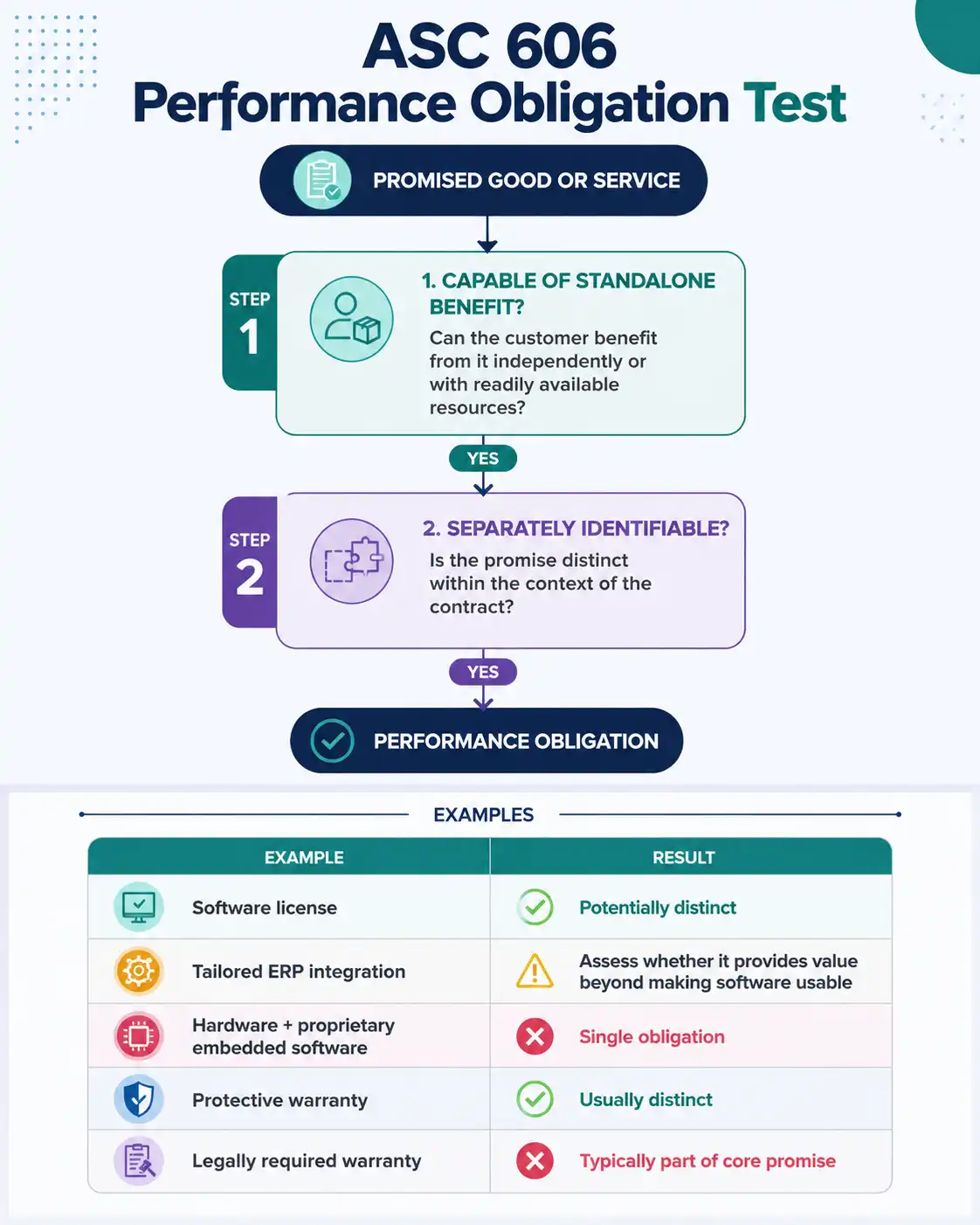
A basic software license clears step one easily. A highly tailored integration built to connect a SaaS product with a customer’s ERP system may also clear it, provided the integration holds value beyond simply making the core software usable. Documenting that value, through customer statements or competitive benchmarking, gives auditors something concrete to test against.
Step two is more qualitative. A hardware device that only functions with its proprietary embedded software fails the separability test, since the two cannot reasonably be sold or used apart from one another, and ASC 606 treats that pairing as a single obligation. A protective warranty sold beside that same device usually passes, unless the warranty is required by law, in which case it typically folds into the core promise instead of standing alone.
Standalone Selling Price and the Bundled Discount
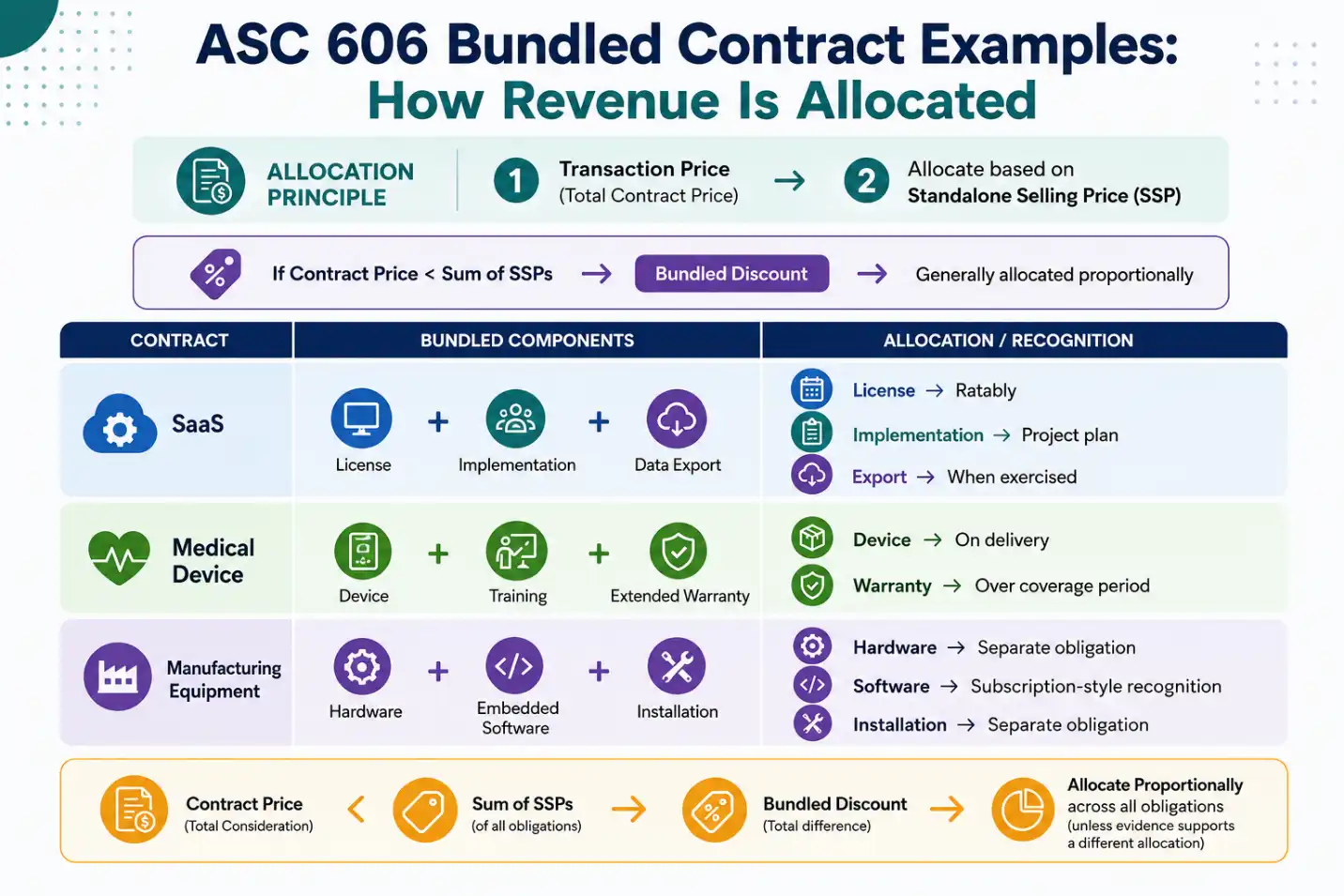
Once obligations are identified, the transaction price must be allocated across them based on standalone selling price, meaning what each piece would sell for if offered independently.
Problems appear when the total contract price is lower than the sum of what each obligation would cost separately. That gap is called a bundled discount, and ASC 606 generally requires the discount to be spread proportionally across every obligation in the contract, rather than absorbed entirely by one line item, unless there is clear evidence that the discount relates to a specific promise. Getting this allocation wrong distorts margin reporting by obligation and can misstate how much of a deal is recurring versus one time in nature.
How the Concept Plays Out in Practice
A few condensed scenarios illustrate how the test and the allocation work together.
A SaaS contract bundling a license, implementation, and an optional data export service typically splits into three obligations, with the license recognized ratably, implementation recognized against a project plan, and the export service recognized only if the customer exercises it.
A medical device sale bundled with training and an extended warranty usually splits into three obligations as well. In a $170M global medical device manufacturing environment spanning plants in multiple countries, standard costing discipline and inventory controls precise enough to survive line by line audit scrutiny made it possible to defend exactly this kind of allocation, separating device revenue recognized on delivery from warranty revenue deferred and recognized over the coverage period.
Manufacturing equipment sold with embedded, regularly updated software and installation often produces three obligations too, separating hardware cost of goods sold from a subscription style software margin that behaves very differently in a forecast.
Deferred payment terms deserve separate attention. When cash is delayed for reasons unrelated to customer convenience, ASC 606 requires evaluating whether a significant financing component exists, in which case part of the contract value is reclassified as interest income rather than service revenue, which changes both the income statement presentation and the tax treatment.
Common Traps That Mislead Companies
Even well-trained finance teams fall into predictable patterns.
- Misapplying the integration service exception, treating deliverables as a single obligation when they are genuinely separable
- Overlooking embedded financing when payment terms are extended for the customer’s benefit
- Bundling itemized promises into one invoice line for simplicity, at the cost of transparency and defensible allocation
Building a Practical Checklist
A short, repeatable process keeps classification consistent across a growing contract portfolio.
- List every promise contained in the contract
- Test each promise for standalone benefit
- Determine whether promises are distinct or too interrelated to separate
- Confirm that the accounting reflects the actual rights granted to the customer
- Allocate the transaction price using standalone selling price, adjusting for any bundled discount
A one-page memo per contract type, reviewed on a quarterly cadence, tends to reduce inconsistency and shortens audit cycles considerably.
Three Key Takeaways
- Performance obligations are defined by a two-step test covering standalone benefit and separability, and both conditions must be satisfied before a promise is treated as distinct for ASC 606 revenue recognition purposes.
- Allocation based on standalone selling price, including proper treatment of any bundled discount, determines how accurately revenue reflects the value actually delivered to the customer.
- Systems and process discipline, including SKU level tagging and a quarterly review log, turn performance obligation classification from a recurring audit risk into a durable operational strength.
Disclaimer: This article is intended for informational purposes only and does not constitute legal, tax, or accounting advice. You should consult your own tax advisor or counsel for advice tailored to your specific situation.
Hindol Datta is a four-time CFO and senior finance executive with over 25 years of leadership experience across cybersecurity, SaaS, gaming, logistics, digital marketing, medical devices, consumer products, and nonprofit organizations. He has led more than $120M in fundraising and over $150M in M&A transactions while building the financial and operational systems that let complex businesses scale with confidence. He is the author of seven books in the Systems CFO Series and holds active CPA, CMA, and CIA credentials.
AI-assisted insights, supplemented by 25 years of finance leadership experience.