
Executive Summary
ASC 606 revenue recognition is not a compliance checkbox. It is the accounting language that translates what a company delivers to customers into numbers. Investors, boards, and lenders rely on those numbers. Those numbers are how stakeholders judge its health. Finance leaders often treat the standard as an audit exercise. In reality, it is a discipline that shapes forecasting, pricing, and system design. Leaders who miss that distinction tend to discover the consequences only once growth accelerates and the gaps turn expensive.
This guide walks through what ASC 606 requires and where 606 accounting most commonly breaks down in practice. It also covers how finance functions across different business models can build systems and governance that hold up under scrutiny. The goal is a common-sense understanding of a standard that rewards judgment far more than it rewards mechanical rule-following.
What Is ASC 606 Revenue Recognition and Why It Matters
Revenue recognition governs the timing and pattern of recording revenue. It reflects the obligations a company has promised to fulfill for a customer. Before ASC 606, industries applied fragmented revenue standards, layered with interpretive guidance such as SOP 97-2 and various EITF releases. That guidance often disconnected from the economic substance of the transaction. ASC 606 replaced that patchwork with a single principle. A company recognizes revenue when control of a good or service transfers to the customer. The amount reflects what it expects to receive.
Revenue functions as more than a line item. It anchors valuation multiples, defines the starting point of gross margin, and signals growth velocity to every external stakeholder reading the financial statements. Get the recognition pattern wrong, and the misstatement does not stay contained to one account. It distorts board reporting, misleads potential acquirers during diligence, and can unravel a financing round when a buyer’s quality-of-earnings review surfaces the gap. This is precisely the kind of exposure that emerges during buy-side diligence on acquisition targets, where EBITDA adjustments tied to revenue timing frequently separate a clean deal from a renegotiated one.
What Is ASC 606? The Five-Step Revenue Recognition Model
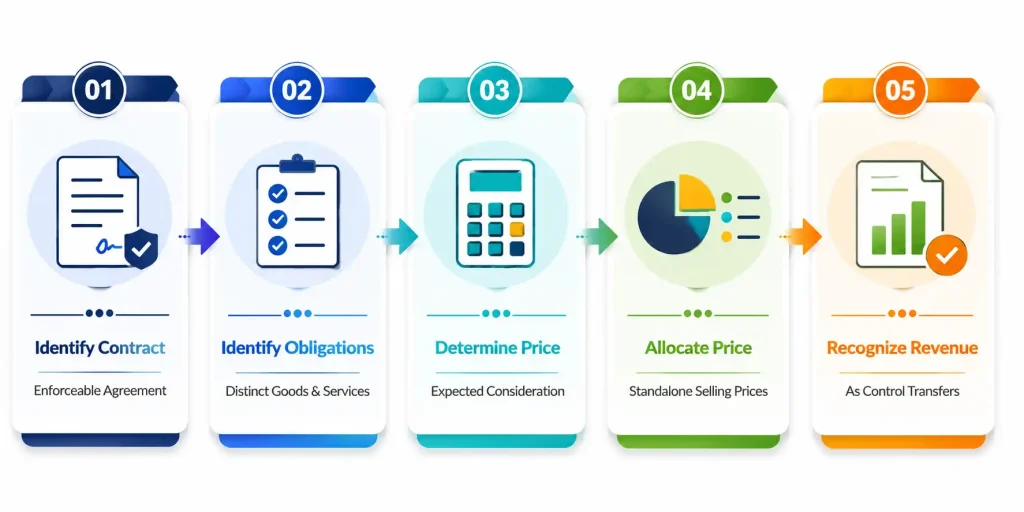
At its structural core, ASC 606 accounting rests on a five-step model. The steps read simply on paper and grow considerably messier once applied to a real contract portfolio.
Identify the contract
A contract is any arrangement creating enforceable rights and obligations, and it need not be a signed order form. Verbal agreements, side letters, and even a pattern of delivering and invoicing without formal documentation can qualify.
Identify the performance obligations
Each distinct promise embedded in a contract, whether platform access, implementation, training, or support, constitutes a separate performance obligation that finance must track and satisfy on its own timeline.
Determine the transaction price
This is what the company actually expects to receive after accounting for discounts, rebates, variable payments, and financing effects, an amount that often falls meaningfully below the face value of the contract.
Allocate the transaction price
The company must split revenue across performance obligations based on standalone selling prices, not list prices and not internal transfer prices, but a defensible, market-based estimate of what each element would command if sold on its own.
Recognize revenue when or as control transfers
Revenue follows delivery of value, not the invoice date and not the date cash arrives in the bank.
A driver-based forecasting engine built around this model, rather than around invoicing schedules, is what allowed one high-growth cybersecurity and identity access management company to hold actuals within five percent of forecast for 8 consecutive quarters. That kind of precision does not happen by accident. It happens when the ASC 606 framework is embedded into the forecasting logic itself, not bolted on at quarter-end.
Where ASC 606 Accounting Gets Complicated in Practice
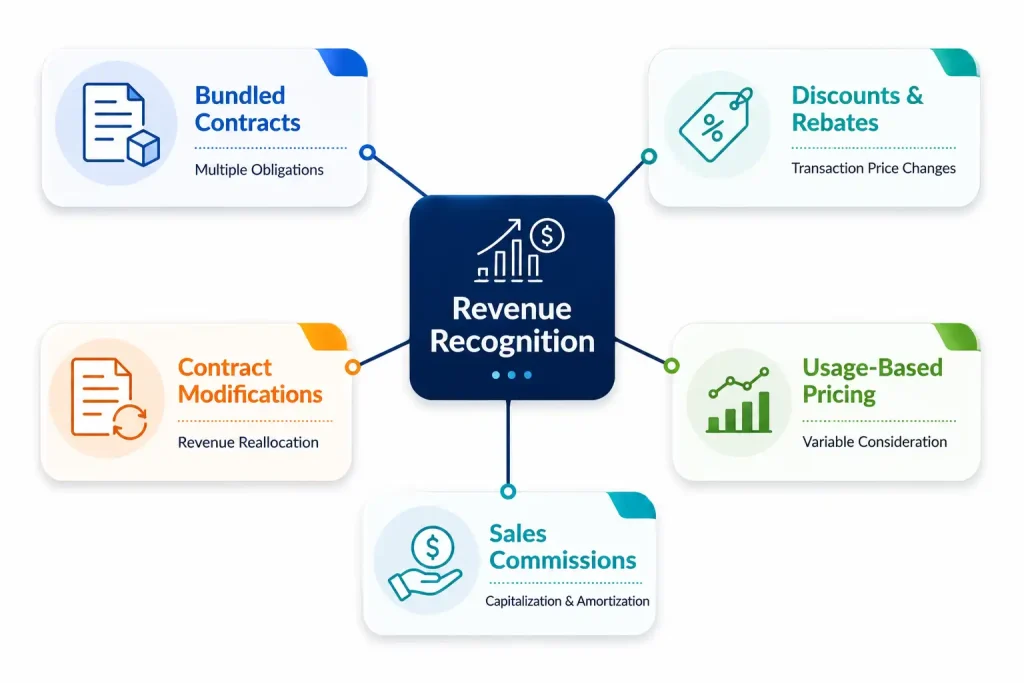
The five steps are elegant in the abstract. The friction shows up in five recurring areas.
Bundled contracts
A $300K deal packaged as license, implementation, and support looks like a single sale to the sales team and looks like three separate obligations to an auditor. If implementation is optional or delivers value on its own, it must be recognized separately from the license.
Discounts and rebates
An end-of-quarter discount approved to close a deal reduces the transaction price immediately, not gradually. If a discount is probable and estimable, it lowers recognized revenue from day one, with downstream effects on commission expense and margin reporting.
Renewals and modifications
When a customer renews early or changes scope mid-term, the question is whether this constitutes a new contract or a modification of the existing one. A modification frequently requires reallocating all remaining revenue, which means finance systems must track contract changes as they happen rather than reconstruct them at period-end.
Usage-based pricing
Seat-based, consumption-based, and threshold-based pricing models introduce variable consideration, requiring either a defensible estimate of that variability or deferral until it resolves. Both paths demand forecasting discipline that many systems are not built to support out of the box.
Commission capitalization
ASC 340-40 requires capitalizing certain incremental costs of obtaining a contract, typically sales commissions, and amortizing them over the expected customer life. Treating all commissions as immediate expense, or capitalizing them without a documented amortization policy, is a common and correctable exposure.
Operationalizing ASC 606 Across Business Models
Service-Based Models
Consulting firms, SaaS companies, and professional services organizations generally recognize revenue over time as performance obligations are satisfied ratably across a subscription or engagement period. A cloud provider charging a $50K implementation fee must determine whether that setup activity provides a distinct benefit to the customer. If it does, the fee is recognized upfront; if not, it is deferred and amortized alongside the subscription. Engagement-level profitability analytics built across a professional services firm’s five business units, during a stretch that took the organization from $12M to $63M in revenue within eight months, illustrated how directly revenue timing and utilization tracking are connected once the business scales quickly.
Product-Based Models
Manufacturers and distributors face a different question: when does control actually transfer? FOB shipping point typically triggers recognition at shipment, while FOB destination defers it until delivery. Bill-and-hold arrangements, common in capital equipment, require a substantive customer request and a ready-for-delivery condition before revenue can be recognized. In a $127M global consumer products company selling across DTC, Amazon, and wholesale channels through a supply chain spanning China and Vietnam, inventory turns more than doubled from three times to seven times once demand planning and SKU rationalization were tightened, work that sits directly upstream of clean revenue and margin reporting.
Licensing and IP Monetization
Revenue from intellectual property depends on whether the license grants a right to use the IP, recognized at a point in time, or a right to access it, recognized over time. A one-time perpetual software license is treated differently than a recurring API access fee tied to real-time analytics, and hybrid arrangements demand careful, documented judgment rather than a default assumption.
Building Systems That Support 606 Accounting Compliance
Enterprise resource planning platforms and revenue recognition engines must mirror the five-step model structurally, not just conceptually. Contract identification and performance obligation mapping often require manual overlay even in well-configured systems, and contract repositories should tag each obligation as distinct or bundled, point-in-time or over-time, with variable consideration flagged explicitly.
Tools such as Zuora, NetSuite ARM, and SAP RAR are only as reliable as the logic configured within them. A global Oracle Financials and MicroStrategy rollout across five countries, undertaken to create one unified definition of revenue across every subsidiary of a publicly traded gaming and digital entertainment company, materially compressed statutory reporting cycles under both IFRS and US GAAP. That kind of consolidation work is what makes a global close manageable rather than a monthly scramble.
Audit Readiness and the CFO’s Governance Role
Audit friction tends to originate from opaque policy positions, inconsistent documentation, and adjustments made under deadline pressure rather than in advance. A revenue playbook documenting positions on variable consideration estimation, contract modifications, and significant financing components turns audit season into a review rather than a discovery process. A company deferring $2M in upfront customization fees, for instance, should be able to document the distinctness assessment, the standalone selling price methodology, the allocation rationale, and the amortization pattern with supporting journal entries before an auditor ever asks.
Beyond the mechanics, the CFO sets the cultural tone around revenue integrity. That means scenario-based training so revenue operations teams can recognize performance obligations before deals close, cross-functional input from sales and legal at the pre-signature stage rather than after, disciplined data capture so systems hold every attribute recognition requires, and board communication that frames revenue disclosures as a window into pricing strategy and customer retention rather than a compliance footnote.
Questions Boards and Founders Should Ask
- Does the company recognize revenue when value is delivered, or when it is billed?
- Do contracts cleanly separate performance obligations, or does sales bundle everything under one label?
- Are discounts, rebates, and usage-based terms reflected in reported revenue, or discovered later?
- Are sales commissions capitalized under a documented policy, or expensed inconsistently?
- Can the finance system handle mid-term contract modifications without a manual rebuild?
Three Key Takeaways
- ASC 606 revenue recognition rewards judgment over mechanical compliance, and the finance functions that treat the five-step model as a forecasting and pricing discipline, not an audit checklist, are the ones that hold up under diligence and board scrutiny.
- The recurring failure points, bundled contracts, discounts, renewals, usage-based pricing, and commission capitalization, are predictable, and a documented revenue playbook addressing each one in advance turns audit season into a review rather than a fire drill.
- Systems matter as much as policy. A revenue recognition engine that mirrors the five-step model structurally, with contract attributes tagged at the point of signature, is what allows 606 accounting to scale alongside the business rather than lag behind it.
Disclaimer: This article is intended for informational purposes only and does not constitute legal, tax, or accounting advice. You should consult your own tax advisor or counsel for advice tailored to your specific situation.
Hindol Datta is a four-time CFO and senior finance executive with over 25 years of leadership experience across cybersecurity, SaaS, gaming, logistics, digital marketing, medical devices, consumer products, and nonprofit organizations. He has led more than $120M in fundraising and over $150M in M&A transactions while building the financial and operational systems that let complex businesses scale with confidence. He is the author of seven books in the Systems CFO Series and holds active CPA, CMA, and CIA credentials.
AI-assisted insights, supplemented by 25 years of finance leadership experience.