
Executive Summary
Revenue recognition gets most of the attention in any conversation about ASC 606. Yet the real test of whether a finance organization understands the standard shows up somewhere quieter. It is in how the organization treats unbilled receivables and the costs required to fulfill a contract. I have built this discipline from a blank page more than once. In every instance, the companies treated unbilled accounts receivable as a footnote rather than a governance discipline. Those were the companies that later had to explain a margin surprise to their board.
This article works through the unbilled receivables meaning under ASC 606. It covers the related and often misunderstood treatment of contract fulfillment costs under ASC 340-40. It also lays out the practical steps a finance leader can take. These steps keep unbilled receivables and fulfillment costs from becoming landmines on the balance sheet. The goal is the operating discipline that lets a CFO stand in front of investors and auditors. That discipline means being able to explain what every unbilled receivable represents and why it will convert to cash.
Understanding the Unbilled Receivables Meaning Under ASC 606
An unbilled receivable arises when a company satisfies a performance obligation and earns the right to payment. The company has not yet issued an invoice to the customer. This is the inverse of deferred revenue, which reflects cash collected ahead of performance. Unbilled receivables sit on the other side of that ledger entirely. Confusing the two is a common error. Finance teams new to accrual-based contract accounting make it often.
In practice, unbilled accounts receivable tends to surface in a narrow set of recurring patterns:
- Time-and-materials contracts with a monthly billing lag between delivery and invoice
- Milestone-based arrangements where the milestone has been achieved but the invoice trigger has not yet fired
- SaaS or implementation engagements where the contract terms allow revenue recognition ahead of the billing schedule
A professional services firm scaled from $12M to $63M in revenue within eight months. Leading finance and analytics across five business units there, this was not an abstract accounting question. Engagement-level billing lag was masking the true economics of the business. That lasted until unbilled tracking got built down to the individual project. Under ASC 606, revenue timing follows the satisfaction of performance obligations, not the mechanics of the invoicing system. A finance organization whose general ledger still ties revenue recognition to invoice generation is likely out of compliance. That holds whether or not anyone has noticed yet.
ASC 340-40 and the Second Half of the Equation: Contract Fulfillment Costs
Where the standard becomes more intricate is on the cost side. ASC 340-40 requires companies to capitalize and amortize the incremental costs of obtaining a contract over the life of the related revenue. Sales commissions are the clearest example. It also introduces a second, less discussed category: costs to fulfill a contract.
These are not commissions. They typically include the following:
- Project setup labor
- Configuration or implementation work
- Dedicated software environments or customization effort
- Pre-delivery staging or manufacturing work for long-lead products
When a cost directly relates to a specific contract, generates or enhances a resource the company will use to satisfy that contract, and the company expects to recover it, the cost belongs on the balance sheet as a capitalized asset rather than as an immediate expense. This marks a meaningful departure from legacy GAAP, which expensed many of these same costs as incurred, and I have seen finance teams consistently underestimate the amount of judgment the standard now demands of them at exactly this departure point.
Why This Distinction Carries Real Economic Weight
Handled with discipline, the capitalization of fulfillment costs alongside the recognition of unbilled receivables allows a company to match cost and revenue in a way that actually reflects economic substance. It protects gross margin integrity and keeps period-over-period comparisons honest rather than distorted by the timing of an invoice.
There is a practical tension underneath that discipline, however. Capitalizing costs lifts EBITDA in the near term, but it also creates a deferred expense that the company must amortize, usually on a straight-line basis, across the revenue recognition period. When churn accelerates, or when a contract terminates early, that amortization has to accelerate with it, and the result can land on the income statement as a sudden and unwelcome shock.
The services organization had capitalized implementation costs aggressively under ASC 340-40 when a version of this played out. When the business later shifted toward shorter-term contracts to stay agile with customers, the amortization schedules no longer matched the underlying reality of how long those contracts actually lasted. The eventual correction required a $600K write-down in contract asset balances and three quarters of restated gross margin, a consequence that traced directly back to a capitalization policy nobody had revisited as the contract book changed shape.
The Flow from Delivery to Cash
The relationship between delivery, unbilled accounts receivable, invoicing, and cash collection is worth mapping explicitly, because it is the sequence that finance, sales, and delivery teams most often describe inconsistently to one another.
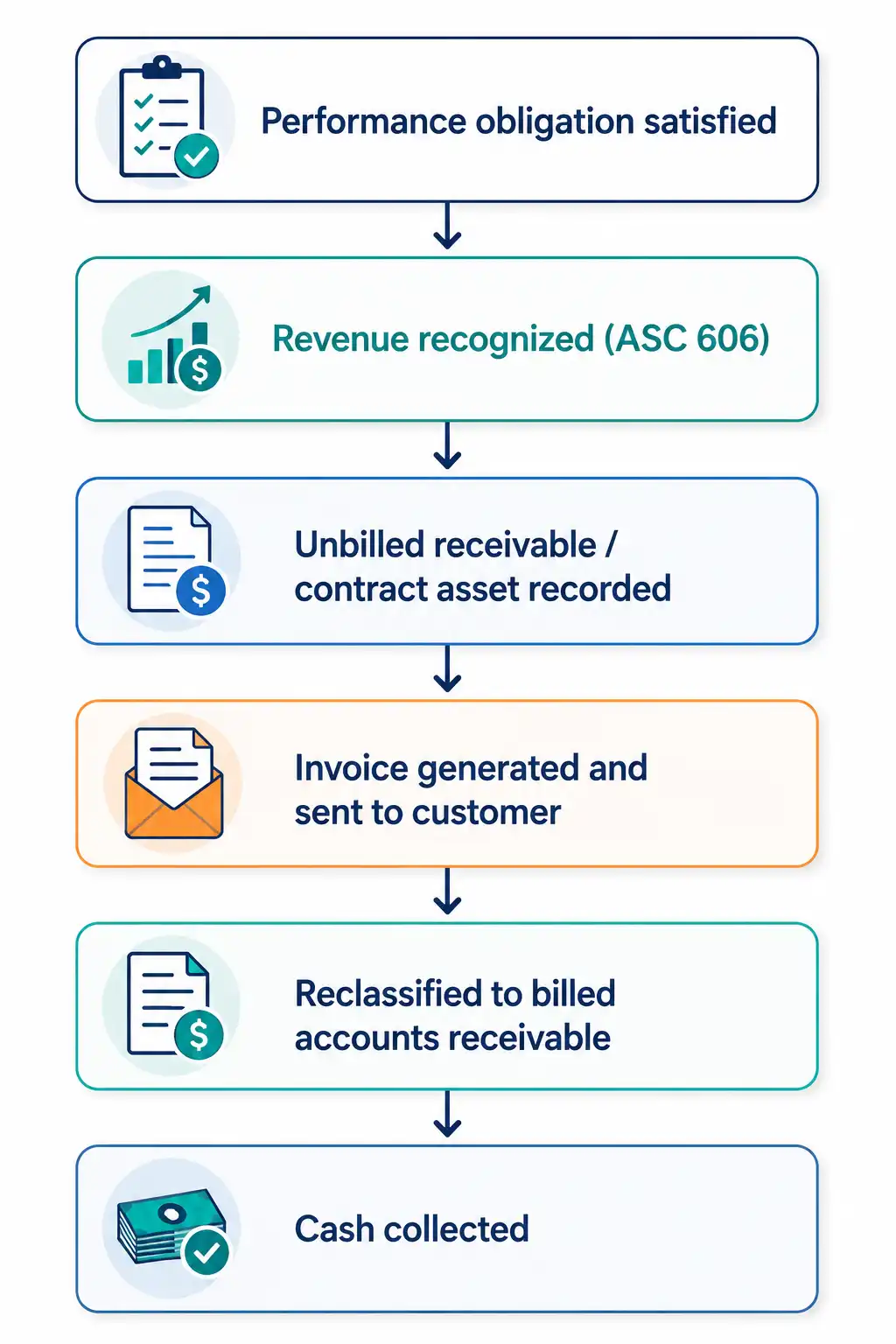
Every transition needs an owner. In most organizations I have worked with, the point where things break down is the gap between recognition and invoicing, where delivery teams and billing systems are not yet talking to one another on the same cadence.
Systems Thinking: This Is Not a Journal Entry Problem
Operationalizing ASC 340-40 and the unbilled receivables discipline that sits alongside it requires alignment across sales, delivery, billing, and finance simultaneously. Capitalization decisions depend on an accurate understanding of contract structure, not merely on the revenue schedule sitting in the general ledger.
The enterprise resource planning system has to track project-level labor and tie it back to specific contracts. The billing system has to separate the invoice trigger from the moment a performance obligation is actually satisfied. And the amortization logic behind capitalized costs has to be reviewed on a quarterly cadence, particularly as the average contract term across the book shifts. When I rebuilt the ASC 606 revenue recognition framework and controls environment at a cybersecurity and identity access management company generating approximately $30M in annual recurring revenue, this cross-functional alignment was the difference between a reporting process that could survive acquisition diligence and one that could not. Relying on spreadsheets or end-of-quarter judgment calls is a reliable way to generate inconsistency, and inconsistency is exactly what invites audit challenge.
Risks and Red Flags Finance Leaders Should Track
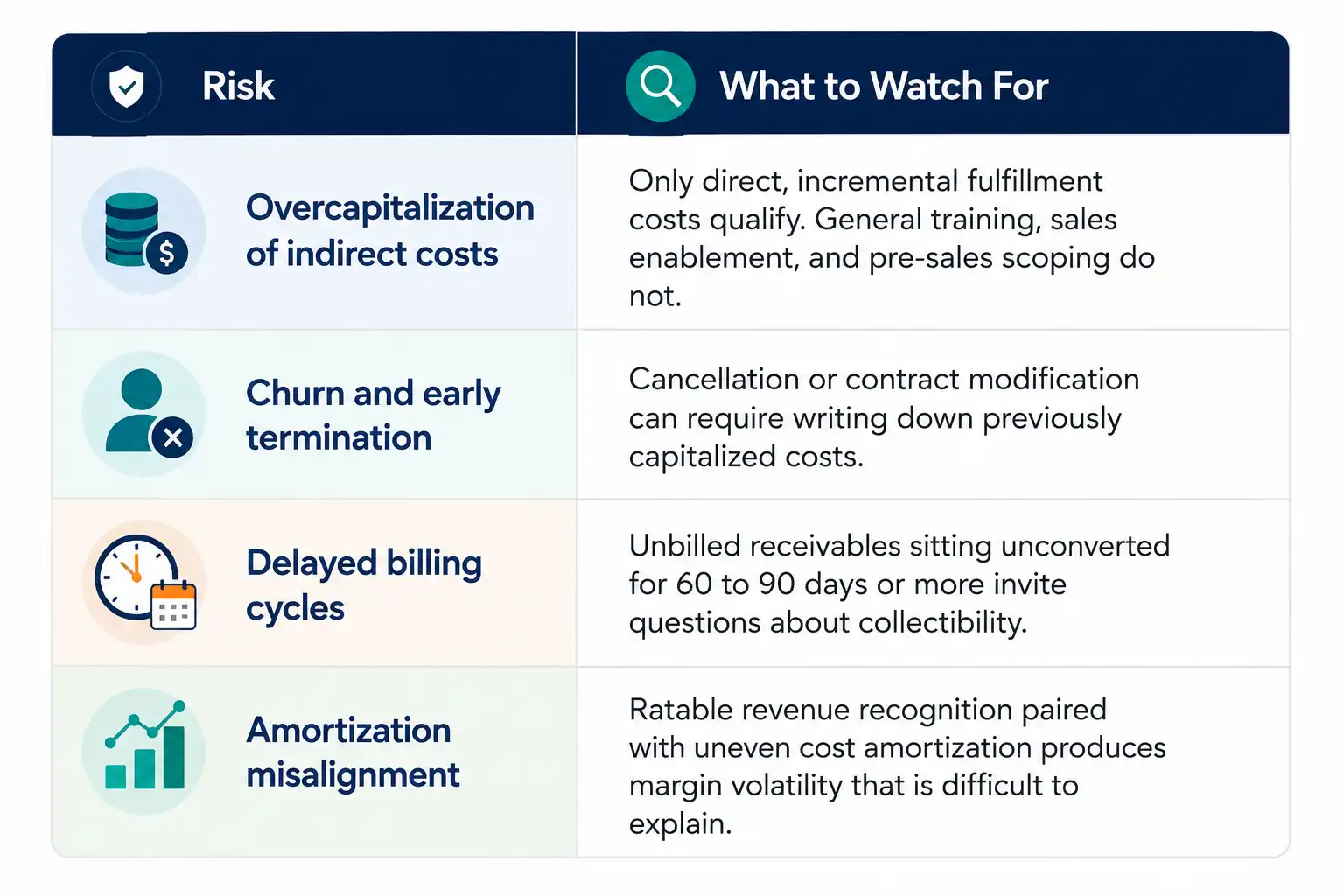
What Investors and Auditors Are Actually Watching For
Investors and auditors have grown considerably more attentive to how unbilled receivables and capitalized contract costs are treated, especially inside high-growth SaaS and professional services businesses, because these accounts move working capital, margin visibility, and free cash flow all at once. During a Series B raise at a marketplace SaaS platform where I served as interim head of finance for the US operations, the cohort and unit economics models we built had to withstand exactly this kind of scrutiny, and the unbilled receivable balances were among the first line items diligence teams wanted explained in detail.
Overstating unbilled receivables can paint an unrealistically optimistic picture of backlog. Undercapitalizing fulfillment costs can understate margin and mislead partners about the true cost to deliver. The CFO’s job sits precisely at that tension, holding compliance and clarity in the same hand without letting either one slip.
Steps for Finance Leaders
- Inventory every contract cost type and identify which qualify for capitalization under ASC 340-40, then build standardized criteria and documentation templates around that judgment.
- Align with revenue operations and project managers so that fulfillment costs are tagged and mapped at the project level from the start, not reconstructed after the fact.
- Review unbilled accounts receivable aging on a recurring basis, watching for trends in delayed billing or disputed milestones, and establish reserves where collection risk is real.
- Refine amortization schedules against actual revenue timing rather than nominal contract length, and revisit that logic every quarter.
- Train sales, legal, and delivery teams on how contract structure drives accounting outcomes, because this is not a controller-only problem.
Three Key Takeaways
- An unbilled receivable represents revenue that has been earned through satisfied performance obligations but not yet invoiced, and treating it with the same rigor as billed accounts receivable, rather than as a reconciling afterthought, is what separates a defensible balance sheet from one that invites audit scrutiny.
- ASC 340-40 fulfillment cost capitalization can flatter near-term EBITDA, but the deferred expense it creates has to be amortized against actual contract economics, and any finance leader who fails to revisit that logic as the contract book evolves is building toward a future write-down.
- Getting unbilled receivables and contract cost capitalization right is fundamentally a cross-functional exercise, requiring sales, delivery, billing, and finance to share a single definition of when a performance obligation is satisfied, because no amount of quarter-end journal entry precision can substitute for that alignment.
Disclaimer: This article is intended for informational purposes only and does not constitute legal, tax, or accounting advice. You should consult your own tax advisor or counsel for advice tailored to your specific situation.
Hindol Datta is a four-time CFO and senior finance executive with over 25 years of leadership experience across cybersecurity, SaaS, gaming, logistics, digital marketing, medical devices, consumer products, and nonprofit organizations. He has led more than $120M in fundraising and over $150M in M&A transactions while building the financial and operational systems that let complex businesses scale with confidence. He is the author of seven books in the Systems CFO Series and holds active CPA, CMA, and CIA credentials.
AI-assisted insights, supplemented by 25 years of finance leadership experience.