
Executive Summary
Understanding what capitalize means in accounting rarely counts as a strategic question inside a finance organization, yet it should. The decision to capitalize a cost spreads it across the periods it benefits. Expensing it recognizes the cost in the period it occurs. That choice sits directly on top of the matching principle. It determines whether a company’s gross margin tells the truth about its unit economics or quietly distorts it.
This article walks through when capitalizing a cost reflects genuine long-term value. It also covers when expensing is the more defensible and conservative call. Deferred commissions and warranty obligations get particular attention, since they expose the sharpest edges of the debate. The article closes with an operational framework for building capitalization policy that survives audit, diligence, and board scrutiny.
What Capitalize Means in Accounting, and Why It Anchors the Matching Principle
To capitalize a cost is to record it as an asset on the balance sheet. It is not an immediate expense on the income statement. The company then recognizes that cost gradually, in the same periods as the revenue or benefit it helped create. That is the entire logic of the matching principle: pairing cause and effect, cost with the revenue the cost supports. The resulting financial statements describe economic reality, not just the timing of a cash outflow.
In most finance teams, finance leaders reduce the capitalizing versus expensing conversation to a checklist item before the books close. That treatment undersells what is actually one of the quietest and most consequential levers available to a finance leader. How a company answers this question shapes reported gross margin. It also shapes how investors, boards, and acquirers read the health of the business.
When Capitalizing Reflects Long-Term Value
A software company selling three-year contracts cannot report a clean gross margin. It must first amortize the sales commissions tied to those contracts, over the life of the revenue they helped generate. Recognizing the commission cost upfront while spreading the associated revenue across three years manufactures a gross margin dip. That dip misrepresents the underlying unit economics, and it is precisely what ASC 340-40 exists to prevent.
Under ASC 340-40, a company must capitalize and amortize contract acquisition costs it expects to recover. The amortization schedule mirrors how the company recognizes the related revenue. Building the ASC 606 revenue recognition framework required exactly this kind of scrutiny. This work took place at a high-growth cybersecurity and identity access management company. That company carried roughly $30M in annual recurring revenue. It meant matching commission amortization schedules to contract terms across a workforce distributed over five countries. The mechanics look tidy on a policy memo. In practice, they demand actuarial judgment about attrition and coordination with revenue operations. They also demand a forecasting discipline precise enough to catch drift before it compounds.
When Expensing Is the Right Call
Capitalizing is not always the correct answer, and there are situations where expensing is the more defensible position. Where customer churn runs high or contract renewals stay unpredictable, the resulting amortization window can be so short that the administrative burden of capitalization outweighs any benefit to the reader of the financial statements. Early-stage companies operating in uncertain go-to-market conditions often find that expensing commissions or warranty costs upfront is both the conservative choice and the strategically flexible one.
Capitalizing a cost also introduces deferred scrutiny alongside deferred expense. Auditors, acquirers, and analysts will ask whether the amortization period is realistic and whether the underlying methodology satisfies both economic rationality and GAAP consistency, a dual test that a rushed or aggressive capitalization policy rarely survives intact.
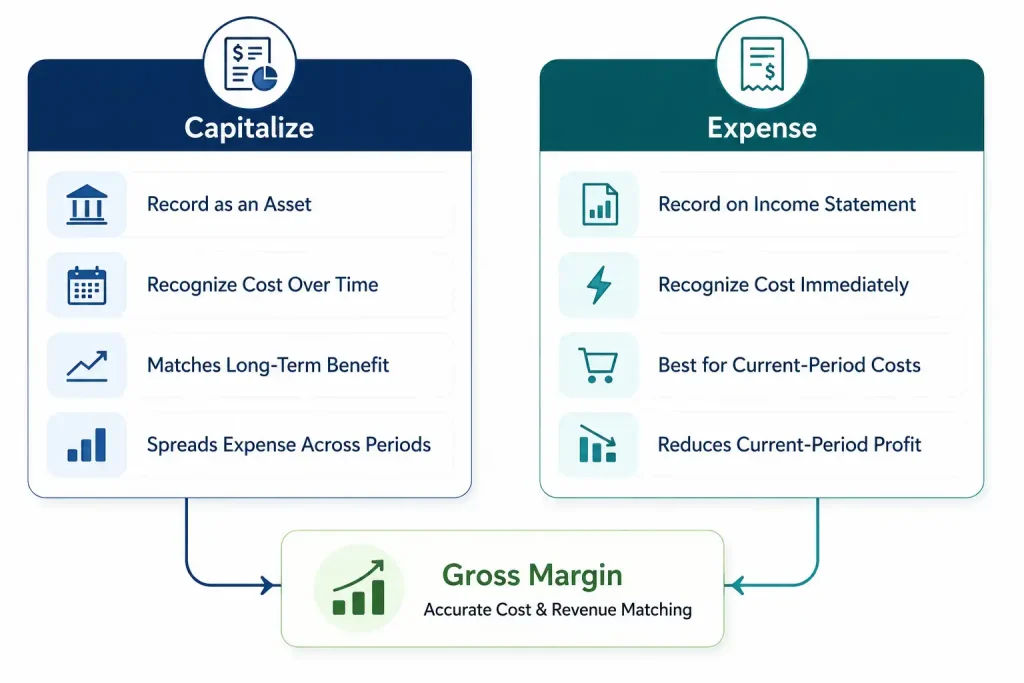
Deferred Commissions and the Risk of Capitalizing Too Broadly
Deferred commissions carry a particular danger. A sales team is typically incentivized on bookings the moment a multi-year deal closes, while finance books the associated commission expense on an amortization schedule that spans the full contract term. Cash leaves the business immediately. The expense shows up in fragments. When a contract cancels mid-term or the business underperforms plan, the company has to accelerate amortization or take a write-off, which erodes EBITDA and invites uncomfortable investor questions at the worst possible moment.
Scaling a venture-backed performance marketing organization from $9M to $180M in revenue over twenty-four months surfaced this tension directly, because the customer acquisition cost, lifetime value, and contribution margin discipline built during that period existed specifically to catch commission and churn assumptions before they became a capitalization problem rather than after. The operational finance leader has to act as an arbiter of economic truth in that moment: is the commission being capitalized because it truly represents a long-lived asset, or because capitalizing it smooths earnings and pacifies optics.
Warranties and Embedded Service Obligations
Warranties and service obligations introduce a related complexity. Standard product warranties are typically accrued upfront based on estimated failure rates, but extended warranties or maintenance obligations must be evaluated under ASC 606 for their revenue deferral implications, since these costs are not tied to the shipment date alone but stretch across a multi-period service relationship.
A product sold with a one-year warranty and a two-year maintenance clause effectively binds the company to service its customer for three years, and failing to capitalize the related service costs, or under-accruing the warranty reserve, misaligns expense with obligation and creates audit exposure that surfaces at the worst time. Operating as controller across a $170M global medical device manufacturer, with plants spanning Copenhagen, Cork, and Taiwan, required exactly this kind of precision: standard costing and bill of materials management in a regulated industry leave no room for warranty reserve estimates that cannot withstand line-by-line audit scrutiny.
Gross Margin as the Litmus Test
At the center of this entire debate sits a single question: how do we measure gross margin honestly. Failing to recognize the full burden of cost tied to delivering a product or service, whether that cost takes the form of commissions, warranties, or fulfillment obligations, risks overstating gross margin and inviting strategic conclusions the business cannot support.
For venture-backed companies, that risk compounds quickly, because misstated margins feed directly into valuation multiples, capital efficiency assumptions, and CAC-to-LTV ratios. The result is not merely a technical GAAP error. It becomes a strategic misstep capable of clouding an entire fundraising or acquisition conversation.
Operationalizing the Matching Principle
Turning the matching principle into a working policy, rather than a year-end debate, requires cross-functional coordination between finance, sales operations, legal, and engineering, so that contract structures, customer onboarding patterns, and product servicing timelines are understood before the accounting treatment is chosen.
A durable capitalization policy tends to include the following elements:
- Amortization templates built to tie directly to revenue recognition schedules, rather than maintained as a separate spreadsheet exercise.
- Commission payout systems integrated with the ERP’s capitalization logic, so the two ledgers cannot silently drift apart.
- Historical churn data reviewed on a quarterly cadence to reassess and, where necessary, shorten amortization periods.
- Documented assumptions for every judgment call, so that an audit becomes a review rather than a reverse-engineering exercise.
Rolling out a global Oracle Financials and MicroStrategy environment across five countries for a publicly listed gaming and digital entertainment company, ahead of an S-1 and IPO-readiness process with Big Four auditors, made a related point unmistakable: a single, unified definition of revenue across every subsidiary is what allows a capitalization policy to hold together once it faces outside scrutiny.
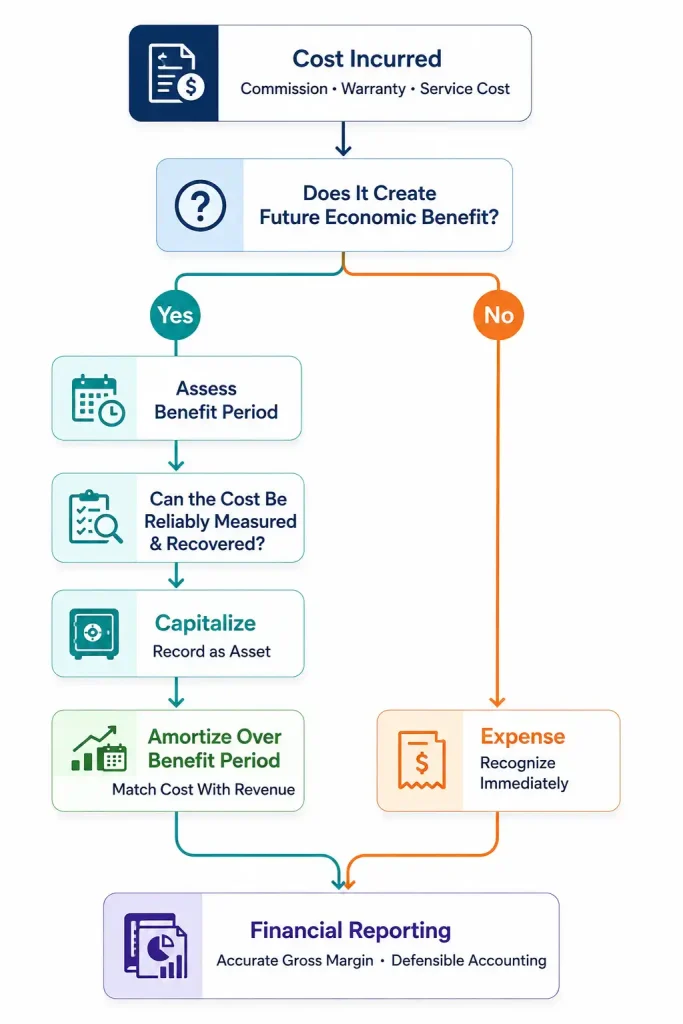
Lessons From the Field on Capitalizing and Expensing
Across engagements from Series A through Series D, the consequences of capitalizing too broadly or too narrowly tend to surface in the same places. A company capitalizing commissions on three-year contracts without weighting the early-termination clauses buried in its paper will eventually meet a churn quarter that forces an amortization correction, and even when the dollar impact is immaterial, the board’s confidence in the underlying numbers takes a hit that outlasts the correction itself.
The opposite failure shows up just as often in physical-product businesses, where warranty and service costs get expensed upfront out of caution, only for post-sale failure rates to stabilize years later and reveal that long-term margins were understated all along. Revisiting that capitalization policy, with actual field data rather than a conservative guess, tends to change the fundraising or acquisition narrative more than any single quarter of revenue growth could.
Choose Transparency Over Convenience
The decision to capitalize or expense is not a question of optics. It is a question of alignment, between cost and revenue, between current-period performance and long-term viability, between the financial statements and the economic reality they are supposed to describe. Capitalization should serve clarity rather than camouflage, and expensing should reflect prudence rather than pessimism.
Finance leaders who move past the checkbox mentality and treat matching as a strategic lever tend to build capitalization policies that survive contact with an audit, a diligence process, or a board meeting where the numbers get questioned line by line. Revisiting that policy this quarter, against current contract lengths, churn realities, and revenue recognition models, is far less costly than issuing a restatement later.
Three Key Takeaways
- What capitalize means in accounting is not a technical footnote; it is the mechanism that determines whether reported gross margin reflects the true cost of delivering a product or service, and that accuracy shapes valuation, capital efficiency, and investor trust.
- Capitalizing versus expensing decisions on deferred commissions and warranty obligations demand actuarial judgment, cross-functional coordination, and a willingness to revisit assumptions quarterly against actual churn and failure-rate data rather than a policy set once and left alone.
- A defensible capitalization policy is built before the audit or the diligence process begins, through amortization templates tied to revenue recognition, integrated commission systems, and documented judgment calls that turn scrutiny into a review rather than a scramble.
Disclaimer: This article is intended for informational purposes only and does not constitute legal, tax, or accounting advice. You should consult your own tax advisor or counsel for advice tailored to your specific situation.
Hindol Datta is a four-time CFO and senior finance executive with over 25 years of leadership experience across cybersecurity, SaaS, gaming, logistics, digital marketing, medical devices, consumer products, and nonprofit organizations. He has led more than $120M in fundraising and over $150M in M&A transactions while building the financial and operational systems that let complex businesses scale with confidence. He is the author of seven books in the Systems CFO Series and holds active CPA, CMA, and CIA credentials.
AI-assisted insights, supplemented by 25 years of finance leadership experience.