
Executive Summary
A single line on an invoice rarely tells the full story of value delivered. Nowhere is that truer than in bundled contracts. ASC 606 revenue recognition governs how finance teams separate hardware, software, licenses, and services sold together for one price. Getting it wrong can distort margin analysis, mislead the board, and complicate a fundraising or M&A process. For growth-stage companies structuring a bundled discount across products and services, the discipline matters. Identifying performance obligations, estimating standalone selling price, and allocating transaction price is not an academic exercise. It shapes forecasting accuracy and investor trust.
This article walks through the mechanics of ASC 606 revenue recognition as applied to bundled arrangements. It then moves into four applied case studies drawn from SaaS, medical device, and manufacturing environments. Readers will leave with a working framework for identifying distinct obligations and choosing a standalone selling price method. It also covers building allocation logic that holds up under audit scrutiny.
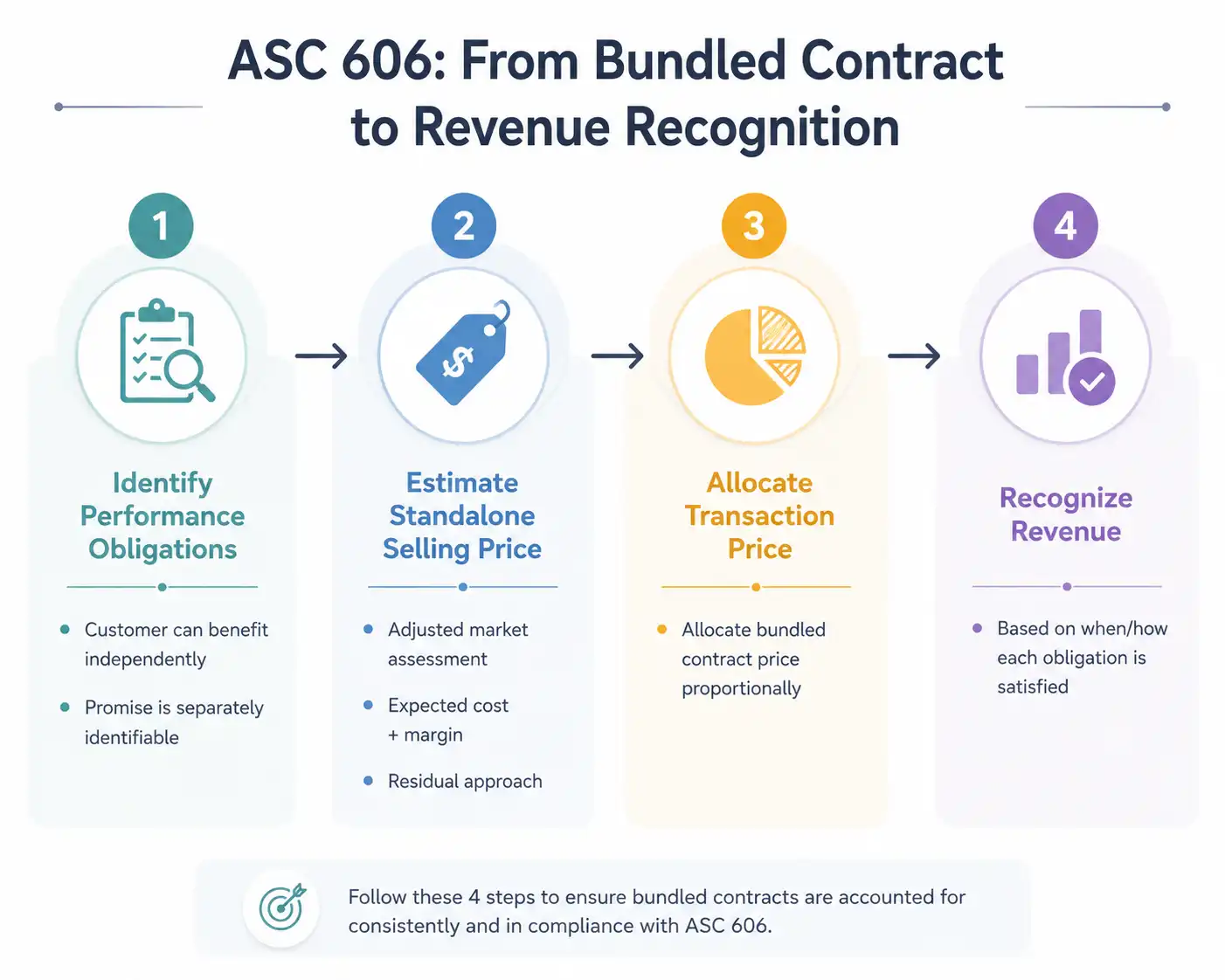
What Makes a Performance Obligation Distinct Under ASC 606
ASC 606 revenue recognition begins with a deceptively simple test. A promised good or service is distinct when two conditions hold.
- The customer can benefit from the item on its own or with resources already available to it
- The promise to transfer that item is separately identifiable from other promises in the contract
Applying this test requires judgment rather than a checklist. Does the hardware function without the cloud subscription. Is the training separable from the license. Does the support agreement carry value on its own.
A $30M ARR cybersecurity and identity access management SaaS company operated across five countries. It needed an ASC 606 revenue recognition framework built from scratch. That framework became one of the conditions that carried the business through acquisition diligence. The company mapped licenses, implementation, and support as distinct obligations. Each delivered standalone value and consumed separate delivery cost. That separation gave the board and eventual acquirer a defensible view of margin by service line.
Estimating Standalone Selling Price in a Bundled Discount Structure
Once a company identifies its obligations, the next question is pricing. How should the contract price each one when it sells them together at a bundled discount? Standalone selling price rarely exists cleanly in a growth-stage business, since components almost never sell apart. ASC 606 allows three estimation methods.
- Adjusted market assessment, which benchmarks against competitor pricing for similar components
- Expected cost plus margin, which builds price from delivery cost and a reasonable markup
- Residual approach, used when one component has a known standalone selling price and the remainder is allocated around it
In a venture-backed manufacturing company where finance did not yet exist, the team built the chart of accounts, forecasting model, and revenue framework from a blank page. The standalone selling price question surfaced early because bundled equipment and service contracts were the primary revenue source. A blend of cost-plus for services and market benchmarking for the physical unit produced a defensible allocation the auditors accepted without extended pushback.
Allocating Transaction Price Across Bundled Components
With standalone selling price established, the company allocates the transaction price proportionally across each obligation. That allocation determines both where revenue lands and when the company recognizes it. Consider a $100,000 bundle split as follows.
- Hardware, $60,000, recognized at delivery
- Software license, $30,000, amortized over 12 months
- Implementation, $10,000, recognized against milestones
This pattern is what preserves the integrity of both internal performance metrics and external financial statements, and it is the piece most often overlooked when a sales team negotiates a bundled discount without looping finance into the contract structure.
Applied Case Studies in ASC 606 Revenue Recognition
SaaS License, Implementation, and Support
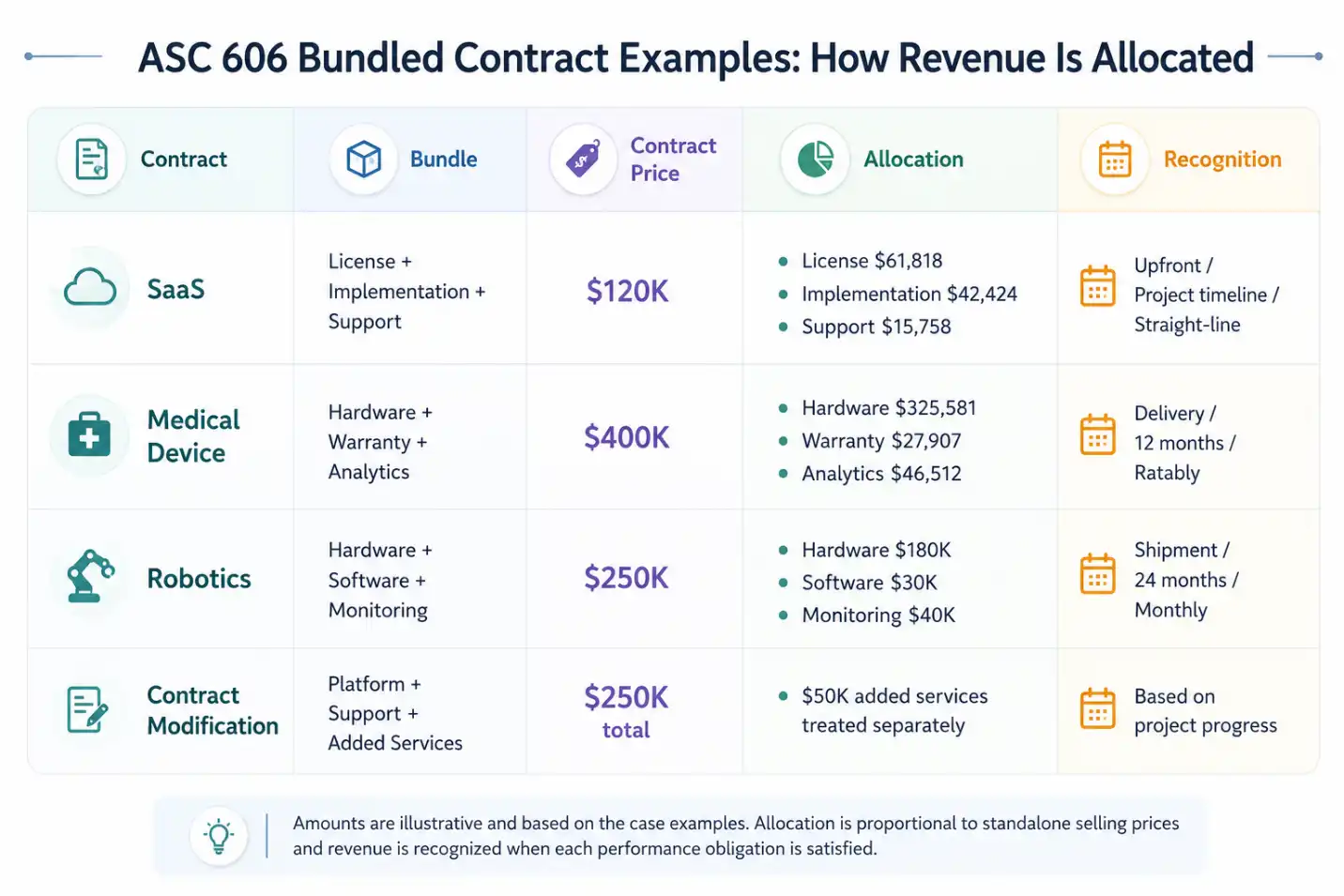
A Series B enterprise software contract priced at $120,000 bundles a one-year license, fixed-fee implementation, and 24/7 support, with a bundled discount applied and no component sold separately. Using cost-plus-margin, estimated values come to $51,000 for the license, $35,000 for implementation, and $13,000 for support, totaling $99,000 against a $120,000 contract price. Normalized proportionally, the final allocation lands at $61,818 for the license, $42,424 for implementation, and $15,758 for support. License revenue is recognized upfront, implementation follows the project timeline, and support runs straight-line, turning one invoice into a mosaic of deferred and earned revenue that gives the CFO a clean bridge between bookings and GAAP revenue.
Medical Device, Hardware, and Warranty
A growth-stage diagnostic equipment sale priced at $400,000 bundles the device, a one-year parts-and-labor warranty, and cloud analytics access, all on a single invoice. None qualifies as a single obligation under ASC 606. Estimated standalone values of $350,000, $30,000, and $50,000 total $430,000, and proportional allocation against the $400,000 contract price produces $325,581 for hardware, $27,907 for warranty, and $46,512 for analytics. Hardware recognizes at delivery and acceptance, warranty amortizes over 12 months, and analytics recognizes ratably. This mirrors the discipline required in a $170M global medical device manufacturer spanning plants in three countries, where standard costing and inventory controls had to withstand line-by-line audit scrutiny in a heavily regulated environment.
Manufacturing With Embedded Software
A robotics contract priced at $250,000 bundles a hardware unit, a renewable and portable two-year software license, and remote monitoring. Because the license can be upgraded independently and transferred to another unit, it qualifies as distinct rather than folded into the hardware. Adjusted market benchmarking sets standalone values at $180,000, $30,000, and $40,000, matching the $250,000 contract price exactly, so allocation is proportional. Hardware recognizes at shipment, the license amortizes evenly over 24 months, and monitoring recognizes monthly based on uptime availability, giving investors visibility into recurring revenue rather than a single shipment event.
Contract Modifications Within Bundled Arrangements
A $200,000 annual platform and support contract gains a $50,000 professional services addition three months in. Because the added scope is distinct and priced at standalone selling price, it qualifies as a separate contract, and the $50,000 recognizes based on project progress without restating the original agreement. Had the addition come bundled with a further license discount, reallocation across the remaining term would have been required instead. A contract modification log reviewed during monthly close keeps this traceable for audit purposes.
Strategic Considerations for Finance Leaders
- Bundles blur the line between product, service, and customer experience, and treating every component as one obligation is tempting but inaccurate
- Allocation drives margin analysis, deferred revenue, ARR, and cash flow modeling, functioning as the skeleton of the reporting system
- Finance, sales, and legal need shared visibility into which SKUs are grouped and what an MSA defines as included versus optional
- Contract metadata, including price, standalone selling price, allocation logic, and recognition pattern, should live inside the CPQ and billing systems rather than in a spreadsheet
- Account managers and customer success teams benefit from basic ASC 606 training, since contract clarity upstream reduces accounting rework downstream
Three Key Takeaways
- Identifying distinct performance obligations is a judgment call grounded in whether a customer can benefit from a component independently, and that judgment should be documented at the contracting stage rather than reconstructed during an audit.
- Standalone selling price estimation methods, whether adjusted market assessment, cost plus margin, or residual approach, need consistent application and clear documentation to survive investor diligence or an acquisition process.
- Allocation of transaction price across a bundled discount is not a one-time exercise but an operating discipline that belongs in the CPQ and billing systems, where it can inform forecasting, board reporting, and margin visibility on an ongoing basis.
Disclaimer: This article is intended for informational purposes only and does not constitute legal, tax, or accounting advice. You should consult your own tax advisor or counsel for advice tailored to your specific situation.
Hindol Datta is a four-time CFO and senior finance executive with over 25 years of leadership experience across cybersecurity, SaaS, gaming, logistics, digital marketing, medical devices, consumer products, and nonprofit organizations. He has led more than $120M in fundraising and over $150M in M&A transactions while building the financial and operational systems that let complex businesses scale with confidence. He is the author of seven books in the Systems CFO Series and holds active CPA, CMA, and CIA credentials.
AI-assisted insights, supplemented by 25 years of finance leadership experience.