
Executive Summary
For much of the history of the corporate finance function, organizations have treated financial decision making as an afterthought. It’s been recordkeeping, mostly, reconciling a spreadsheet against outcomes it had no hand in shaping. That posture no longer serves organizations that compete on speed and precision. Across cybersecurity, gaming, consumer products, and mission-driven organizations, finance teams have too often sat outside the room where strategy takes shape. They arrive only once the numbers need explaining. A stronger model exists. It treats financial decision making as a design discipline. In this model, finance builds the dashboards, the incentive structures, and the governance systems. These tools make good outcomes more likely, before a single decision is reached.
What follows draws on twenty-five years of experience. That means building forecasting engines from nothing. It means sitting inside boardrooms during capital raises. It means redesigning compensation plans that changed how sellers behaved, without a single memo being circulated. Disciplined, data-driven decision making turns a dashboard from a record of the past into an instrument for what comes next. It does this by translating numbers into the language that product, sales, and customer success teams already speak. The result, when the architecture holds, is a finance function that behaves less like a scorekeeper and more like an architect of momentum. In this model, strategic CFO decision making becomes the connective tissue between capital, culture, and execution.
Rethinking the Role of Finance in Financial Decision Making
For decades, organizations have cast finance as the function that shows up after decisions are made. It tallies the consequences of choices it had no part in shaping. That model wastes the one advantage finance genuinely holds. Finance sees where the money moves before anyone else in the building understands the pattern forming beneath it. A more useful posture treats finance as a catalyst. It’s a function that designs the systems, dashboards, and incentives that make good outcomes more likely, before anyone even reaches a decision. It doesn’t simply grade the decision after the fact.
That shift begins with presence. Financial decision making improves the moment finance shows up in the rooms where strategy originates. That’s different from showing up in the rooms where results get reported after the work is done. Finance can sit inside product roadmap reviews and engineering standups, asking about usage thresholds and funnel impact. It can sit inside deal structuring conversations, asking about marginal return before a plan is finalized rather than after. Doing this builds a habit the rest of the organization comes to recognize over time. Finance stops being the department that says no. It becomes the one that asks the sharper question earlier in the process, well before the deal terms or the roadmap commitments have hardened into something difficult to unwind.
Presence at the Point of Decision
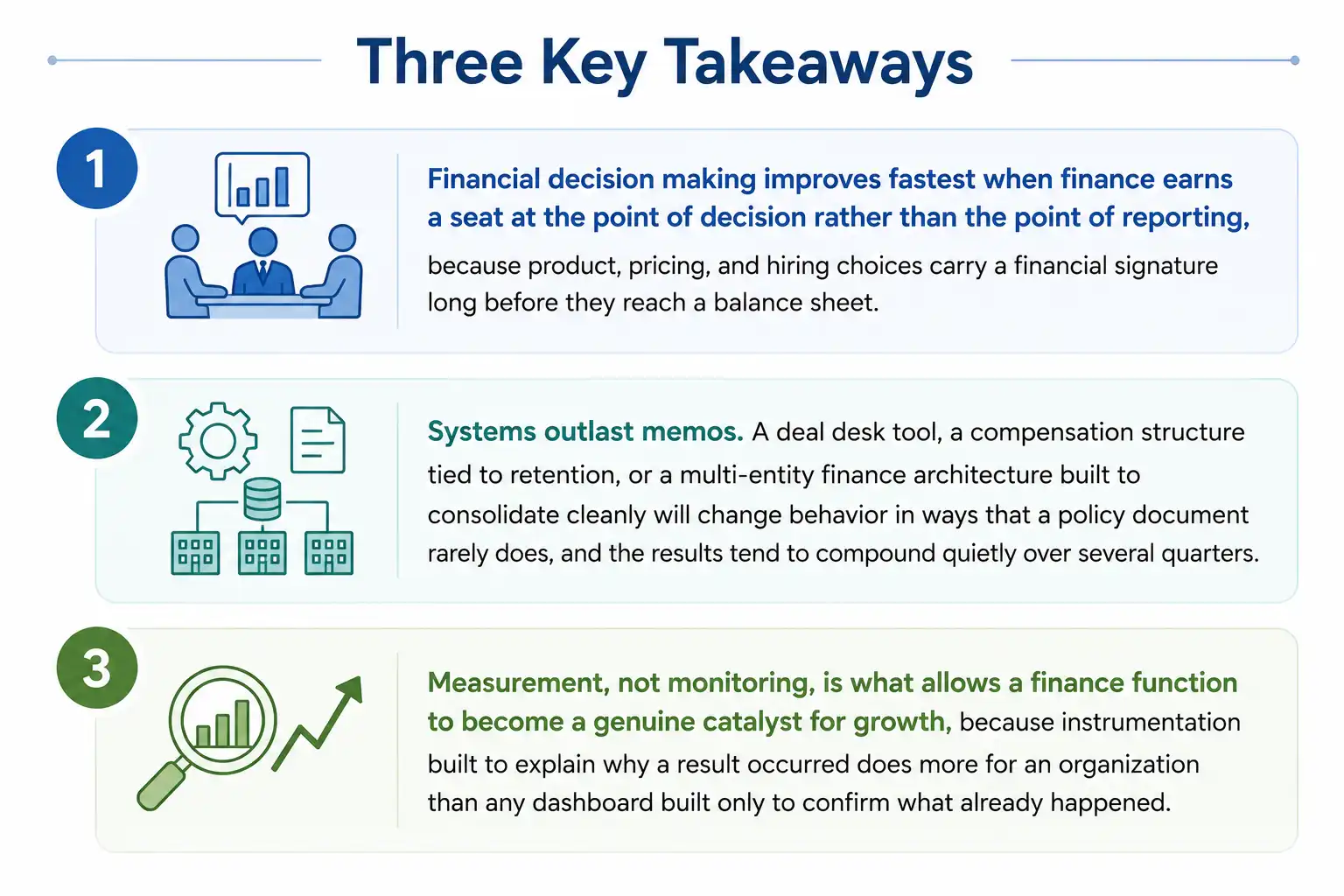
This is not a stylistic preference so much as a structural truth about how growth-stage organizations actually operate. A high-growth cybersecurity and identity access management company generating roughly $30M in annual recurring revenue offers a useful illustration, since product decisions, pricing decisions, and hiring decisions all carried a financial signature long before any of them appeared on a balance sheet. A finance function that only reviews outcomes after the fact has already missed the moment where it could have added the most value. Presence at the point of decision, rather than commentary after the decision has been made, is what separates a finance team that informs strategy from one that merely archives it, and it is the foundation of any credible finance strategy built for scale.
The following signals tend to indicate that finance has made this shift from archivist to catalyst inside an organization:
- Finance leaders sit inside product and engineering planning conversations before a roadmap commitment is finalized, not after.
- Deal terms are reviewed for margin and retention impact during structuring, not during quarter-end reconciliation.
- Hiring plans are stress-tested against revenue scenarios before an offer goes out, not after headcount has already grown.
- Dashboards answer the question a functional leader is actually asking, rather than the question finance finds easiest to report.
Building Systems That Anchor Strategic Financial Decision Making
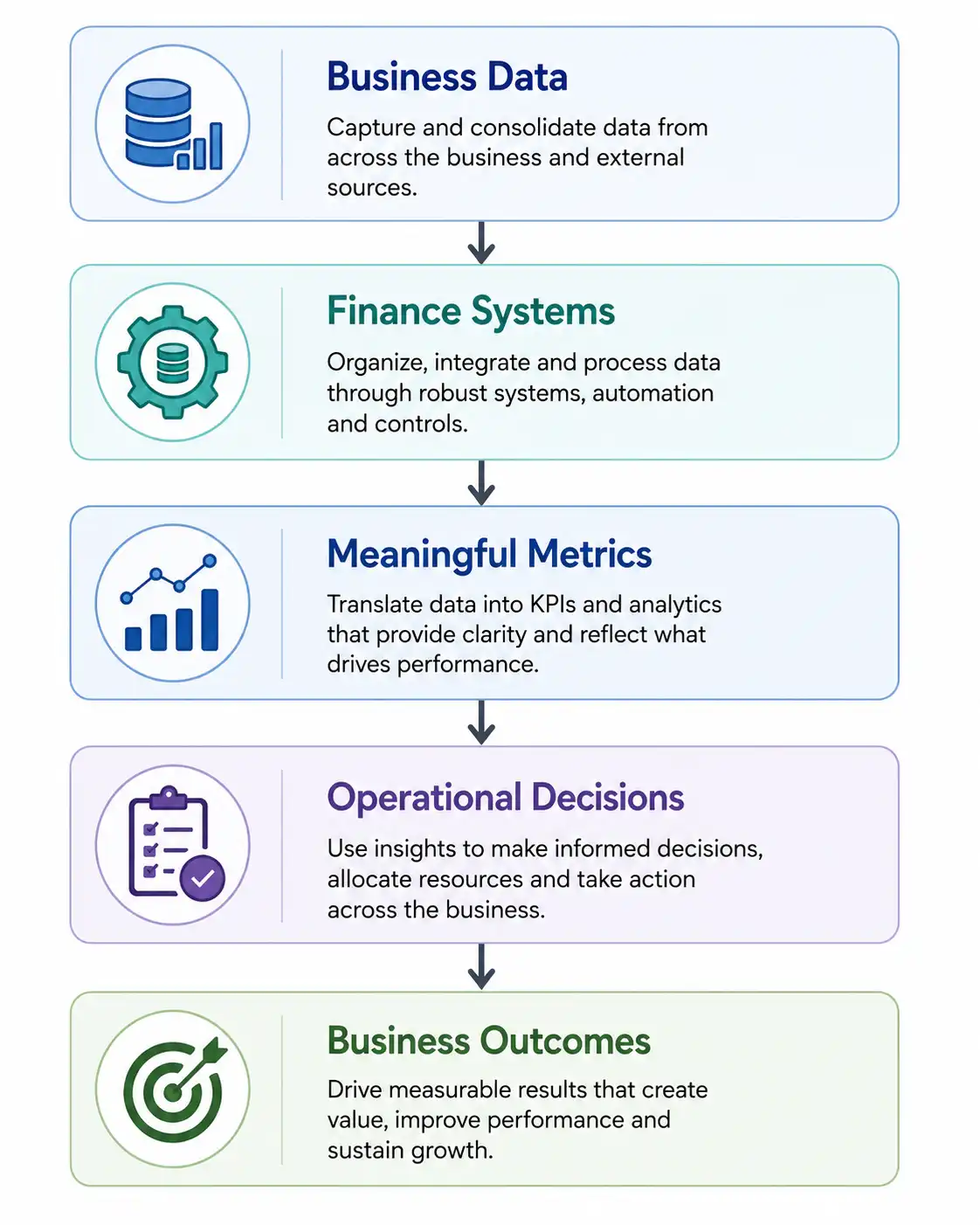
Sound financial decision making is rarely the product of a single insight. It tends to emerge from systems that make the right choice visible and the wrong choice costly. That’s a lesson that becomes apparent only after watching well-intentioned finance teams issue memos that nobody reads. Replacing reactive pricing concessions with real-time margin dashboards counts as a structural intervention rather than an incidental improvement. So does automating recurring billing tasks, freeing analysts to spend their hours on commercial opportunity instead of data entry. These changes move an organization forward quietly, without requiring a mandate from above. They compound in a way that a single policy document never can.
Compressing the Close Cycle Through Multi-Entity Architecture
Legacy enterprise resource planning tools can make disciplined financial decision making harder than it needs to be. This is especially true inside organizations that have grown through acquisition or rapid geographic expansion. A NetSuite implementation across five country entities, spanning the United States, India, Nepal, Canada, and Mexico, offers a concrete case. The fragmented reporting environment inherited at the outset had made consolidated visibility nearly impossible. Designing a multi-entity finance architecture that consolidates cleanly across regions, paired with modern business intelligence tooling, compressed the monthly close from 18 days to 10 within that organization. A close cycle that once consumed most of a finance team’s month freed that same team to spend its time on interpretation rather than reconciliation. That’s the entire point of building the system in the first place.
Translating Metrics Across Functions for Better Financial Decision Making
The philosophy behind Objectives and Key Results points toward one conclusion. The logic of the balanced scorecard arrives at the same place from a different direction. Financial success only emerges when learning, internal process, and customer alignment connect to one another. Finance plays a central role in that synthesis. It must resist the temptation to present numbers in its own dialect. A marketing leader benefits far more from leading indicators that refine copy, channel mix, and audience targeting than from a single return on investment figure delivered a quarter too late. A customer success leader benefits from early signals of adoption risk rather than a lagging churn report that arrives after the relationship has already soured. These translation points are where finance shifts from a scorekeeping function to an operating one. They’re also where data-driven decision making becomes a shared practice across the organization, rather than a finance department slogan repeated in quarterly meetings.
Deal Desk Governance and Discount Discipline
Discount creep is a familiar pattern inside a growing quote-to-cash pipeline. The instinct to respond with a policy memo rarely changes behavior in any organization built around human incentive rather than compliance theater. A more durable fix is a deal desk tool that flags discounts falling below margin floors and suggests upselling structures while a team is still building the deal. Embedding that logic into the workflow itself, rather than into a compliance document nobody opens twice, moves average discount rates in a measurable direction. It does this without a single confrontation between finance and sales leadership. This is the essence of a catalytic approach to financial decision making. It doesn’t complain about a trend. Instead, it redesigns the system that produces the trend in the first place.
Cultivating Teams That Practice Data-Driven Decision Making
The strongest finance organizations build teams that carry a data-driven mindset forward on their own initiative, without waiting for a formal directive from above. The strongest analysts do not wait to be asked to fix recurring friction. They notice it, build a script in Python or R, and deliver an answer before anyone has formally raised the question in a meeting.
From Dashboard to Story
Training analysts to treat ambiguity as a starting point rather than a barrier, paired with the storytelling skills that make a finding land, ensures that data-driven decision making does not stall at the dashboard. A billing delay, properly framed, becomes a story about its downstream effect on customer satisfaction, escalations, and renewal, rather than a stray line item buried inside a report nobody finishes readi
Where Pattern Recognition Comes From
This connects to a broader habit worth cultivating deliberately, one that tends to develop somewhere between an early career spent modeling freight economics in the logistics industry and later years spent inside gaming, cybersecurity, and consumer products companies that had almost nothing in common on the surface. Exposure to fields outside finance, from behavioral psychology to systems theory, sharpens the pattern recognition that turns raw numbers into frameworks worth acting on. Finance, at its best, behaves as a synthesis discipline rather than an arithmetic one, and the analysts who internalize that distinction tend to become the ones a business cannot operate without.
Aligning Incentives with Long-Term Value
Systems and dashboards only go so far if incentives point in the opposite direction. This is where financial leadership earns its keep or fails to. Aligning compensation, deal terms, and capital deployment with the metrics that matter most tends to produce faster and more durable behavior change than any policy statement. That’s because a compensation plan reaches every seller in a way a memo never will.
Restructuring Compensation Around Retention
A sales compensation structure built around bookings alone often rewards short-term volume at the expense of long-term margin. Redesigning that structure around net revenue retention and margin upside, and embedding commission deferrals directly into the quote-to-cash system, makes every discount or term concession a conversation about renewal and capital return rather than a one-time transaction. When that logic lives inside a seller’s own dashboard rather than in a policy binder, adoption tends to follow quickly, because better deal structuring protects both commission and margin at once, and sellers respond to their own incentives faster than they respond to instruction.
Instrumenting Deal Velocity
Many organizations describe themselves as data driven while still operating with noisy dashboards and missed metrics. That contradiction was visible in a venture-backed digital marketing organization that scaled from $9M to $180M in revenue over 24 months. Tagging every quote line with deal velocity, measuring how quickly a proposal moves to signature and how many discount approvals it passes through, tends to change behavior. It does this without a single directive. Deal desk leaders begin streamlining clauses on their own initiative. Sellers begin pre-qualifying opportunities before submission, without anyone instructing them to do so. Financial decision making improves not because finance issued a decree, but because visibility increased into a process that had previously been invisible to everyone involved in it.
Capital Allocation as an Act of Discipline
Capital allocation platforms merge scenario modeling, deal pacing, and expansion timing. Doing so shifts the nature of the conversation around growth investment. Requiring a forecasted capitalization curve and an expected payback curve for every go-to-market investment brings product, sales, and finance into the same planning workshop. There, the question isn’t only what should happen next, but whether now is the right time to invest at all. The value finance delivers in that setting is not the capital itself. It is the opportunity map that lets an organization move from chasing every opportunity to allocating with intention, pausing when a pause is the more disciplined choice available.
This capacity to connect capital discipline to operating reality tends to compound across sectors. A career spanning cybersecurity, gaming, and mission-driven organizations has included more than $120M in growth and expansion capital raised, merger and acquisition activity exceeding $150M, and a $37M capital raise across equity and venture debt for a mission-driven education and research institution navigating variable philanthropic and earned-revenue conditions. Each of those engagements reinforced the same lesson: capital allocation works best when treated as a strategic conversation rather than a transactional milestone, and when a strategic CFO sits close enough to the operating detail to know which curve is worth betting on.
The elements below tend to separate disciplined capital allocation from ad hoc investment decisions:
- A forecasted capitalization curve and expected payback curve for every go-to-market investment, reviewed before capital commits.
- A shared planning workshop where product, sales, and finance evaluate timing together, not sequentially.
- Explicit permission to pause an investment when the data suggests patience is the more disciplined choice.
- A capital narrative built for board and investor scrutiny well before a raise becomes urgent.
Culture as the Foundation of Sustainable Growth
None of these systems function apart from culture. When attrition rises inside a product organization following each quarterly release, the useful response is rarely another retention metric layered on top of the ones already being ignored. Tracing feature-level escalations, developer sentiment, and customer satisfaction together as a single dataset can reset release timelines. This restores ownership rather than eroding it further. Release velocity tends to accelerate not because deadlines loosen, but because quality becomes something the organization can finally measure and discuss with honesty rather than defensiveness.
Scaling Through Systems, Not Heroics
Complexity theory offers a useful lens for anyone thinking about finance strategy at scale. Companies, like networks, scale not by adding nodes but by reinforcing the patterns that already work. Finance builds those patterns through automation, modeling, and scenario thinking. Then it steps back and allows the system to operate, rather than managing every detail personally. This played out inside a Euronext Paris-listed gaming and digital entertainment company operating across five countries. There, executing more than $100M in cross-border acquisitions depended less on any single decision and more on a system built to make good decisions repeatable across geographies and time zones. The same pattern surfaced again inside a $127M global consumer products company. That company more than doubled its inventory turns, moving from 3x to 7x through demand planning and SKU rationalization. Each outcome traced back to a system, not a hero moment. That distinction is what allows a finance strategy to survive the departure of any single person who built it.
Where Culture and Financial Systems Drift Apart
Culture and financial systems tend to drift apart in recognizable ways. Retention metrics multiply without any corresponding change to the release process generating the attrition. Dashboards measure activity rather than the quality outcomes that activity was meant to produce. Incentive plans sit unchanged for years while the business model around them shifts substantially. In each case, the underlying failure is the same: a finance function that reports on culture from the outside rather than instrumenting it from within, and that only notices the drift once it has already cost the organization something real.
Measurement Over Monitoring in Strategic CFO Leadership
Strategic finance depends on a meaningful difference between measuring a business and monitoring it. That’s a distinction that takes most finance leaders longer to internalize than they would like to admit. Monitoring looks backward, confirming that a target was hit or missed after the fact. This is the default posture of finance functions that have not yet made the shift this article describes. Measurement looks forward, building the instrumentation needed to understand why a result occurred and what it implies for the next decision.
Designing for Learning, Not Compliance
A finance function oriented around measurement designs for learning rather than compliance, and for impact rather than credit. That distinction is what allows financial decision making to compound in value over time instead of merely accumulating as historical record. Financial decision making reaches its fullest potential when finance stops waiting to be asked and starts designing the systems that make good outcomes likely by default. That means building dashboards that clarify rather than mystify, automating the tasks that free analysts to think, and translating metrics into the language of the teams who must act on them. It means treating compensation, deal governance, and capital allocation as instruments of behavior change rather than administrative controls. Across cybersecurity, SaaS, gaming, logistics, digital marketing, medical devices, and mission-driven organizations, the same pattern holds. Data-driven decision making does not emerge from more reporting. It emerges from better architecture, built by people willing to sit in the room before the decision is made rather than arrive afterward to explain what happened.
Disclaimer: This article is intended for informational purposes only and does not constitute legal, tax, or accounting advice. You should consult your own tax advisor or counsel for advice tailored to your specific situation.
Hindol Datta is a four-time CFO and senior finance executive with over 25 years of leadership experience across cybersecurity, SaaS, gaming, logistics, digital marketing, medical devices, consumer products, and nonprofit organizations. He has led more than $120M in fundraising and over $150M in M&A transactions while building the financial and operational systems that let complex businesses scale with confidence. He is the author of seven books in the Systems CFO Series and holds active CPA, CMA, and CIA credentials.
AI-assisted insights, supplemented by 25 years of finance leadership experience.