Executive Summary
Knowing when to hire a fractional CFO is only half the decision. The other half is knowing what that CFO should already have in place before the engagement begins. A fractional CFO without a legal entity, a signed contract, or insurance is not a bargain. That CFO is a liability wearing a spreadsheet.
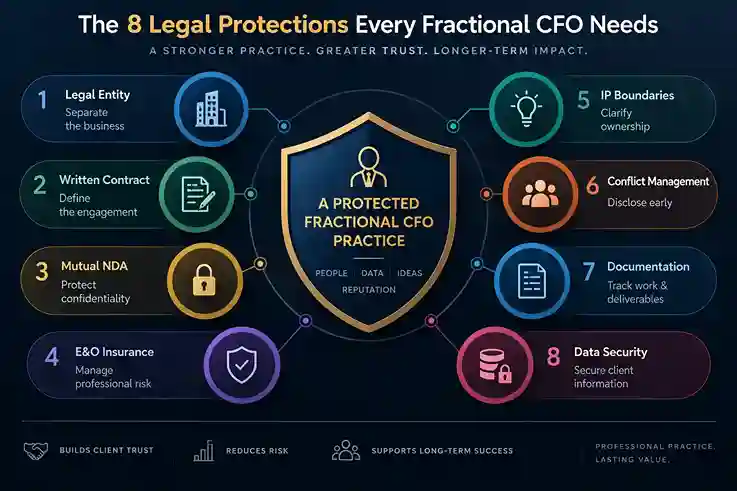
This playbook covers the eight protections every fractional CFO needs, from entity formation and engagement letters to NDAs, insurance, intellectual property boundaries, conflict-of-interest discipline, documentation habits, and data security. Founders evaluating a hire can use the same list as a readiness checklist. A CFO who has all eight in order is a CFO who treats the practice as a business, not a side gig.
Why Legal Structure Matters When You Hire a Fractional CFO
Operating as a sole proprietor is a liability trap. Personal assets sit exposed the moment a dispute arises. Forming an LLC or an S-Corp creates a clean legal separation between the individual and the consulting practice.
The benefits are practical rather than theoretical. Liability protection, clearer tax treatment, and a more professional presentation to clients all follow from the same decision. A CPA and an attorney can help choose the structure that fits the practice’s size and risk profile.
Building an entire finance function from a blank page for a pre-Series A AI governance and assurance platform made this lesson concrete. The work touched sensitive investor material and unproven financial models from day one. An unincorporated consultant carrying that exposure personally is taking on far more risk than the engagement fee justifies.
Put the Engagement in Writing Before Work Begins
Handshake deals do not scale, and they rarely protect either party when memory of an agreement starts to drift. A client contract or engagement letter should define the scope of work, fees and payment terms, confidentiality and data handling, intellectual property ownership, and termination clauses.
Even a short engagement deserves a written agreement. A one-page letter that covers these five items protects the CFO and the client equally, and it sets the tone for a professional relationship from the first invoice.
Require NDAs for Sensitive Financial Conversations
Fractional CFOs routinely see investor decks, internal KPIs, burn data, payroll figures, and equity details before a contract is even signed. A mutual NDA, where both the CFO and the client agree to confidentiality, should be standard before diligence work or early advisory conversations begin.
This is not about mistrust. It is about alignment, and it removes ambiguity about what can and cannot be shared as the relationship develops.
Carry Professional Liability Insurance
Mistakes happen even to careful practitioners. An error in a financial model, a missed deadline, or a tax oversight can carry real consequences for a client. Errors and omissions coverage protects against claims related to negligence, breach of contract, or misrepresentation.
Premiums vary by state and by the scope of work, but the coverage is not optional. A burn rate model that leads to a hiring decision, and that decision leads to a cash crunch, can point fingers back at the CFO who built the model. Insurance does not excuse negligence, but it covers the unforeseen issues that surface even with careful work.
Clarify Intellectual Property Boundaries Early
Fractional CFOs often build reusable tools: unit economics templates, budget variance dashboards, investor narrative frameworks. Two questions need answers before the first deliverable ships. Does the client own the output outright, or does the CFO retain the right to reuse the underlying framework with future clients?
Some CFOs maintain a personal library of reusable tools and license their use. Others grant full ownership to each client. Neither approach is wrong, but the decision needs to be documented before the tool is built, not after a client assumes exclusive ownership of something the CFO intends to reuse elsewhere.
Watch for Conflicts of Interest as the Client List Grows
Advising multiple clients at once raises the odds of overlap. A fractional CFO should avoid working with directly competing companies, never reuse confidential data across engagements, and disclose potential conflicts as soon as they surface.
Managing engagement-level profitability across five business units for a professional services firm made the value of early disclosure obvious. Two client relationships that later turned out to be eyeing the same customer base were handled by disclosing immediately and offering to step back from one. Reputation is the currency of this work, and it is protected through disclosure, not silence.
Document Time and Deliverables as a Matter of Course
In a dispute, documentation is the best defense available. Weekly summaries of work, saved client emails and feedback, and a record of delivered outputs such as models, reports, and decks all matter.
Beyond dispute protection, this habit improves billing transparency and reminds clients of the volume of strategic input delivered across a quarter, something that is easy to forget once the work is done.
Protect Client Data Like It Is Your Own
Fractional CFOs sit inside bank credentials, payroll systems, and cap table platforms. A cybersecurity and identity access management engagement spanning five countries made the stakes of that access unmistakable, since the finance function itself sat downstream of the company’s own access control discipline.
Secure cloud storage, password managers, and multi-factor authentication are the baseline, not an upgrade. Sensitive files should never travel through unencrypted email, and personal email addresses should never be used for client work.
What This Means for Founders Deciding When to Hire a Fractional CFO
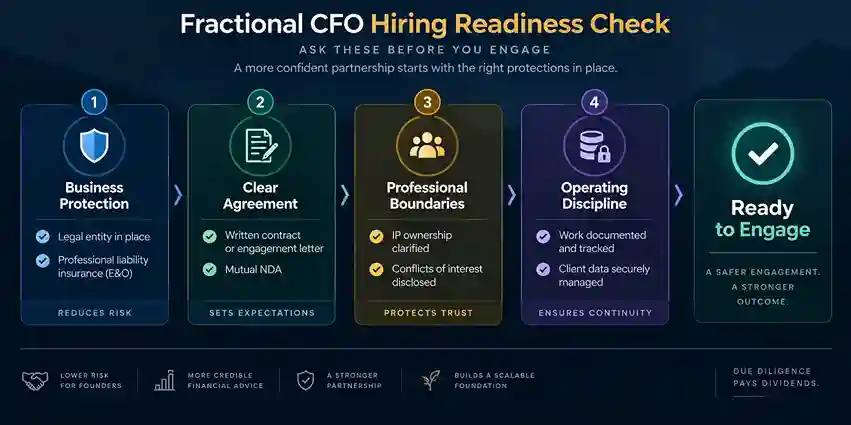
Founders often ask when to hire a fractional CFO, but the more useful question is which fractional CFO to hire. A candidate who already operates through a legal entity, works from a signed engagement letter, insists on an NDA, carries E&O insurance, and documents work as a habit is a candidate who has already absorbed the risk of the engagement rather than passing it downstream to the client.
Checklist for Founders and CFOs Alike
- Legal entity in place, with a dedicated business bank account
- Written contract or engagement letter for every client relationship
- Mutual NDA signed before sensitive data changes hands
- Errors and omissions insurance matched to the scope of work
- Intellectual property ownership clarified in writing
- Conflicts of interest disclosed early and managed transparently
- Time and deliverables tracked and documented
- Client data protected through secure storage and multi-factor authentication
Three Key Takeaways
- The best fractional CFOs are not just skilled at spreadsheets. They run their practice as a business, and legal structure, contracts, and insurance are the foundation that makes the financial work defensible.
- Founders deciding when to hire a fractional CFO can use legal readiness as a filter. A CFO who has already put these eight protections in place is signaling professionalism before a single model gets built.
- Legal hygiene is not about paranoia. It is about protecting the trust that a fractional CFO practice depends on, and it pays for itself the first time an engagement does not go as planned.
Disclaimer: This article is intended for informational purposes only and does not constitute legal or insurance advice. Always consult licensed professionals when making legal or compliance decisions.
Hindol Datta is a four-time CFO and senior finance executive with over 25 years of leadership experience across cybersecurity, SaaS, gaming, logistics, digital marketing, medical devices, consumer products, and nonprofit organizations. He has led more than $120M in fundraising and over $150M in M&A transactions while building the financial and operational systems that let complex businesses scale with confidence. He is the author of seven books in the Systems CFO Series and holds active CPA, CMA, and CIA credentials.
AI-assisted insights, supplemented by 25 years of finance leadership experience.