Executive Summary
Startup momentum has a way of making paperwork feel like friction. A promising investor call, an acquisition inquiry, or a large customer finally showing interest can trigger an all-hands sprint. Speed becomes the only currency that seems to matter, and an NDA feels like the thing standing in the way. That instinct is understandable. It also explains why so much intellectual property leaks out of early-stage companies before anyone notices it is gone.
This article makes the case that an NDA in business is not a bureaucratic tax on momentum. Instead, it is one of the few structural tools protecting intellectual capital before it becomes commercial value. It walks through when NDAs matter and when they do not. Founder IP protection habits formed early also determine whether a company can fundraise, sell, or exit cleanly. A diligence process that stalls on unanswered questions about who saw what, and when, can derail all three.
What Is an NDA in Business?
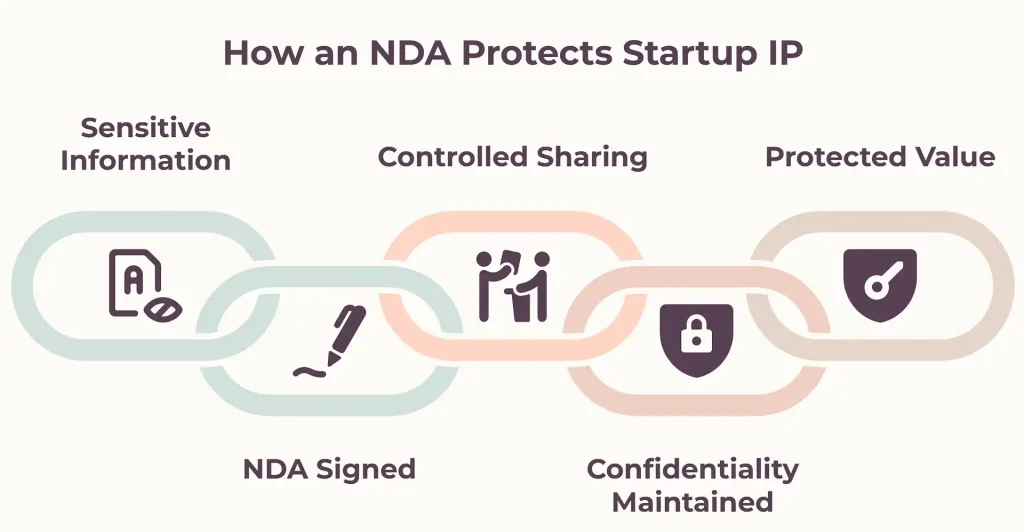
The question of what is an NDA in business comes up constantly in founder conversations. It usually surfaces right before a term sheet, a data room, or a big customer introduction. Put simply, an NDA in business is a contract barring one or both parties from disclosing confidential information. Answering that question at the definitional level, though, misses the point. The real value lies not in the legal language but in the discipline, it forces around who sees sensitive material. And that discipline protects a startup’s intellectual capital long before it shows up on a balance sheet.
The FOMO Trap and the Cost of Skipping Structure
Fear of missing out is a real force inside founder culture, and it shows up in ways that rarely look dramatic in the moment. A pitch deck goes out without tracking. A product roadmap gets shared a few weeks earlier than it should. A customer list lands in the inbox of a “strategic partner” who, eighteen months later, turns out to be a well-funded competitor. None of these decisions feel reckless when made, each one rationalized as the cost of moving quickly in a market where hesitation looks like weakness.
Real opportunity, though, tends to respect process rather than resent it. Legal process, handled with judgment, protects the thing that makes innovation valuable in the first place, which is exclusivity of information. Building finance functions from nothing across sectors ranging from cybersecurity to consumer products has made one pattern difficult to unsee: the companies that scale cleanly are rarely the ones with the most aggressive NDA policies. They are the ones with a policy at all, applied consistently and understood by everyone who touches sensitive material.
Why NDAs Still Matter for Startup IP Protection
Founders tend to underestimate how much of their competitive differentiation lives in ideas rather than in execution. Product architecture, early market entry points, and monetization models are strategic assets long before they show up on a balance sheet, and they are often shared informally, in calls, pitch meetings, and follow-up emails with no record of what was disclosed or to whom.
Building a Paper Trail
A signed NDA creates a documented moment at which sensitive information changed hands. That record can matter in a future dispute, and it matters just as much during a routine fundraising or acquisition process, when buyers and investors want a clean answer to a simple question: who has seen this, and under what terms. A cybersecurity and identity access management company operating near $30M in annual recurring revenue, with delivery teams spread across five countries, made this visible through its board-grade reporting discipline: diligence questions got answered in a single afternoon only when disclosure history had been tracked from day one.
Shaping Behavior and Enabling Selective Transparency
Beyond the paper trail, an NDA changes behavior. A signed agreement makes a recipient pause before forwarding materials, and it sends a cultural signal that the company sending it takes its own strategy seriously. It also enables selective transparency, letting founders share the right details with the right stakeholders while retaining control over the rest. Without that structure, founders tend to swing between two failure modes: holding back information that would have accelerated a deal, or oversharing without any framework at all. Both outcomes quietly erode enterprise value.
When to Use an NDA and When to Skip It
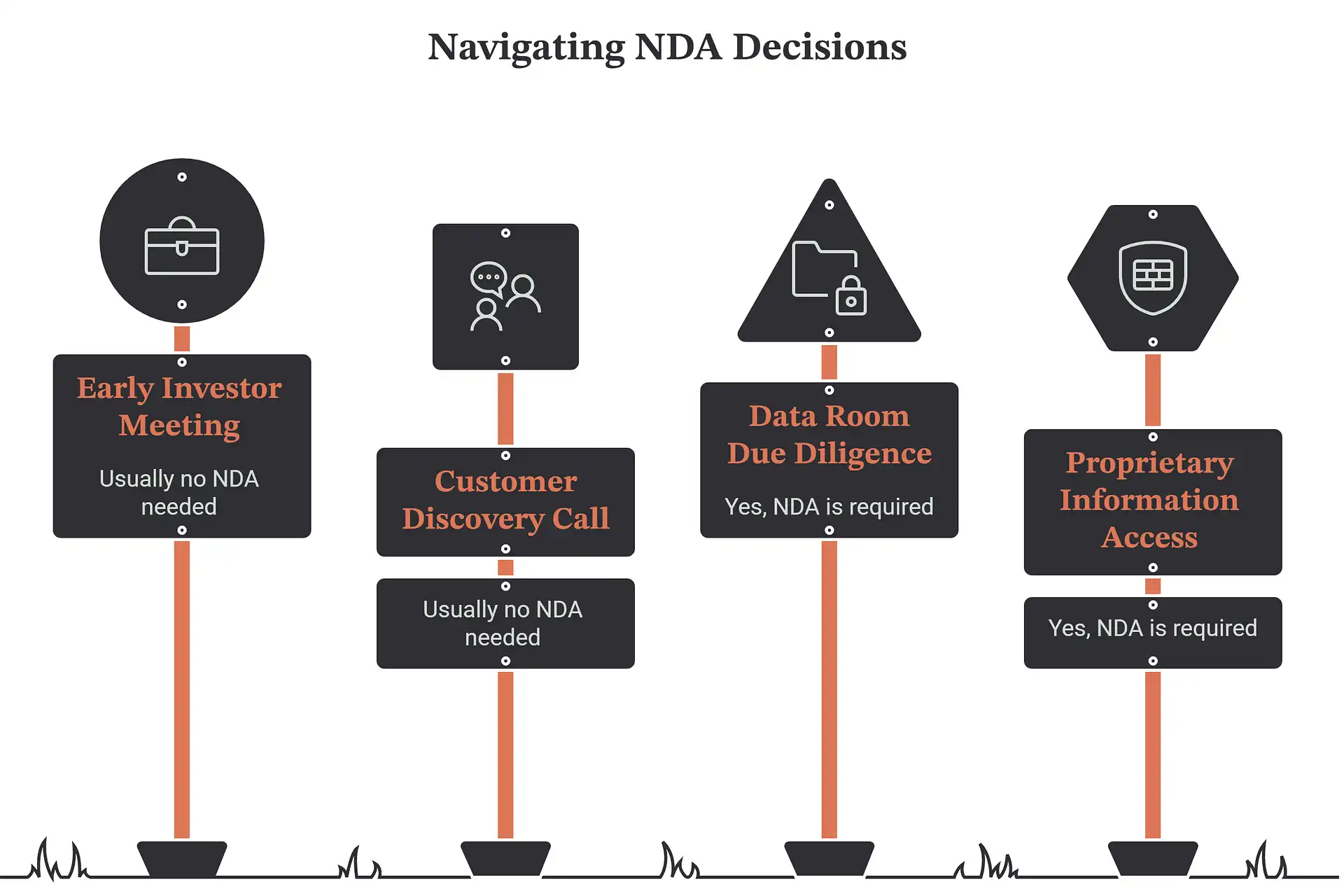
Not every conversation calls for an NDA, and asking for one in the wrong context can do more damage than skipping it entirely. Institutional investors almost never sign NDAs during early-stage meetings, because their deal flow is broad enough that overlap across portfolio companies is a structural reality rather than an exception. Pushing for a signature in that setting tends to signal inexperience with fundraising norms rather than diligence.
As conversations move toward customer agreements, vendor partnerships, or acquisition discussions, the calculus changes. Sharing a data room, granting access to source code, or walking a counterparty through a proprietary method are all moments where the asymmetry of information is real and the downside of a leak is concrete.
| Conversation Type | NDA Typically Needed | Reasoning |
| Early investor coffee meeting | No | Broad deal flow makes overlap normal; requesting one signals unfamiliarity with norms |
| Customer discovery calls | Rarely | Low sensitivity of information exchanged at this stage |
| Data room access for diligence | Yes | Financial, operational, and technical detail is fully exposed |
| Source code or proprietary method review | Yes | Direct exposure of the core technical asset |
| Strategic partnership or BD exploration | Yes | Roadmap and customer information often shared before terms are set |
| Employee and contractor onboarding | Yes, via IP assignment | Protects ownership of work product from day one |
A founder once hesitated to ask a large enterprise partner for a signature, worried it would kill momentum at a delicate moment in the relationship, and moved forward with informal sharing instead. Six months later, the partner launched a product difficult to distinguish from the startup’s own, built with a different vendor. There was no malice in what happened and no clean recourse either, only a missing structure that would have cost nothing to put in place.
The Broader Risk: IP Leakage and Commercial Ambiguity
The deeper risk of skipping NDAs is not theft in any dramatic sense. It is dilution of ownership. Founders who fail to document access to algorithms, customer strategies, and unpublished roadmaps eventually find it difficult to claim exclusivity when it matters most, whether in an acquisition, a patent filing, or a funding round where buyers expect clean representations rather than open questions about exposure.
During a due diligence process at a $127M global consumer products company, thin documentation around who had reviewed prior technical materials nearly stalled a transaction, and rebuilding that trail took weeks of backchannel verification that a properly archived NDA library would have made unnecessary.
A separate and equally costly version of this problem involves people rather than partners. A growth-stage company that skipped a formal IP assignment during a hiring sprint discovered, two years later during exit preparation, that a core piece of its codebase had been built before the relevant engineer joined and had never been formally transferred. That gap nearly disrupted the transaction. Legal process of this kind is structure, and structure is what preserves enterprise value when the stakes are highest.
NDAs as a Signal of Discipline
Experienced founders treat NDAs less as barriers and more as signals. A clean, founder-friendly agreement communicates that a company understands what matters and protects it accordingly, and most sophisticated counterparties, particularly in corporate development and enterprise sales, expect nothing less. The same discipline applies internally: employment agreements with IP assignment clauses, confidentiality terms with advisors, and vendor contracts with defined usage limits are variations on the same principle. They clarify boundaries, and in doing so, reinforce that a company takes its own future seriously.
Building an NDA Culture Without Bureaucracy
The goal is normalization, not over-legalization. A lightweight NDA that can be signed quickly protects a company more than an intimidating document nobody uses. A few practices separate companies that manage this well:
- Build NDA requests into data room workflows, partnership discussions, and vendor onboarding so the step becomes routine.
- Maintain a simple, tagged archive of signed agreements by counterparty, so diligence readiness does not depend on memory.
- Frame the request as a standard step that lets both sides move quickly once confidential material is involved, not as a sign of distrust.
- Train the team on when a request fits and when it does not, since a poorly timed ask can cost more credibility than the protection is worth.
Three Key Takeaways
- Founder IP protection is an operational habit rather than a legal exercise, and companies that scale cleanly build NDA discipline into routine workflows instead of reaching for it only under pressure.
- Timing matters as much as the agreement itself: requesting a signature too early can damage credibility with investors, while waiting too long around data rooms, source code, or proprietary methods can leave a company exposed when it matters most.
- Diligence readiness during fundraising, M&A, or an exit depends on documentation built years earlier, and a tagged archive of signed agreements consistently shortens the path to a closed transaction compared with reconstructing disclosure history under deadline pressure.
Disclaimer: This article is intended for informational purposes only and does not constitute legal, tax, or accounting advice. You should consult your own tax advisor or counsel for advice tailored to your specific situation.
Hindol Datta is a four-time CFO and senior finance executive with over 25 years of leadership experience across cybersecurity, SaaS, gaming, logistics, digital marketing, medical devices, consumer products, and nonprofit organizations. He has led more than $120M in fundraising and over $150M in M&A transactions while building the financial and operational systems that let complex businesses scale with confidence. He is the author of seven books in the Systems CFO Series and holds active CPA, CMA, and CIA credentials.
AI-assisted insights, supplemented by 25 years of finance leadership experience.