Executive Summary
What investors look for in founders at the seed stage has very little to do with product completeness and everything to do with the human qualities that determine whether a company can survive and scale. Narrative clarity, behavioral consistency, coachability, founder-market fit, and emotional resilience form the mosaic that sophisticated investors assemble before writing a check. Drawing on over twenty-five years of experience across capital raises exceeding one hundred and twenty million dollars and M&A transactions exceeding one hundred and fifty million dollars, spanning sectors from SaaS and cybersecurity to logistics and digital marketing, this article examines the signals investors read, the behaviors they reward, and the framework founders can use to position themselves as credible, investable leaders long before traction arrives.
The Bet Investors Actually Make
In venture circles, the phrase is familiar: bet on the jockey, not the horse. It is shorthand for something more calibrated than it sounds. At the seed stage, when traction is sparse, the product is still forming, and the market opportunity is more thesis than fact, investors are asked to make high-conviction decisions with incomplete information. The product may pivot. The market may shift. The team will certainly evolve. What investors are betting on is the founder’s capacity to navigate all of it.
This is not sentiment. It is strategy. The founder versus investor dynamic at the earliest stages is fundamentally an exercise in signal reading. Every interaction, every email, every response to pushback becomes data. Founders who understand this use it to their advantage. Those who do not often find themselves wondering why a polished deck was not enough.
The Signals Investors Read
Narrative Clarity
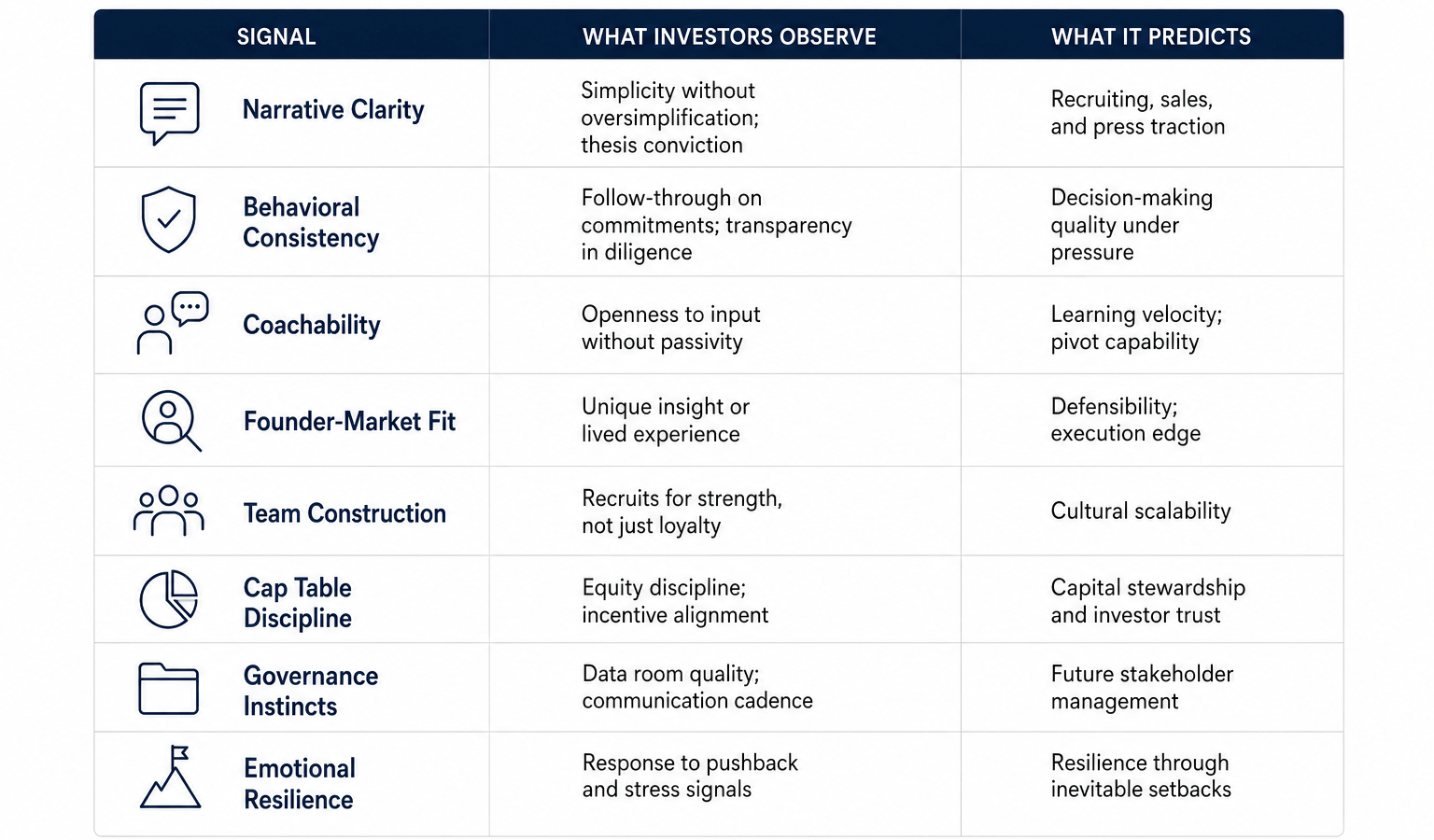
Narrative clarity is not marketing polish. It is intellectual rigor made accessible. Can the founder explain what they are building in a way that is simple without being simplistic? Do they understand the market forces, the behavioral shifts, and the economic levers that underpin the opportunity? Most importantly, can they make the investor feel that they are seeing something others have missed?
The most compelling seed-stage founders do not promise traction. They promise inevitability. They back their thesis with research, perspective, and a reading of the market that feels both contrarian and obvious in hindsight. Investors recognize in that clarity a preview of how the founder will recruit talent, attract press, and eventually win customers.
Behavioral Consistency
How a founder behaves across every touchpoint of the fundraising process is as important as what they say in a pitch. Investors observe whether founders follow through on commitments, respond to diligence requests with transparency, and acknowledge gaps in their model rather than obscure them. These behaviors reveal decision-making temperament.
In the absence of performance history, investors bet on judgment. Founders who demonstrate self-awareness, responsiveness, and intellectual honesty build trust quickly. Those who deflect, blame externalities, or respond defensively signal a pattern that investors expect to see replicated under the far greater pressure of actually running a company.
Coachability
Coachability is frequently misunderstood. It is not compliance. It is the ability to process input and adapt without losing conviction. The best founders listen to learn, not to please. They can hold the productive tension between a strong point of view and genuine openness to being wrong.
In my experience across capital-intensive environments, including cybersecurity and SaaS organizations where strategic decisions carry significant financial consequences, the leaders who compounded the most value over time were those who could update their beliefs quickly without abandoning their principles. Investors apply the same lens to founders. Coachability becomes a proxy for learning velocity, which at seed stage is perhaps the most important performance metric of all.
Founder-Market Fit
Investors ask whether this particular founder has a unique insight, access, or lived experience that makes them distinctly suited to solve the problem. A background inside the inefficiencies of an industry, a personal pain point that generated proprietary understanding, or a contrarian observation rooted in deep domain knowledge all serve as evidence of fit.
This matters because founder-market fit is a form of moat. It is not easily replicated by a better-funded competitor. When a founder can articulate not just what they are building but why they specifically are the right person to build it, the investor’s confidence in the bet increases substantially.
The Hidden Signals That Compound the Case
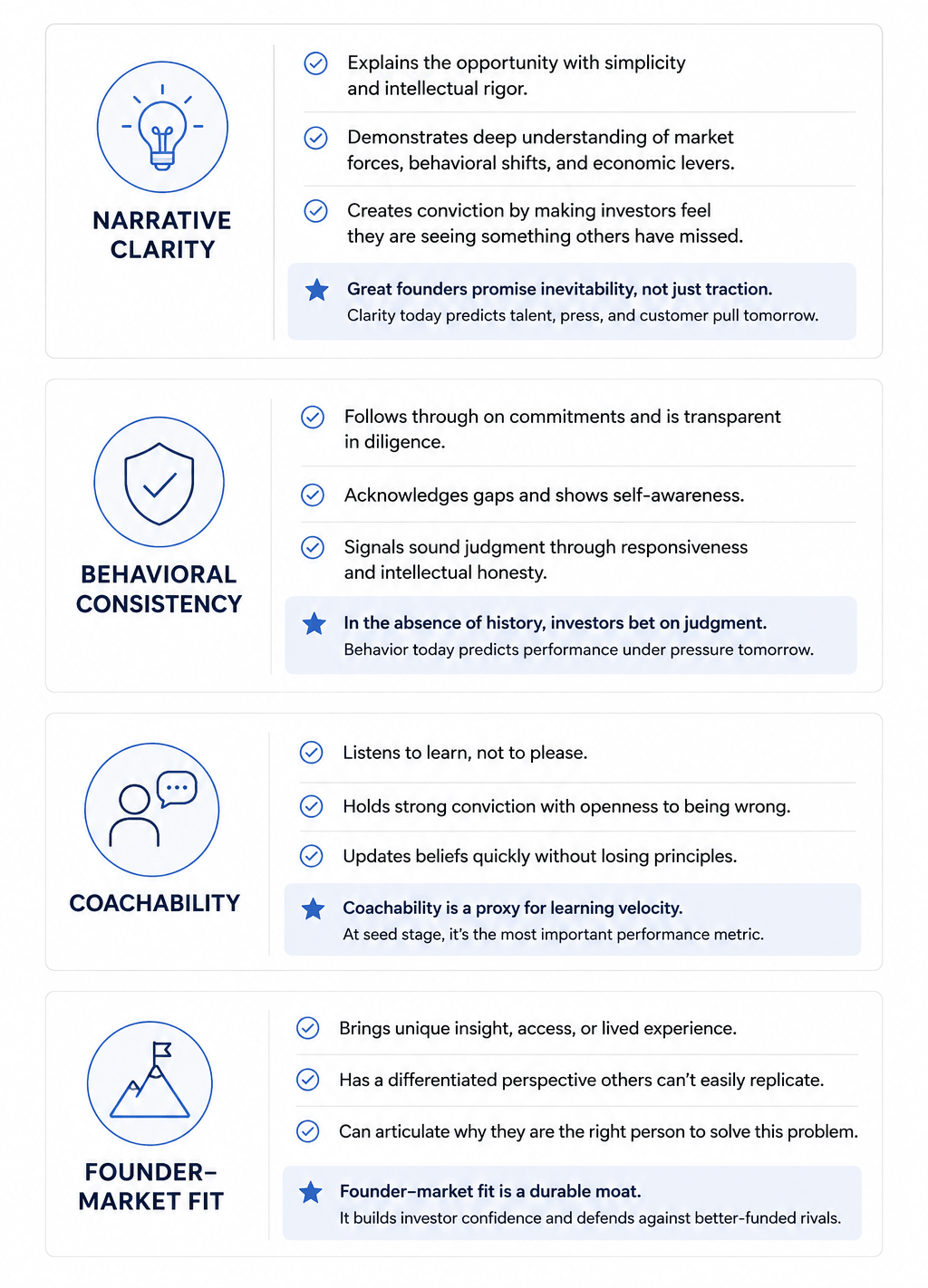
Beyond the four primary qualities above, investors triangulate a founder’s credibility through several additional signals that are less visible but equally weighted.
Early team construction reveals values. Founders who recruit people stronger than themselves in specific domains signal confidence and long-term thinking. Those who over-index on loyalty at the expense of talent signal a culture that may not scale.
Cap table discipline signals financial maturity. Founders who dilute themselves heavily in early rounds, or who distribute large equity stakes to advisors and service providers without strategic rationale, raise questions about their understanding of incentive alignment and long-term value creation.
Governance instincts provide a preview of future behavior. A clean data room, timely investor updates, and thoughtful responses to diligence questions are not administrative details. They are rehearsals for how the founder will manage capital and communicate with stakeholders as the company grows.
Emotional resilience is perhaps the most difficult to evaluate and the most consequential to the outcome. Building a company is a sustained exercise in managing uncertainty. Investors watch how founders respond to light pressure in a meeting, knowing that the real test will come when targets are missed, key hires depart, or the market moves unexpectedly.
A Framework for Founder Evaluation
The following table summarizes the primary signals investors assess and what each one predicts about future performance.
What Founders Can Do With This
Understanding what investors look for in founders is not merely useful for fundraising. It is a framework for leadership development. Each of the signals above maps to a behavior that founders can practice deliberately.
Founders who show up to every investor interaction with prepared clarity, honest acknowledgment of what they do not know, and evidence of how they learn are not performing. They are demonstrating the same qualities that will define their leadership through every stage of the company’s growth.
The pitch is not a separate event. It is a compressed preview of how the founder operates. The most successful founders treat it as such.
Conclusion
The question investors are answering at the seed stage is not whether the product is good. It is whether this founder can build something that endures. That determination rests on a mosaic of signals assembled across every interaction, from the first email to the final diligence call. Narrative clarity, behavioral consistency, coachability, founder-market fit, disciplined team construction, cap table awareness, governance instincts, and emotional resilience are not abstract virtues. They are observable, evaluable, and ultimately decisive. Founders who internalize this understand that they are always being assessed and that every touchpoint is an opportunity to demonstrate the qualities that make capital flow toward conviction. The check does not follow the product. It follows the person.
Disclaimer: This blog is intended for informational purposes only and does not constitute legal, tax, or accounting advice. You should consult your own tax advisor or counsel for advice tailored to your specific situation.
Hindol Datta is a seasoned finance executive with over 25 years of leadership experience across SaaS, cybersecurity, logistics, and digital marketing industries. He has served as CFO and VP of Finance in both public and private companies, leading $120M+ in fundraising and $150M+ in M&A transactions while driving predictive analytics and ERP transformations. Known for blending strategic foresight with operational discipline, he builds high-performing global finance organizations that enable scalable growth and data-driven decision-making.
AI-assisted insights, supplemented by 25 years of finance leadership experience.