
Executive Summary
Most founders treat legal support for startups as a reactive function, summoned when a deal needs closing or a problem needs cleaning up. The founders who scale with intention treat it differently. They fold legal thinking into the operating rhythm of the company from the earliest days. It strengthens governance, protects intellectual property, and keeps the business ready for whatever opportunity or scrutiny arrives next.
This distinction rarely shows up in a single dramatic moment. It shows up in the paper trail behind every board decision, in how quickly a data room can be assembled, and in whether a founder can sit across from an investor and speak the language of the deal rather than deferring every question to counsel. None of it requires a large legal budget. It requires discipline, and it requires a founder willing to lead the conversation rather than avoid it.
Why Legal Support for Startups Should Begin at the Boardroom
Board structure ranks among the most underused levers of long-term value creation. Many founders treat it as paperwork to satisfy an investor rather than as an asset in its own right. Board composition shapes decision rights. So does meeting cadence, and so does the discipline behind its governance, along with fundraising leverage. Together, they shape the confidence a company projects to the outside world, long before any transaction is on the table.
One mission-driven education and research institution in Silicon Valley illustrates this well. Its finance function carried direct responsibility for legal and audit committee staffing. Board reporting fell under its core financial duties as well. That structure made clear how tightly governance and finance intertwine in a lean organization. Every board resolution had an owner. Every consent was signed and filed the same week it was needed, not reconstructed months later under pressure. That kind of governance discipline, applied early, tends to compound. Investors read clean minutes and unambiguous voting thresholds as evidence that a company takes structure seriously. That reading shapes how much friction a future raise or sale will carry.
Contrast that with the more common pattern, where board minutes go missing, consents sit unsigned for a quarter, and decision rights blur under growth pressure. Legal counsel then has to reconstruct history from email threads and memory, and that reconstruction itself becomes a signal of disorganization to anyone conducting diligence.
Intellectual Property Planning Belongs to the Whole Company
Intellectual property is not simply the domain of engineers filing patents. It includes trade secrets, proprietary algorithms, customer insight, brand identity, and the accumulated domain expertise that gives a company its edge, and it is routinely neglected until diligence forces the issue. Effective legal support for startups treats IP as a living asset that needs maintenance well before a transaction demands proof of ownership.
Contractor assignment agreements, code contribution logs, and early trademark registration are unglamorous work, but they determine how fast a company can move when the moment matters. During acquisition diligence at a high-growth cybersecurity and identity access management company generating close to $30M in annual recurring revenue, clean IP records and a documented controls environment let the acquiring counsel complete its review in days rather than weeks, removing the indemnity holdbacks and late-stage surprises that typically erode valuation. Founders who wait until diligence begins to think about IP are already behind the timeline that speed requires; the ones who build IP hygiene into the company’s legal culture make it a durable asset rather than a scramble.
Deal Readiness Is a Discipline, not a Milestone
Legal readiness is often treated as an event: a sprint that begins when a fundraise or sale process kicks off. Companies that use legal well instead build readiness into the quarterly cadence of the business, maintaining a current data room, an updated cap table, and refreshed vendor contracts and NDAs as a matter of course rather than as a pre-deal fire drill.
That discipline pays off in ways that are easy to underestimate until it matters. Across three acquisitions led during a period when a venture-backed performance marketing company scaled from $9M to $180M in revenue over twenty-four months, the acquiring and target-side diligence processes moved fastest when vendor onboarding, contract filing, and documentation had already been treated as routine hygiene rather than a special project. Being ready does not require perfection. It requires documentation, because investors and acquirers can work around imperfections; what stalls a deal is chaos they cannot map.
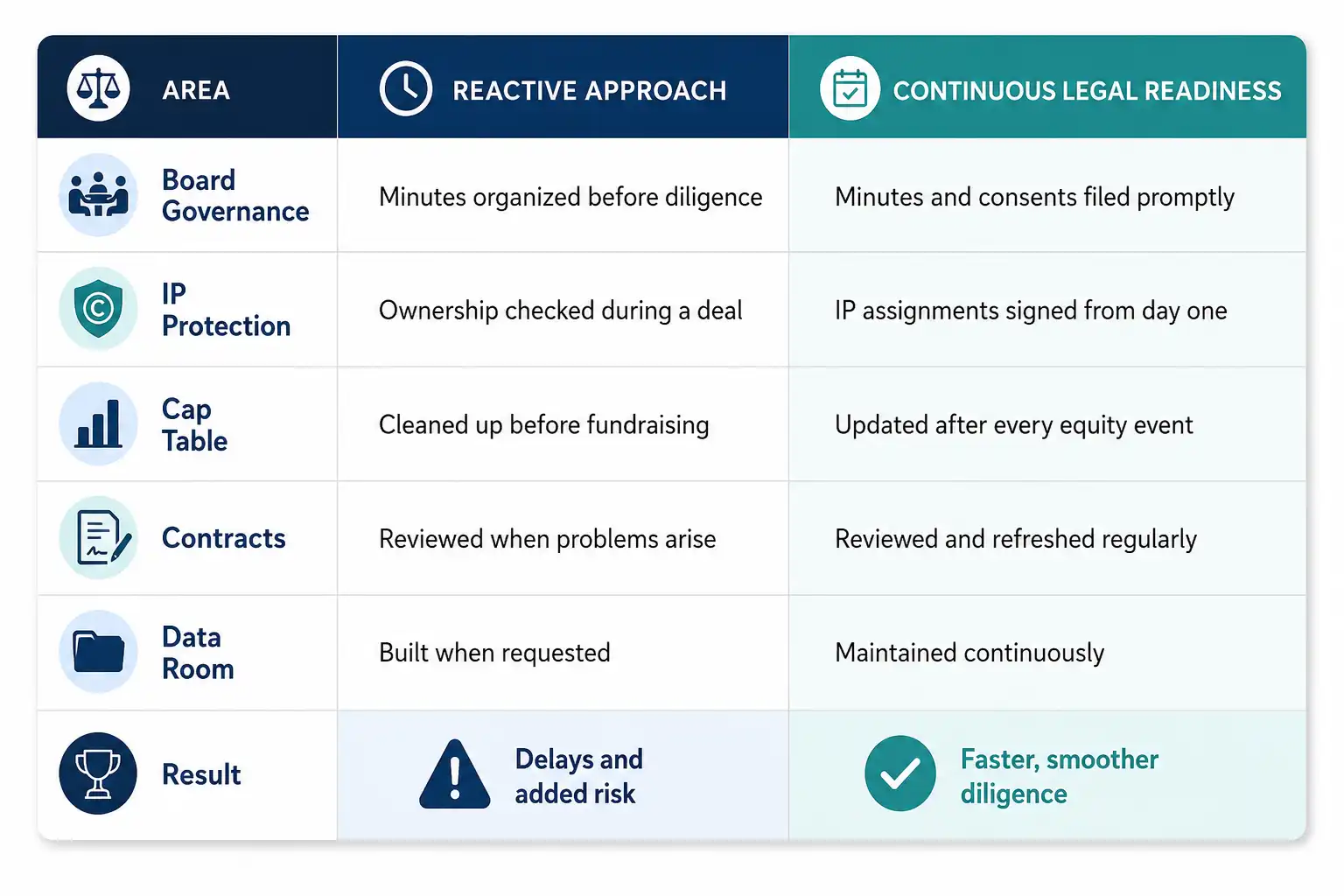
The Readiness Checklist
- Cap table kept current, with every grant, exercise, and transfer reflected in real time
- Vendor contracts and NDAs reviewed and refreshed on a rolling basis
- Board minutes, consents, and resolutions filed within days of the meeting, not months later
- IP assignment agreements signed by every contractor and employee before work begins
- A data room maintained continuously, not assembled under deadline pressure
Founders Who Speak the Language of Legal Lead Stronger Boards
One of the more subtle traits separating strong founders from the rest is fluency, the ability to engage directly with legal counsel rather than routing every question through a CFO or outside advisor. Fluency does not require a law degree. It requires enough command of term sheets, governance structures, indemnities, and data privacy obligations to ask sharp questions and know when to push back.
During an S-1 preparation and IPO-readiness process for a Euronext Paris-listed gaming and digital entertainment company operating across five countries, the founders and executives who could walk underwriters and Big Four auditors through the reasoning behind a governance decision, not just the decision itself, earned faster trust from the board and a smoother path through the review. That trust came from fluency, not from formality or credentials. A founder does not need to master every clause in a contract. Leading the conversation matters more than reciting it.
Legal Discipline as a Mirror of Company Maturity
Legal discipline often reflects the maturity of a company more accurately than its revenue line does. A startup generating $10M in ARR with disorganized documentation signals fragility to anyone looking closely, while a company at half that revenue with tight governance and clean contracts signals a business built to last. Founders who treat legal support for startups as a genuine strategic asset do not fear transparency. They welcome the scrutiny of clean board resolutions, clear contracts, and equity documentation that employees can actually understand, because that posture is what builds the kind of trust that compounds over successive rounds and eventually over an exit.
Embedding Legal Thinking Across Every Function
Legal support for startups works best when it stops being a silo and becomes a shared discipline across the company. Sales teams that understand approved contract templates close faster and with fewer redlines. HR teams that understand offer letter structure and equity documentation avoid costly rework. Finance teams that track vesting schedules and board approvals in real time save weeks during diligence. Product teams that understand the boundaries of data sharing and privacy law avoid building features that create legal exposure later.
This cross-functional literacy showed up clearly in a $127M global consumer products company with a supply chain spanning China and Vietnam, where finance, operations, and legal worked closely enough that contract terms with logistics and manufacturing partners were reviewed for risk before signing, not after a shipment problem forced a renegotiation. Founders who promote this literacy do not slow their teams down. They give them the judgment to move faster with fewer costly detours.
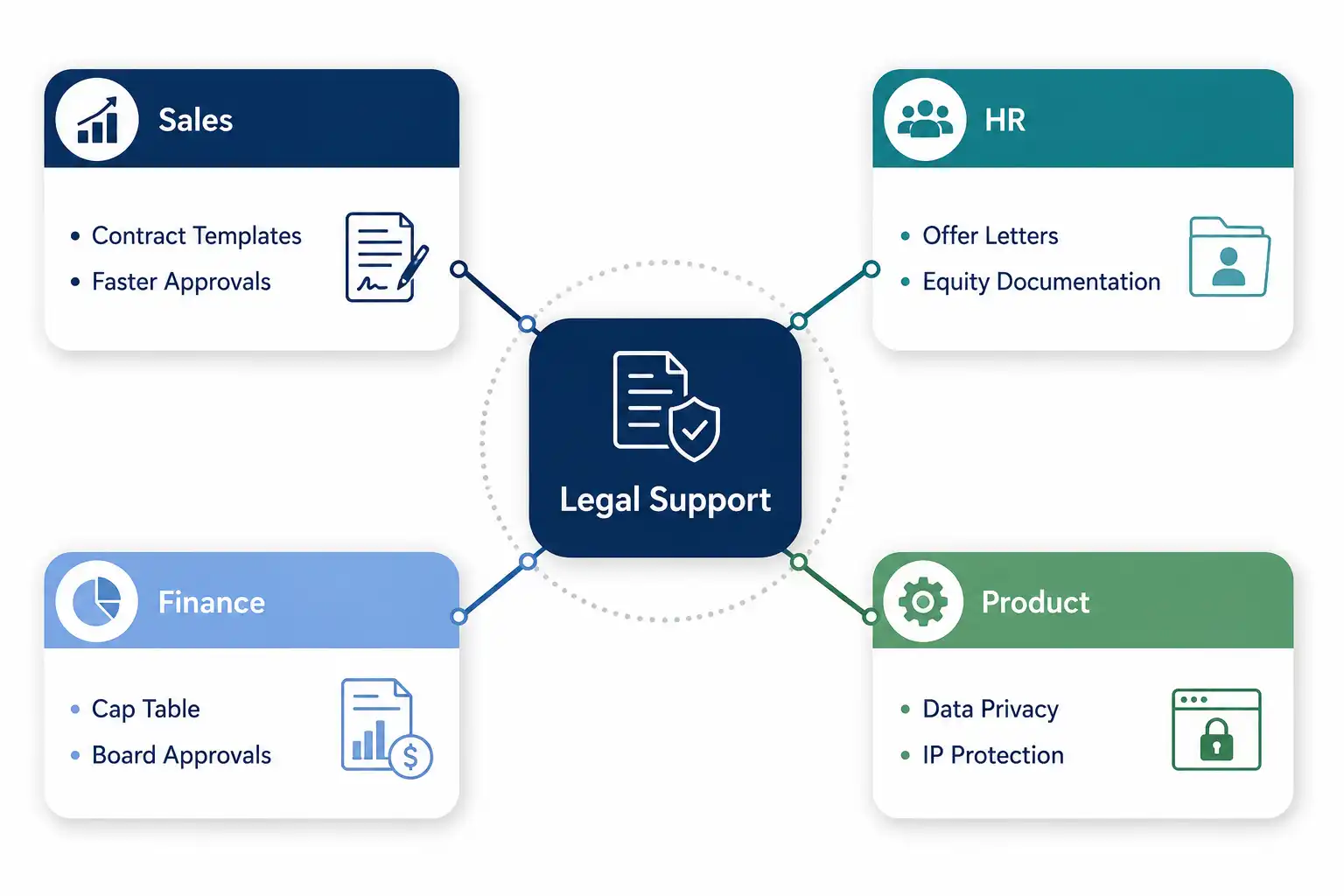
From Cost Center to Catalyst
Legal will always carry a cost, but used deliberately, that cost becomes a catalyst rather than a drag. It accelerates deals, removes distractions during diligence, and strengthens the narrative a company tells its investors and acquirers. The founders who get the most from legal support for startups do not ask whether they need it. They ask how to use it better, reviewing strategy on a regular cadence and treating every engagement with counsel as an opportunity to build institutional knowledge rather than simply close a task.
That shift does not demand complexity or a large budget. It demands ownership, starting with the founder’s own mindset: treat legal support for startups as an afterthought, and it will behave like one; elevate it into the operating system of the business, and it becomes a genuine competitive edge.
Three Key Takeaways
- Board structure and legal governance should be designed at formation, not bolted on before a Series B or C raise, because the paper trail a company builds early becomes the credibility it draws on during every future financing or sale.
- Intellectual property protection and deal readiness are ongoing disciplines rather than pre-transaction sprints, and companies that treat documentation, contractor agreements, and data rooms as routine hygiene move through diligence faster and with fewer costly surprises.
- Legal support for startups delivers the most value when it is distributed across every function rather than siloed within a single team, giving sales, HR, finance, and product the shared literacy to make faster, lower-risk decisions on their own.
Disclaimer: This article is intended for informational purposes only and does not constitute legal, tax, or accounting advice. You should consult your own tax advisor or counsel for advice tailored to your specific situation.
Hindol Datta is a four-time CFO and senior finance executive with over 25 years of leadership experience across cybersecurity, SaaS, gaming, logistics, digital marketing, medical devices, consumer products, and nonprofit organizations. He has led more than $120M in fundraising and over $150M in M&A transactions while building the financial and operational systems that let complex businesses scale with confidence. He is the author of seven books in the Systems CFO Series and holds active CPA, CMA, and CIA credentials.
AI-assisted insights, supplemented by 25 years of finance leadership experience.