Executive Summary
For twenty-five years across cybersecurity, consumer products, gaming, and logistics, founders and boards have too often treated China market entry strategy as a paperwork exercise instead of a financial architecture decision. The scale on offer still pulls global companies toward the market. China has a middle class larger than the population of most continents. Its manufacturing ecosystem is one few regions can match. What changes year over year is the cost of entering without discipline. Undisciplined entry blocks capital. It disqualifies deductions. And it leaves boards discovering the entity structure was wrong only after they’ve already committed the money.
This article lays out the practical architecture of a sound China market entry strategy. It covers choosing an entity, moving currency and capital once that entity exists, working within the corporate tax landscape, and locating where transfer pricing exposure hides. This is the sequence I build, defend in board meetings, and live with through audits and repatriation cycles.
Choosing the Right China Market Entry Strategy for Your Entity
Foreign companies cannot incorporate in China the way they might in Singapore, Canada, or Ireland. Any China market entry strategy has to begin with that fact. The regulatory environment demands alignment with local policy priorities before it demands alignment with a business plan. And the choice of entry vehicle shapes everything downstream, from how profits move to how parties resolve disputes.
The Wholly Foreign-Owned Enterprise
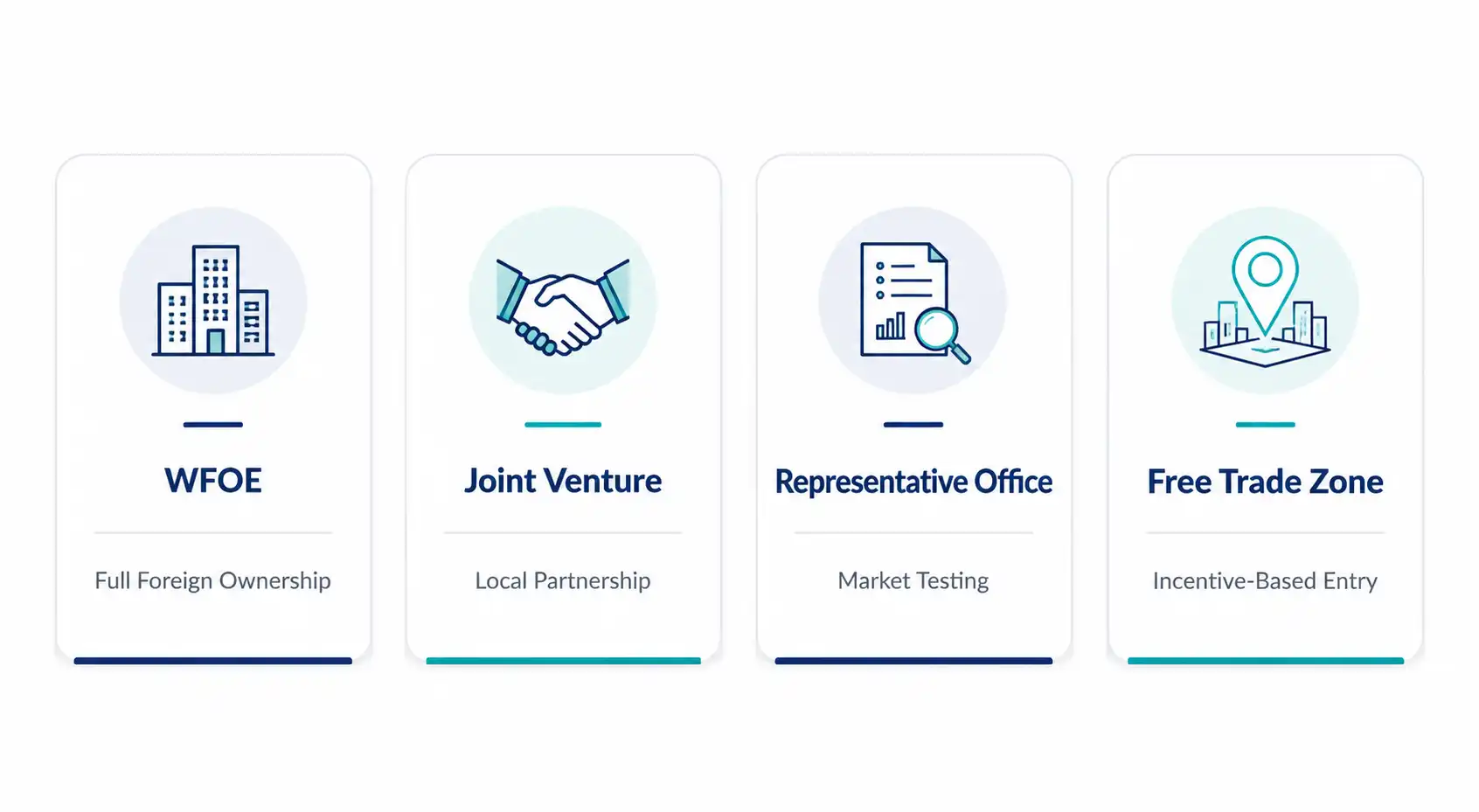
The most common vehicle remains the Wholly Foreign-Owned Enterprise, or WFOE. It allows a foreign parent to own 100 percent of a limited liability company in China without a local partner. A WFOE can invoice in RMB, hire staff directly, and repatriate profits under conditions that, while strict, are at least knowable in advance. I served as Chief Financial Officer of a consumer products company, a $127M global business selling through direct-to-consumer, Amazon, and wholesale channels. Its supply chain ran through China and Vietnam. Entity structure determined how quickly we could react to a tariff shift or a supplier renegotiation. A WFOE generally suits sales, consulting, or sourcing operations. But it demands more capital discipline upfront than founders tend to expect.
Joint Ventures, Representative Offices, and Free Trade Zones
A Joint Venture pairs a foreign company with a Chinese partner. Policy has liberalized, so it has become less common. But it remains the practical path in regulated industries such as media, telecommunications, and education. Partners share control. No one should underestimate governance and exit terms unless they’ve negotiated a shareholder agreement across two legal traditions at once.
A Representative Office suits companies still testing the market. It cannot generate revenue or sign local contracts. It can perform market research and support the home office. But it still triggers filings that surprise founders expecting no compliance burden. Free trade zones and high-tech industrial parks can offer streamlined registration and reduced tax rates. The incentives, though, typically arrive with conditions or a limited geographic scope worth reading closely.
Regardless of vehicle, incorporation runs through several checkpoints. These include Ministry of Commerce approval and registration with the State Administration for Market Regulation. They also include local tax registration and a foreign exchange account with SAFE, the State Administration of Foreign Exchange. Timelines run six to twelve weeks depending on city and structure. And every week of delay is a week of burn without a China entity generating revenue.
Currency Control and Capital Structuring After Entry
China imposes tighter controls over currency conversion and cross-border capital flows than most jurisdictions a Western CFO will have operated in previously. This is where a well-drafted org chart meets the reality of moving cash. A WFOE typically operates two accounts: a basic RMB account and a foreign currency capital account. The parent must wire paid-in capital into the foreign currency account before converting it into RMB for operational use.
Formal capital contribution requirements have relaxed, but SAFE continues to monitor how funds move and what they fund. Intercompany loans, service agreements, and license fees structured carelessly can result in blocked payments, fines, or frozen accounts. Every inflow and outflow needs to tie back to an approved business scope with audit-ready documentation. In my experience running multi-entity finance across geographies for a Euronext Paris-listed gaming and digital entertainment company, the entities that struggled were rarely the ones with bad intentions. They were the ones whose cash movements had outrun their documentation.
Repatriation of profits adds another layer of review. Dividends move only after the WFOE has paid its taxes, funded statutory reserves, and closed its audit. They then pass through the SAFE system subject to a withholding tax, typically 10 percent unless a tax treaty reduces it. Startups often model a China market entry strategy in U.S. dollars. What looked like sufficient runway can become illiquid once trapped behind these bottlenecks. Sequencing and documentation, not intent, separate the entities that move cash smoothly from the ones that do not.
Understanding the Corporate Tax Landscape
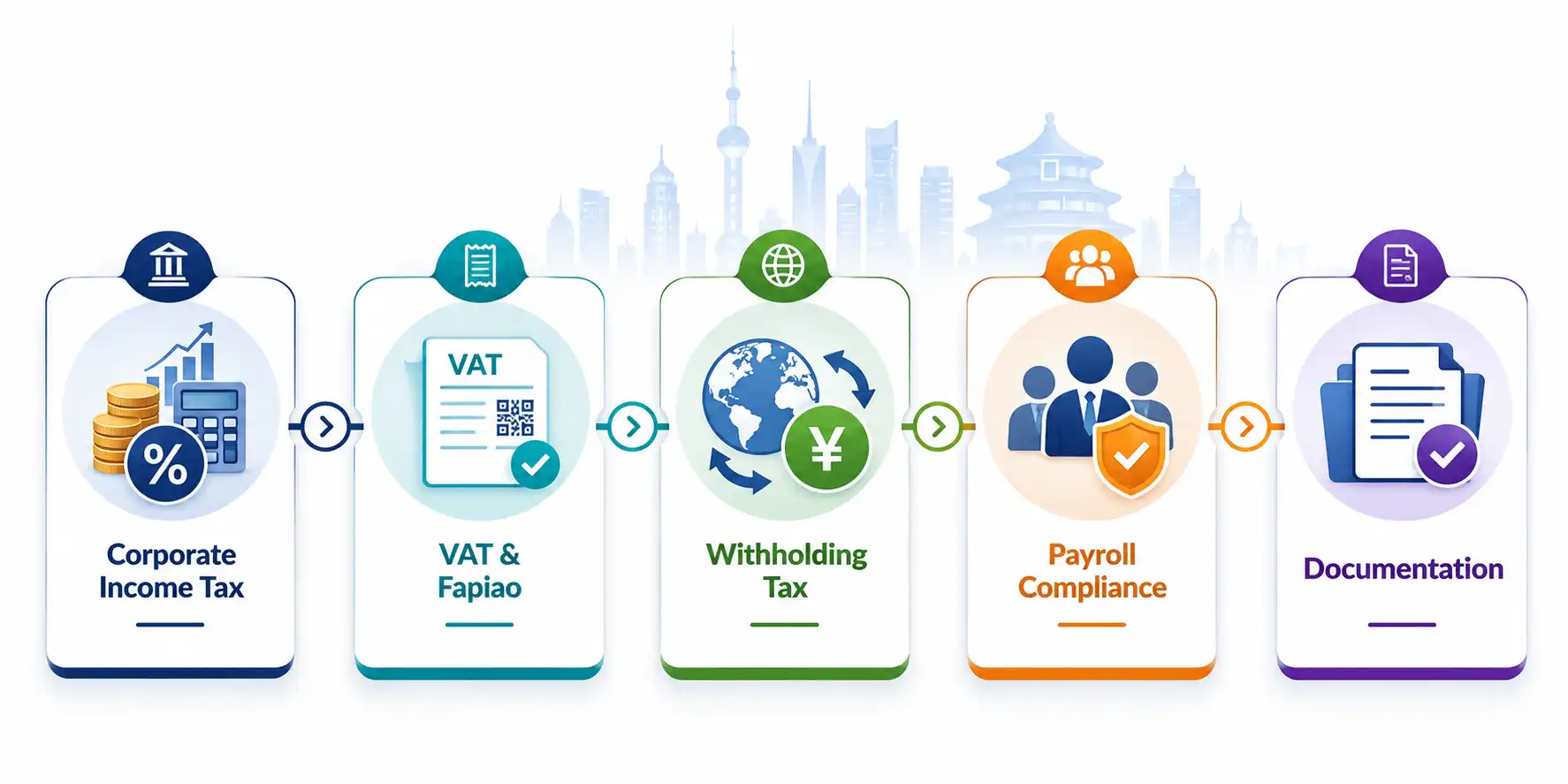
China’s corporate income tax sits at a standard rate of 25 percent for most resident enterprises, though certified High and New Technology Enterprises can qualify for a reduced 15 percent rate, subject to R&D thresholds and annual renewal that demand real substance, not a one-time filing. Companies are taxed on worldwide income if resident, or on China-sourced income if not, and income is computed under PRC accounting standards, which diverge from U.S. GAAP in revenue recognition, depreciation, and expense treatment in ways that catch finance teams off guard during their first close.
Value-Added Tax runs alongside income tax, at 13 percent for goods and 6 percent for services, filed monthly with invoice-level detail through the fapiao system, China’s government-controlled invoicing infrastructure. Miss a compliant fapiao, and the input VAT is not recoverable, nor can the underlying expense be deducted for corporate income tax. Companies used to informal vendor relationships elsewhere often find, in their first year, that legitimate expenses cannot be claimed because the paperwork falls short of the standard.
Beyond CIT and VAT, other levies shape the total tax burden:
- Withholding Tax (WHT): Applies to dividends, interest, royalties, and service fees paid to non-residents, at a default rate of 10 percent, reducible through tax treaties with proper filings.
- Stamp Duty: Levied on specific documents such as contracts and property leases, typically at nominal rates of 0.03 to 0.1 percent.
- Urban Maintenance and Construction Tax and Education Surcharges: Calculated as a percentage of VAT and other indirect taxes, adding roughly another 10 to 12 percent to the overall tax burden.
Payroll taxes are mandatory and set locally, with social insurance and housing fund contributions varying by city. Under-contributing or failing to register is treated as labor non-compliance, and it can cost a company its business license or draw litigation from employees who know these entitlements better than most incoming finance teams do.
Transfer Pricing and Related-Party Transactions
For companies operating through a WFOE or another China subsidiary, transfer pricing compliance sits close to the center of any durable China market entry strategy. China follows OECD guidelines in principle, but applies them with a location-based emphasis on where value is actually created inside the country, especially for companies with intellectual property, brand equity, or high-margin services flowing through the entity.
Annual filings must disclose related-party transactions, and companies above certain thresholds must prepare contemporaneous documentation able to withstand scrutiny years later. Outbound payments draw particular attention, especially royalties, service fees, and cost-sharing arrangements authorities may view as shifting value out of the country without adequate substance. When I led due diligence and post-merger integration on cross-border transactions exceeding $100M, the related-party structures that held up under scrutiny were documented with real benchmarking, updated annually, not assembled once and left untouched. Adjustments and penalties can apply retroactively, so the safest posture treats intercompany pricing as a living discipline, not a one-time filing exercise.
Common Mistakes in China Market Entry
The most common missteps I have seen, and occasionally inherited, tend to repeat across industries:
- Choosing the wrong entity structure or failing to define a clear business scope at the outset
- Neglecting SAFE rules and losing access to capital because of mischaracterized transactions
- Underestimating the documentation burden of VAT and fapiao compliance
- Overpaying or undercharging in intercompany transactions without proper support
- Assuming local tax treatment will mirror U.S. practice, particularly around expense recognition
- Misclassifying employees and running afoul of local labor rules
Each is preventable, and none requires a large compliance department to solve. What it requires is early awareness and advisors who understand the cross-border texture of the business, not generalists applying a domestic playbook to a market that runs on different assumptions.
Leading with Structure, Not Assumption
China rewards discipline, transparency, and control more than it rewards speed, and the companies that succeed there are rarely the ones chasing the lowest tax bill. They are the ones who anticipate the tax, the currency bottleneck, and the documentation burden, and who build a China market entry strategy around that anticipation instead of around optimism. A founder entering this market should ask, from the first conversation, how capital will move, how profits will be distributed, how taxes will be reported, and how the company will eventually exit. These are not distant governance concerns. They live inside every contract, every payroll run, and every unit sold.
Three Key Takeaways
- The entity choice made in the first ninety days, whether WFOE, Joint Venture, or Representative Office, sets the ceiling on how quickly capital and profit can move for years afterward, so it deserves the same scrutiny a board would give a financing round.
- Currency and tax compliance in China are not back-office functions to bolt on later. They are structural decisions that belong in the operating model from day one, because a fapiao missed today is a deduction lost at year-end and a dividend blocked at repatriation.
- Transfer pricing documentation should be treated as a living record updated annually with real benchmarking, not a filing exercise completed once and forgotten, because the companies that survive scrutiny are the ones that can show their work years after the transaction closed.
Disclaimer: This article is intended for informational purposes only and does not constitute legal, tax, or accounting advice. You should consult your own tax advisor or counsel for advice tailored to your specific situation.
Hindol Datta is a four-time CFO and senior finance executive with over 25 years of leadership experience across cybersecurity, SaaS, gaming, logistics, digital marketing, medical devices, consumer products, and nonprofit organizations. He has led more than $120M in fundraising and over $150M in M&A transactions while building the financial and operational systems that let complex businesses scale with confidence. He is the author of seven books in the Systems CFO Series and holds active CPA, CMA, and CIA credentials.
AI-assisted insights, supplemented by 25 years of finance leadership experience.