Executive Summary
Founders tend to picture culture as a mission statement someone framed and hung on a wall. In practice, it lives in far smaller places: who files a contract, who records a decision, how someone words an offer letter before sending it. Legal hygiene for startups is not a compliance checkbox founders hand outside counsel once a year. It is a set of habits that either compound into trust or quietly erode it. The difference rarely announces itself early. It surfaces only when a funding round, a board dispute, or an acquisition puts every document under a spotlight at once.
Twenty-five years building finance functions across cybersecurity, gaming, consumer products, and education have taught a consistent lesson. Startup legal compliance is not a legal problem wearing a business costume. It is a leadership posture. That posture shows up in the data room and in the language of internal emails. It also shows up in how a company assigns intellectual property, and in whether founders keep equity promises or merely speak them. This article walks through each of those fronts. It offers a practical way to think about building legal hygiene before the stakes force the issue on their own terms.
Culture Lives in the Data Room, Not the Deck
Ask any founder to imagine a diligence request arriving tomorrow, even when the company plans no raise. If a buyer, a board member, or a lead investor asked for a complete data room today, would it exist. The company should already have signed and dated its equity grants, customer contracts, and board minutes. It should have done the same for IP assignments, NDAs, and tax filings. A stranger should be able to find them without a scavenger hunt through someone’s inbox.
Most companies cannot produce that room without days of scrambling, and that scramble is not a moral failing. It signals that the company never built the habit of legal hygiene for startups into its operating rhythm. The finance team worked at a high-growth cybersecurity and identity access management company generating roughly $30M in annual recurring revenue. There, they built the reporting cadence and controls environment. They built it from the ground up. The goal was simple: assemble board-grade materials and diligence packets on short notice, not reconstruct them under pressure. The team built that infrastructure before any acquisition conversation began. It carried the business through diligence without the panic that consumes teams treating documentation as optional.
What a Ready Data Room Actually Contains
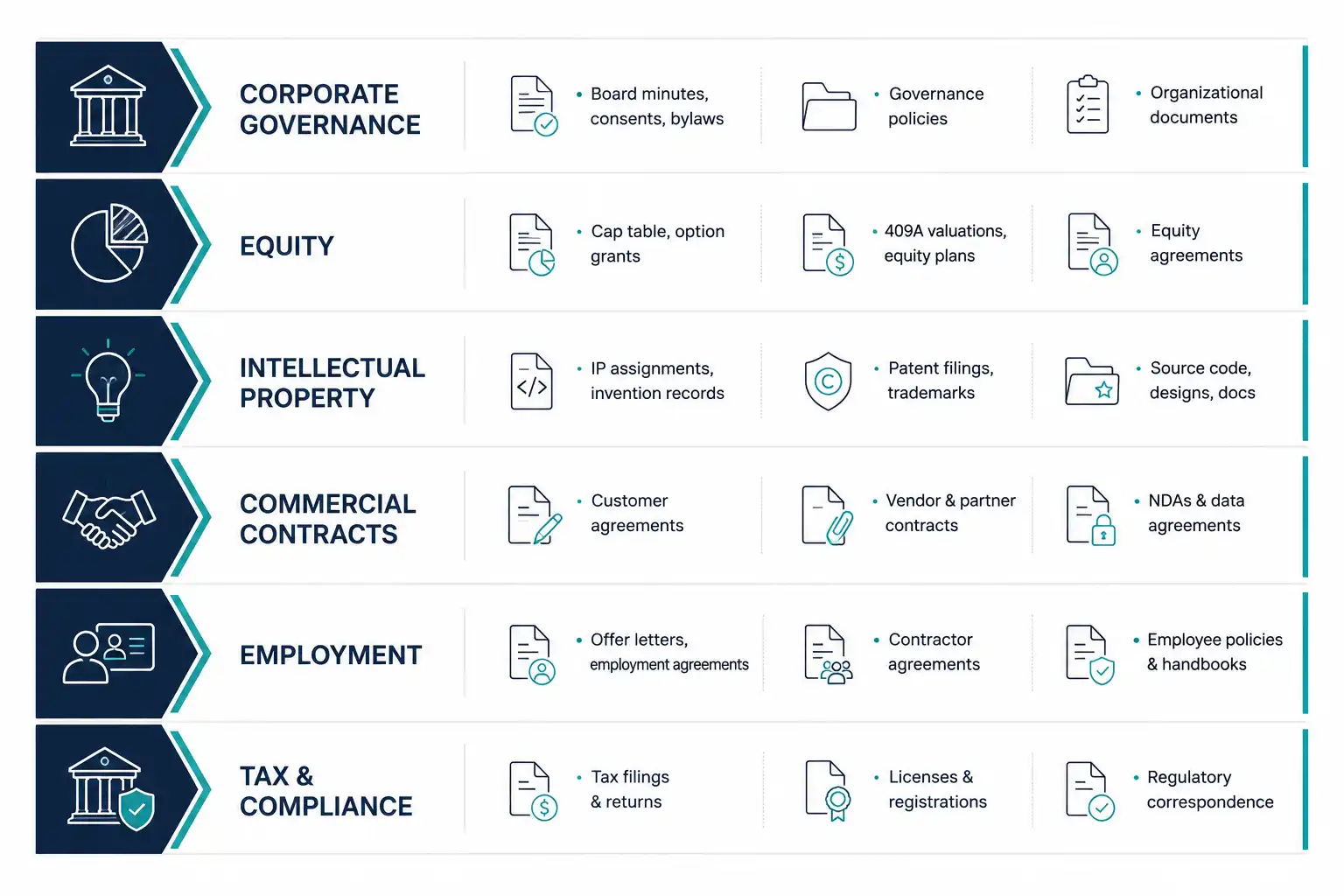
Culture is what a team repeats without anyone asking. Leaders can train a team to flag ambiguous terms and file signed documents the same week they sign them. Archiving redlines as routine, not as an afterthought, sets a pattern that scales with the company. The pattern scales with the company. When a company treats legal steps as optional, the team learns that too. The gaps widen precisely as the company grows large enough for them to matter.
Emails Are Legal Artifacts, Not Casual Conversation
Startups move fast, and email threads become the informal backbone of internal agreements, customer negotiations, and investor conversations. Few founders internalize that these threads are discoverable. Once litigation or diligence enters the picture, they can carry weight comparable to a signed contract.
That reality changes how founders should handle language. Founders sometimes promise equity in a Slack message. Others agree to a revenue share over email without follow-up documentation. Both habits create exposure. That exposure surfaces months or years later, usually at the worst possible moment. That exposure surfaces months or years later, usually at the worst possible moment. Board settings across sectors reinforce the same lesson, from a public-company board in gaming and digital entertainment to an audit committee at a mission-driven education institution. In every one, the written record settled disputes, not anyone’s recollection of what someone meant.
Teams operating with genuine legal awareness do not over-lawyer every message. They write with intention instead, recapping decisions in the same thread where they were made and confirming next steps so ambiguity has no room to grow. This habit is not paranoia. It is professionalism applied to the medium founders actually use all day, and it reduces rework and conflict more than any policy memo could.
Protecting Intellectual Property Is a Cultural Posture
Many founders assume IP protection belongs entirely to legal counsel. It does not. It shows up in onboarding, in contractor agreements, and in whether every code contribution can be traced back to a signed assignment. Startups that treat this as someone else’s job tend to discover the gap precisely when it is most expensive to close, typically while preparing for a patent filing, a fundraising round, or an acquisition.
The Cost of Deferred IP Assignment
Early engineers who join before formal IP assignment agreements exist can create ownership questions that surface years later, once those engineers have moved on and the product has matured around work whose ownership was never cleanly documented. During diligence on a Euronext-listed gaming and digital entertainment company’s cross-border acquisitions, tracing this exact kind of gap across target companies consumed a material share of the diligence timeline, time that assignment agreements made standard from day one would have avoided entirely.
Contrast that with a founder who builds the habit early. Every offer letter includes IP language. Each contractor signs a confidentiality and assignment agreement before touching a repository, and every contribution stays traceable to a named individual under a signed agreement. That founder walks into diligence with confidence instead of anxiety, because the cultural asset was built at the same time as the product.

Equity Must Be Documented, Not Merely Promised
Equity functions as the currency of trust in an early-stage company. Employees join because they believe in the upside, yet founders routinely mention percentages verbally, delay the paperwork, and never fully explain strike prices or vesting schedules. That informality is not a minor administrative lag. It is a source of cultural risk that compounds quietly until an employee discovers that a promised grant was never approved by the board or properly recorded, at which point the erosion of trust can outlast any single lawsuit.
Legal hygiene for startups around equity means explaining terms with precision, documenting grants as they happen instead of in a batch months later, and keeping the cap table current instead of reconstructing it during diligence. It means partnering with counsel to structure the option pool correctly and to maintain 409A compliance, and it means treating that work as a leadership responsibility instead of something to hand off entirely to outside advisors.
A practical hygiene checklist for equity administration includes the following steps, applied consistently instead of in occasional bursts:
- Record every option grant in writing within the same pay cycle it is approved by the board
- Reconcile the cap table on a fixed monthly or quarterly cadence, not only before a raise
- Walk every new hire through vesting mechanics and strike price before they sign
- Maintain a current 409A valuation and refresh it on schedule, not only when counsel flags it
- Archive board consents for every grant alongside the corresponding offer letter
In scaling a venture-backed digital marketing organization from $9M to $180M in revenue over twenty-four months, the customer acquisition cost and contribution margin discipline that sustained that growth ran alongside the far less visible work of standing up the company’s first audit and getting equity administration onto a defensible cadence before three acquisitions raised the stakes on every prior grant. The growth story gets the attention, but the documentation underneath it is what let the growth survive scrutiny.
Small Habits Compound into Startup Legal Compliance at Scale
None of this requires legalese. It requires rhythm. A checklist for every major corporate action, standard templates instead of one-off drafting, a routine for contract review, and a habit of archiving instead of filing away in memory alone will accelerate trust instead of slowing the company down. When a board sees every consent documented and every signature tracked, it trusts the leadership team’s judgment on matters far beyond legal process. When investors see a founder who understands indemnities and representations without needing a translator, they trust the company’s readiness for whatever comes next.
Legal Culture Is a Leadership Function
Companies that treat legal infrastructure as a side function rarely build organizations that last. The ones that do, across sectors as different as SaaS, medical devices, logistics, and consumer products, share a CEO who treats legal hygiene for startups as a growth discipline instead of a defensive one. Serving simultaneously across Finance, HR, IT, Legal, and Facilities at a mission-driven education institution made one thing unmistakable: the operational mandate of a finance leader in a lean organization extends well past the general ledger, and the instinct for documentation that satisfies a board audit committee is the same instinct that keeps equity, IP, and contracts clean.
Founders who build this posture do not see contracts as obstacles. They see them as guardrails, and they lead the legal conversations inside their companies instead of avoiding them until counsel forces the issue.
Three Key Takeaways
- Treat the data room as a living artifact instead of a fundraising deliverable, because the habit of keeping equity grants, IP assignments, and board minutes current is what determines whether diligence takes days or consumes months when the stakes finally rise.
- Recognize that email and casual internal communication carry the same evidentiary weight as formal contracts, and write with the intention that recaps decisions and confirms next steps so ambiguity has nowhere to hide.
- Build equity and IP documentation into the operating cadence from the first hire instead of the first fundraise, since the cost of repairing an undocumented promise or an unassigned invention only grows as the company scales around the gap.
Disclaimer: This article is intended for informational purposes only and does not constitute legal, tax, or accounting advice. You should consult your own tax advisor or counsel for advice tailored to your specific situation.
Hindol Datta is a four-time CFO and senior finance executive with over 25 years of leadership experience across cybersecurity, SaaS, gaming, logistics, digital marketing, medical devices, consumer products, and nonprofit organizations. He has led more than $120M in fundraising and over $150M in M&A transactions while building the financial and operational systems that let complex businesses scale with confidence. He is the author of seven books in the Systems CFO Series and holds active CPA, CMA, and CIA credentials.
AI-assisted insights, supplemented by 25 years of finance leadership experience.