Executive Summary
Boards and investors rarely ask about deferred taxes directly, yet the deferred tax liability meaning behind a balance sheet often decides whether a diligence process moves smoothly or stalls on unexplained volatility. A deferred tax liability, together with its counterpart the deferred tax asset, reflects nothing more exotic than a timing gap between what a company reports under GAAP and what it owes the tax authorities in a given year. For founders and finance leaders preparing for a raise, an audit, or an eventual sale, understanding that gap is not optional homework; it is the language investors use to judge financial discipline.
This piece walks through what a deferred tax liability actually signals, how the calculation works in practice, where valuation allowances enter the picture, and how these figures get read during fundraising and exit events. Along the way, it draws on engagements across cybersecurity, SaaS, consumer products, and public-company gaming operations, where deferred tax schedules have repeatedly served as an early test of whether a finance function has its house in order.
Understanding the Deferred Tax Liability Meaning Behind Timing Differences
A deferred tax liability arises when tax rules allow a company to defer a tax obligation into a future period, even though the expense already sits on the books today. The reverse situation produces a deferred tax asset, a future benefits the company expects to use once profitable years arrive. Neither figure is a mistake on the balance sheet; each is a marker of timing, and reading that marker correctly separates a mature finance organization from one still finding its footing.
Consider depreciation, the most common source of these timing gaps. A company might report $1M in depreciation expense under GAAP while deducting only $700K under tax rules in the same year. That $300K gap generates a deferred tax asset, because the company will claim the remaining depreciation later. Flip the mechanics, where tax rules accelerate a deduction that GAAP spreads over several years, and the result becomes a deferred tax liability instead, a future tax bill sitting quietly on the books.
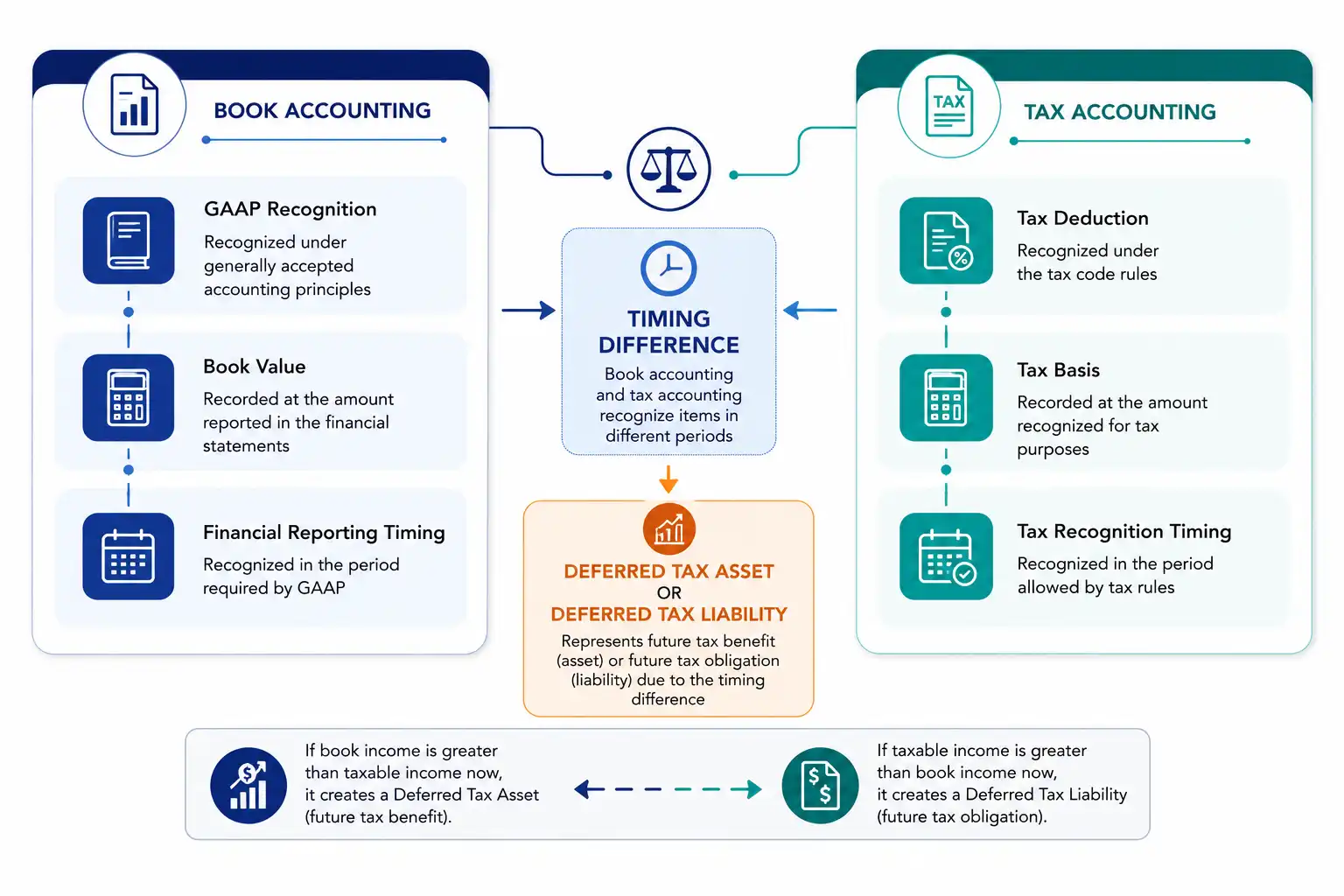
In a high-growth cybersecurity and identity access management company carrying roughly $30M in annual recurring revenue, deferred tax schedules became part of the standard board packet well before any acquirer asked for them, precisely because unexplained swings in the effective tax rate tend to draw more scrutiny than the underlying numbers deserve.
Where Temporary Differences Come From
Several timing differences recur across industries and stages, and each deserves its own line on a deferred tax schedule:
- Bad debt reserves recognized under GAAP before they become deductible for tax purposes
- Stock-based compensation, which books differently than it deducts
- Research and development credits with multi-year recognition patterns
- Revenue recognition under ASC 606, which can diverge from the timing tax rules require
- Net operating losses carried forward against future taxable income
Deferred revenue deserves a separate mention here, since founders sometimes confuse it with a deferred tax liability. Deferred revenue is cash collected for a service not yet delivered, sitting on the balance sheet as a liability until the company earns it. A deferred tax liability, by contrast, has nothing to do with cash collected; it reflects a tax obligation the company will eventually owe because of a timing mismatch between book and tax treatment. The two concepts occupy different corners of the balance sheet, though both tend to surprise less experienced founders during their first serious diligence process.
How to Calculate a Deferred Tax Liability
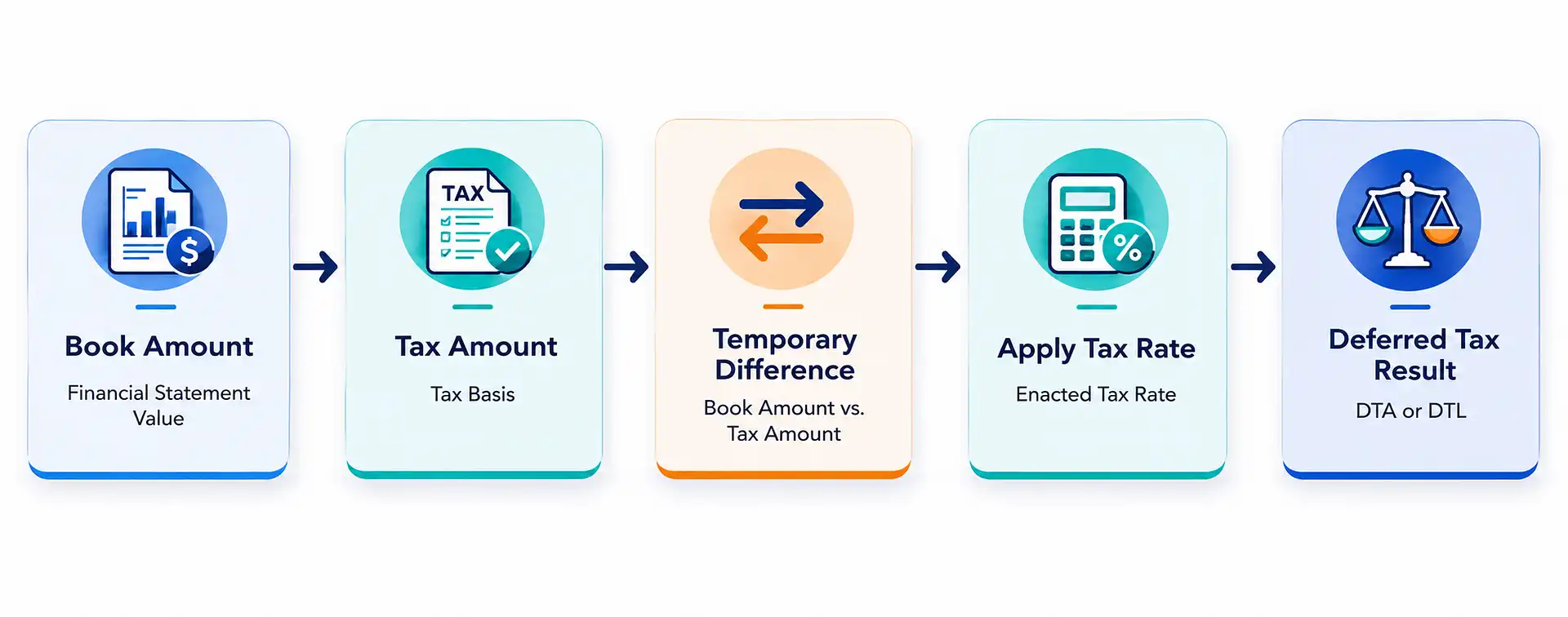
Calculating a deferred tax liability, or its counterpart the deferred tax asset, follows a repeatable process rather than a judgment call. The finance team builds a schedule of temporary differences line by line, comparing the book-based amount against the tax-based amount for each item, from depreciation to stock compensation to allowances. The difference between those two figures, multiplied by the enacted tax rate, produces the deferred tax effect for that line.
A Worked Example
| Item | Book Amount | Tax Amount | Difference | Rate | Deferred Tax Effect |
| Depreciation | $1M | $600K | $400K | 21% | $84K DTA |
A $400K gap between $1M in GAAP depreciation and $600K in tax depreciation, multiplied by the 21% corporate rate, produces an $84K deferred tax asset. Reverse the relationship, where tax depreciation runs ahead of book depreciation, and the same mechanics produce a deferred tax liability instead.
Timing does not stay fixed. Every reporting date calls for a fresh look at these balances, since new tax legislation, revised depreciation schedules, or a change in the enacted rate can all shift the numbers. During a period when Congress extended a tax credit affecting a public-company gaming operation with reporting obligations under both IFRS and US GAAP, restating the deferred tax position carried a modest cash impact but a considerable improvement in clarity, correcting the effective tax rate in a way that reassured investors ahead of an IPO-readiness review. Maintaining a deferred tax worksheet, reconciling it to cash taxes paid, and documenting every assumption behind it is what allows the numbers to survive an audit rather than merely appear plausible.
Deferred Revenue, Valuation Allowances, and the Realization Question
Not every deferred tax asset deserves a place on the balance sheet at full value. Accounting standards require an honest assessment of whether the company will actually realize the benefit, and where realization looks unlikely, a valuation allowance steps in to reserve against it.
The logic holds few surprises. A company expecting continued losses, or one whose earnings history raises doubt, should not carry a deferred tax asset at a value it cannot reasonably expect to use. A biotech-style company loaded with R&D credits and losses might report a substantial deferred tax asset, only to offset most or all of it with a valuation allowance until profitability becomes probable rather than aspirational.
When a Valuation Allowance Signals Discipline, Not Weakness
Judging a valuation allowance correctly requires weighing forecasts, historical performance, market conditions, and pending tax law changes together. In a venture-backed SaaS environment preparing for its next institutional round, a $5M deferred tax asset required a $3M valuation allowance once a five-year forecast showed only two break-even years within the projection window. Communicating that the allowance changed nothing about the cash position, only the book tax expense, turned what could have read as a red flag into evidence of conservative, credible forecasting.
Valuation allowances also shape U.S. tax filings once profitability arrives. Releasing an allowance as the company turns profitable reduces taxable income going forward, though the release itself increases current tax expense under GAAP even while cash taxes remain largely unchanged, a distinction that confuses investors unless someone explains it plainly.
Reading Deferred Tax Liability Signals During Fundraising, Audit, and Exit
Auditors and acquirers scrutinize valuation allowance reasoning closely during IPOs and M&A processes. A fully reserved deferred tax asset can raise questions if the underlying projections look overly cautious, while an unreserved asset at a company with no profit history raises the opposite concern. Handling the disclosure transparently, rather than defensively, tends to be the difference between a diligence question that closes quickly and one that lingers.
Across a $127M global consumer products company managing supply chain exposure through China and Vietnam, and separately across a Euronext Paris-listed gaming operation running consolidated reporting under both IFRS and US GAAP, deferred tax positions consistently served as a proxy for how seriously the finance function treated its own numbers. Four consecutive clean external audits at the consumer products company, and a successful S-1 preparation process at the gaming operation, both depended in part on deferred tax schedules that auditors could trace without friction.
Three Key Takeaways
- A deferred tax liability, and its counterpart the deferred tax asset, exist because book accounting and tax rules recognize the same economic event at different times, and neither figure should be treated as an error that needs explaining away.
- Deferred revenue and a deferred tax liability sit in entirely different parts of the balance sheet, the first tied to cash already collected for undelivered services, the second tied to a future tax bill created by timing mismatches, and conflating the two during investor conversations damages credibility quickly.
- Valuation allowances, when grounded in a realistic forecast and explained clearly, read as evidence of financial discipline rather than weakness, and finance teams that document their reasoning tend to move through audit and diligence processes with far less friction.
Disclaimer: This article is intended for informational purposes only and does not constitute legal, tax, or accounting advice. You should consult your own tax advisor or counsel for advice tailored to your specific situation.
Hindol Datta is a four-time CFO and senior finance executive with over 25 years of leadership experience across cybersecurity, SaaS, gaming, logistics, digital marketing, medical devices, consumer products, and nonprofit organizations. He has led more than $120M in fundraising and over $150M in M&A transactions while building the financial and operational systems that let complex businesses scale with confidence. He is the author of seven books in the Systems CFO Series and holds active CPA, CMA, and CIA credentials.
AI-assisted insights, supplemented by 25 years of finance leadership experience.