Executive Summary
Value added internal audit moves the function away from procedural inspection and toward strategic insight, treating audit as a capability that explains how an organization actually behaves rather than a cost incurred to satisfy regulators. This article describes how audit earns the standing of a trusted advisor through sharper questions, stronger talent and data, deliberate trust building, and a wider mandate.
Readers will find a practical path across self-knowledge, capability, culture, purpose, and continuous assurance, with actions a CFO can sponsor so that internal audit informs decisions about risk, capital, and performance.
Why Value Added Internal Audit Begins with Organizational Self-Knowledge
As companies scale, communication structures multiply and reporting layers stack, yet the organization grows less certain about where errors accumulate and which assumptions have hardened into risk. Internal audit is the mechanism through which a business asks whether it is what it believes itself to be, and the answer carries more strategic worth than any list of exceptions.
From Risk Avoidance to Operational Insight
Most finance leaders measure audit by the harm avoided, such as the compliance failure averted or the control weakness corrected before a regulator or external auditor arrived. That logic is defensible but incomplete, and a value added internal audit function asks what the pattern of findings reveals about how the business operates, because recurring late reconciliations in one region may point to a training gap, while persistent access control failures may expose a weak change management culture.
Experience in a cybersecurity and identity SaaS company with roughly $30M in ARR and teams across five countries supports this view. A disciplined controls environment and board-grade reporting carried that business through acquisition diligence, which showed that assurance built early becomes a commercial asset later.
Independence That Still Carries Influence
Independence is a daily negotiation rather than a ceremonial virtue. Audit must stay close enough to operations to grasp nuance yet remain far enough removed to speak without fear, funded robustly but never beholden, and reporting to the audit committee with courage. Findings should read as short accounts of how process drifts from plan, not as inventories of failure.
Building the Capability Behind a Value Added Internal Audit Function
Independence without insight delivers little, and a function that informs boardroom decisions must be multidisciplinary by design, able to think like operations, analyze like data science, and interpret like intelligence.
Talent and Skills for the Modern Audit Team
A supply chain with real-time API connections and IoT telemetry cannot be reviewed with a legacy checklist, so the skills below form the baseline.
- Process automation and ERP fluency
- Cybersecurity and identity access management knowledge
- Data science, analytics, and visualization
- Behavioral risk and third-party ecosystem management
- ESG taxonomies and ethical AI standards
The CFO should hire, rotate, and upskill audit talent with the same intent applied to core P&L functions. Secondments from operations into audit build both empathy and expertise, and pairing auditors with data science teams widens what the function can see.
Data Architecture and Technology Infrastructure
Audit belongs inside the data architecture of the company, with programmatic access to transactional systems, user activity logs, configuration histories, and third-party integrations. Manual sampling then gives way to continuous assurance, where controls are sensed rather than inspected and reconciliations are validated automatically.
A $170M global medical device manufacturer with plants across three countries illustrates the point. Standard costing, bill of materials management, and inventory controls had to withstand line-by-line scrutiny, and that regulated setting showed how much simpler assurance becomes when controls live inside the systems rather than beside them.
Audit technology deserves funding as strategic infrastructure, including analytics platforms with AI pattern recognition and live audit committee dashboards.
Connecting Findings to Strategy
Audit findings create value only when they travel into planning cycles, budget reviews, and executive discussion. The flow below shows how a single finding becomes a funding or process decision.
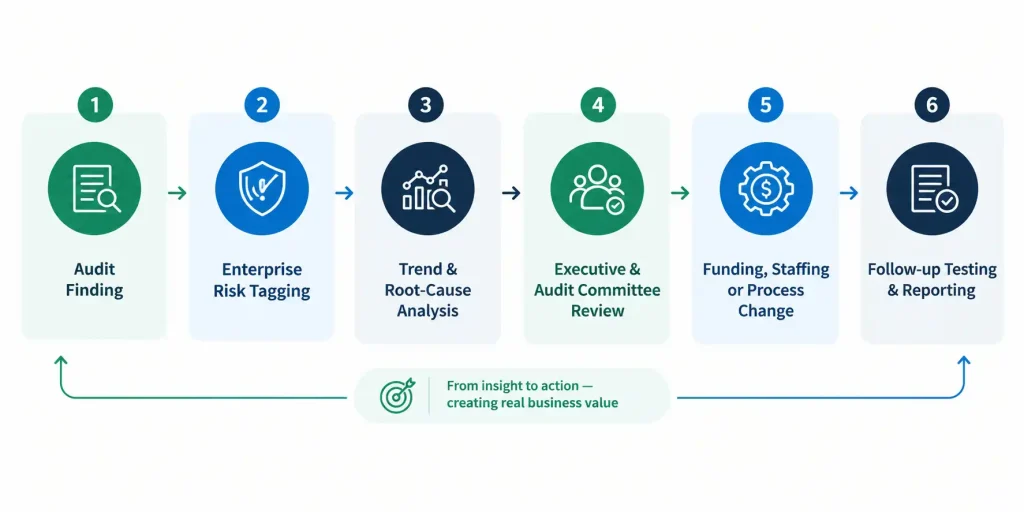
Findings tagged and trended across periods reveal which functions are chronically underfunded, which regions face unusual regulatory pressure, and which processes depend dangerously on key people.
Earning the Trusted Advisor Role Through Culture and Trust
Auditors are respected in principle but seldom embraced, and that distance limits what the function can learn, since audit depends on access and conversation that policy alone cannot compel. Trust here does not mean confidence that audit will always speak gently. It means confidence that audit will speak honestly, in a spirit of partnership rather than provocation.
Tone, Presence, and Continuity
Three habits turn a compliance function into a trusted advisor.
- Tone, written as narrative that explains misaligned incentives and overburdened processes rather than sterile control language
- Presence, with auditors joining onboarding sessions and project kickoffs to understand context
- Continuity, through stable relationships that build the relational equity needed when stakes are high
Sponsorship Without Capture
CFO sponsorship matters, yet partnership is not license, and audit must preserve its skepticism. In a mission-driven education and research institution in Silicon Valley, where the finance lead served on the executive team as an advisor to the CEO and managed audit committee engagement, credibility came from candor delivered consistently rather than from agreement.
Over time this relational trust becomes a strategic advantage, because functions begin to surface their own risks, leaders request audits for process insight rather than only for assurance, and executives treat audit as a sounding board for how complexity is aging inside their systems.
Extending Value Added Internal Audit into ESG, Ethics, and Governance
Investors, employees, and customers now expect proof of values, which makes purpose an auditable subject. This expansion is a discipline of evidence rather than a judgment of intention, and it tests whether stated commitments are encoded in operational behavior.
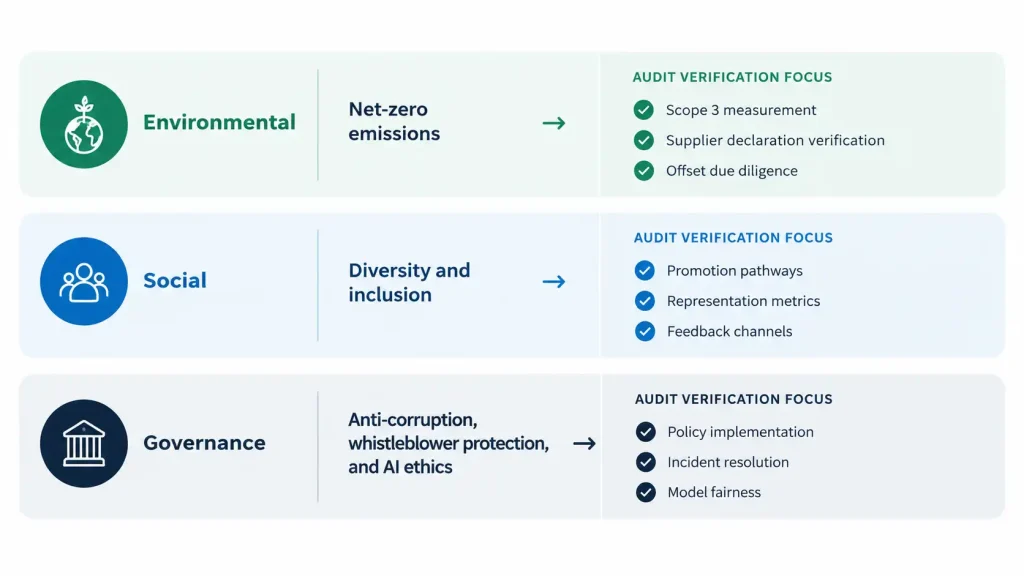
Leading firms embed these themes into process audits instead of isolated reviews, so a procurement audit examines supplier labor practices and a data governance audit checks ethical algorithm use.
Interpretation is the harder task, because tone, incentive drift, and fear that suppresses whistleblowing rarely appear in a spreadsheet. Qualitative methods such as interviews, sentiment analysis, and process mapping through the lens of integrity allow auditors to detect ethical erosion early. The function should review ESG reports before publication to substantiate them without becoming a mouthpiece for sustainability leaders. Resistance from legal or marketing teams is a sign of growing relevance, since only functions that matter are resisted.
Continuous Assurance and the Future of Value Added Internal Audit
A calendar-based plan assumes that risk waits patiently for the auditor, which is a fallacy in a fluid and interdependent enterprise. Continuous audit is therefore a philosophical shift from intermittent inspection to a standing capability for perception embedded in the firm.
Instrumentation and Systems Thinking
Modern enterprises emit telemetry from procurement, payments, access credentials, and inventory, so rule engines, exception monitors, and behavioral baselines can alert on deviation from normal patterns, while AI agents extend the reach of auditors without replacing judgment. Interpretation still depends on systems thinking, since a misconfigured access right may reflect a rushed product release and a spike in manual journal entries may follow executive turnover.
A publicly listed gaming and digital entertainment company that unified its definition of revenue across every subsidiary, reporting under both IFRS and US GAAP, shows the benefit. Embedded controls and one data standard shortened reporting cycles and gave audit something concrete to test.
Operating Model and Governance
The operating model of a value added internal audit function changes in four ways.
- The annual plan becomes a living risk map updated by signal
- Iterative insights replace long retrospective reports
- Workflow engines track remediation with clear ownership and escalation
- Audit committees review live dashboards and interpret institutional health
Intentionality guards against surveillance, because not every risk warrants constant observation, and the aim is to free judgment from latency so that insight arrives while it is still useful.
Three Key Takeaways
- Value added internal audit begins when the function treats patterns in findings as evidence of how the organization operates, which turns reports into strategic insight for the CFO and the board.
- Audit earns the trusted advisor role through capable multidisciplinary teams, embedded data access, and a consistent tone of honest partnership, supported by CFO sponsorship that protects independence.
- Extending assurance into ESG, ethics, and continuous monitoring lets audit verify purpose and surface risk early, so that controls adapt before failures reach customers, regulators, or investors.
Disclaimer: This article is intended for informational purposes only and does not constitute legal, tax, or accounting advice. You should consult your own tax advisor or counsel for advice tailored to your specific situation.
Hindol Datta is a four-time CFO and senior finance executive with over 25 years of leadership experience across cybersecurity, SaaS, gaming, logistics, digital marketing, medical devices, consumer products, and nonprofit organizations. He has led more than $120M in fundraising and over $150M in M&A transactions while building the financial and operational systems that let complex businesses scale with confidence. He is the author of seven books in the Systems CFO Series and holds active CPA, CMA, and CIA credentials.
AI-assisted insights, supplemented by 25 years of finance leadership experience.