Executive Summary
Finance automation tools promise speed, but their deeper value lies in coherence at speed. Every day between the close and real understanding lets risk compound and opportunity slip by. The CFO’s goal is to deliver financial truth faster, with fewer manual bottlenecks and less risk of a stale story.
The sections ahead explain how CFOs can use automation to reshape board cycles without overwhelming directors. They cover the cost of quarterly rhythms, automation that surfaces meaningful patterns, and automation that structures board judgment. They also address how to govern automation itself. Together they present automation as a way to free people to think, not a way to produce faster decks.
Why Legacy Board Cycles Need Finance Automation Tools
The quarterly board cycle has changed little since reporting relied on paper, mail, and hand-reconciled ledgers. It arose from what was feasible, not from what produced the best insight, and then hardened into doctrine.
The Hidden Cost of Reporting Lag
Today, weak signals can grow into structural shocks within weeks. Competitive responses take days, and customer sentiment can shift overnight. A 90-day reporting rhythm assumes change is gradual and risk announces itself early, and that assumption no longer holds.
The lag creates three distinct problems for boards and directors. First, it opens a gap between operations and oversight, so directors judge past results without current context. Second, packaging for quarterly presentation strips nuance and smooths away important variation. Third, it invites performative automation, where tools speed up packet production without improving decisions.
Automation inserted into a legacy rhythm tends to amplify that rhythm’s flaws. If the cycle stays fixed, every tool bends toward making the quarterly packet faster and neater. If leaders rethink the cycle as a continuous dialogue punctuated by moments of synthesis, automation can close the gap between action and interpretation.
None of this calls for real-time governance by the board. The boardroom is a space for synthesis, not surveillance. The CFO’s task is to decide what delay between an event and its interpretation the company can tolerate.
Event-Triggered Board Engagement
Finance automation tools make a more responsive model possible. Major divergences can trigger a focused review, and emerging anomalies can prompt a short note to directors between meetings. Imagine a CFO noting that a third straight week of data suggests margin pressure in one segment. That signal warrants attention before the next meeting.
A cybersecurity and identity SaaS company with entities in five countries shows how automation compresses reporting lag. Implementing NetSuite across five entities shortened the monthly close from 18 days to 10. A faster close gave leadership and the board more current information to act on.
Designing Finance Automation Tools as an Insight Pipeline
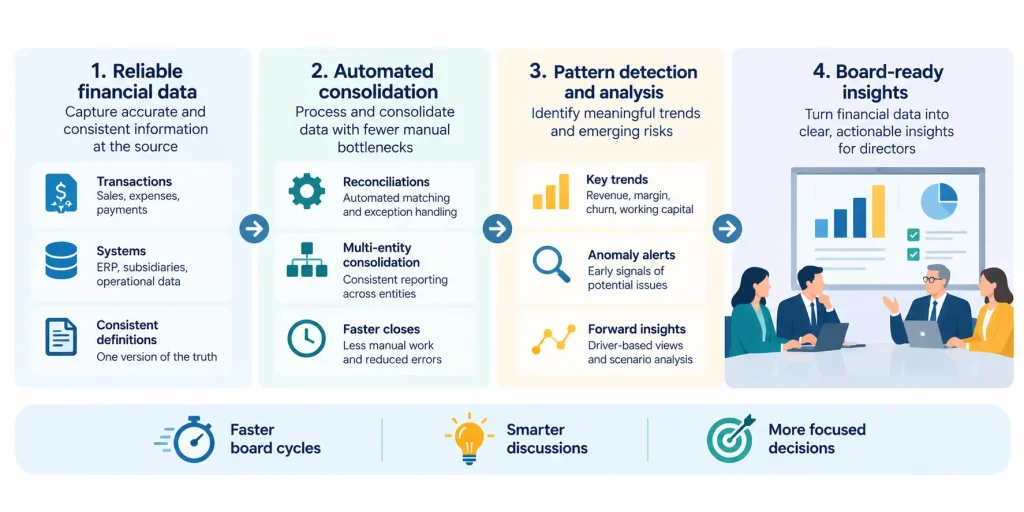
Most financial automation targets repetitive work such as journal entries, bank reconciliations, and intercompany eliminations. That work matters, because it saves time and reduces error. Yet it does not deliver the patterned insight the board needs.
Start with Data Fidelity at the Source
Financial signal degrades every time someone adjusts it by hand. Manual adjustments mark the places where operational reality and accounting diverged. Automation that depends on heavy downstream cleanup rests on weak foundations.
The cleanest signal comes from systems that capture meaning at the point of transaction. Those systems record what was sold, to whom, on what terms, and with what timing, rebate, or deferral logic. Consistent metric definitions matter just as much as clean data. If teams calculate ARR differently or treat revenue recognition as tribal knowledge, no tool can fix it.
A Euronext Paris-listed gaming company with subsidiaries in five countries shows the value of shared definitions. A firmwide rollout of Oracle Financials and MicroStrategy created a single definition of revenue across every subsidiary. That foundation made automated reporting consistent across markets.
Layers of Finance Automation Tools
| Layer | Typical Tools | What It Delivers to the Board |
| Transactional | Reconciliation, close management, and intercompany automation | Faster, more accurate closes with fewer manual adjustments |
| Consolidation and data | ERP, data integration, and shared metric definitions | One consistent version of financial truth across entities |
| Planning and analysis | Driver-based planning and rolling forecast platforms | Forward views that update as conditions change |
| Pattern detection | Variance analysis, anomaly alerts, and cohort analytics | Early signals of shifts in unit economics, churn, or working capital |
| Board narrative | BI dashboards and automated commentary drafts | Context-rich insight instead of raw data dumps |
Surface Patterns, Not Just Exceptions
Once the foundation is sound, automation can shift from completing tasks to harvesting signal. Control flags catch errors, but strategic automation should surface meaningful variance. Examples include subtle shifts in unit economics, early movement in churn, or timing distortions in working capital.
Distribution matters as much as totals in these views. Leaders need to know whether revenue grows evenly or concentrates in a few segments. They should also ask whether falling CAC reflects real efficiency or selective exclusion. Well-designed dashboards orient instead of dazzle, tracing each variance back to the actions that drove it.
Automation should also follow the company’s strategic questions instead of the reporting calendar. If the board watches burn rate, automation should show spend patterns over time, not only cash balances. If a product strategy is shifting, cohort LTV divergence becomes the signal to watch.
A pre-Series A AI governance and assurance platform shows how early this mindset can take root. Finance built an AI-first finance workflow alongside the operating model, scenario analyses, and capital strategy. Building automation in from the start supported faster decisions.
Using Board Reporting Automation to Shape Judgment
A polished board packet can still leave directors unmoved. Many companies automate delivery but fail to design how the board receives and processes information. Faster packets alone do not guarantee better board decisions.
Designing the Rhythm of Board Insight
Every board meeting is an exercise in allocating limited attention. The board exists to test beliefs, direct resources, and challenge trajectory, not to validate reports. Board reporting automation should therefore create room for structured inquiry.
The CFO can shape what directors see first, what arrives in advance, and what stays for live discussion. Automation can open the packet with changes in system behavior instead of every number. A useful opening line might note that acquisition cost held steady while lifetime value fell, which suggests weaker renewal behavior.
Balancing Automation and Human Judgment in Board Cycles
| Board Need | Role of Automation | Role of the CFO and Directors |
| Monthly performance pulse | Automated scorecards and variance summaries | Review trends and flag areas for deeper discussion |
| Emerging risk signals | Threshold-based alerts between meetings | Decide whether a signal warrants off-cycle dialogue |
| Quarterly board packet | Pre-built packet sequenced by strategic theme | Interpret causes and frame decisions for the meeting |
| Strategic debates | Scenario models and supporting data on demand | Weigh market entry, pricing, and culture through live debate |
Sequencing also shapes how directors absorb and use information. Packets can move from system health to validation of key assumptions to directional decisions. Organizing insight by strategic theme instead of by department helps directors think about the business as a whole.
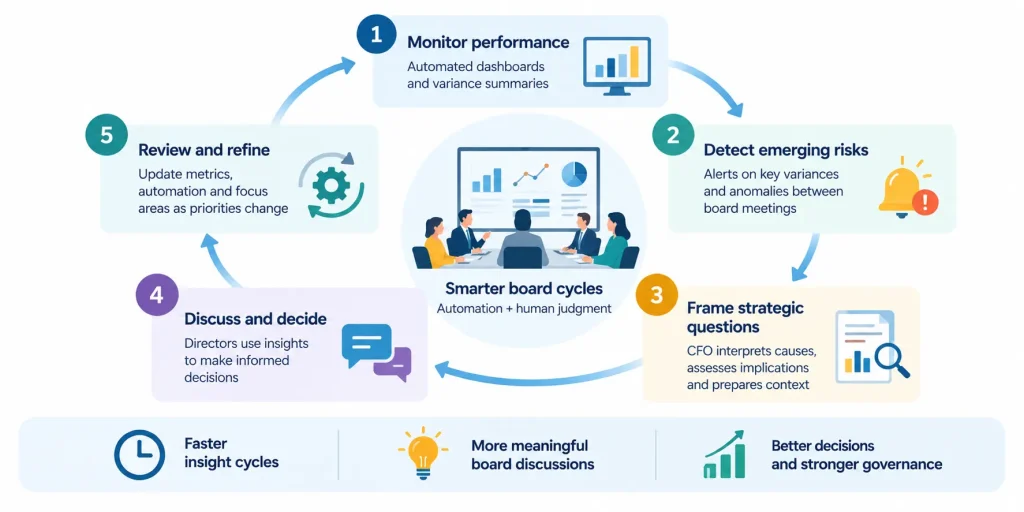
The CFO must also decide what not to automate. Decisions about entering a new market, debates over pricing power, and early signs of cultural strain need human discussion. No dashboard captures tone, hesitation, or doubt in the room.
Between meetings, short curated updates can keep interested directors informed without operational overload. A brief note that a shift in customer mix may become material over time builds a habit of preemptive governance.
A Silicon Valley education and research institution shows the value of disciplined board communication. Finance reported to the board and audit committee while overseeing Finance, HR, IT, Legal, and Facilities. Timely reporting supported oversight across a complex structure.
Governing Finance Automation Tools
Automation can reshape the organization that adopts it. When dashboards refresh nightly, teams may react to every movement instead of reflecting on what it means. Fragmented judgment can then pass for agility across the team.
Guardrails for Responsible Automation
Every automation encodes a view of what matters. Choices about what to measure, when to display it, and how to group it define the edges of organizational attention. CFOs should ask whether automated metrics reflect real enterprise health or only convenience.
Several guardrails help keep automation aligned with its purpose:
- Maintain an automation inventory that records each automation, its purpose, its start date, and its assumptions
- Review automations each quarter to retire or revise those built for an outdated business model
- Separate detection from judgment, so faster alerts do not trigger rushed decisions
- Protect space for teams to examine anomalies without fear of blame
- Watch for teams gaming dashboards instead of improving underlying performance
A venture-backed digital marketing company that grew finance from a single hire to a team of 12 shows why governance must scale with growth. That team completed the company’s first audit while supporting three acquisitions. Strong controls and clear ownership kept reporting reliable as complexity increased.
Finance automation tools, governed well, help the company see itself more truthfully. Governed poorly, they help it move faster in the wrong direction.
Three Key Takeaways
- Finance automation tools create the most value when they close the gap between events and board understanding, not when they only speed up packets.
- Effective automation starts with clean source data and shared definitions, then surfaces meaningful patterns aligned with the board’s strategic questions.
- Board reporting automation works best when the CFO designs the rhythm of insight, reserves key debates for human judgment, and governs the automation itself.
Disclaimer: This article is intended for informational purposes only and does not constitute legal, tax, or accounting advice. You should consult your own tax advisor or counsel for advice tailored to your specific situation.
Hindol Datta is a four-time CFO and senior finance executive with over 25 years of leadership experience across cybersecurity, SaaS, gaming, logistics, digital marketing, medical devices, consumer products, and nonprofit organizations. He has led more than $120M in fundraising and over $150M in M&A transactions while building the financial and operational systems that let complex businesses scale with confidence. He is the author of seven books in the Systems CFO Series and holds active CPA, CMA, and CIA credentials.
AI-assisted insights, supplemented by 25 years of finance leadership experience.