
Executive Summary
Many leaders describe corporate governance as a culture or a set of values posted on a wall. In practice, it works as a system with inputs, reviews, limits, and feedback loops. Financial reporting controls give that system its spine. They decide how money moves, who approves it, and how the company knows its numbers are true.
The sections ahead explain how controls become the grammar of governance and why they enable speed instead of blocking it. They also cover how controls clarify accountability and shape the way investors and regulators see the company. The final section explains why their value compounds over time. Together they show why the CFO should treat control design as the foundation of trust.
How Financial Reporting Controls Shape Corporate Governance
Governance asks who makes decisions, on what basis, with which guardrails, and who answers when results go wrong. Mission statements cannot answer those questions on their own. Financial reporting controls answer them through daily practice.
Controls as the Memory of the Firm
Every number in a financial statement records something the company did or chose not to do. Controls determine which of those records leaders can rely on. They confirm that a sale was a sale, that a cost had a purpose, and that an accrual reflects reality instead of hope.
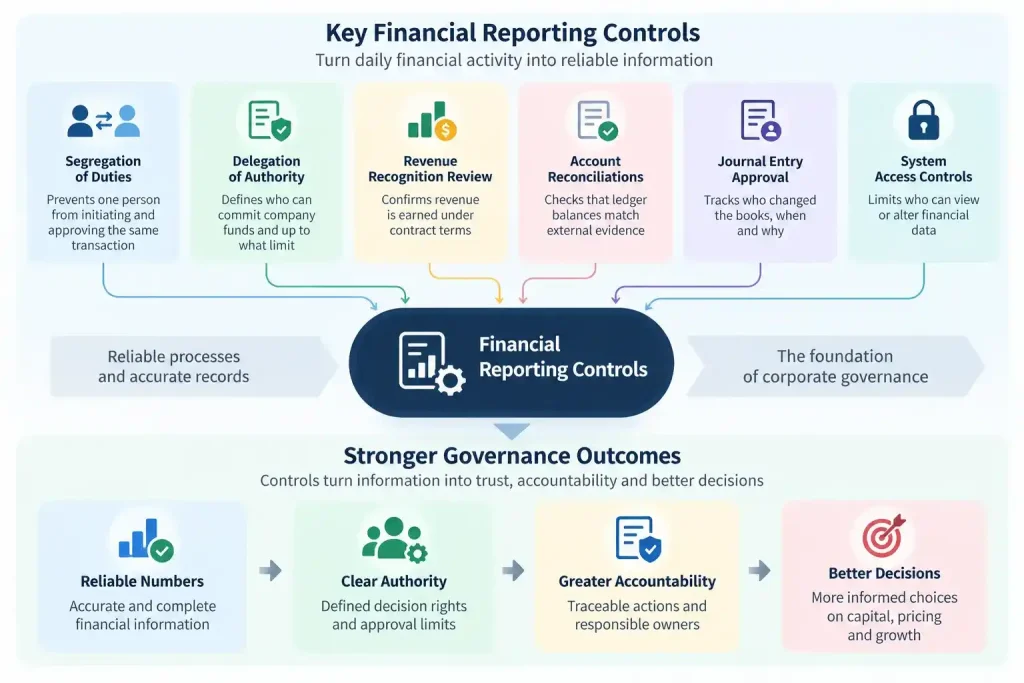
Core Controls and the Governance Questions They Answer
| Control | Governance Question It Answers |
| Segregation of duties | Can one person both initiate and approve a transaction? |
| Delegation of authority | Who may commit company funds, and up to what limit? |
| Revenue recognition review | Did the company earn this revenue under its contracts? |
| Account reconciliations | Do the ledger balances match external evidence? |
| Journal entry approval | Who changed the books, when, and why? |
| System access controls | Who can view or alter financial data? |
Without reliable controls, budgets turn into guesswork and forecasts turn into narrative fiction. Board materials then become performances, and decisions on capital, pricing, and compensation drift toward misjudgment. Controls do not prevent every failure, but they prevent self-deception.
Controls must also evolve as the company grows. A process that worked at $50M in revenue can break quietly at $300M as approvals lag and journal entries depend on memory. The risk at that stage is not always fraud; more often it is fog, and fog is the enemy of corporate governance.
How Controls Break as Companies Scale
| Warning Sign | Underlying Cause | Governance Response |
| Approvals lag behind activity | Workflow built for a smaller team | Redesign the approval matrix by role and risk |
| Manual journal entries multiply | Systems not integrated across entities | Automate recurring entries and add review gates |
| Close cycles stretch out | Inconsistent processes across units | Standardize the close calendar and checklists |
| Access rights outgrow roles | Permissions not updated as people move | Review ERP access on a fixed schedule |
A cybersecurity and identity SaaS company with entities in five countries shows the value of scaling controls on purpose. Its operations spanned the United States, Canada, Mexico, India, and Nepal. Implementing NetSuite across five entities shortened the monthly close from 18 days to 10. ASC 606 revenue recognition policies and audit-ready reporting supported that structure.
Financial Reporting Controls as the Infrastructure of Speed
Many fast-growing companies believe that governance slows them down. The belief usually shows up in small exceptions, such as early spending authority for a new hire. A vendor signed on a handshake is another common example. Each shortcut feels harmless, yet together they build a culture of exemption that mistakes informality for agility.
Calibrated Freedom
A race car can travel fast only because it can stop and turn with confidence. Companies with strong corporate governance work the same way. Financial reporting controls do not tell a product team what to build. They define how money moves, who owns it, and what its release requires. Once people know those lanes, they can act without asking permission for every move.
The highest-functioning organizations tend to have the most clarity, not the most flexibility. A team leader in such a company can explain the delegation of authority policy, and a regional manager knows the threshold for capitalizing costs. During a product push or pricing overhaul, these teams move faster because they do not pause to learn the rules.
Controls can also overreach, as when every expense needs three signatures or budget revisions take a full quarter. Strong CFOs treat control design like user experience. They walk the process, find unnecessary friction, and keep only the scaffolding that trust requires. Effective controls within a sound corporate governance framework tend to share several traits:
- Sized in proportion to the risk they are meant to address
- Embedded in everyday tools and automated wherever possible
- Visible to the people who use them without feeling punitive
- Reviewed and updated on a schedule as the business changes
How Corporate Governance Clarifies Accountability
Many companies invoke accountability only after something goes wrong, usually as a search for someone to blame. In well-governed companies, it works differently, because leaders design it into the structure in advance. Financial reporting controls reveal who signs journal entries, who approves purchase orders, and who validates contract terms.
From Blame to Ownership
Unclear accountability causes more confusion than malice or incompetence. When a budget misses, leaders ask who owned the forecast, and when a supplier overruns, they ask who signed the purchase order. Companies with vague controls spiral into finger-pointing, while those with active controls find answers and corrections quickly.
Controls also build sound judgment across every level of the organization. A manager who approves expense reports learns what counts as reasonable. A product head who defends capitalization decisions in monthly reviews comes to understand long-term ROI. Over time, these habits create a culture where leaders know how to account as well as how to inspire.
Visibility completes the picture of accountability for each team. Dashboards, approval trails, and shared metrics let people see the downstream effect of their choices. The result is alignment instead of shame, because the system does not demand perfection; it demands clarity and ownership.
Projecting Integrity to Investors and Regulators
Investors may listen to the forecast, but they believe the balance sheet. Regulators scrutinize the ledger, and board members trust the structure beneath the narrative. Over time, documented policies, reconciliations, audit trails, and access logs become the grammar of reputation.
Integrity Under Pressure
Perceptions of integrity form when pressure arrives, not during quiet quarters. Consider a company whose bookings fall sharply after a regulatory change in its largest market. Suppose revenue recognition stays rigorous, accruals stay conservative, and the audit committee hears the news in real time. In that case, the board and investors tend to stay aligned. Recovery can then begin with planning instead of crisis management.
A $127M global consumer products company with operations spanning China and Vietnam shows how consistent controls earn external trust. The business achieved four clean audits while managing a complex supply chain and multiple sales channels. That track record supported $12M in growth financing and strong lender relationships.
Markets tend to reward predictability in corporate governance more than perfection. Companies that review approval matrices each year, update ERP permissions as roles change, and document policy exceptions openly build confidence with every cycle. That confidence buys time in downturns and patience when innovation runs behind forecast.
The Compounding Return of Strong Corporate Governance
Financial reporting controls seldom earn praise in strategy meetings. Yet companies that survive restatements, audits, and board reckonings often owe their resilience to them. Strong controls do not prevent hard quarters or layoffs, but they help a company move through volatility without losing trust.
Resilience, Continuity, and Psychological Safety
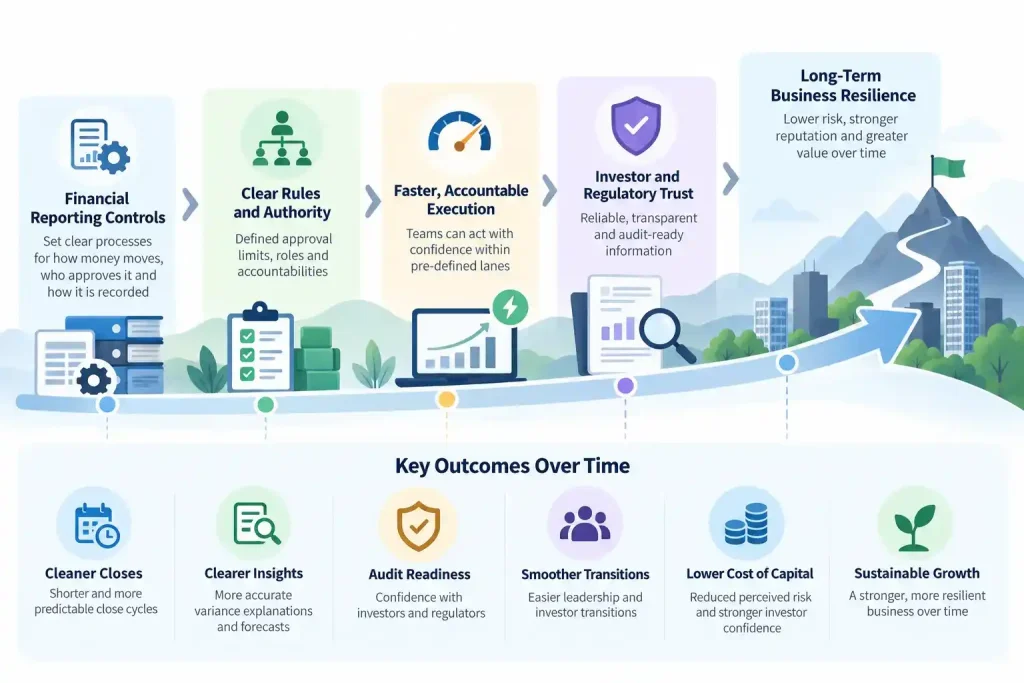
The value of strong controls shows up in several ways over time:
- Faster and cleaner closes that free finance to focus on analysis
- Clear variance explanations when investors call during a downturn
- Audit findings that reveal adjustments instead of evasions
- Smooth handoffs when new leaders inherit a system instead of a mess
- Lower perceived risk, which can reduce the cost of capital
Controls also create psychological safety inside the company. When approvals follow process instead of personality, people understand expectations and can take thoughtful risks. Institutions built this way outlast founders and business cycles, because they retain what the company learns.
A Euronext Paris-listed gaming company with operations in five countries illustrates this continuity at scale. Finance there maintained reporting under both IFRS and US GAAP and led S-1 and IPO readiness work. A team of more than 15 professionals kept controls consistent across borders as the company grew through more than $100M in M&A.
Corporate governance, in the end, is what a company insists on when no one is watching. Financial reporting controls make that insistence visible and repeatable. For the CFO, designing them is a way of shaping the company’s long-term character.
Three Key Takeaways
- Corporate governance works as a system, and financial reporting controls give it structure by defining approvals, reconciliations, and access.
- Well-designed controls speed up execution by clarifying authority, and they build accountability that focuses on ownership instead of blame.
- Consistent controls earn trust with investors, lenders, and regulators, and their value compounds through cleaner audits, smoother transitions, and resilience under pressure.
Disclaimer: This article is intended for informational purposes only and does not constitute legal, tax, or accounting advice. You should consult your own tax advisor or counsel for advice tailored to your specific situation.
Hindol Datta is a four-time CFO and senior finance executive with over 25 years of leadership experience across cybersecurity, SaaS, gaming, logistics, digital marketing, medical devices, consumer products, and nonprofit organizations. He has led more than $120M in fundraising and over $150M in M&A transactions while building the financial and operational systems that let complex businesses scale with confidence. He is the author of seven books in the Systems CFO Series and holds active CPA, CMA, and CIA credentials.
AI-assisted insights, supplemented by 25 years of finance leadership experience.