
Executive Summary
Board presentation best practices start with a simple truth: directors want meaning, not just numbers. In thirty or forty minutes, a CFO must turn sprawling financial complexity into a clear account. That account should show where the company stands and where it is heading. A perfectly accurate board package can still be forgettable if it lacks a point of view.
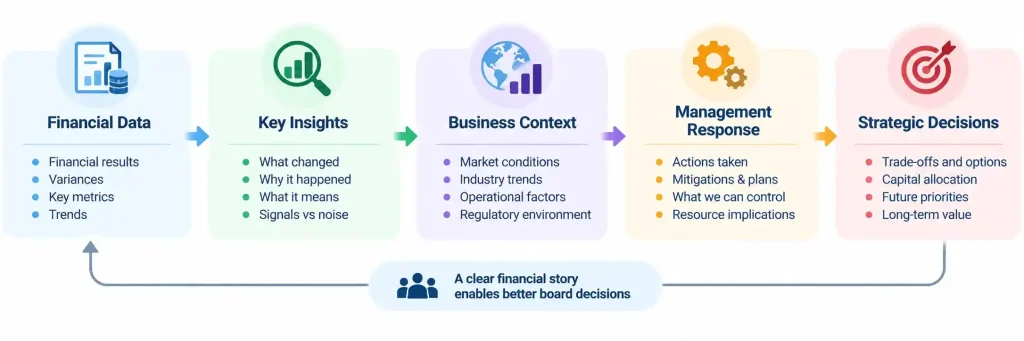
The sections ahead explain how financial storytelling makes board presentations more effective. They cover how boards listen and remember, how to structure the narrative, and how to design visuals that argue instead of decorate. They also address the CFO’s voice and the integration of data, operations, and strategy into one coherent story. Together they show the board presentation as an act of stewardship, not performance.
Understanding the Board as an Audience
A board is a collective of experienced operators, investors, and advisers. Directors do not live in the monthly variances; they watch a story that plays once a quarter and judge it against years of memory. Effective presentations start by respecting that vantage point.
What Directors Remember and What They Forget
Boards remember inflection points: a sharp swing in margins, a missed guidance, a surprise win, or a moment when the trajectory seemed to tilt. They seldom recall the exact SG&A change from one quarter to the next. Detail matters only when the CFO frames it as signal instead of noise.
Directors also tend to listen in a consistent sequence. They want to know what the market and the company are doing and how those two realities meet. Then they want the CFO’s view of what comes next. That final element separates an interpreter from a reporter.
Boards are wary of overconfidence, so the best language combines probability with conviction. A CFO might note early signs of price erosion in one segment and explain that assumptions have moved down. The CFO can add that two containment plans are ready if the trend accelerates. That kind of language sounds measured, reasoned, and actionable.
In the boardroom, tone carries as much weight as content. Clear speakers use fewer acronyms and define their terms. A CFO who explains margin erosion in thirty words instead of three slides earns more trust than one who displays mastery through density.
A mission-driven education and research institution in Silicon Valley offers a useful reference. Finance leadership there reported to a board and audit committee while overseeing Finance, HR, IT, Legal, and Facilities. Regular board engagement in that setting required clear communication across many functions and funding conditions.
Structuring the Financial Narrative
A strong board presentation unfolds instead of overwhelming. It moves in arcs, not lists, and each section prepares the board for the next. Structure is one of the most important board presentation best practices, because it shapes what directors notice.
A Proven Sequence for Board Presentations
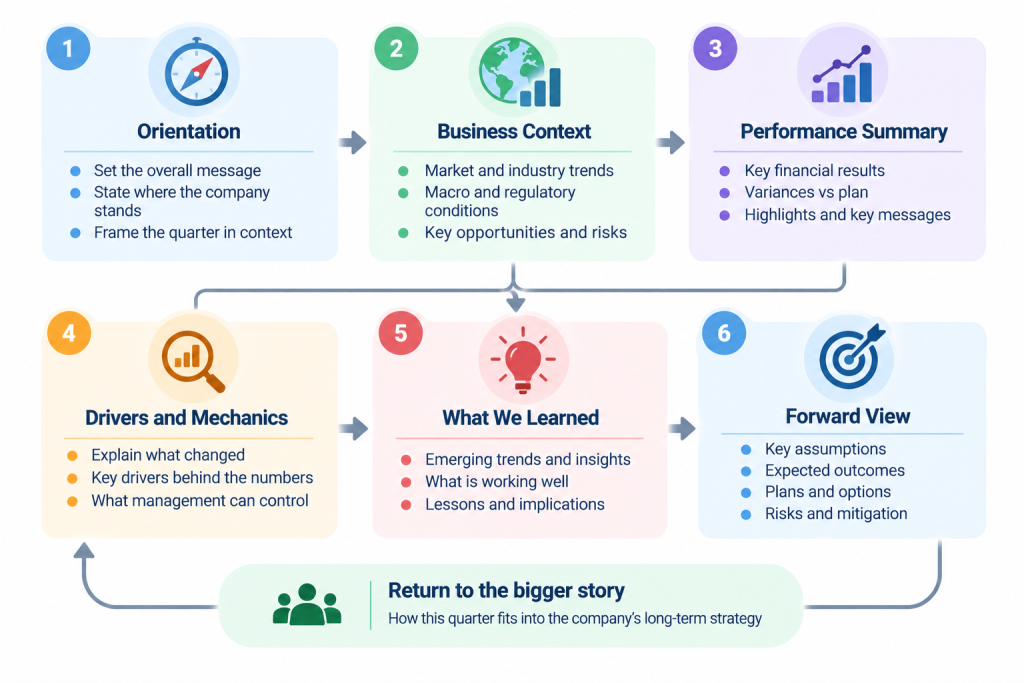
Most effective board presentations follow a consistent sequence that moves from orientation to forward view.
The Structure of an Effective Board Presentation
| Section | Purpose | Example Framing |
| Orientation | Sets the lens for everything that follows | This was a strong quarter given softer demand in two regions |
| Context | Explains market, macro, and regulatory conditions | Freight costs eased early, then rose sharply late in the quarter |
| Performance summary | States key messages before detail | Revenue grew 4.6% in constant currency, led by North America |
| Drivers and mechanics | Explains the causes behind the numbers | Margin fell 110 basis points on product mix and freight costs |
| Recognition | Shares what the company is learning | Customers are delaying renewals to align with budget cycles |
| Forward view | Lays out assumptions and expected outcomes | Guidance assumes stable FX and modest input cost relief |
| Return to the arc | Places the quarter in the company’s longer story | Risk profile is lower than last quarter despite slower growth |
The drivers section deserves special care from finance. Consider a sentence explaining that gross margin contracted 110 basis points on an unfavorable mix shift and higher freight costs. If it adds that pricing discipline partly offset the decline, it answers three questions at once. It states what happened, explains why, and signals what management can control.
The forward view should begin with assumptions, not outcomes. Directors want to understand the logic behind guidance, including beliefs about currency, input costs, and demand elasticity. The structure of belief matters more than the belief itself.
A marketplace SaaS company with operations in the United States and Poland shows the value of a clear structure. Consolidated cross-border reporting and cohort and unit economics models anchored investor diligence during a $20M Series B. Investors could follow the story because the numbers followed the drivers that mattered.
Designing Visuals That Argue
Many board decks treat charts as decoration or as a way to fit more data onto a page. Tiny fonts, crowded axes, and confusing colors push interpretive work onto directors. Effective visuals do the opposite: they turn description into recognition.
Intent, Coherence, and Comparison
The first principle for board visuals is intent. If the presenter cannot state a chart’s takeaway in one sentence, the chart is not ready. The second is coherence, so each visual should show at a glance what the board is seeing. It should also make clear how large the movement is and why it matters.
Weak Versus Strong Board Visuals
| Element | Weak Visual | Strong Visual |
| Purpose | Shows all available data | Makes one clear point |
| Labels | Abbreviations and unlabeled bars | Plain-language labels such as FX headwinds or pricing uplift |
| Comparison | Single figure in isolation | Actual against budget, prior year, or guidance |
| Sequencing | Random order of items | Ordered by size or by what management controls |
| Narration | Presenter reads the slide aloud | Presenter points to the insight and explains its cause |
A revenue bridge illustrates the difference between the two. Unlabeled bars invite guesswork, while bars labeled in plain language and ordered by controllability turn the chart into an argument. Financial truths are relational, so comparison against budget, prior year, or guidance gives numbers meaning.
Several practical habits strengthen the visuals in a board deck:
- Storyboard the deck as a sequence of scenes before building slides
- Split complex ideas into a trend slide, a driver slide, and an implication slide
- Use color to carry meaning instead of serving as decoration
- Leave out data that does not support a decision
Sometimes the strongest choice is no visual at all. A CFO who pauses and speaks directly about a region or customer trend can convey judgment that a slide cannot.
The CFO’s Voice in the Boardroom
Voice in the boardroom is not about style or polish. It is the combination of clarity, judgment, and integrity that makes directors trust what they hear. In volatile periods, boards seek composure more than charisma.
Confidence, Humility, and Candor
Strong financial voices speak confidently about what is known and humbly about what is not. Stating that the full downstream impact is still unclear, while naming the indicators under watch, earns more trust than bullish projection. This mirrors how scientists present findings, with assumptions stated and error bars visible.
Candor matters most when results disappoint the board. Imagine a CFO facing a serious earnings miss caused by overly optimistic ramp assumptions for a new product. Owning the mistake, explaining what the team learned, and describing how the pattern will change can deepen the board’s faith in management. Defensive slides and blame tend to do the opposite.
Careful language can also reframe a difficult debate. A phrase such as “optimizing for strategic optionality instead of growth at any cost” shifts the discussion from targets to philosophy. Every capital proposal and working capital policy reflects a theory about time, risk, and value. The CFO’s role is to make that theory explicit.
A venture-backed digital marketing company that raised $36.5M across three funding rounds offers a relevant example. Rigorous analysis of CAC, LTV, and contribution margin supported each conversation with investors and the board. Clear financial communication helped sustain confidence through rapid growth and three acquisitions.
Integrating Financial Storytelling With Strategy
The final step in board presentation best practices is integration. Pricing decisions, inventory builds, headcount, and discounting all express a single evolving story. The CFO’s task is to present that story with fidelity and vision.
Leading the Board Through a Volatile Quarter
Picture a quarter marked by swinging input prices, a competitor’s price war, and a key client signaling restructuring. Instead of opening with results, the CFO might describe how the organization moved from surprise to adaptation and finally to clarity. The presentation then walks through the market, the company’s response, and the numbers that resulted.
The close matters as much as the opening. Ending with a strategic question, such as which investments will hold their value under continued uncertainty, invites directors to think alongside management. The board then shifts from auditing results to co-navigating the future.
Financial storytelling, practiced this way, is not spin. It is the discipline of making complexity understandable without distorting it. Quarter after quarter, it helps the board and the company see the business with greater precision.
Three Key Takeaways
- Board presentation best practices begin with understanding how directors listen: they remember inflection points and value probabilistic, candid interpretation.
- A clear sequence from orientation to forward view, supported by visuals with one clear point each, turns data into decision support.
- A composed, honest voice and an integrated story across market, operations, and finance make the CFO the board’s most trusted interpreter.
Disclaimer: This article is intended for informational purposes only and does not constitute legal, tax, or accounting advice. You should consult your own tax advisor or counsel for advice tailored to your specific situation.
Hindol Datta is a four-time CFO and senior finance executive with over 25 years of leadership experience across cybersecurity, SaaS, gaming, logistics, digital marketing, medical devices, consumer products, and nonprofit organizations. He has led more than $120M in fundraising and over $150M in M&A transactions while building the financial and operational systems that let complex businesses scale with confidence. He is the author of seven books in the Systems CFO Series and holds active CPA, CMA, and CIA credentials.
AI-assisted insights, supplemented by 25 years of finance leadership experience.