
Executive Summary
Many companies treat talent management and financial accountability as separate disciplines. Finance builds capital plans and controls risk, while human resources manages hiring, development, and promotion. Yet capital and people move together, and managing one without the other misreads how organizations create value.
The sections ahead explain how CFOs can connect financial structures to talent outcomes. They cover incentives as signals of what the company values, capital plans as talent architecture, and human bottlenecks that limit throughput. They also address the ethics of advancement and selection. Together they present the CFO as an architect of incentive design, not only a guardian of budgets.
Incentives as Signals in Talent Management
Incentives are never neutral inside a growing organization. They encode beliefs in compensation plans and tell employees what matters and what they can safely ignore.
What Pay Plans Actually Communicate
Pay people for volume, and they will deliver volume, sometimes at the cost of trust. Reward cost reduction alone, and product or service quality may suffer. Reward novelty, and teams may produce ideas that never scale. Incentives reliably produce behavior, but not always shared understanding.
Consider a newly acquired unit given a bonus plan tied tightly to quarterly revenue. By the second quarter, revenue climbs, but so do customer returns and employee burnout. Mid-level leaders begin leaving because they sense the game but not the purpose. The plan meets its financial goal while failing as a human system.
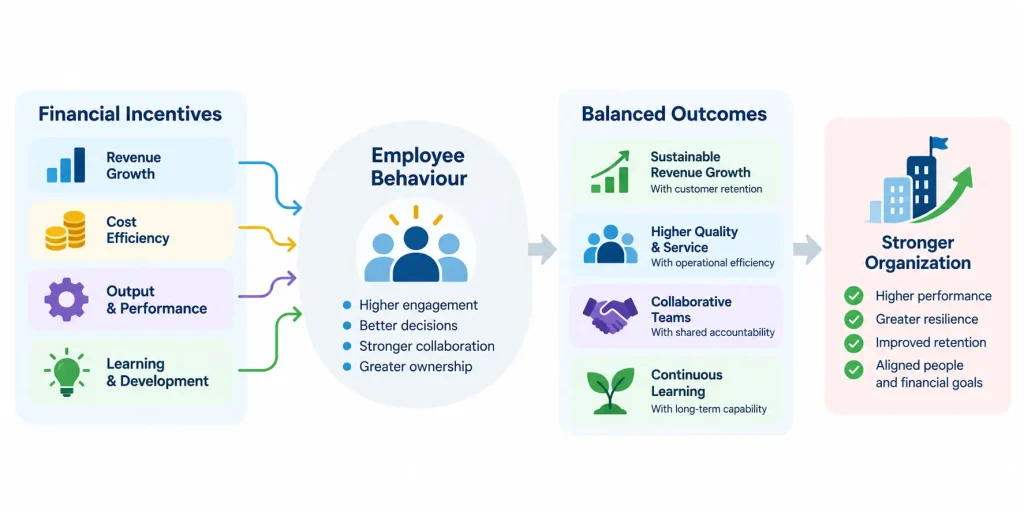
Game theory explains a common result inside companies. Employees watch one another, interpret signals, and optimize their own position. When incentives conflict and decision rights stay unclear, the stable outcome is often polite mediocrity, where safety beats excellence.
Incentive Design and Its Effect on Behavior
| Incentive Focus | Likely Unintended Behavior | Better-Balanced Design |
| Quarterly revenue only | Discounting, pull-forward deals, and burnout | Revenue paired with retention and customer health |
| Cost reduction only | Underinvestment in quality and capability | Cost targets paired with quality and service measures |
| Output volume | Short-term expediency over ownership | Output paired with process quality and peer feedback |
| Predictability | Suppressed experimentation | Room for tested learning goals alongside targets |
| Individual heroics | Weak collaboration and knowledge hoarding | Team and enterprise contribution measures |
Designing Incentives That Build Coherence
Well-designed incentives align individual ambition with company purpose. One approach ties part of a bonus to learning goals that teams define each quarter. Teams then assess whether that learning improved decisions. Over time, reviews become more rigorous, and talent often emerges from unexpected places.
This approach does not mean vague or subjective pay. It requires precision about meaning, rewarding process and judgment as well as results. Leaders should also update incentives as evidence changes, because frozen plans breed cynicism.
A venture-backed digital marketing company that grew finance from a single hire to a team of 12 shows the value of deliberate talent building. That team supported revenue growth from $9M to $180M, three acquisitions, and the company’s first audit. Building capability alongside growth required clear roles and expectations at every stage.
Capital Plans as Talent Management Architecture
A budget reveals what a company believes about its people and its talent management priorities. Vision statements can praise collaboration and growth, but resources show where conviction lies. If a company does not fund the development of its people, it does not believe in it.
Talent as a Probabilistic Asset
Traditional capital planning sees talent only as salaries, headcount, and training line items. The real drivers sit elsewhere, in the time for coaching, the bandwidth for experimentation, and the space for mentorship. These are investments, yet their returns resist easy attribution, so budgets often ignore them.
People grow unevenly, with spurts, plateaus, and sudden leaps. A junior analyst may appear marginal in one quarter and prove critical in the next. Talent management and capital models should account for that lag between investment and return instead of demanding immediate results.
Budgeting for Optionality
Real options theory offers a useful lens for talent decisions. When a company funds coaching, secondments, or stretch roles, it buys options on future value. Some options expire unused, while others become invaluable, and their value rises in volatile environments.
Imagine a company deciding whether to fund an engineering rotation program without clear near-term returns. Earlier experience suggests such rotations improve retention and cross-functional problem-solving. Eighteen months later, a rotated engineer leads a platform redesign that cuts major costs. The plan did not predict that outcome, but it made the outcome possible.
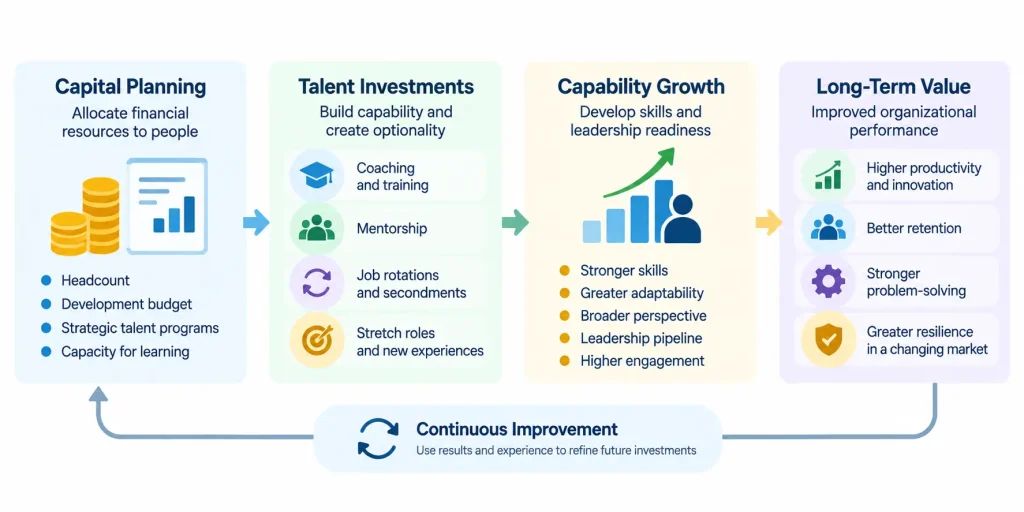
Talent Investments as Real Options
| Investment | Near-Term Cost | Potential Long-Term Value |
| Coaching and mentorship | Leader time and reduced short-term output | Faster readiness for larger roles |
| Secondments and rotations | Temporary productivity dips | Cross-functional insight and stronger retention |
| Stretch assignments | Higher execution risk | Accelerated leadership development |
| Protected learning capacity | Capacity not assigned to delivery | Faster onboarding and more adaptive solutions |
| Lateral career tracks | Added pay bands and planning effort | Retention of deep specialists who should not manage |
A Euronext Paris-listed gaming company with operations in five countries shows why talent investment matters across borders. Finance led a team of more than 15 professionals while supporting more than $100M in cross-border M&A. Integrating people and practices across markets required sustained investment in capability.
Human Bottlenecks and Organizational Slack
Human limits, not technical ones, often create the most consequential bottlenecks in any enterprise. A stalled conversation, a misaligned incentive, or a premature promotion can halt progress faster than any system failure. Strategies dissolve when plans move faster than the people charged with delivering them.
Why Removing All Slack Backfires
Industrial thinking treats idle time as waste and unallocated budget as an invitation to overspend. Human systems do not work like assembly lines. They accumulate stress, degrade unevenly, and recover only with space. Removing all slack makes organizations brittle, not more productive.
Eliyahu Goldratt’s theory of constraints holds that a system’s narrowest point limits its output. In talent management, that constraint is often a team lead with too many reports or an executive with no time to think. If leaders do not surface these limits, they end up optimizing around them.
Human throughput measures how fast an organization turns insight into action and mistakes into learning. Some companies protect a fixed share of team capacity for development, such as shadowing a colleague or testing a new tool. Teams with that protected capacity often onboard new members faster and retain high performers longer.
Lagging effects make these bottlenecks hard to see. A high performer promoted too early may cope today but fail to develop successors. A manager burning out slowly may deliver each quarter while weakening team stability. The CFO should ask whether plans optimize for this quarter or for long-term resilience.
A cybersecurity and identity SaaS company with more than 230 employees across five countries shows the value of capacity discipline. Finance helped hold bench utilization under 5% to 7%. Visibility into capacity helped leaders plan hiring and allocation without overloading teams.
Financial Accountability in Advancement Decisions
Behind every financial approval for a raise or promotion lies a deeper question about whom the company trusts with more. These choices shape careers and send signals to everyone watching. Advancement is never only about skill; perception, sponsorship, and timing also play a role.
Reducing Bias and Noise in Selection
Selection decisions rely on incomplete information and noisy signals. Contributions such as quiet mentoring or long-cycle work often go unrecognized in quarterly reviews. Promotions also act as public bets, because others infer what success looks like from each decision.
Two opposite risks deserve equal attention from leadership. Promoting someone too soon exposes them to visible failure, while overlooking someone too long causes quiet erosion. The first can often recover with support, but the second may never return to full engagement.
CFOs can help build fairer structures through several practices:
- Gather input from multiple observers instead of relying on a single sponsor
- Treat low visibility as a problem to solve, not a reason to defer
- Evaluate current role performance and leadership potential separately
- Fund lateral growth paths for strong specialists who should not manage
- Support newly promoted leaders with feedback, coaching, and room to learn
A professional services firm with five business units offers a relevant example of evidence-based talent decisions. Finance built engagement-level profitability and utilization analytics from scratch. Those measures gave leaders clearer data on where people created value across units.
Financial accountability in talent, practiced this way, allocates possibility as well as pay. It decides who shapes the future and whose voice grows louder.
Three Key Takeaways
- Talent management depends on incentive design, because every pay plan signals what the company values and shapes behavior beyond its stated goals.
- Capital plans should treat coaching, rotations, stretch roles, and protected learning capacity as real options that create long-term value.
- Financial accountability in advancement requires multiple inputs, separate evaluation of performance and potential, and support for newly promoted leaders.
Disclaimer: This article is intended for informational purposes only and does not constitute legal, tax, or accounting advice. You should consult your own tax advisor or counsel for advice tailored to your specific situation.
Hindol Datta is a four-time CFO and senior finance executive with over 25 years of leadership experience across cybersecurity, SaaS, gaming, logistics, digital marketing, medical devices, consumer products, and nonprofit organizations. He has led more than $120M in fundraising and over $150M in M&A transactions while building the financial and operational systems that let complex businesses scale with confidence. He is the author of seven books in the Systems CFO Series and holds active CPA, CMA, and CIA credentials.
AI-assisted insights, supplemented by 25 years of finance leadership experience.