
Executive Summary
ESG accounting has moved from the margins of ethical investing to the center of capital access. Environmental, social, and governance data now influences investor screens, lending terms, index inclusion, and talent decisions. Yet ESG reporting is neither purely financial nor purely narrative, and it lives between what a company owns and what it owes.
The sections ahead explain how CFOs can bring finance-grade discipline to this contested area. They cover how ESG evolved into a reporting regime, why ESG data is hard to verify, and how to design control systems that scale. They also address ESG as a mirror of strategy and trust. Together they present the CFO as the translator who turns expectations into verifiable structure.
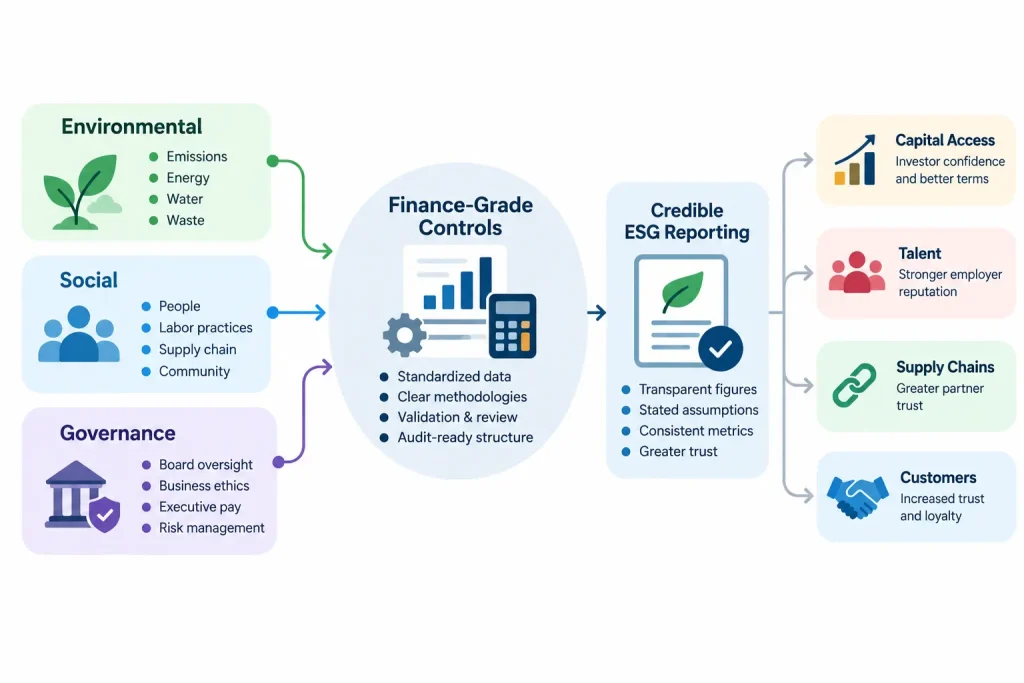
How ESG Accounting Became a Finance Responsibility
ESG did not emerge from a single governing logic. It grew from several overlapping movements, including ethical investing, environmental accounting, anti-corruption efforts, and stakeholder capitalism.
From Ethical Screens to Material Risk
Early socially responsible investors excluded sectors such as tobacco and weapons to align capital with values. Those exclusions expressed identity more than performance, and most finance teams treated them as peripheral. Two later shifts changed that view for finance leaders.
First, investors recognized that issues such as climate exposure, regulatory change, and talent flight could become material financial risks. Second, large asset managers grew too big to exit entire markets, so they began engaging with companies instead. Engagement required data, and that data in turn required metrics.
A wave of frameworks followed, including GRI, CDP, and the ISSB standards, which built on earlier TCFD recommendations and SASB industry standards. Each framework aimed to make non-financial information decision-useful. Yet the frameworks differed in their underlying focus. Some measured a company’s impact on the world, while others measured how external issues create risk.
Why ESG Challenges Traditional Accounting
Traditional accounting rests on closure: the period ends, the ledger balances, and the audit signs off. ESG data, by contrast, often remains incomplete at period end. Carbon figures rely on estimates, social metrics depend on definitions, and impacts unfold over years instead of quarters.
This mismatch creates real tension for finance leaders. CFOs must report uncertain information in a language that implies precision. Rating agencies may also score the same company in conflicting ways, reflecting disclosure choices as much as actual performance.
ESG has become a question of access to capital, talent, supply chains, and customer trust. That reality places ESG reporting with finance, the function most experienced in managing ambiguity through structure.
The Data Challenge Behind ESG Accounting
If traditional accounting turns ambiguity into auditability, ESG reporting often works in reverse. Teams must turn uncertain inputs into meaningful disclosures while knowing that full verification may remain out of reach.
Inferred, Fragmented, and Noisy Data
Companies infer much of their ESG data instead of collecting it. Teams often extrapolate Scope 3 emissions from supplier spend categories, while water usage may come from utility bills and facility logs. Even precise local data becomes noisy when aggregated across regions with different measurement practices.
ESG performance also resists any simple summary measure. Environmental metrics span carbon, water, waste, energy, and biodiversity. Social metrics cover labor practices, supply chain integrity, and community impact, while governance now includes cybersecurity, executive pay, and ethics oversight.
ESG Data Domains and Verification Challenges
| Domain | Typical Data Owner | Common Verification Challenge |
| Environmental | Facilities, operations, and supply chain | Emissions estimates, inconsistent factors, and incomplete supplier data |
| Social | Human resources and procurement | Definitional drift, privacy limits, and uneven regional data |
| Governance | Legal, board secretary, and finance | Qualitative policies that are hard to measure consistently |
| Supply chain | Procurement and supplier management | Reliance on third-party disclosures and audits |
A $127M global consumer products company with a supply chain spanning China and Vietnam illustrates the complexity of supplier-level data. Finance managed a logistics P&L covering ocean freight, trucking, last-mile delivery, and warehousing. Data across that many partners and handoffs shows why value chain metrics require careful sourcing and validation.
Designing for Reliability
Strong ESG accounting starts with a sound data structure. Controlled vocabularies, standardized units, version-controlled assumptions, and explicit estimates of variance reduce interpretive noise. The goal is not perfection but transparency about how teams derived each figure.
Each disclosure should read as a conditional statement. The company believes a figure to be accurate within stated boundaries, at a given confidence level, subject to refinement. That framing signals control without overpromising certainty to readers.
Timing adds another challenge for ESG reporting teams. ESG outcomes often take years to change, while investors expect regular updates and media cycles move hourly. CFOs must report progress before outcomes mature, without implying more certainty than the data supports.
The greatest risk is confusing a clean dashboard with credible data. Fragile lineage, hidden methodology, or untested assumptions can turn a polished report into a future liability. Greenwashing often reflects weak system design as much as exaggeration.
Designing ESG Control Systems That Scale
At some point, the systems behind the numbers become the real story. Stakeholders trust ESG disclosures based on the repeatable mechanisms that produce them. The CFO must extend finance discipline into areas that sit outside traditional accounting.
Clarifying Ownership
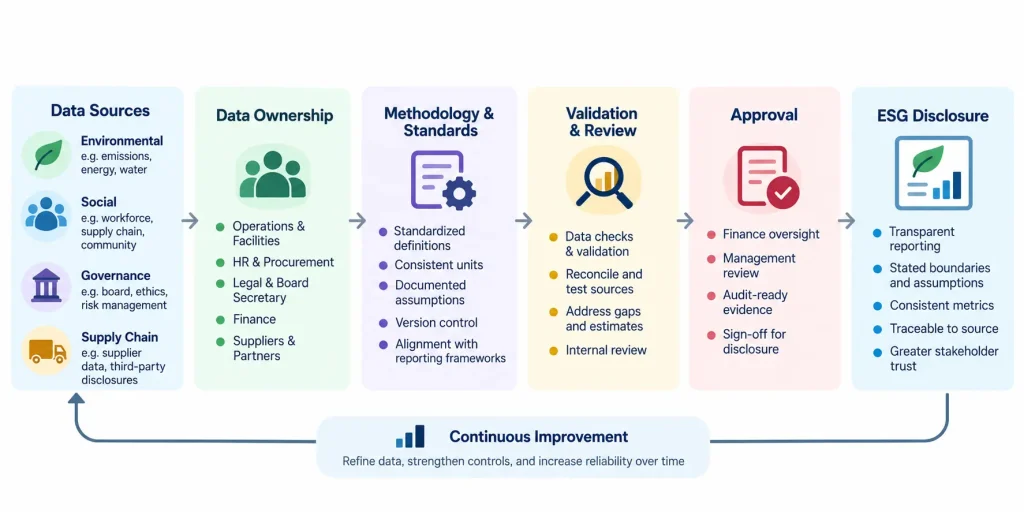
In many companies, ESG data ownership sits across several functions. Human resources owns workforce metrics, facilities owns energy data, supply chain owns sourcing audits, and legal manages governance disclosures. The CFO often oversees none of it directly yet signs off on the final report.
The answer is not full centralization but governance of the interfaces. Every ESG data point should link to a named process owner, a documented source, declared assumptions, and a traceable lineage. That common spine turns scattered claims into a defensible system.
Applying Sarbanes-Oxley Discipline
Sarbanes-Oxley offers a useful model for ESG governance. Just as SOX imposed rigor on financial controls, ESG reporting benefits from defined control points, risk assessments, and exception handling.
Building a SOX-Style ESG Control Environment
| Control Element | What It Involves | Why It Matters |
| Data ownership | Named owner for each metric and source system | Ends ambiguity over accountability |
| Documented methodology | Boundaries, assumptions, and emission factors recorded and versioned | Supports consistency and assurance |
| Review and approval | Multi-level sign-off before disclosure | Catches errors before publication |
| Exception handling | Clear process for anomalies and restatements | Builds credibility through transparency |
| Integration with finance systems | ESG data linked to ERP and procurement records | Improves traceability and reconciliation |
| Internal audit coverage | Periodic testing of ESG controls | Prepares the company for external assurance |
Spreadsheets and shared drives are not enough for this work. ESG data should flow through interoperable systems that link energy data with emission factors and procurement with supplier risk records. Each data point should trace to a source of record.
A cybersecurity and identity SaaS company with entities in the United States, Canada, Mexico, India, and Nepal shows the value of consistent systems. Implementing NetSuite across five entities shortened the monthly close from 18 days to 10. The same multi-entity discipline applies when teams gather ESG data across countries.
Embedding ESG in the Operating Rhythm
Effective ESG governance is cultural as well as structural. ESG metrics should appear in planning cycles, performance reviews, and capital allocation discussions alongside financial goals. Quarterly reviews help keep metrics credible, even when the underlying outcomes change slowly.
Companies also need a safe way to raise concerns. Whistleblower channels should cover metric misrepresentation as well as fraud. If a team games a target or a carbon offset lacks integrity, employees must be able to speak up before publication.
A Silicon Valley education and research institution shows how board oversight supports reporting integrity. Finance reported to the board and audit committee while overseeing Finance, HR, IT, Legal, and Facilities. Oversight that spans those functions mirrors the cross-functional reach ESG governance requires.
ESG Reporting as a Strategic Mirror
Behind every ESG metric sits a harder question: does the report describe who the company is, or who it wants to appear to be? At that point, ESG reporting becomes part of how the company builds trust.
Materiality, Reputation, and Adaptability
Every disclosure reflects a choice about what to report and in how much depth. Highlighting some metrics while omitting others signals where leaders believe obligations lie. Unreported issues may later look like omissions, while weakly supported claims become liabilities.
ESG reporting also faces scrutiny from several directions. Some stakeholders want more disclosure, while others question the coherence or financial materiality of ESG mandates. CFOs can hold a steady position by disclosing what is material, measuring what they can defend, and correcting misalignment between claims and conduct.
Expectations will keep evolving across regions and frameworks. ESG programs should adapt to stakeholder feedback and revise metrics without destabilizing trust. Admitting when a target was unrealistic often builds more credibility than defending it.
A Euronext Paris-listed gaming company that maintained reporting under both IFRS and US GAAP shows the value of reconciling multiple standards. Managing parallel frameworks requires clear mapping, consistent definitions, and careful disclosure. ESG reporting across overlapping frameworks demands similar discipline.
ESG accounting, practiced with rigor, becomes an expression of the company’s self-governance. It shows what the company pays attention to and what it accepts responsibility for.
Three Key Takeaways
- ESG accounting belongs with finance because ESG data now affects capital access and risk, and finance brings discipline to uncertain information.
- Credible ESG reporting depends on clear data ownership, documented methodologies, version-controlled assumptions, and transparent statements about confidence.
- A SOX-style control environment, integrated systems, and regular reviews help ESG disclosures withstand scrutiny and build lasting trust.
Disclaimer: This article is intended for informational purposes only and does not constitute legal, tax, or accounting advice. You should consult your own tax advisor or counsel for advice tailored to your specific situation.
Hindol Datta is a four-time CFO and senior finance executive with over 25 years of leadership experience across cybersecurity, SaaS, gaming, logistics, digital marketing, medical devices, consumer products, and nonprofit organizations. He has led more than $120M in fundraising and over $150M in M&A transactions while building the financial and operational systems that let complex businesses scale with confidence. He is the author of seven books in the Systems CFO Series and holds active CPA, CMA, and CIA credentials.
AI-assisted insights, supplemented by 25 years of finance leadership experience.