
Executive Summary
The financial close process often runs as routine compliance. Transactions lock, ledgers reconcile, and the calendar turns, yet the company rarely learns much from the effort. A well-run close can do more by turning monthly activity into early warnings and clearer strategic signals.
The sections ahead explain how CFOs can reshape the month-end close into a source of insight. They cover what the close reveals and conceals, how variance analysis can detect drift early, and how to connect closing with planning. They also address the culture of financial truth that makes the close credible. Together they show the close as the start of the next question, not the end of the month.
What the Financial Close Process Reveals and Conceals
On the surface, the close follows a familiar sequence. Teams finalize revenue, accrue expenses, settle deferred items, post intercompany eliminations, record depreciation, and reconcile accounts. The result is a set of financial statements that simplify complex activity into stable order.
The Compression Problem
That simplification carries a cost for decision makers. To close the books is to strip away context and unusual detail in favor of clean account balances. The anomalies that carry early signals of pressure or change can disappear in the process.
Accruals offer a common example of this loss of signal. A marketing expense arrives without an invoice, so the team accrues it and moves on. Few people ask why the invoice was late, which may reflect procurement fatigue, cash timing, or supplier churn.
Reconciliation is not the same as real comprehension of the business. The ledgers may tie out and variances may resolve, yet leaders may understand no more than they did the month before. A balanced view can create a false sense that equilibrium equals insight.
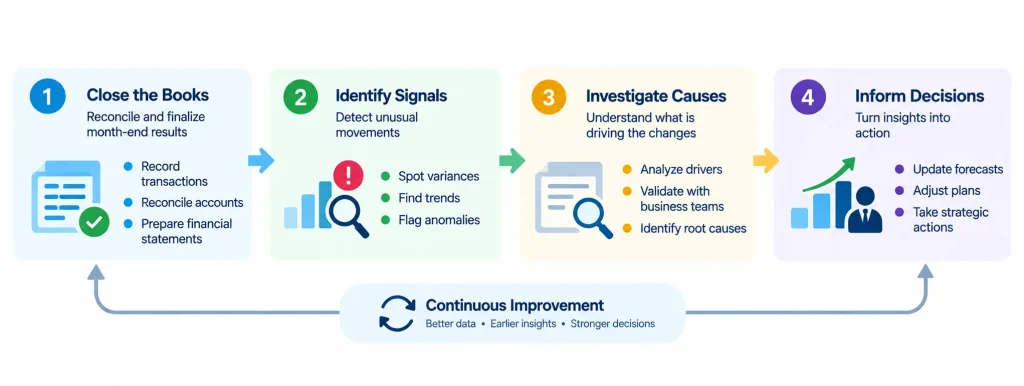
Close Activities and the Signals They Can Reveal
| Close Activity | What It Records | Signal Worth Investigating |
| Revenue cutoff and recognition | Revenue earned in the period | Shifts in deferred revenue that hint at changing customer engagement |
| Expense accruals | Costs incurred but not yet invoiced | Delayed invoices that point to supplier or procurement issues |
| Intercompany eliminations | Transactions between entities | Recurring mismatches that reveal process gaps across entities |
| Account reconciliations | Agreement between ledgers and sources | Repeated manual adjustments that signal upstream data problems |
| Classification choices | Where costs and revenues land | Shifts in cost mix, such as contractors replacing permanent staff |
Classification as a Belief Update
Choices made during the close shape the company’s story about itself. Imagine a surge in freight costs from a port disruption. Treating it as a timing issue suggests the company expected it, while calling it unusual suggests surprise. Expecting it to recur changes the forecast, so each label carries a different message into the boardroom.
Incentives can distort these close choices as well. Once results trigger hiring or investment, teams may defer expenses, pull revenue forward, or rework allocations. The close then becomes a contest over optics instead of a measurement of reality.
Consider a quarter in which revenue looks strong while SG&A composition quietly shifts from permanent headcount toward contractors. Total spend appears stable, yet the change may reflect leaders hedging against uncertainty. A close that only checks totals would miss that early sign of lost confidence.
A cybersecurity and identity SaaS company with entities in the United States, Canada, Mexico, India, and Nepal shows what a disciplined close can achieve. Implementing NetSuite across five entities shortened the monthly close from 18 days to 10. Finance also implemented ASC 606 revenue recognition, which brought consistency to how revenue entered the books.
Variance Analysis as an Early Warning System
Organizations often report variances as mechanical differences explained by timing or categorization. Familiar phrases such as hiring delays or spend slipping into next month hide something more important. Variances often carry the first signs that a business is drifting from its plan.
Decomposing Variance to Find Causes
A variance is never simply a number on a report. It measures the gap between what happened and what the company believed would happen. Each variance asks which assumption failed and which part of the model needs revision.
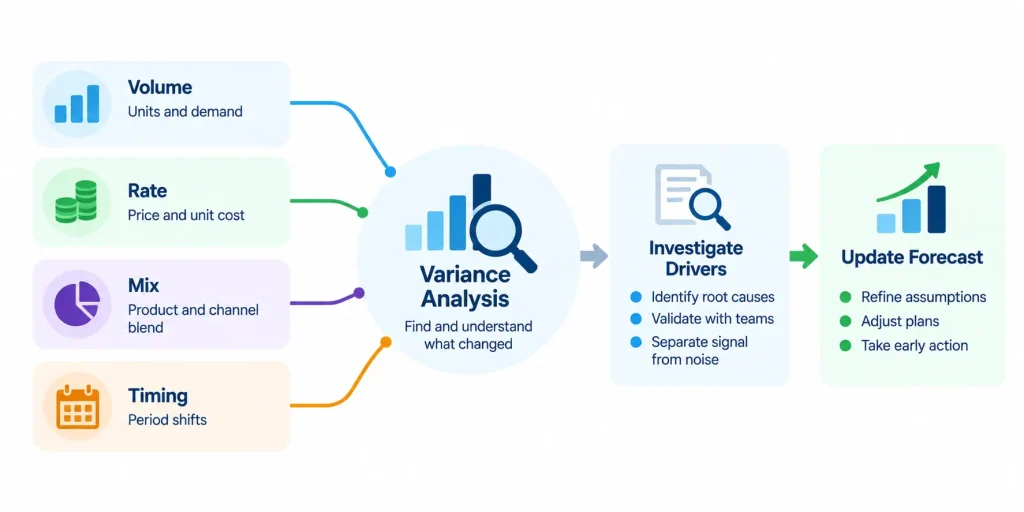
Effective analysis during the month-end close breaks each variance into components instead of reporting a single delta. Four core drivers explain most movements in results.
Decomposing Variance in the Financial Close Process
| Driver | What It Explains | Example Question |
| Volume | Changes in units, customers, or transactions | Did demand shift, or did capacity limit output |
| Rate | Changes in price or unit cost | Did discounting or supplier pricing move the result |
| Mix | Changes in the blend of products, segments, or channels | Did a lower-margin segment grow faster than planned |
| Timing | Shifts between periods | Is this a one-month delay or the start of a trend |
Consider a quarter where customer acquisition costs rise above plan. The marketing team attributes the increase to channel experimentation. Deeper analysis shows that a new test segment engaged early but converted poorly downstream, so the spend was ineffective as well as high.
Separating Signal from Noise
Not every variance deserves immediate action from leadership. A shipment may miss cutoff, or a hire may slip for reasons outside anyone’s control. Bayesian reasoning helps teams judge how much a single observation should change their beliefs.
One variance rarely overturns a model, but repeated variances across functions or periods signal real drift. CFOs can strengthen this discipline with a few practices:
- Tag each variance above a set threshold by its behavioral driver, such as customer demand or execution
- Separate structural changes from transient ones before adjusting forecasts
- Rebuild forecast assumptions when a variance reveals a broken belief
- Track how quickly teams detect and respond to deviations, not only whether they hit plan
Connecting the Financial Close Process to Planning
Many finance teams treat closing and planning as separate domains. Accounting owns historical accuracy, while FP&A owns forward projections. Both describe the same company, yet they often operate on different calendars and systems.
From Sequential to Concurrent
In the traditional model, the books close first and the forecast refreshes later. By the time that cycle finishes, conditions may have changed. A better approach treats each close as a live input to the forecast instead of a post-mortem.
Planning models should be built around business drivers instead of the chart of accounts. The ledger records effects, while the model must explain causes such as price realization, conversion rates, churn, and sales velocity. When actuals arrive, they should update both numbers and the reasoning behind them.
Forecast assumptions also benefit from clear provenance and ownership. Each key assumption can record its value, last update, and owner, along with the variance that prompted any change. That record turns the planning model into a living repository of organizational belief.
The integration is cultural as well as technical. When accountants, analysts, and operators review results together, the conversation shifts from defending variances to interpreting them. The central question becomes what the team has learned, and budgets, hiring, and investment pacing follow from that answer.
A Euronext Paris-listed gaming company with operations in five countries shows the value of consistent definitions across close and planning. Finance maintained reporting under both IFRS and US GAAP, and a firmwide rollout of Oracle Financials and MicroStrategy created a single definition of revenue. Consistent definitions made it easier to carry actuals into forward planning.
Building a Culture of Financial Truth
After the arithmetic settles, a harder question remains: did the company tell itself the truth? The answer depends less on formulas than on how teams handle judgment, uncertainty, and error.
Discretion as Inquiry, Not Distortion
Every financial output involves some degree of judgment. Accruals are estimates, allocations are compromises, and items such as capitalized labor and deferred revenue require interpretation. In a culture focused on optics, that discretion becomes distortion, as teams manipulate timing and retrofit narratives.
In a culture committed to truth, discretion becomes inquiry. A $200K overrun in services spend prompts a deeper look at procurement behavior instead of excuses. Precision still matters, but insight that is relevant to decisions matters more.
Imagine a quarter where gross margin expands by sixty basis points. Analysis shows the gain came from a one-time product mix shift driven by a large deal unlikely to repeat. Reporting the improvement without that context would be technically defensible yet strategically misleading, so the right choice is to surface the detail.
A $127M global consumer products company that completed four clean audits shows how disciplined close practices build credibility over time. A venture-backed digital marketing company shows the same principle at an earlier stage. It completed its first audit while growing finance from one person to 12. In both cases, consistent close discipline gave leaders numbers they could trust. The financial close process, repeated twelve times a year, either deepens alignment with truth or slowly erodes it.
Three Key Takeaways
- The financial close process should surface early signals, such as shifts in cost mix or deferred revenue, instead of stopping at reconciliation.
- Variance analysis works best when teams decompose results by volume, rate, mix, and timing, then update forecast assumptions when beliefs break.
- Integrating the month-end close with planning and building a culture of financial truth turn monthly reporting into strategic foresight.
Disclaimer: This article is intended for informational purposes only and does not constitute legal, tax, or accounting advice. You should consult your own tax advisor or counsel for advice tailored to your specific situation.
Hindol Datta is a four-time CFO and senior finance executive with over 25 years of leadership experience across cybersecurity, SaaS, gaming, logistics, digital marketing, medical devices, consumer products, and nonprofit organizations. He has led more than $120M in fundraising and over $150M in M&A transactions while building the financial and operational systems that let complex businesses scale with confidence. He is the author of seven books in the Systems CFO Series and holds active CPA, CMA, and CIA credentials.
AI-assisted insights, supplemented by 25 years of finance leadership experience.