
Executive Summary
Strategic partnership KPIs often decide whether an alliance creates value or quietly unravels. Many partnerships begin with promising forecasts and compatible incentives on paper. Months later, they drift because each side measures success differently. One partner tracks delivery volume while the other depends on customer retention, and the gap widens with every quarter.
The sections ahead explain how CFOs can design shared KPIs that hold partnerships together. They cover partnerships as incentive games, KPIs as feedback systems, and the ethics of shared measurement. They also address how metrics should evolve over the life of an alliance. Together they show that fragile partnerships usually suffer from misaligned metrics, not weak contracts.
Why Strategic Partnership KPIs Shape Incentives
Vendors, suppliers, joint ventures, and alliances are not simply external cost centers. They are parts of a shared system, where a shift in one organization forces others to adapt. Without shared clarity on what success means, noise multiplies and accountability blurs.
Partnerships as Incentive Games
Game theory offers a practical lens for partnership design. Each party has goals it seeks to maximize, constraints such as budgets and timelines, and incomplete information about the other. Each also responds to the other’s observable behavior, which turns a transaction into a system.
Consider a vendor paid only for inputs such as hours logged or units delivered. Its best strategy is to meet the contract clause without stretching or innovating. Both sides would benefit from more effort and better information sharing, yet neither moves first, which mirrors the classic prisoner’s dilemma.
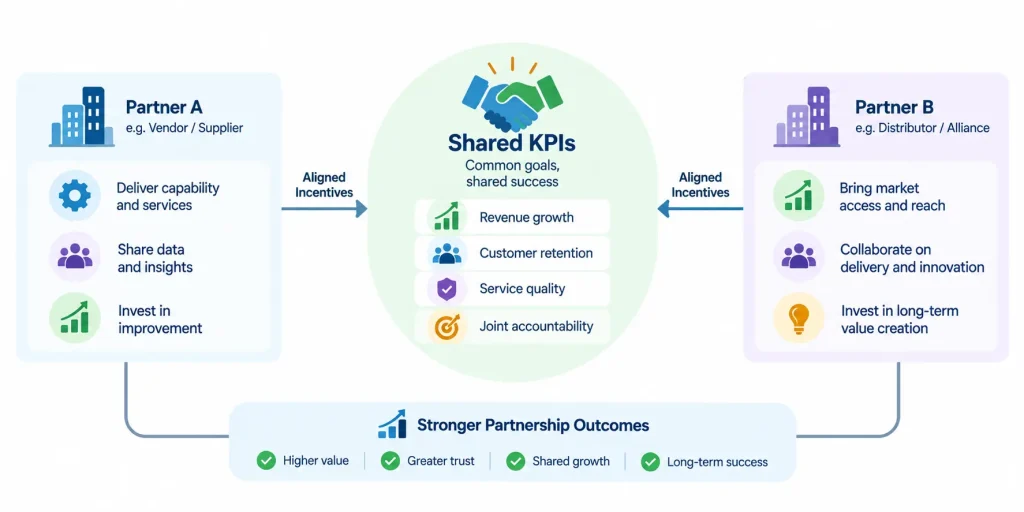
Well-designed shared KPIs change the structure of the game. A coupled metric means neither side can win unless both do. Performance becomes interdependent, and cooperation becomes the rational choice instead of an act of goodwill.
Avoiding False Alignment
A KPI may look shared while hiding divergence. Both partners may target faster time to market, yet one defines launch as revenue-ready while the other defines it as code-complete. Without common definitions, the metric misleads and can invite theatrical compliance.
Signaling theory helps separate real commitment from surface agreement. A credible signal is costly to fake, which gives it weight. Investing in real-time data sharing sends one signal. Tying a bonus pool to customer satisfaction sends a stronger one.
Imagine a logistics partner that links part of its incentive pool to the client’s Net Promoter Score instead of delivery SLAs alone. Site managers begin redesigning routes and cross-training teams. They start to act like co-owners instead of vendors. A single shared KPI can reshape the whole relationship.
A pre-Series A AI governance and assurance platform shows how partnership economics belong in the plan from the start. Finance built go-to-market modeling and partnership economics alongside the operating model and capital strategy. Modeling those economics early clarified what each partnership needed to deliver.
Designing Strategic Partnership KPIs as a Feedback System
A shared KPI is more than a goal. It is a node where feedback loops, constraints, and adaptation meet. Designing a partnership without attention to these flows produces an attractive structure on a weak engine.
Closing the Feedback Loop
Metrics reviewed only monthly may arrive too late to matter. Real-time tracking without joint discussion changes nothing at all. A true loop exists only when both partners see the same data, share thresholds, and investigate small deviations together.
Shared KPIs should also reveal constraints in the joint system. The theory of constraints holds that the narrowest bottleneck limits system throughput. In partnerships, bottlenecks often appear in information flow, approvals, or incentive design, and good metrics point teams toward those root causes.
Consider a marketing services partner measured on campaign volume without a matching quality metric. As volume climbs, the partner reports strong results while the client’s acquisition cost rises. Adding a shared quality measure, such as trials per lead, realigns both sides around real outcomes.
Layering Metrics to Prevent Distortion
Narrow metrics invite perverse optimization by one or both partners. Someone measured only on qualified leads may route traffic from low-intent sources. A layered structure of metrics guards against this risk.
A Layered Structure for Strategic Partnership KPIs
| Layer | Purpose | Example |
| Primary KPI | Shows the outcome both partners care about most | Customer retention or revenue from joint accounts |
| Supporting metrics | Explain what drives the primary KPI | Onboarding time, lead quality, and fulfillment accuracy |
| Counter-KPIs | Warn when optimization distorts results | Customer complaints, refund rates, or acquisition cost |
| Operational signals | Flag issues early for joint review | Service uptime, response times, and backlog levels |
Dashboards should show the headline KPI while allowing drill-down into key drivers. Compressing complex outcomes into a single number improves clarity but hides nuance. The best systems combine a simple headline with transparent detail underneath.
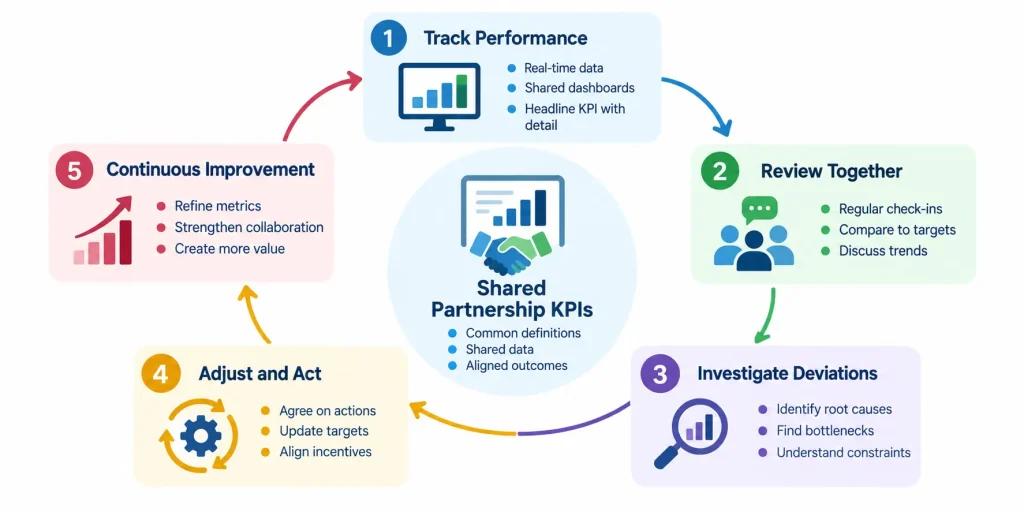
Rituals keep these systems alive across the partnership. Weekly reviews can balance scorecards with qualitative reflection. Quarterly workshops can recalibrate targets, and annual sessions can test whether the partnership’s purpose still holds.
A $127M global consumer products company that sold through direct-to-consumer, Amazon, and wholesale channels shows why partner metrics matter. Finance managed a logistics P&L covering ocean freight, trucking, last-mile delivery, and warehousing partners. Each partner relationship depended on clear, shared measures of cost and performance.
The Ethics of Shared Measurement
Sharing a metric changes behavior on both sides. When partners expose dashboards or tie compensation to shared numbers, they alter how people work. That change may help or harm, but it is never neutral.
When Measurement Shapes Behavior
Imagine a cloud services partner that begins sharing real-time uptime metrics. Its engineers start prioritizing resilience over feature delivery. Stability improves, but release velocity slows and the client’s roadmap stalls, because measuring one priority crowded out another.
Sharing a metric also exerts a form of soft governance. It asks the partner to optimize through one company’s lens, which may or may not match its own. CFOs should ask whether they are imposing goals or discovering joint ones.
Trust and Reciprocity
Shared measurement works only when anchored in trust. Partners must believe that no one will weaponize the data, that interpretation stays joint, and that transparency will not become surveillance. Public reprimands after a dip in performance can lead a partner to restrict data access, turning a useful KPI into a toxic one.
Several practical principles help keep shared measurement healthy:
- Make visibility reciprocal, with both partners sharing relevant metrics
- Document data sources, metric definitions, and any default assumptions
- Give each partner the right to question or challenge reported figures
- Treat deviations as prompts for joint inquiry, not grounds for blame
- Recognize that many misses reflect system friction, not bad faith
The CFO’s role here is co-investigator, not auditor. Every data point requires interpretation, and many deviations point to friction in the joint system instead of failure by one party.
Keeping Strategic Partnership KPIs Alive
Shared KPIs emerge from purpose, evolve with practice, and decay if left unchanged. Treating them as permanent ignores how partnerships mature. Metrics should act as vessels of shared learning, not monuments.
Managing the KPI Lifecycle
Picture a distribution partnership that tracks customer onboarding time. For months, improvements follow, but as onboarding matures, the real challenges shift to adoption and feature activation. If the partners keep optimizing onboarding alone, they chase diminishing returns while engagement fades.
Metrics also suffer from atrophy when attention erodes. A KPI may remain on the dashboard while nobody acts on it, producing false confidence. Regular reviews should ask whether each metric still matters and still guides decisions.
Lifecycle Practices for Shared KPIs
| Practice | Frequency | Purpose |
| Performance review | Monthly | Tracks results and flags deviations for joint inquiry |
| KPI relevance review | Quarterly | Asks whether each metric still reflects what matters |
| Sunset clause check | Every 12 to 18 months | Retires metrics unless both partners reaffirm them |
| Strategic alignment session | Annually | Tests whether partnership goals and metrics still fit |
A sunset clause can make this discipline routine. Some partners agree at signing that KPIs expire after a set period unless both sides reaffirm them. Teams must then explain why a metric still matters or choose a better one.
Not every metric should change at the same pace. Customer satisfaction and strategic growth may stay stable for years, while operational measures such as demo-to-deal time may cycle more often. Deciding which metrics are long-horizon is itself a strategic choice.
A venture-backed digital marketing company that grew from $9M to $180M in revenue shows the value of revisiting metrics as a business scales. Finance built CAC, LTV, and contribution margin frameworks to guide decisions through rapid growth and three acquisitions. Metrics that fit an early stage needed review as the business and its partnerships expanded. Strategic partnership KPIs, managed this way, become the start of a dialogue instead of a verdict.
Three Key Takeaways
- Strategic partnership KPIs work best when they couple incentives, so neither partner can win unless both do, and when both sides share precise definitions.
- Shared KPIs should form a layered feedback system with primary metrics, supporting drivers, counter-KPIs, and regular joint reviews.
- Healthy partnerships treat measurement as reciprocal and evolving, using relevance reviews and sunset clauses to keep metrics aligned with current goals.
Disclaimer: This article is intended for informational purposes only and does not constitute legal, tax, or accounting advice. You should consult your own tax advisor or counsel for advice tailored to your specific situation.
Hindol Datta is a four-time CFO and senior finance executive with over 25 years of leadership experience across cybersecurity, SaaS, gaming, logistics, digital marketing, medical devices, consumer products, and nonprofit organizations. He has led more than $120M in fundraising and over $150M in M&A transactions while building the financial and operational systems that let complex businesses scale with confidence. He is the author of seven books in the Systems CFO Series and holds active CPA, CMA, and CIA credentials.
AI-assisted insights, supplemented by 25 years of finance leadership experience.