Executive Summary
Startup legal mistakes almost never announce themselves. They arrive quietly. A handshake agreement between co-founders. An offer letter borrowed from a template. A contractor arrangement sealed with a nod rather than an assignment clause. None of these decisions feel dangerous in the moment, because the moment belongs to product and velocity. The danger surfaces later. A term sheet stalls. A co-founder walks away with equity and no further contribution. An acquirer’s counsel finds a hole in the intellectual property chain that nobody thought to close.
Having spent more than two decades sitting across from boards, auditors, and acquirers as a finance executive, I have watched legal risk accumulate the same way compound interest does: slowly, then all at once. This article walks through where that risk concentrates inside a growing company. It looks at why founders often treat legal advice for startups as a later problem rather than a present one, and how founders can build legal support for startups into the operating rhythm of the business before the cost of neglect comes due.
Why Startup Legal Mistakes Compound Instead of Resolve
Legal entropy in a startup is rarely the product of a single catastrophic decision. It is an accumulation, built from a hundred small choices made under time pressure. The people making those choices rarely intend harm. They simply do not yet know what matters. Founders are, by disposition, builders and salespeople, and the instinct that closes a customer in a week is the same instinct that signs a distributor contract without a termination clause. The deal in front of them matters more than the document underneath it.
I have sat inside the cleanup of these situations more than once, and fraud or bad faith was rarely the cause. The pattern was almost always the same. A founder assumed a problem could be fixed later, and later arrived in the form of a diligence request that could not be answered. In a cybersecurity and identity access management company I supported through roughly $30M in annual recurring revenue, we built the board-grade reporting and controls environment years before any acquisition conversation began. That groundwork was what carried the company through diligence without a stumble. The lesson was not that governance prevents every problem. It is that governance determines whether a problem, once it surfaces, is a footnote or a dealbreaker.
When Co-Founder Friendships Collapse
The most emotionally difficult legal issue a startup faces is the co-founder breakup, and it is difficult precisely because it begins as the opposite of a legal problem. In the earliest days, energy is collaborative and trust feels permanent. Founders split equity in a hurry, often straight down the middle, and rarely draft a founder agreement with real teeth. Vesting schedules, decision rights, and dispute mechanisms get set aside for later, alongside everything else that feels less urgent than the product.
As the company grows, asymmetries appear. One founder steps into the CEO role while the other drifts toward the periphery. The informal arrangement that once felt fair begins to feel unjust to at least one party. I have watched a company nearly lose an investor round because a departed co-founder retained a substantial equity stake with no ongoing contribution, and the board had no contractual mechanism to address it. The employees noticed. The investors noticed more.
The remedy is not suspicion between founders on day one. It is structure that survives the relationship, whatever direction that relationship takes. A founder agreement with real vesting, defined roles, and a dispute resolution path is not bureaucratic overhead bolted onto the business. It is the mechanism that lets the company keep operating even when the personal relationship underneath it changes.

Employee Equity Without a Map
Stock options are one of the more elegant tools available to an early-stage company. They let founders extend real ownership to employees without spending cash the company does not have. That elegance depends entirely on the mechanics underneath being handled correctly, and those mechanics, covering pricing, vesting, taxation, and documentation, are where most startups run into trouble.
Options granted informally, without board approval, or with strike prices set after the fact create exposure under Section 409A. That exposure can remain invisible until a diligence team goes looking for it. Worse, employees are sometimes never told what an exercise event will mean for their tax position. I have sat in rooms where a team member’s shock at an unexpected AMT liability did more damage to morale than any product setback could have. During my time running finance and revenue operations for a venture-backed digital marketing company that scaled from $9M to $180M in revenue over twenty-four months, the option pool and its documentation were among the first things every acquirer’s counsel wanted to see across three separate transactions. A clean equity structure was not a formality in those conversations. It was the price of admission.
The Diligence Test
Acquirers and later-stage investors apply a consistent test to a company’s equity practices, and it is worth naming plainly:
- Was every option grant approved by the board and documented at the time it was made
- Were strike prices set at fair market value rather than adjusted retroactively
- Do the cap table and the option ledger agree with each other line for line
- Have employees been given a clear understanding of the tax consequences of exercise
A company that can answer yes to all four moves through diligence in days. A company that cannot spends weeks reconstructing history that should have been documented the first time.
The Danger of Unvetted Contracts
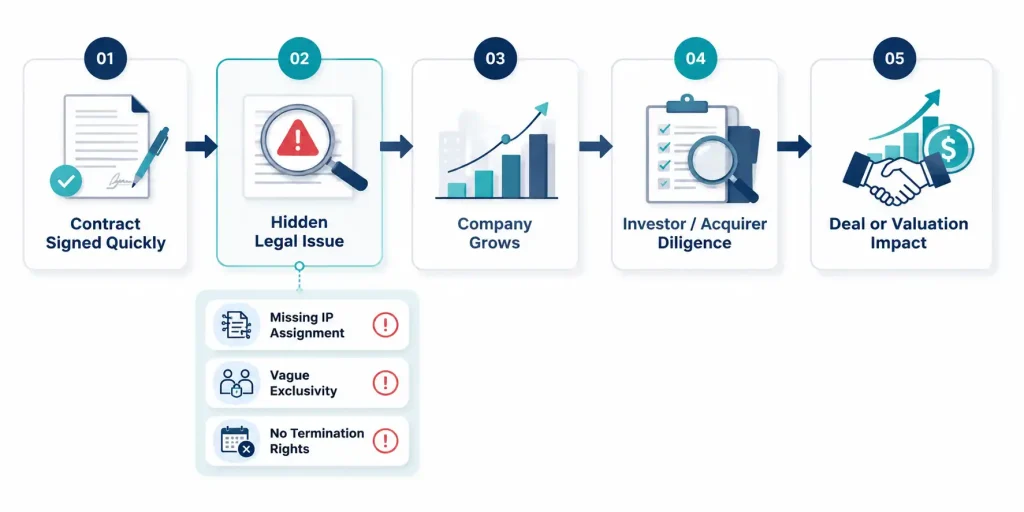
Startups run on speed. In the early stages, nearly every signed contract feels like a win, whether it is a beta customer, a channel partner, or a strategic advisor. That same speed is what allows ambiguous exclusivity clauses, missing termination rights, and unaddressed intellectual property ownership to slip into agreements that nobody expects to matter again.
One company I advised had built a promising relationship with an overseas distributor under a contract with vague exclusivity language and no clean exit. Years later, an acquirer came to the table, and the distributor asserted rights over several key markets. The deal only closed after a costly settlement negotiation. A separate early-stage company outsourced core development work to a contractor without securing IP assignment. When it came time to file patents, ownership of the work product was in dispute, and that delay showed up directly in the company’s valuation at the next financing round. In buy-side diligence work I have done on acquisition targets, contract review of exactly this kind routinely surfaces the adjustments that most affect what a buyer is actually willing to pay.
These are not edge cases. They are common, and they share a pattern: a contract that seemed minor when signed becomes foundational once the company matters enough for someone else to read it closely.
From Mistakes to Muscle Memory
Most legal mistakes in a startup are avoidable, and avoiding them does not require a general counsel on staff from day one. It requires process, applied consistently, so that legal thinking becomes part of how the company operates rather than a task assigned after something breaks. That means reviewing contracts before signature and documenting board approvals as they happen. It also means maintaining a cap table that reconciles cleanly and making sure employees understand what their equity actually means.
It also means asking better questions before a deal is on the table, not after. Is the agreement enforceable as written? Is the intellectual property actually owned by the company? Do the option grants match what the board approved? Investors do not expect a founder to have all of this memorized. They expect awareness, and a founder who can speak fluently about the company’s legal structure signals a kind of operational maturity that a clean pitch deck cannot substitute for.
Why Founders Must Own the Legal Narrative
Legal risk in a startup is ultimately a leadership question rather than a compliance one. Founders who hand legal thinking entirely to outside counsel too early often lose visibility into one of the most consequential levers in their business. I have seen the cost of that firsthand. During an IPO readiness process at a publicly traded gaming and digital entertainment company, the founders who understood the mechanics of what they were signing negotiated from a position of strength with underwriters and auditors. Elsewhere, I have watched founders sidelined in their own M&A conversations because they did not fully understand the rights they had already signed away.
Counsel can advise, and finance leadership can support the process with clean data and documentation. Founders still have to lead. Treating legal hygiene as an asset rather than a cost signals maturity to a board, alignment to employees, and integrity to customers, and none of that happens by accident.
Three Key Takeaways
- Founder agreements, equity documentation, and contract review are not administrative tasks to defer. They are the infrastructure that determines whether a diligence process or a co-founder dispute resolves quickly or derails the company entirely.
- A clean cap table and a documented option grant history are worth more during a financing round or an acquisition than almost any other piece of paperwork a startup can produce, because they answer the questions a buyer or investor will ask first.
- Legal risk management belongs to the founder, not just to outside counsel. A founder who understands the company’s contracts, equity structure, and governance obligations negotiates from a position of strength when it matters most.
Disclaimer: This article is intended for informational purposes only and does not constitute legal, tax, or accounting advice. You should consult your own tax advisor or counsel for advice tailored to your specific situation.
Hindol Datta is a four-time CFO and senior finance executive with over 25 years of leadership experience across cybersecurity, SaaS, gaming, logistics, digital marketing, medical devices, consumer products, and nonprofit organizations. He has led more than $120M in fundraising and over $150M in M&A transactions while building the financial and operational systems that let complex businesses scale with confidence. He is the author of seven books in the Systems CFO Series and holds active CPA, CMA, and CIA credentials.
AI-assisted insights, supplemented by 25 years of finance leadership experience.