Executive Summary
Startup financial metrics shape far more than board decks. In the early days, instinct often drowns out data, and teams confuse activity with progress. Yet the habits a company forms around its numbers before its first audit often define its decisions for years.
The sections ahead explain how founders and CFOs can build a culture around a few well-chosen startup KPIs. They cover choosing the right first metrics, turning numbers into shared narrative, and overcoming resistance to measurement. They also address the founder’s emotional relationship with financial truth and the rituals that embed financial thinking into daily work. Together they show that a metrics-driven culture is less about control and more about collective clarity.
Choosing the Right Startup Financial Metrics
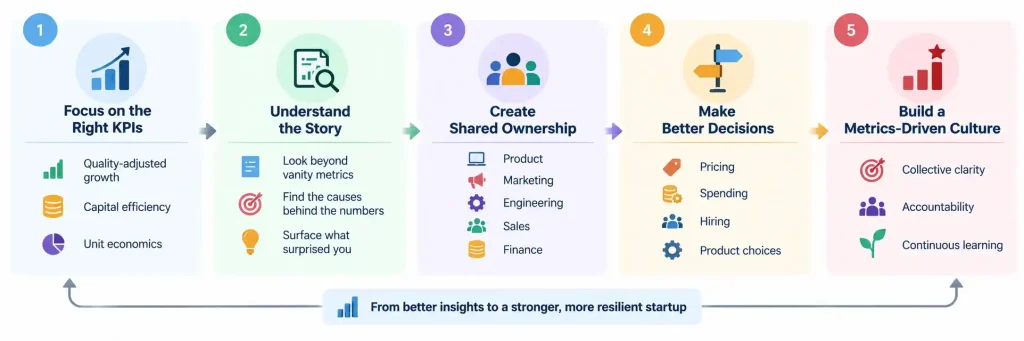
The first real metric arrives when founders stop asking only what they can build and start asking what they must sustain. Metrics are not neutral, because each one frames how the company sees itself. The danger in early-stage companies is not having too few metrics but having too many, or the wrong ones.
Three Questions Every Startup Must Answer
Vanity metrics such as downloads or monthly active users can look impressive while cohort decay hollows out the base. A strong set of startup financial metrics starts with no more than three core measures, each tied to a fundamental question.
Core Startup KPIs and the Questions They Answer
| Core Question | What It Tests | Example Startup KPIs |
| Is the company growing in a way customers value and pay for? | Quality-adjusted growth | Net revenue retention, paid conversion, gross margin by cohort |
| Is capital burning wisely enough to reach escape velocity? | Capital efficiency | Burn multiple, cash runway, burn per net new ARR dollar |
| Do leaders understand unit economics well enough to decide? | Value creation and capture | CAC, LTV, payback period, contribution margin |
Each metric works best when every function can see its own fingerprints on it. Product, engineering, and marketing should understand how their work moves the number, not just finance. This distributed ownership is the heart of a financial metrics culture.
Metrics also need stories to carry meaning for the team, because a note that churn is up is only an observation. Linking that churn to a shorter onboarding flow and a support team at 120% of capacity creates a story that invites accountability. Weekly reviews in which functional owners explain what happened and what surprised them turn numbers into a compass instead of a scoreboard.
A marketplace SaaS company with operations in the United States and Poland shows the value of early discipline. Cohort and unit economics models, along with consolidated cross-border reporting, anchored investor diligence during a $20M Series B. Clear metrics gave investors confidence in the business model.
Turning Startup KPIs Into Shared Narrative
Numbers stay silent until someone gives them a voice. In a fast-moving startup, it is not enough to track metrics; the company must learn to tell stories with them and act on them. That fluency allows teams to see complexity through structure without losing empathy.
Translation and Context
The CFO often becomes the translator-in-chief for the company. A statement such as “the company burns $1.5M a month” means little on its own. A more useful statement notes that the company spends $3 for every $1 of net new ARR. It adds that sales cycles have lengthened by 30 days. It connects spending to conversion, time, and return.
Some teams open every all-hands with three numbers, such as cash runway, gross margin, and net revenue retention, each introduced with its cause. Runway may grow because collections beat forecast, or margin may dip because of temporary overage costs. Over time, this framing trains people to ask better questions about why CAC rose or why payback lengthened.
Context also helps leaders avoid overreaction when a key number moves. Imagine a company that sees retention fall sharply over three months and fears a loss of product-market fit. Deeper analysis may show that a cohort acquired through a heavy discount campaign has simply matured and left. The issue then lies in channel strategy, not the product, and the company can correct course calmly.
Financially fluent cultures do not require every employee to master spreadsheets. They require every team to understand the financial consequences of its decisions:
- Engineers who link system latency to churn risk
- Marketers who weigh impressions against CAC and lifetime value
- Product managers who model feature adoption in revenue per seat
- Founders who explain board metrics as signals, not static outcomes
Overcoming Resistance to Measurement
Many startups begin as a rebellion against bureaucracy and sterile KPIs. That instinct protects creativity, but it can also push discipline aside. Measurement then becomes something the company plans to adopt after it wins.
Measurement as Empowerment
Resistance to measurement seldom appears openly inside a startup. Teams question numbers only when they are inconvenient, quote metrics selectively, or reinterpret forecasts mid-course. Picture a founder who dismisses a burn analysis by joking that the company builds rockets, not accounting reports. When the market turns, that company may find itself short of both cash and the habits needed to weigh trade-offs.
The CFO’s task is to frame measurement as a tool for learning, not policing. Visibility helps teams see patterns earlier and act sooner. Empathy, however, should not become indulgence, because a startup that cannot measure itself will struggle to scale.
Resistance can also take the form of over-measurement, where leaders bury hard questions under dashboards. A few direct questions cut through the noise. Which decision does this number inform, and which assumption sits beneath this trend? What would the team do differently if the number changed tomorrow? Any metric that carries no consequence quickly becomes theater.
An early-stage email marketing SaaS company illustrates the cost of acting late and the value of acting decisively. A financial turnaround there reduced monthly burn from $800K to $200K. Clear burn metrics made the scale of change visible and gave the team a shared target.
The Founder’s Relationship With Financial Truth
Founders carry a particular kind of loneliness: they bear the financial consequences of every major decision. Early on, vision drives everything and numbers feel secondary. As the company grows, metrics such as cohort retention, contribution margin, and runway begin to feel like personal judgments.
Setting the Tone
When numbers disappoint, the temptation is to narrate over them instead of into them. Forecasts become performances, bad news waits, and leaders reframe every dip. The strongest founders take a different and more honest path. They study variance, explore causes, and treat misses as moments to recalibrate.
The tone a founder sets spreads quickly through a startup. A defensive founder creates an evasive team, while an analytical founder creates a curious one. A simple opening question at executive meetings, such as what surprised the team this week, can turn financial reviews from defense into discovery.
Honesty matters most when the company is under financial stress. Consider a founder facing a revenue shortfall that forces a large reduction in staff. Showing the actual forecast gap and burn scenario at an all-hands can earn loyalty even in a painful moment. Calling the cut a strategic realignment tends to have the opposite effect. Founders need not start fluent in finance, but they must become conversant, because every hire, launch, and discount is a financial choice.
A venture-backed digital marketing company offers a useful reference. Finance there grew from a single hire to a team of 12 as revenue scaled from $9M to $180M. The company also completed its first audit during that period. Building that financial foundation alongside rapid growth gave leadership clear metrics to steer by.
Rituals That Embed Financial Thinking
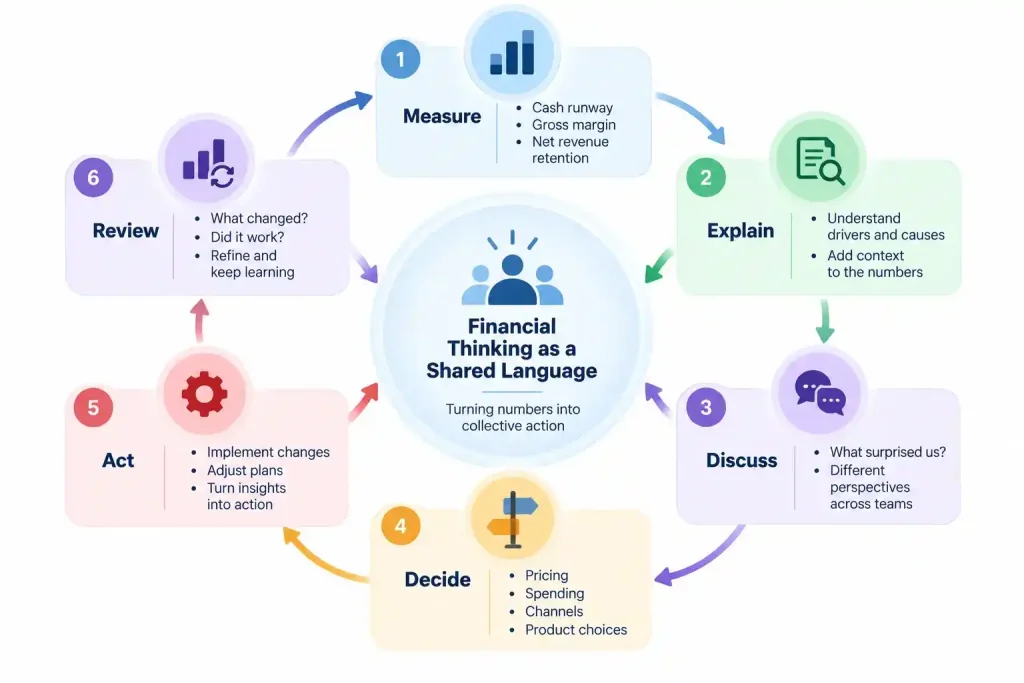
No one can declare a financial culture into existence; teams practice it until it becomes habit. Rituals give numbers meaning and keep them present in daily work. Paired with symbols and systems, they turn awareness into instinct.
From Rituals to Systems
Several recurring practices help startups make financial thinking part of everyday decisions.
Rituals and Systems That Build a Metrics Culture
| Practice | How It Works | What It Builds |
| Weekly metric walkthrough | Teams explain drivers, surprises, and what they will watch next | Comfort with learning in public |
| Monthly forecast adjustment | Teams revisit prior assumptions and record what changed | Humility and faster course correction |
| Visible symbols | Shared dashboards or a burn-rate display in common spaces | Curiosity across functions |
| Onboarding on metrics | New hires learn core startup KPIs on day one | Shared language from the start |
| Blended incentives | Bonuses tied to growth, margin, and retention together | Focus on quality, not just volume |
Visibility must also lead to concrete action, or it serves little purpose. A company that reviews CAC weekly but never adjusts pricing or channel mix has metrics theater, not a metrics culture. Leaders should trace decisions back to the numbers behind them, such as pausing a product line because of margin erosion.
Psychological safety completes the picture for growing teams. Teams must feel free to surface inconvenient truths and to say they do not know yet. When executives explain approvals in financial terms, they show that finance is a craft, not a constraint. Over time, startup financial metrics stop belonging to finance alone and become the company’s shared language for choosing well.
Three Key Takeaways
- Effective startup financial metrics start with a vital few that test quality growth, capital efficiency, and unit economics.
- Startup KPIs create value when teams translate them into stories, understand their causes, and see their own impact on the numbers.
- Founder tone, honest communication, and steady rituals turn measurement into a durable culture of clarity instead of control.
Disclaimer: This article is intended for informational purposes only and does not constitute legal, tax, or accounting advice. You should consult your own tax advisor or counsel for advice tailored to your specific situation.
Hindol Datta is a four-time CFO and senior finance executive with over 25 years of leadership experience across cybersecurity, SaaS, gaming, logistics, digital marketing, medical devices, consumer products, and nonprofit organizations. He has led more than $120M in fundraising and over $150M in M&A transactions while building the financial and operational systems that let complex businesses scale with confidence. He is the author of seven books in the Systems CFO Series and holds active CPA, CMA, and CIA credentials.
AI-assisted insights, supplemented by 25 years of finance leadership experience.