Executive Summary
A solo fractional CFO service has a ceiling. It shows up as a full calendar, good-fit clients turned away, and a growing sense of being stretched too thin across too many accounts. At that point, the decision is not whether to work harder. It is whether to hire fractional CFO talent onto a bench and build a firm around a practice that used to run on one person.
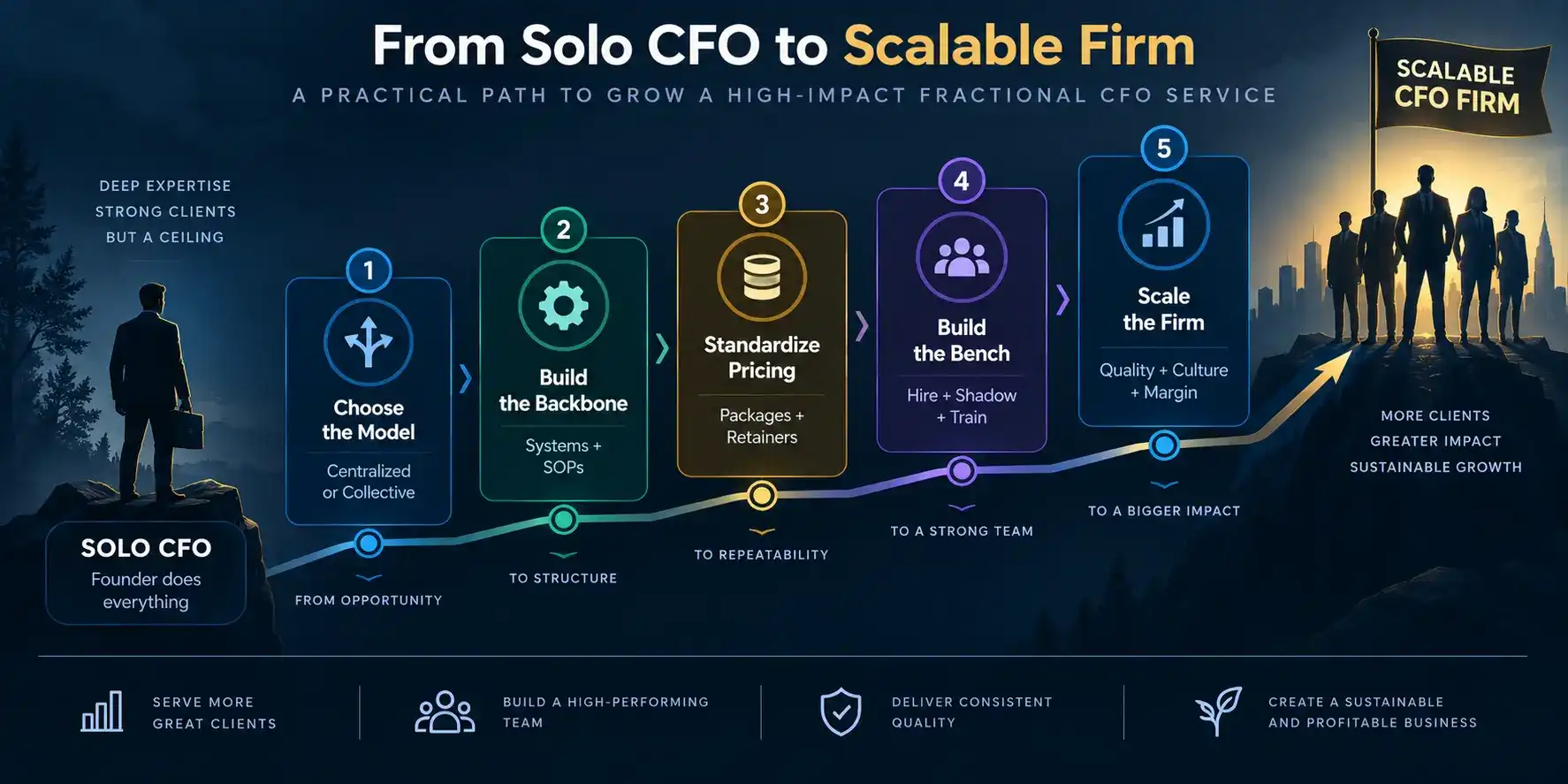
This playbook covers the seven steps behind that transition: spotting the triggers to scale, choosing a firm model, building the operating backbone, redesigning pricing, curating a bench with intention, protecting quality and culture, and planning the business model shift that follows. Done well, scaling a fractional CFO service multiplies impact without diluting the trust that built the practice in the first place.
Identify the Triggers to Scale
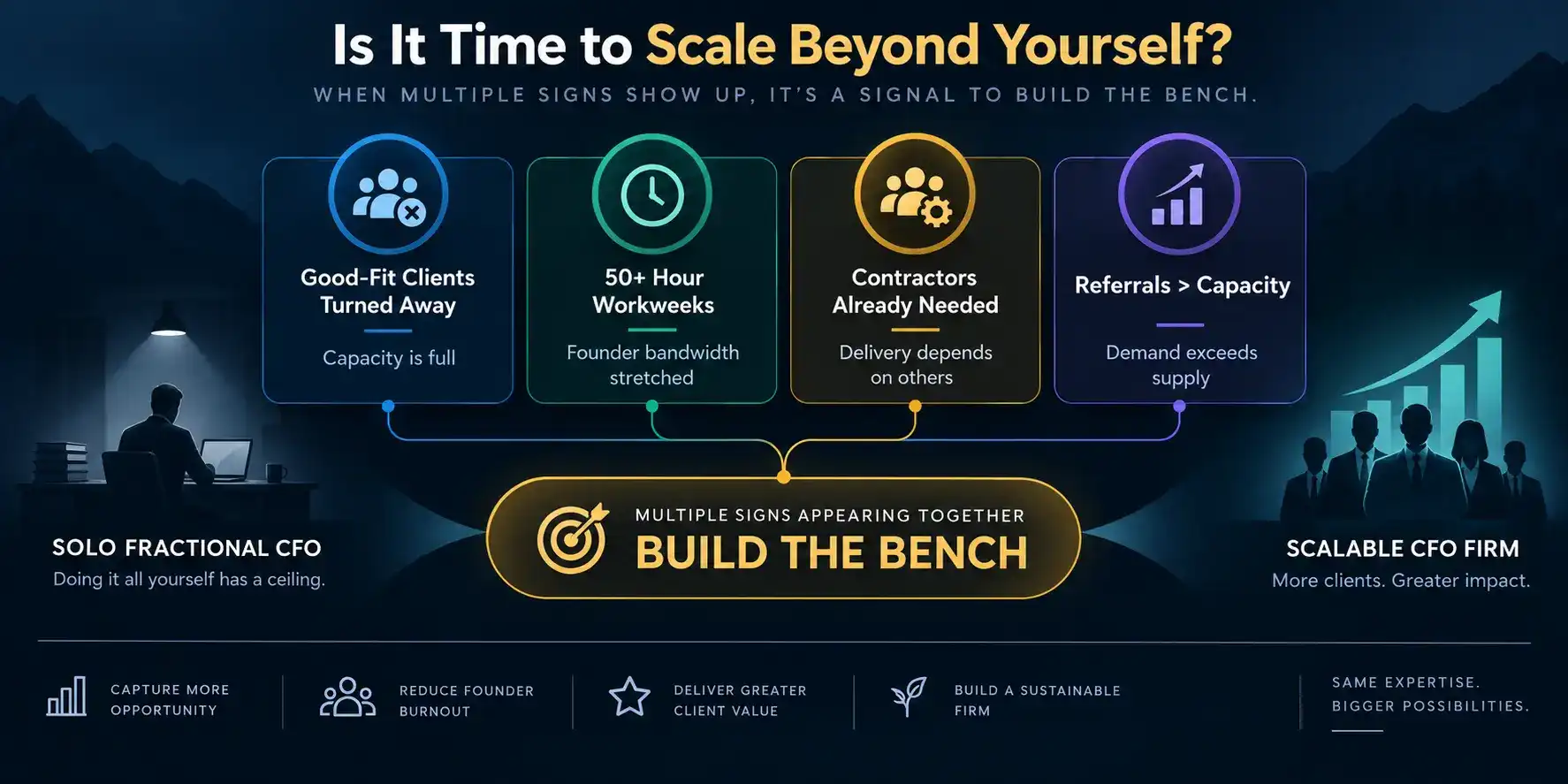
A few signs tend to show up together before the solo model breaks. Good-fit clients get turned away for lack of bandwidth. The workweek quietly exceeds fifty hours. Multiple contractors are already in the mix informally, and inbound referrals keep arriving faster than capacity allows.
Once these signs stack up, the opportunity cost of staying solo starts to exceed the risk of scaling. The question shifts from whether to grow to how to grow without losing what made the practice work.
Decide Your Firm Model
Two structures dominate this decision. In a centralized firm, the founder owns every client relationship while staff handle delivery behind the scenes. In a collective model, clients contract directly with the firm, and delivery is shared across the bench rather than routed through one person.
The right choice comes down to how much control and client intimacy the founder wants to retain. A centralized model keeps the founder as the face of every account. A collective model spreads that exposure, and the load, more evenly.
Build the Operating Backbone Before You Hire Fractional CFO Talent
Infrastructure has to exist before people get added to it. Shared tools such as a shared drive, a messaging platform, and a project tracker are the baseline. Standard operating procedures for onboarding, reporting, billing, and quality review come next, alongside contract templates, invoicing systems, and compliance processes.
This is where many solo CFOs stumble, because the business needs to run without the founder’s direct involvement in every task. Managing finance and revenue operations across US and offshore delivery centers for a cybersecurity and identity access management company, spanning five countries and more than 230 employees, made this dependency visible early. A reporting cadence and a driver-based forecasting engine only scale when they do not require one person to hold every detail in their head.
Develop a Scalable Pricing Model
Custom quotes work at a small scale and become a bottleneck at a larger one. Moving to tiered service packages, monthly retainers or milestone-based pricing, and clearly defined deliverables and timelines lets clients self-select into the right tier, which reduces sales friction on both sides.
A tier built for startups just past pre-seed looks different from one built for Series A and B companies, and both look different from a growth advisory tier aimed at later-stage clients preparing for an exit. Defining these tiers up front removes the guesswork from every new client conversation.
Curate and Train Your Bench Before You Hire Fractional CFO Support
Reactive hiring rarely produces a bench worth trusting. Building it ahead of demand, with controllers, FP&A leads, bookkeepers, and analysts who share a communication style, a toolset, and a set of values, protects quality at the moment scale actually arrives.
Shadowing and pilot engagements are the most reliable training method available. Scaling revenue from $9M to $180M in twenty-four months at a venture-backed digital marketing company required growing a finance team from a single person to twelve, and the hires who worked out were the ones who shadowed real client work before taking it on directly. Quality scales only when culture and expectations are shared, not assumed.
Preserve Quality and Culture as the Practice Grows
Staying personally involved in hiring and onboarding matters even as the firm grows past the founder’s direct capacity. Monitoring client satisfaction and churn, and holding weekly team syncs and retrospectives, keeps small problems from becoming pattern-level ones.
Leading fifteen or more finance professionals across geographies for a publicly listed gaming and digital entertainment company underscored how quickly brand becomes a shared asset once a team exists. Every action taken by any team member reflects back on the firm, and every misstep echoes louder than it would for a solo practitioner. That reality calls for guarding the brand through culture, not through control alone.
Plan the Business Model Shift
A handful of decisions become unavoidable during this transition. Staying client-facing or moving into a management role is one. Raising prices or accepting thinner margins on some accounts is another. Splitting revenue fairly with contractors is a third, and it deserves as much rigor as any client-facing model.
Modeling these scenarios before committing to one clarifies what kind of firm is actually being built, rather than letting the structure emerge by accident from whichever decisions felt easiest in the moment.
A Starting Checklist for the Transition
- Document current services and delivery processes
- Define the ideal firm model: team size, scope, and client profile
- Hire fractional CFO talent for the first bench with intention and shared values
- Build internal tools before expanding external reach
- Protect the brand through culture rather than through control
Three Key Takeaways
- The signs that a fractional CFO service has outgrown the solo model tend to arrive together: turned-away clients, a workweek past fifty hours, and inbound referrals outpacing capacity. Those signs, taken together, are the signal to plan a transition rather than push through it.
- Scaling should begin with infrastructure and firm design, not with hiring. A firm model, an operating backbone, and a tiered pricing structure all need to exist before the first hire joins the bench.
- Culture and brand become shared assets the moment a fractional CFO service adds its first team member. Protecting them takes deliberate hiring, shadowing before client-facing work, and regular team retrospectives, not just good intentions.
Disclaimer: This article is intended for informational purposes only and does not constitute legal, HR, or financial advice. Always consult licensed professionals when building a services firm.
Hindol Datta is a four-time CFO and senior finance executive with over 25 years of leadership experience across cybersecurity, SaaS, gaming, logistics, digital marketing, medical devices, consumer products, and nonprofit organizations. He has led more than $120M in fundraising and over $150M in M&A transactions while building the financial and operational systems that let complex businesses scale with confidence. He is the author of seven books in the Systems CFO Series and holds active CPA, CMA, and CIA credentials.
AI-assisted insights, supplemented by 25 years of finance leadership experience.