Executive Summary
Scaling a CFO practice rarely fails because founder relationships weaken. It fails because the fractional CFO remains the only hands on every engagement. The calendar stops supporting that model long before the founder notices. The practice built its credibility in year one on handling everything personally and answering every message within the hour. That same habit becomes the ceiling on growth by year three. Recognizing that shift matters. Building a bench deliberately, rather than reactively, is what separates a solo consultant from a firm.
This article lays out the signals that a CFO practice has outgrown its founder’s bandwidth. It covers the sequence for building a reliable bench, and the structures that keep client trust intact as delegation increases. The goal is not to hire broadly. It is to hire precisely, in the right order, with the right safeguards. Done this way, scaling a CFO practice adds leverage rather than risk.
Recognizing the Signals That You Are Past the Tipping Point
A CFO practice tends to announce its own limits before the founder is willing to admit them. The calendar leaves no room, so the practice turns away good-fit clients. Deliverables that once went out early now slip past deadline. The standard has not dropped; more clients are simply competing for the same set of hours. Catch-up work fills weekends instead of strategic thinking. Clients start requesting services outside the founder’s core skill set, bookkeeping, detailed FP&A modeling, or systems implementation that a generalist CFO never intended to handle personally.
Any one of these signals is worth noting. Two or more, sustained over a quarter, mean the practice has crossed from a staffing inconvenience into a structural problem. In a high-growth cybersecurity and identity access management company carrying roughly $30M in annual recurring revenue across five countries, the finance function only became predictable once the team deliberately built out the forecasting engine and delivery bench, holding actuals within five percent of forecast for eight consecutive quarters. That kind of consistency does not happen when too many priorities stretch one person thin. It happens when someone maps and distributes the workload before the cracks appear.
Building the Bench: Where to Start When Scaling a CFO Practice
The instinct when scaling a CFO practice is often to hire for the hardest problems first, since those consume the most time. The more durable approach is the opposite. The first hires should absorb the most repeatable, lowest-ambiguity work, freeing the founder’s judgment for the decisions that actually require it.
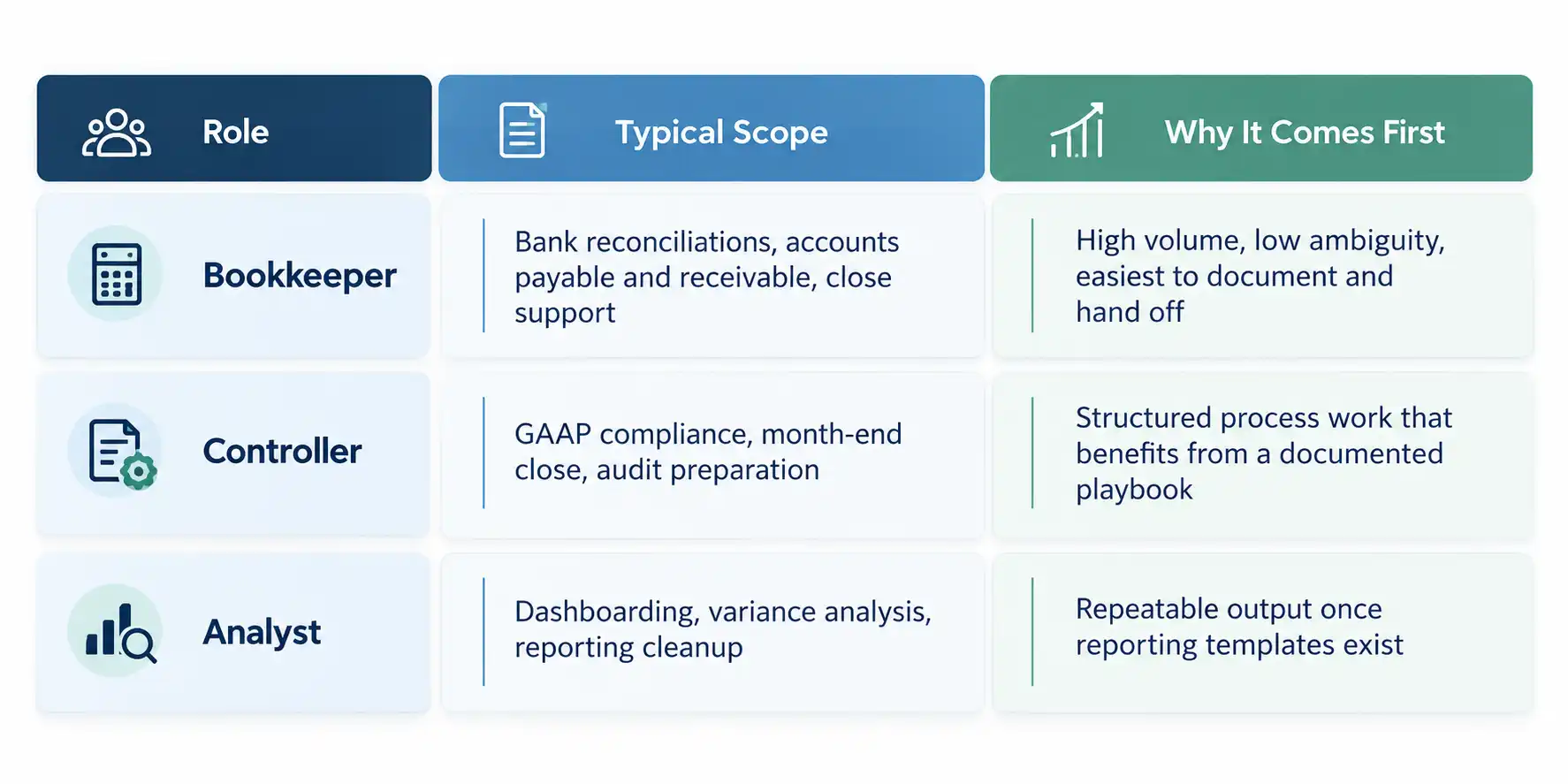
Before any of these roles is filled, the process itself needs to exist on paper. A checklist handed to a capable contractor saves hours every week; a verbal explanation handed to the same contractor produces inconsistent output and, eventually, a client call that should never have happened. The finance operations discipline built inside a venture-backed digital marketing company, one that scaled from $9M to $180M in revenue over 24 months while growing the finance team from a single hire to twelve, depended entirely on documentation built before headcount, not after it.
Matching the Hire to the Complexity
Not every engagement calls for the same sequence. A company still building its first chart of accounts needs different support than one preparing for a Series B raise or an acquisition. The underlying principle holds regardless of stage: document the repeatable work, delegate it first, and reserve direct involvement for the judgment calls that cannot be templated.
Vetting for Skill and Trust Before Delegating
Scaling a CFO practice means putting a stranger, however qualified, in front of a client who trusts the founder specifically. That makes vetting a different exercise than a typical hiring process. Independents and small firms tend to integrate more smoothly than staffing agencies, particularly when they arrive through a referral from an existing professional network rather than a cold application.
A paid pilot project reveals more than any résumé. Watching how a candidate handles ambiguity, how they respond to edits, and whether they can push back on a client respectfully when the client is wrong tells a founder more in two weeks than a portfolio review tells in two hours. Useful questions to ask during that pilot include:
- What happens when a mistake is discovered after delivery, and how quickly is it disclosed
- How does the candidate handle an ambiguous or incomplete brief
- Can the candidate disagree with a client’s request without damaging the relationship
- Is the candidate comfortable with the pace and informality of early-stage or startup environments
Calm confidence under ambiguity matters more than a polished credential list. A subcontractor mix that held bench utilization between five and seven percent during a period of rapid client growth at a cybersecurity SaaS firm was not built on résumés. It was built on pilot projects that filtered for judgment before commitment.
Structuring Engagements to Protect Scope and Clarity
Vague instructions produce vague results, and vague results produce awkward client calls. Every engagement, even a short one, benefits from a scoped statement of work covering four elements: the deliverables and their boundaries, the deadlines and check-in cadence, the rate or fee structure, and clear ownership of the client relationship. None of this needs to be elaborate. It needs to exist in writing before the work begins, not after a misunderstanding surface.
Protecting the Client Relationship While the Bench Grows
Trust built directly with a founder does not automatically transfer to a new contractor. It has to be handed off deliberately. A brief, specific introduction, naming the collaborator and their role, does more for client confidence than a generic notice that additional support has been added. Framing the benefit matters as well: explaining that the new support frees senior attention for forecasting, board preparation, or investor conversations reassures the client that quality has not been diluted, only redirected.
The founder remains accountable for the output regardless of who produced it. That accountability is what preserves the relationship. Multi-function leadership at a $127M global consumer products company, spanning the full P&L, supply chain, and four consecutive clean external audits, only worked because the client always knew who owned the result, even when specialists were executing pieces of it.
Building Feedback and Handoff Loops
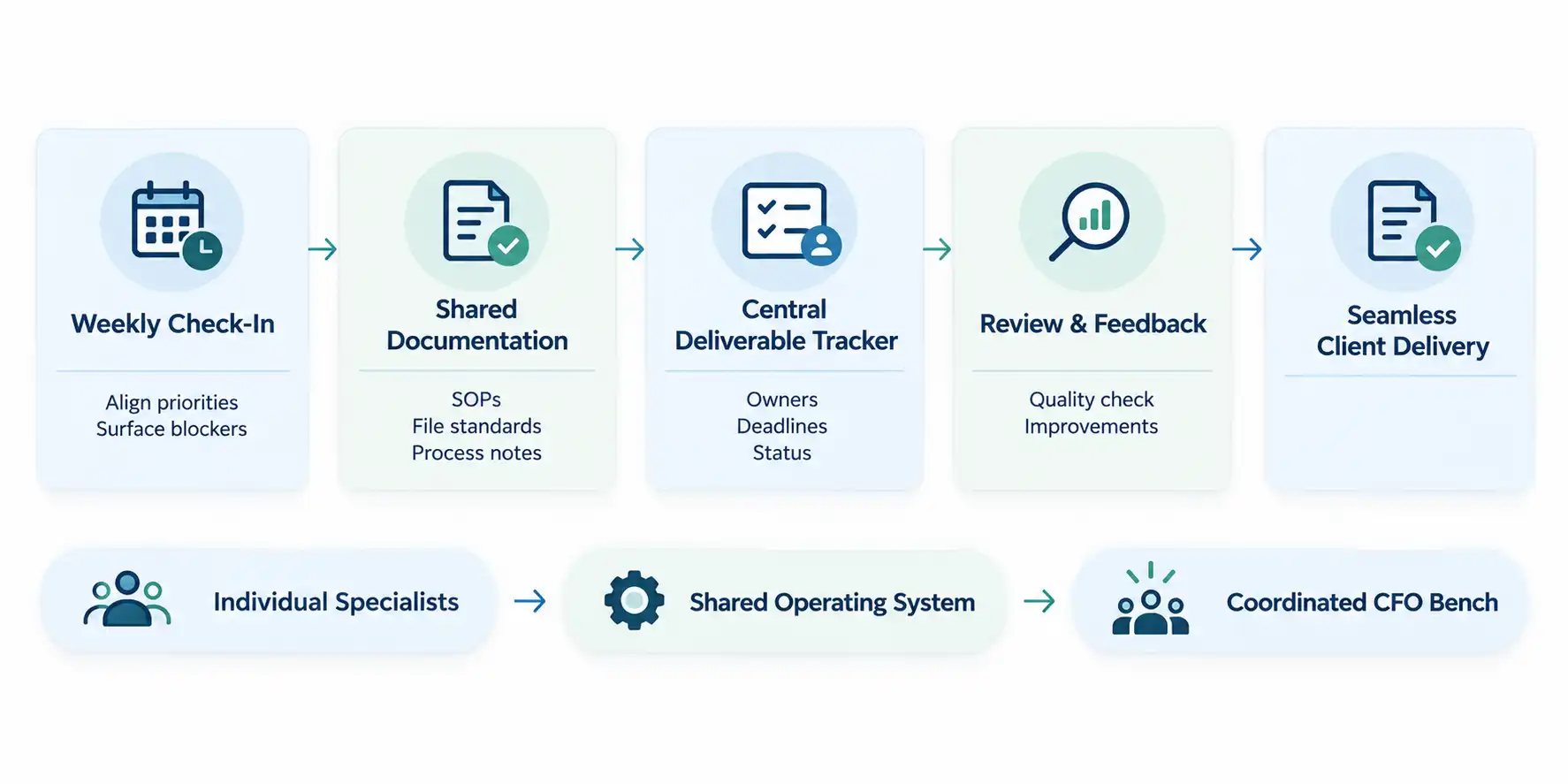
A bench that operates like a loose collection of contractors will eventually show the seams. Weekly check-ins on active projects, shared documentation, and consistent feedback loops turn a group of independents into something closer to a team. Shared SOPs, standardized naming conventions for files, and a master deliverable tracker create the kind of continuity where one analyst falling ill does not stall a client’s close. That level of cohesion, built and tested across a global gaming company’s finance function spanning five countries under both IFRS and US GAAP, depended on documentation robust enough that a fifteen-person team could operate from the same playbook regardless of time zone.
Knowing When to Formalize the Model
At a certain point, a CFO practice with a mature, well-documented bench looks less like an individual consultant with contractors and more like a firm. The signals for formalizing include:
- Shared branding or a firm-level website distinct from the founder’s personal identity
- Tiered pricing based on the depth of support a client selects, from finance administration through full CFO strategy
- Formal revenue-sharing or subcontractor agreements replacing informal hourly arrangements
Formalizing is not required for every practice, and premature formalization can add overhead before the client base justifies it. But for a practice consistently turning away work, running a stable bench, and fielding requests spanning the full range from bookkeeping to strategic finance, formalization converts an informal network into a durable business asset.
Three Key Takeaways
- The signals that a CFO practice needs a bench are visible well before burnout sets in, and they show up as turned-away clients, slipping deliverables, and requests outside the founder’s core skill set; treating these as early warnings rather than temporary noise is what allows scaling a CFO practice to happen on schedule rather than in crisis.
- Sequencing matters more than headcount. Delegating the most repeatable, lowest-ambiguity work first, supported by documented processes and a paid pilot for every new hire, builds a bench that can be trusted with client-facing work without putting the founder’s reputation at risk.
- Client trust survives delegation only when it is actively protected through clear introductions, retained accountability for outcomes, and shared systems that keep the bench operating as a coordinated team rather than a scattered group of contractors.
Disclaimer: This article is intended for informational purposes only and does not constitute legal, tax, or accounting advice. You should consult your own tax advisor or counsel for advice tailored to your specific situation.
Hindol Datta is a four-time CFO and senior finance executive with over 25 years of leadership experience across cybersecurity, SaaS, gaming, logistics, digital marketing, medical devices, consumer products, and nonprofit organizations. He has led more than $120M in fundraising and over $150M in M&A transactions while building the financial and operational systems that let complex businesses scale with confidence. He is the author of seven books in the Systems CFO Series and holds active CPA, CMA, and CIA credentials.
AI-assisted insights, supplemented by 25 years of finance leadership experience.