
Executive Summary
A private equity firm rarely decides its exit strategy in a single boardroom moment. The firm builds it quarter by quarter, from the day capital arrives until the day it rotates back to limited partners. Having sat inside four private equity backed companies as chief financial officer, I have come to see the exit not as an event but as a discipline, one that requires reading buyer intent, market rhythm, and internal readiness at the same time, and shaping the narrative long before a banker ever opens a data room.
This article walks through how exit strategies for private equity firms actually take shape in practice: the divide between strategic and financial buyers, the signals that determine timing, and the organizational work that separates a company that sells well from one that merely sells. None of it is theoretical. It is drawn from years of preparing companies, boards, and finance teams for the moment when ownership changes hands.
The Practitioner’s View of Exit Strategies for Private Equity Firms
When a private equity firm takes control of a company, a clock starts. This is not because the product has grown stale or the team has lost its ambition. The clock exists because limited partners expect returns inside a defined window. Every decision after closing gets filtered through that constraint. I have watched this play out from both chairs, first as the operator building the systems, and later as the finance leader sitting across from the sponsor while preparing the exit case. The lesson that stays with me is that private equity rarely views a business as it is today. It views the business as what it could become under a specific buyer’s lens three or five years out.
That forward orientation changes how a sponsor allocates attention. Not every product improvement matters equally, and not every market expansion earns investment. What matters is whether the move sharpens the story for the buyer universe the fund is targeting. In one cybersecurity and identity access management company where I ran the finance function, we watched the sponsor recalibrate investment priorities in real time as strategic acquirers began consolidating the space, shifting dollars toward integration-friendly product features precisely because those features would matter to a specific class of buyer, not because they carried the strongest standalone return.
Two Buyer Universes, Two Different Companies to Build
Private equity exits strategies generally converge on one of two buyer types, and each expects a different company to walk into diligence. Strategic acquirers operate in the same or adjacent markets. They buy synergy: cost takeout, technology access, or consolidation within their own ecosystem. Financial buyers, typically a larger fund or a platform consolidator, are buying something different: scalability, recurring revenue, and a margin trajectory clean enough to support their own future exit. The valuation logic differs as much as the buyer psychology does.
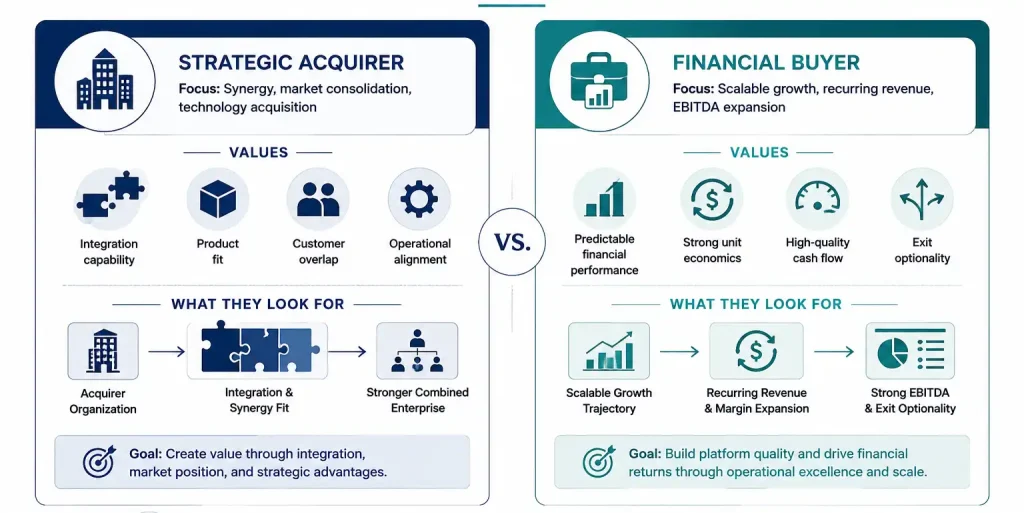
| Dimension | Strategic Acquirer | Financial Buyer |
| Primary interest | Synergy, market consolidation, technology access | Scalability, cash flow, exit optionality |
| Valuation basis | Strategic impact, often with earnouts or stock | Multiple of stable, forecastable EBITDA |
| Diligence focus | Cross-functional fit: product, HR, legal, customer success | Quality of earnings, cohort data, forecast accuracy |
| Narrative built for the buyer | Adjacency and integration thesis | Retention, churn, CAC to LTV, predictability |
| Deal friction | Longer cycles, integration risk | Faster, cleaner, less disruptive |
I have built exit materials for both audiences inside the same company, running parallel tracks so leadership could pivot toward whichever buyer type showed real conviction. The data rooms differ meaningfully. Strategic buyers want cross-functional access and integration answers. Financial buyers want granular unit economics and a forecast that has already proven itself over several quarters.
Timing an Exit: Reading the Market Alongside the Company
Founders often assume a buyer arrives once performance is strong, but performance alone rarely closes a deal. It has to intersect with buyer appetite and market timing, and those externalities frequently override internal readiness. I have seen a portfolio company post twenty-five percent revenue growth, expanding margins, and net dollar retention above 120%, and still attract no buyers because the category itself had fallen out of favor after one high-profile failure elsewhere in the sector. The board delayed the process, retooled the go-to-market motion, and waited nearly two years for buyer confidence to return. The company then sold for close to double the price it would have commanded at the earlier moment.
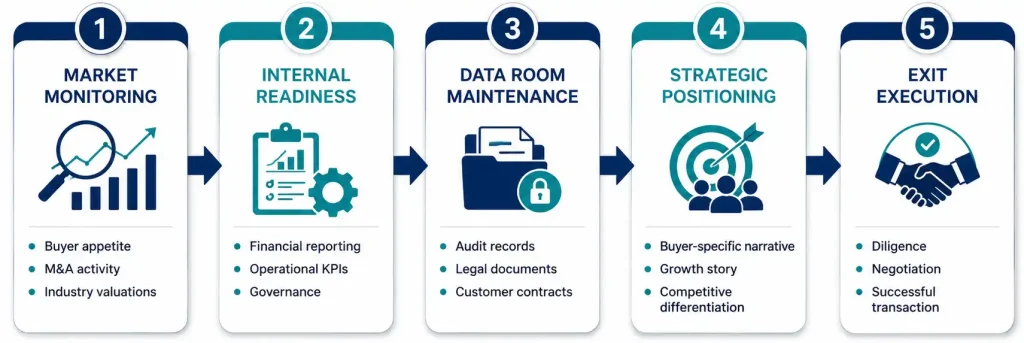
This is why private equity treats exit readiness as a permanent state rather than a scheduled event. I encourage every finance team I lead to build what amounts to a perpetual data room: current org charts, an updated equity ledger, sales playbooks, pricing analysis, and legal audits. All of it stays maintained continuously rather than assembled under deadline pressure. In a $127M global consumer products company where I served as CFO, that discipline meant our audit history, inventory data, and supply chain records were always current. When strategic conversations opened unexpectedly, we were narrating a documented story rather than building one from scratch.
Signals Worth Tracking Beyond Company Metrics
Sponsors track buyer behavior with the same intensity they track KPIs, and operators benefit from doing the same. Are strategic acquirers deploying integration teams alongside their offers? Are balance sheets healthy enough to absorb a transaction? Is dry powder building pressure on financial buyers to deploy capital before fund cycles close? These signals shift faster than internal operating metrics, and reading them accurately is often what separates a well-timed exit from a merely well-run company that waited too long.
Preparing the Organization for the Two-Year Run-Up
Once a portfolio company approaches roughly two years post-investment, exit machinery begins to hum quietly in the background. Internal audits tighten, banker relationships develop, and boardroom tone shifts even when nothing is announced publicly. The leadership challenge in this window is running the company as though ownership will never change, while simultaneously preparing it to be owned by someone else. That duality is one I have lived through more than once, and it tests operational discipline as much as narrative discipline.
The sponsor, meanwhile, is weighing two questions constantly: which path drives the strongest fund-level return, and which exit window offers the least friction. A strategic buyer offering a premium headline price may still produce a lower internal rate of return once earnouts and a longer diligence cycle are factored in. A financial buyer offering a faster, cleaner close, particularly in a sponsor-to-sponsor deal, can align better with fund mechanics even at a lower nominal price. I have advised leadership teams to evaluate offers through the fund’s return math rather than the sticker price alone. That is the lens the sponsor is actually using.
Culture and Retention During the Run-Up
As leadership senses change approaching, retention risk climbs and uncertainty spreads faster than any memo can contain it. At a mission-driven education and research institution where I served as CFO while also overseeing HR, legal, and operations, we ran open town halls and answered anonymized boardroom questions directly. We framed the transition as an inflection point rather than an ending. Attrition dropped. By the time outside stakeholders engaged, they encountered a team building toward the next phase rather than one waiting to be sold.
Building the Data Layer Buyers Actually Trust
Financial buyers, in particular, scrutinize cohort stability, churn, and CAC to LTV ratios with a level of granularity that punishes disorganized data. I advocate for connecting CRM, ERP, billing, and product usage into a single source of truth well before a process begins. While scaling revenue operations at a venture-backed digital marketing organization from $9M to $180M over twenty-four months, building that unified reporting discipline early was what let the finance team answer diligence questions in real time rather than reconstructing history under a deadline.
Co-Authoring the Exit Thesis
Bankers run the process and draft the CIM, but the most persuasive parts of the story tend to come from inside the company. Buyers are not only purchasing numbers; they are purchasing momentum, clarity, and confidence in the team executing the plan. That clarity depends on adaptive thinking, updating the exit thesis as new information arrives rather than defending an outdated narrative, and that kind of adaptability is only possible when the underlying operating systems are mature enough to absorb change without losing the thread.
Three Key Takeaways
- Private equity exit strategies are built around buyer psychology as much as company performance, so leadership should understand early whether the likely buyer is strategic or financial and prepare distinct narratives, data rooms, and priorities for each path.
- Timing an exit depends on external signals, including buyer balance sheets, integration appetite, and available capital, and these signals deserve the same ongoing attention that a finance team gives to internal KPIs.
- Exit readiness functions best as a permanent operating state rather than a pre-deal scramble, built through continuous financial discipline, a unified data layer, and clear communication that keeps culture and retention intact through the transition.
Disclaimer: This article is intended for informational purposes only and does not constitute legal, tax, or accounting advice. You should consult your own tax advisor or counsel for advice tailored to your specific situation.
Hindol Datta is a four-time CFO and senior finance executive with over 25 years of leadership experience across cybersecurity, SaaS, gaming, logistics, digital marketing, medical devices, consumer products, and nonprofit organizations. He has led more than $120M in fundraising and over $150M in M&A transactions while building the financial and operational systems that let complex businesses scale with confidence. He is the author of seven books in the Systems CFO Series and holds active CPA, CMA, and CIA credentials.
AI-assisted insights, supplemented by 25 years of finance leadership experience.