
Executive Summary
The modern CFO is increasingly asked to behave less like a gatekeeper. Instead, this leader acts more like an internal venture capitalist. Structured experiments replace simple compliance enforcement. This article traces that shift. It shows how capital allocation can move from a budgeting ritual toward a disciplined cycle. That cycle covers hypothesis, measurement, and reallocation. It examines how finance teams build lightweight experiment frameworks. It also covers capital scoring, cohort tracking, and sunset discipline. Sunset discipline lets underperforming bets end with intention rather than inertia. A tiered pricing pilot illustrates this approach in action. Fast framing and tight measurement turned a small test into a scaled feature within a single quarter. Finance no longer waits for permission. It operates with purpose instead, fusing capital with insight so every allocation decision compounds learning as much as return.
From Gatekeeper to Capital Allocator
The traditional finance function has often resembled a gatekeeper, controlling capital, enforcing discipline, and ensuring compliance. Compliance alone, however, does not drive growth. It manages risk. The modern CFO can offer something different instead. This means structured exploration, funding bets, defining guardrails, measuring outcomes, and redeploying capital toward the experiments that actually work. External investors sunset underperforming ventures. Internal finance needs that same willingness to end weak initiatives. This is not punishment. It is a deliberate reallocation of attention and energy.
This mindset places finance at the intersection of strategy, data, and execution. It depends less on checklists and more on pattern recognition, and less on static spreadsheets and more on framing decisions clearly for the teams involved. Two shifts make this possible. One is cognitive, treating every budget allocation as a discrete experiment with its own risk profile and value potential. The other is cultural, building circuits of accountability and decision velocity that match the pace of the business rather than the pace of an annual planning calendar.
Capital allocation in many organizations tends to follow the path of least resistance, rewarding teams that communicate well or ask loudly rather than teams with the strongest evidence. That approach may hold up in stable environments, but it fails quickly in high-velocity, venture-backed companies where experimentation must be systematic rather than accidental.
Treating Every Budget as an Experiment
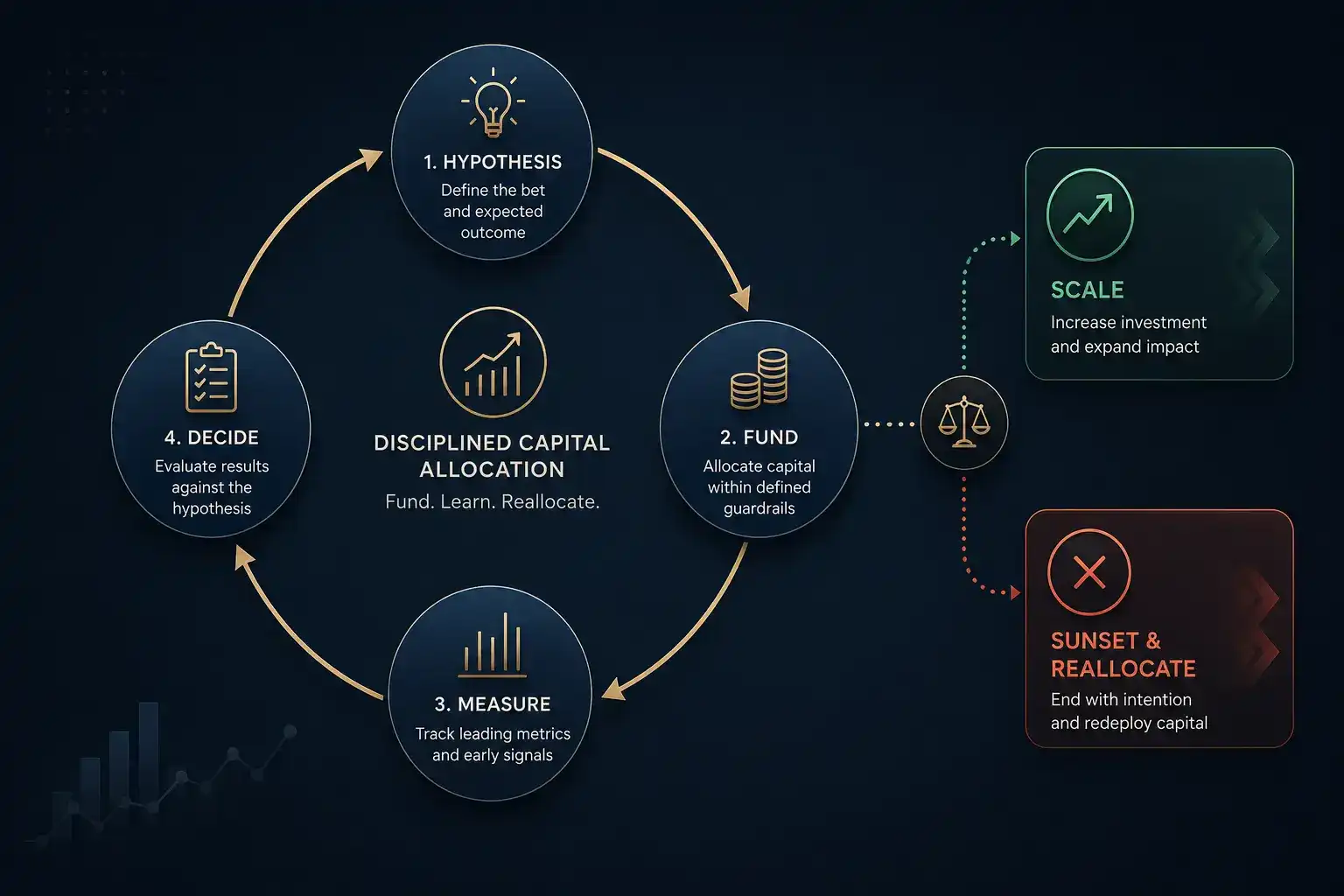
A simple framework can turn this philosophy into practice. Every initiative, whether a product expansion, a marketing pilot, or an infrastructure build, enters planning as an experiment answering four questions:
- What is the hypothesis being tested
- What metrics will prove or disprove it
- What capital is genuinely at risk
- How long before the team revisits the result
A three-month trial period, lightweight dashboards, and biweekly check-ins keep this cycle honest. Early signals get analyzed with straightforward tools rather than elaborate models, and experiment status is published alongside pipeline metrics and cohort retention curves rather than buried in a private spreadsheet. Strategy connects to measurement, and measurement connects directly to resource decisions, the same logic that governs external venture capital, where money flows to experiments that deliver rather than to plans that merely sound persuasive.
The Anatomy of Capital Discipline
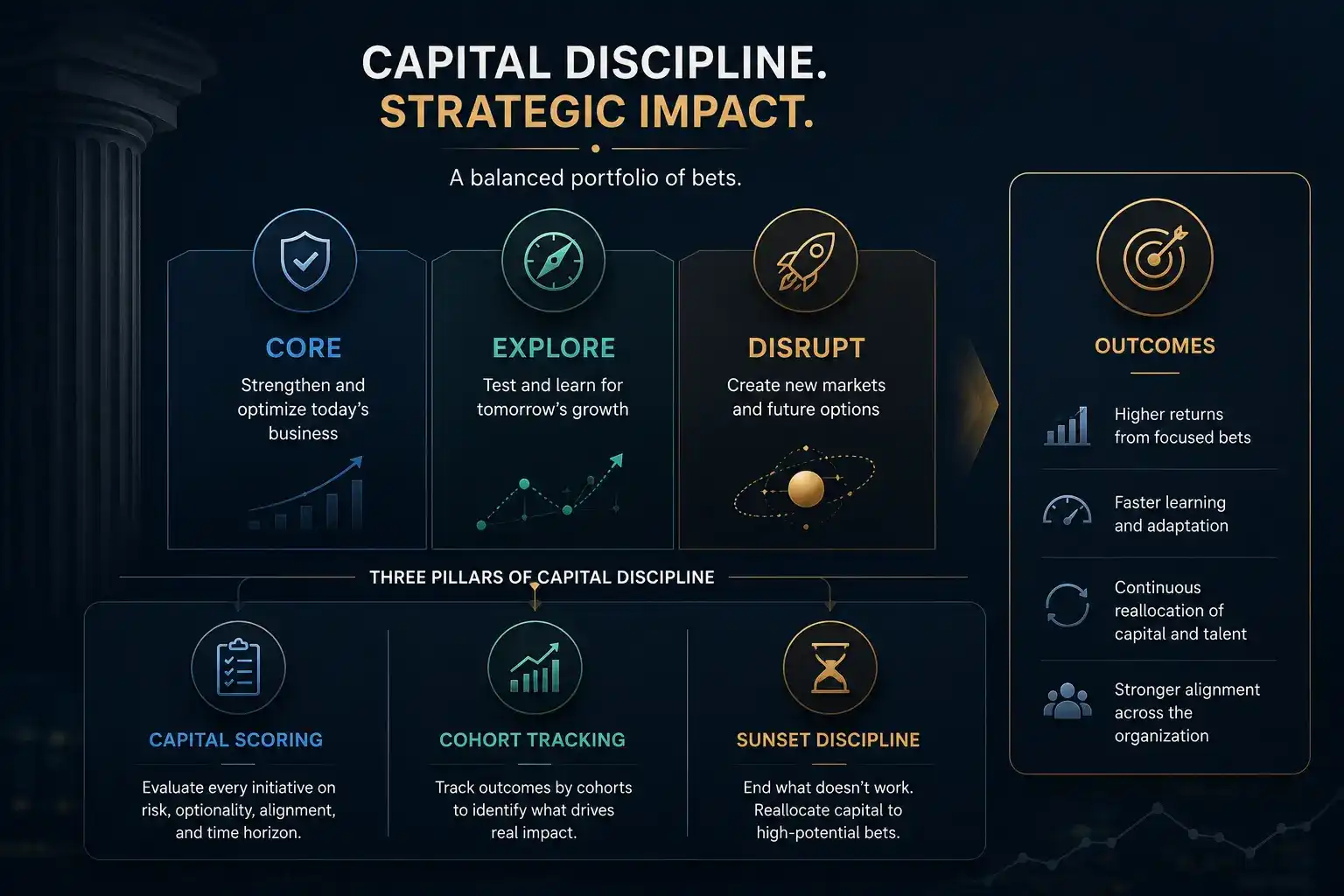
Sustaining this shift depends on three supporting pillars. Capital scoring evaluates each initiative on risk, optionality, strategic alignment, and time horizon, then publishes that score alongside the funding request, forcing a pause before capital moves. Cohort ROI tracking treats internal initiatives like portfolio lines, tagging each project so that outcomes can be traced back to the variables, whether segment, messaging, or pricing, that actually drove results.
Sunset Discipline as the Hardest Pillar
Sunset discipline is the most difficult of the three to sustain. Expiration triggers and calendar checkpoints get built into every pitch from the start. If metrics fail to signal forward motion, the initiative ends on schedule rather than lingering. Without that discipline, capital accumulates in low-performing corners of the business and inertia quietly sets in. With it, capital stays fluid and ambitious teams learn faster, because the organization treats sunsetting as a transition into new funding rather than a quiet failure to be avoided.
Turning Data into a Shared Narrative
Capital is not the only currency finance manages. Information carries equal weight. A shared value ledger connecting capital flows to business outcomes, drawing from billing systems, usage logs, and CRM data into simple weekly dashboards, closes the distance between decisions and their visible impact. Task owners see the consequences of choices across time rather than only in a retrospective quarterly review.
A quarterly portfolio learning day complements this infrastructure. Teams present successes, failures, and surprises together, with finance hosting the conversation rather than policing it. Calibration matters here as much as measurement. Too few experiments slow growth, while too many create confusion, so segmenting investments into Core, Explore, and Disrupt categories helps finance advise on allocation without dictating an exact mix. Legal and compliance teams benefit as well, since templated pilot agreements with built-in sunset clauses reduce contract complexity and long-duration risk, strengthening governance rather than straining it.
Real-World Proof: The Tiered Pricing Pilot
A tiered pricing add-on shows this framework in action. Sales had anecdotal interest from prospects, product wanted room to test, and finance needed assurance that margin would hold. Rather than a formal release, the initiative launched as a pilot with a compact profit and loss model covering gross margin impact, retention sensitivity, and churn risk, tracked over a two-month runway. When early data showed a segment of customers willing to pay a premium without added churn, the team fast-tracked the feature and scaled it within the same quarter.
That outcome came from intentional framing rather than luck. It reflected capital allocation treated as orchestration rather than simple allotment, with finance embedded early in the decision cycle instead of reviewing results after the fact. This is what it looks like when a finance function becomes a genuine strategic business partner to the rest of the organization, funding fast, measuring fast, and adjusting faster still.
Conclusion
The evolving role of the CFO increasingly depends on this willingness to fund with intention, measure with rigor, and learn at pace rather than defaulting to a calendar-driven budgeting ritual. Analysts move from variance detectives to learning architects, designing evaluation logic and coaching teams to frame sharper hypotheses. Capital scoring, cohort tracking, and sunset discipline give this shift structure, while a shared portfolio narrative keeps the whole organization oriented around the same evidence. None of this requires elaborate technology. It requires discipline and a systems perspective applied consistently over time. When a finance leader can say yes, if, rather than simply no, the organization senses invitation rather than restriction, and that invitation tends to scale faster than any capital line alone. The work is never fully finished, but the direction is clear, from auditor to architect, and from steward of the past to catalyst for what comes next.
Disclaimer: This blog is intended for informational purposes only and does not constitute legal, tax, or accounting advice. You should consult your own tax advisor or counsel for advice tailored to your specific situation.
Hindol Datta is a seasoned finance executive with over 25 years of leadership experience across SaaS, cybersecurity, logistics, and digital marketing industries. He has served as CFO and VP of Finance in both public and private companies, leading $120M+ in fundraising and $150M+ in M&A transactions while driving predictive analytics and ERP transformations. Known for blending strategic foresight with operational discipline, he builds high-performing global finance organizations that enable scalable growth and data-driven decision-making.
AI-assisted insights, supplemented by 25 years of finance leadership experience.