
Executive Summary
A carve out checklist is often built around systems, timelines, and cost separation. It rarely accounts for something more fragile. That missing piece is identity. When private equity executes a carveout, the process can unlock real value and sharper strategic focus. It can also fracture culture if leadership treats the transition as a purely financial event. Drawing on decades spent inside carveouts from both sides of the table, this article summarizes what actually preserves a company’s soul during separation. The article covers how to narrate continuity from day one. Governance and incentives, and how they should evolve, get equal attention. It also examines how hiring, systems, and communication either reinforce culture or quietly dilute it. Along the way, it touches on where a transitional service agreement fits into this picture, since integration friction is often mistaken for cultural failure. The goal is simple. Keep the spirit of the business intact while giving it a new operating structure.
Why Culture Is the First Casualty of a Carveout
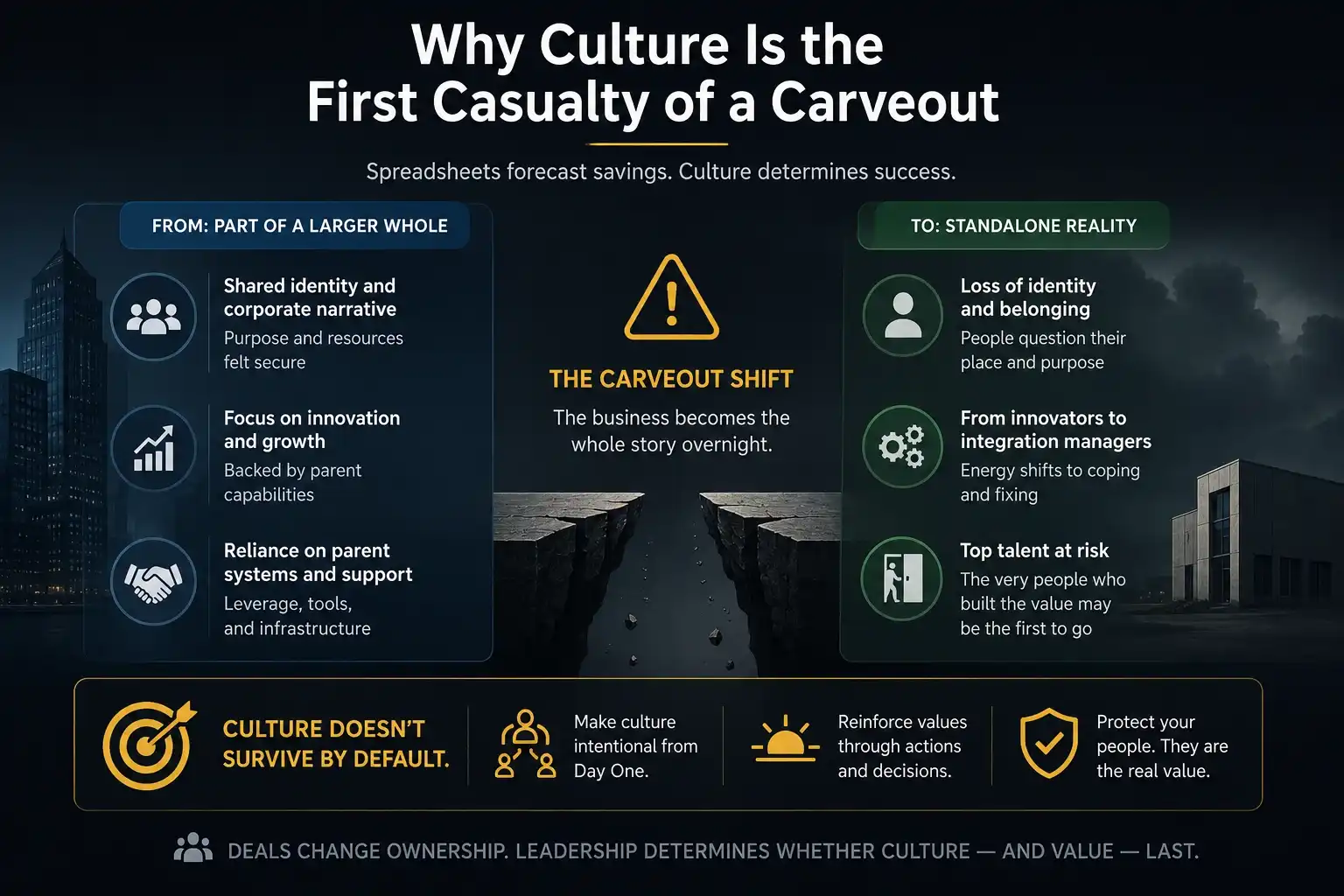
Most carveouts make sense on paper. A parent company divests a non-core unit. Private equity steps in, drawn by a clear margin story. The spreadsheets forecast savings, and the deal team signs off. What rarely shows up in the model is the emotional shift inside the business itself.
A team that once operated inside a larger corporate narrative suddenly becomes the whole story. Leaders who once championed innovation now manage integration instead. People who once leaned on a parent company’s resources must think like standalone operators overnight. The very individuals who made the business worth acquiring are often left searching for a new sense of belonging. The spreadsheets delivered their numbers, but the soul did not automatically follow.
Identity inside a company is not a mission statement. It is not a set of brand colors either. Instead, it is the shared beliefs and unspoken habits that guide behavior when no one is watching. These habits show up in how teams escalate problems, and in how they celebrate wins together. When the infrastructure of a parent company disappears, whatever remains must be intentional. Leaders who treat this as an afterthought usually discover the gap only after key people have already left.
Building a Carve Out Checklist for Cultural Continuity
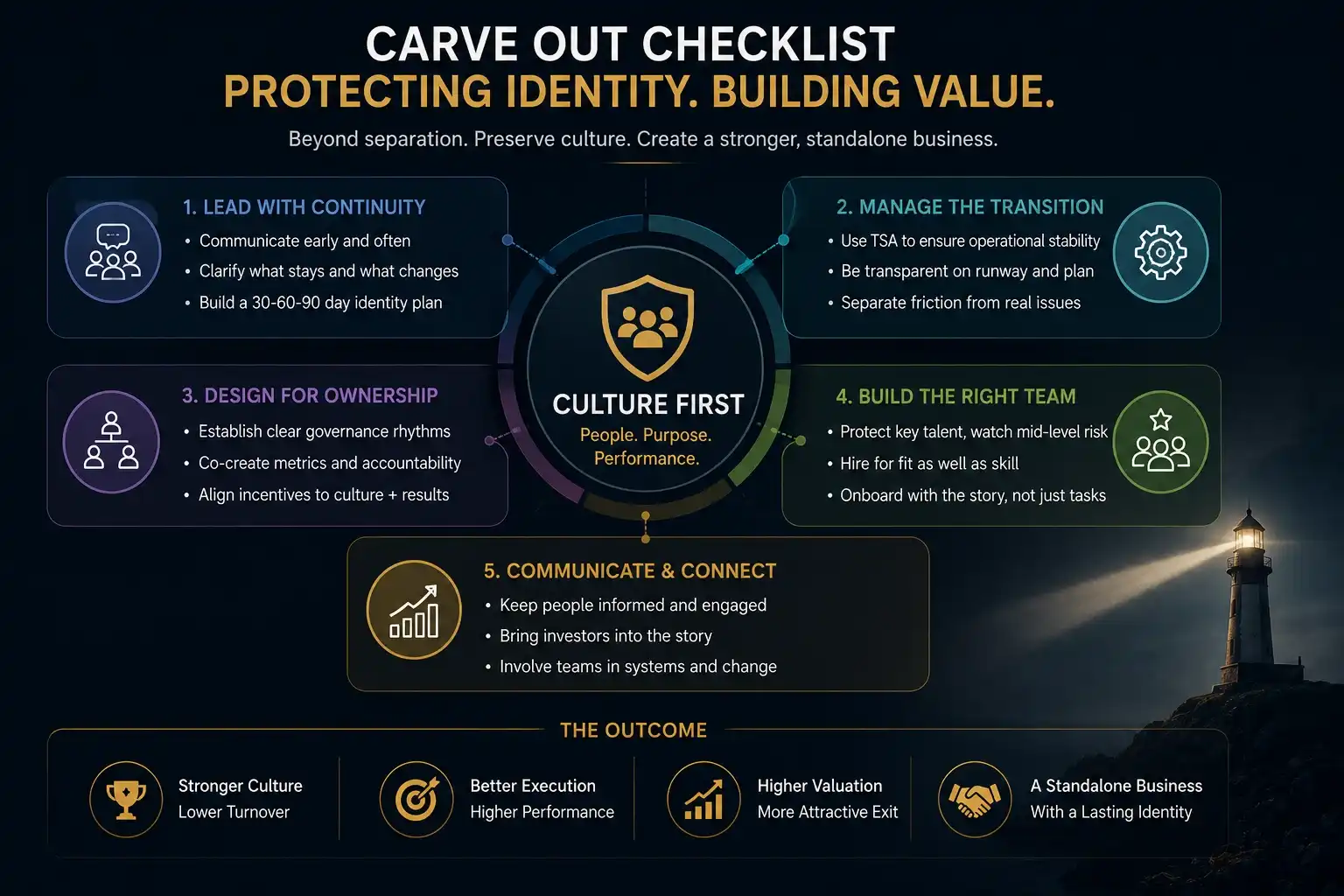
A carve out checklist that only tracks systems migration and cost separation misses half the job. Culture needs its own line items. These need to be built around communication, rhythm, and symbolism from the very first day of independence.
- Narrate continuity early. Gather leadership somewhere familiar and explain plainly what has changed and what has not.
- Build a 30-60-90 day plan focused on identity, not only execution.
- Run weekly stand-ups so communication stays tight during the highest-risk period.
- Watch for attrition risk among mid-level leaders in the first 100 days, since this group often feels most exposed.
- Use symbols deliberately. Renaming a tool or reframing a weekly meeting can signal forward motion without denying the past.
None of these items require a large budget. They require attention and consistency. They work best when leadership treats them with the same seriousness applied to the financial workstreams.
What a Transitional Service Agreement Covers
Understanding tsa meaning in business helps explain why so much energy gets absorbed by operational friction during a spinout. A transitional service agreement is the arrangement that lets a newly separated company keep using a parent company’s systems, support functions, or infrastructure for a defined period after the deal closes. It exists to prevent a hard stop in operations while the new entity builds its own capabilities from scratch.
The difficulty is that TSA timelines are tight. Shared systems tend to break down before replacements are fully ready. This creates real fatigue among teams. That fatigue is often mistaken for a cultural problem, when in fact it is an operational one. Investing early in financial transparency helps here. When employees can see the runway and the investor thesis in plain numbers, they can separate genuine uncertainty from ordinary transition friction.
Governance, Incentives, and Talent After Separation
Once the ceremonial part of a carveout ends, usually by the second quarter, the real work of building a business begins. This is the moment when culture either solidifies or quietly dissolves. Charisma alone will not sustain it beyond the first hundred days. Structure will.
A useful operating rhythm includes monthly operating reviews and quarterly strategic checkpoints. It also includes weekly management syncs. Each meeting needs a clear purpose behind it. In one carveout, tension peaked during budgeting season. A parent company’s flexible, growth-led approach collided with a sponsor’s stricter cost models. Rather than imposing a new framework from above, leadership invited each department to co-create its own metrics. Resistance turned into ownership almost immediately. Marketing built its own dashboard. Engineering mapped delivery timelines to cost. Accountability rose, and morale rose alongside it.
Compensation deserves the same intentional redesign. Founder-led teams are often motivated by mission rather than pure output. After a spinout, equity can become more distributed and harder to track. Rebuilding equity programs for visibility matters here. Tying short-term rewards to cultural behaviors, such as mentorship and team leadership rather than revenue alone, sends a clear signal. It tells people that protecting the culture is worth rewarding in real terms.
Hiring is the next pressure point most carveouts face. Standalone businesses often need to backfill shared services quickly. The temptation is to prioritize raw skill over cultural fit. Every new hire either reinforces or dilutes the culture that is forming in real time. Including original team members on interview panels helps guard against this. Building onboarding around the actual story of the spinout does too. Recruiting becomes both a tactical task and a symbolic one.
Communication and the Human Side of Separation
Large parent companies often rely on formal announcements and hierarchical messaging. Once a business becomes standalone, that structure flattens quickly. The gap it leaves behind creates both risk and opportunity in equal measure. A deliberate communication architecture helps close that gap. Weekly updates from leadership, rotating department spotlights, and informal touchpoints all give people a steady sense of presence rather than volume.
The relationship with the private equity sponsor also needs careful framing. Employees often see investors as distant and purely analytical figures. Most sponsors actually want the business to succeed. They simply use a different vocabulary to express it. Bringing investment partners into all-hands meetings changes this dynamic. The goal is not to discuss returns, but to explain why they believed in the team in the first place. That conversation turns the sponsor from an outside observer into a genuine ally.
Systems selection matters here too, more than most leaders expect. New ERPs, CRM platforms, and data tools tend to arrive quickly under private equity ownership. If they are dropped on a team without context, they create friction rather than efficiency. Involving cross-functional leads in systems selection changes the outcome. Building tools around how teams actually work, rather than around a generic template, turns adoption into a matter of trust rather than compliance.
Exit Readiness as a Cultural Alignment Tool
Exit planning shapes every private equity backed company, and carveouts are no exception to that rule. Thinking about exit early is not a distraction from culture. It is an alignment tool in its own right. When employees understand that value creation is the shared mission, their perspective shifts. They begin to see how product velocity drives valuation. They begin to see how retention feeds multiple expansion. Culture stops being a soft factor at that point. It becomes a measurable advantage, one that reduces turnover and improves how attractive the business looks to a future buyer.
Balancing legacy and reinvention is the deeper design challenge underneath all of this work. Quarterly retrospectives help make that balance concrete. Three questions tend to work best here. What made the team proud, what held it back, and what it wants to become are worth asking every quarter. These questions turn reflection into a genuine steering mechanism rather than a box-ticking exercise conducted once a year.
Conclusion
A carve out checklist that only tracks systems and cost separation will miss the part of the business most likely to break. Identity is fragile during a spinout. It survives only when leadership treats continuity, incentives, and communication with the same rigor applied to a transitional service agreement or a financial model. The lesson from real carveouts stays consistent across industries. Narrate what has changed honestly. Build governance rhythms that give people predictability. Redesign incentives so they reward the behaviors that hold a culture together. Treat hiring and systems adoption as trust-building exercises rather than administrative tasks. None of this replaces the operational discipline that private equity brings to a business. It simply ensures that discipline has a culture worth protecting underneath it. When leaders honor the past without clinging to it, and design new structures that reinforce shared values, a carveout becomes more than a legal and financial event. It becomes a company that remembers who it is while becoming something stronger.
Disclaimer: This blog is intended for informational purposes only and does not constitute legal, tax, or accounting advice. You should consult your own tax advisor or counsel for advice tailored to your specific situation.
Hindol Datta is a seasoned finance executive with over 25 years of leadership experience across SaaS, cybersecurity, logistics, and digital marketing industries. He has served as CFO and VP of Finance in both public and private companies, leading $120M+ in fundraising and $150M+ in M&A transactions while driving predictive analytics and ERP transformations. Known for blending strategic foresight with operational discipline, he builds high-performing global finance organizations that enable scalable growth and data-driven decision-making.
AI-assisted insights, supplemented by 25 years of finance leadership experience.