Executive Summary
The ideal customer profile is often treated as a marketing artifact. In practice, it functions as one of the most consequential financial controls inside any revenue organization. This article draws on more than twenty five years of executive finance leadership. That experience spans cybersecurity, SaaS, gaming, logistics, digital marketing, medical devices, and nonprofit sectors. It examines how a well governed customer profile shapes margin, forecast accuracy, and organizational discipline. The article also explores the layered framework needed to balance global consistency with local nuance. In addition, it examines the deal desk as a live signal filter. And it looks at the role finance must play as steward of fit quality across marketing, sales, and customer success. Real cohort data supports these points, drawn from closed won deals rather than intuition. That data shows how fit correlates directly with retention, support cost, and forecast reliability. The conclusion is straightforward. Fit is not a filter applied after the fact. It is the foundation on which durable, capital efficient growth is built.
What Is ICP in Business, and Why Finance Should Own It
Ask ten executives to define customer fit. Most will describe a list of firmographic attributes: industry, headcount, geography, perhaps a use case or two. That description is not wrong. But it is incomplete. A properly constructed ideal customer profile is a statement about where a company earns durable margin. It also states where a company does not earn durable margin. It is, in effect, an economic model dressed in the language of segmentation.
A useful way to frame what is ICP in business is to think of it as an economic boundary rather than a target list, one that separates accounts a company can serve profitably from accounts it merely can serve.
Over a career spent as CFO and VP of Finance, I have worked across a range of organizations. These range from a cybersecurity and identity access management firm to a global logistics and wholesale enterprise. Across that career, I have come to see customer fit as a control mechanism rather than a branding exercise. The questions that matter most rarely appear in a positioning deck. What does it cost to serve a segment that resembles our best customers but is not actually them? How much selling time is lost pursuing logos that later churn or downgrade? These are finance questions, and they deserve a finance answer.
Some organizations treat their ideal customer profile as a static list. These organizations tend to define it once and revisit it rarely. Other organizations treat it as a living, empirical variable. These organizations tend to compound their advantage year over year. That is because they keep measuring what actually happened after the deal closed.
The ICP Stack: Balancing Global Consistency and Local Nuance
When I took on responsibility for finance operations spanning North America, EMEA, and APAC, it became clear quickly how fragile a single, uniform customer profile can be once it crosses borders. The value proposition rarely changes from one region to another. The surrounding constraints do. Procurement cycles, budget structures, support expectations, and even the local interpretation of urgency all vary in ways that a single global document cannot capture.
The resolution was not to abandon a global standard, but to build what might be called a three tier ICP stack.
| Layer | Purpose | Example |
| Global framework | Attributes that correlate with high value, low friction revenue everywhere | Multi year purchasing intent, executive sponsorship, integration readiness |
| Regional modifiers | Adjustments for cultural, economic, and regulatory context | Flexible ramp schedules in parts of Southeast Asia where budget approvals follow different cadences |
| Field driven nuance | Insights from local sellers, partners, and finance teams closest to the deal | Stronger privacy compliance alignment required as a baseline in parts of Europe |
As CFO, validating these regional variants meant running cohort analyses market by market. Each analysis checked whether an adjusted profile still produced strong LTV to CAC ratios. It also checked whether the profile produced reasonable operational efficiency. Where the numbers did not hold, we tightened the criteria. Where they did hold, we institutionalized the learning across comparable markets. The result over time was something closer to a distributed intelligence system. That system respected local knowledge while preserving global accountability. Sellers felt heard. Field marketing could operate with genuine context. And finance could build scenario plans with a level of realism. A one size fits all profile never allowed that level of realism.
ICP in Sales: From Static Document to Empirical Variable
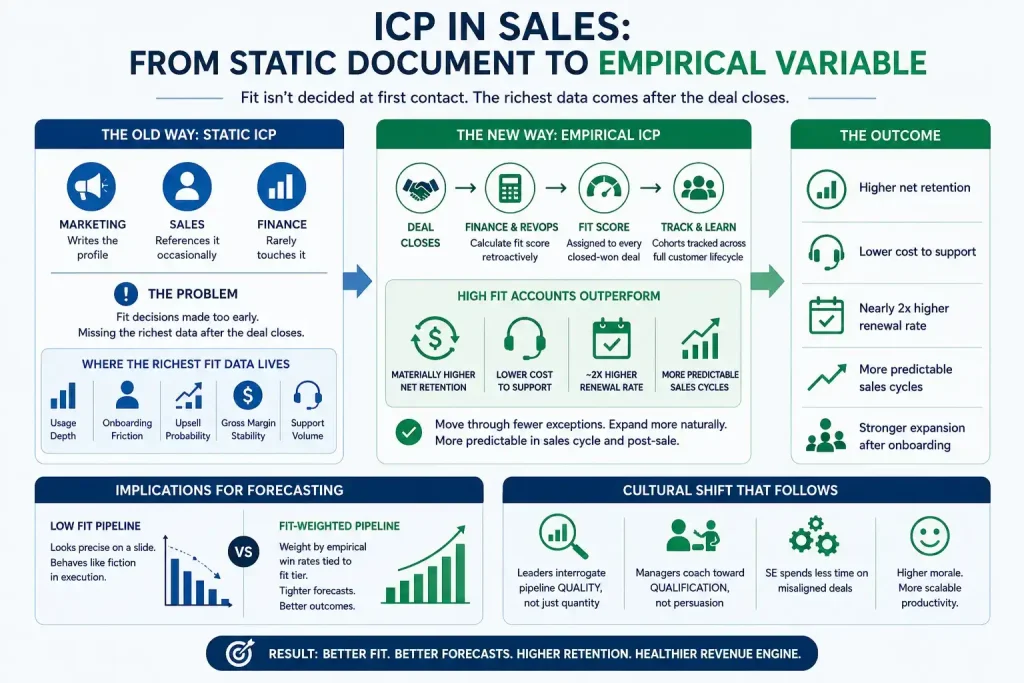
Understanding ICP in sales requires letting go of the idea that a company decides fit once, at the top of the funnel, and never revisits it. In most organizations, marketing writes the profile, sales references it occasionally, and finance rarely touches it. That is a missed opportunity, because the richest fit data does not exist at the point of first contact. It exists after the deal closes, in usage depth, onboarding friction, upsell probability, gross margin stability, and support volume.
At one global organization, we introduced a fit score for every closed-won deal, calculated retroactively by finance and revenue operations rather than by sales or marketing. Over time, this produced fit based cohorts that could be tracked through the full customer lifecycle. High fit accounts delivered materially higher net retention, cost meaningfully less to support, and renewed at nearly double the rate of low fit peers. Just as important, they behaved with more predictability through the sales cycle itself, moving through fewer exceptions and expanding more naturally once onboarded.
This has direct implications for forecasting. A pipeline populated with low fit opportunities produces a forecast that looks precise on a slide and behaves like fiction in execution. Weighting pipeline by empirical win rates tied to fit tier, rather than treating every opportunity as equivalent, produced not only a tighter forecast but a cultural shift. Regional leaders began interrogating pipeline quality rather than quantity. Sales managers coached toward qualification rather than persuasion. Sales engineering spent less time supporting misaligned deals, which improved both morale and scalable productivity.
The Deal Desk as a Signal Filter, Not a Gate
If the pipeline is the circulatory system of a go to market motion, the deal desk functions as its immune system. For many years, organizations have treated it as a transactional gatekeeper, a place where they approve or deny discounts and non standard terms. In a properly designed operating model, it becomes one of the most powerful sensing tools available to finance.
The shift begins with how exceptions are logged. Rather than categorizing requests only by type, such as discount or billing frequency, each deviation can carry metadata describing region, vertical, rep tenure, solution complexity, and fit score at the time of quote. Reviewed monthly not as a compliance exercise but as a source of signal, patterns tend to surface quickly.
- Certain segments repeatedly requiring exceptions on implementation timeline often point to a mismatch between product readiness and buyer expectation.
- Recurring requests for unusual invoicing formats often reveal localized procurement friction rather than pricing objections.
- In some Latin American markets, consistent deviation around currency stabilization clauses led directly to localized contract addenda that preempted the need for future exceptions.
These adjustments are not cosmetic. In one instance, we found that a vertical widely considered high fit was margin negative once we accounted for exception driven customization, a discovery the deal desk surfaced well before post sale systems would have caught it.
That insight fed back into finance revenue projections, into sales education about which concessions correlate with expansion versus churn, and eventually into the CPQ tooling itself, which began offering guided alternatives based on similar, successful past deals. Approval cycles shortened, sales representatives gained confidence, and finance gained visibility into risk before it compounded.
Marketing and Customer Success Aligned to Fit
A revenue organization cannot treat customer fit as a top of funnel concern alone. Marketing teams that align spend and messaging to a well maintained ideal customer profile tend to speak with more clarity, qualify with greater precision, and build content that resonates with decision makers rather than only influencers. Tracking conversion through to renewal, not simply lead to opportunity, keeps that alignment honest over time.
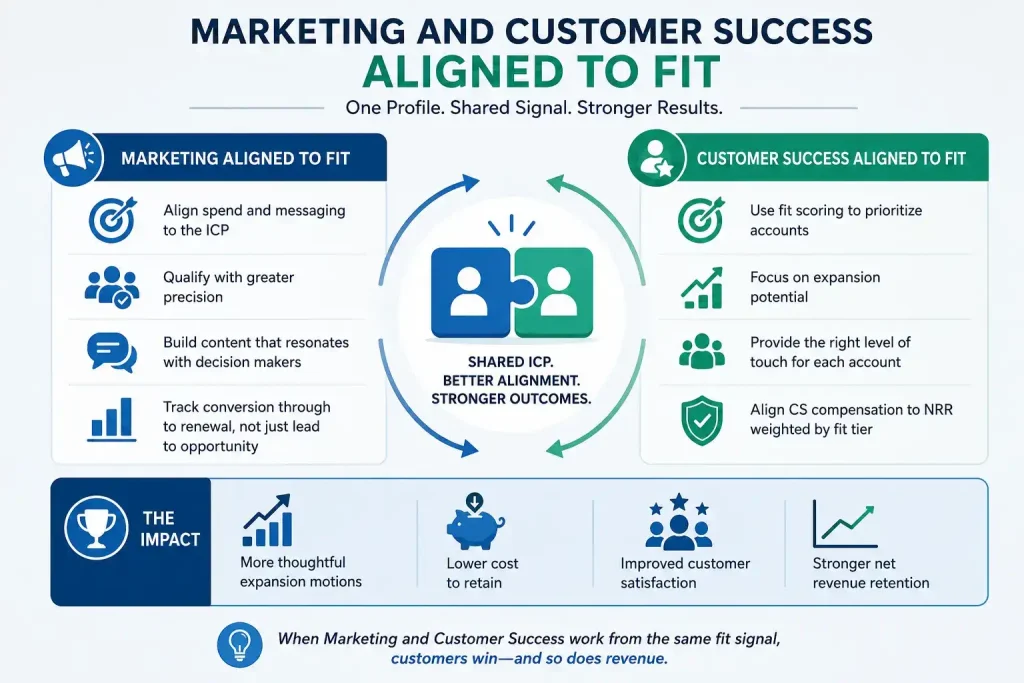
On the customer success side, fit scoring helps teams move from reactive fire fighting toward deliberate account planning. Success teams gain a clearer sense of where to invest, which accounts are likely to expand, and which need a more strategic touch. In one initiative, aligning customer success compensation to net revenue retention weighted by fit tier produced a fairly immediate shift in time allocation, more thoughtful expansion motions, and a lower overall cost to retain, even as satisfaction scores improved.
Finance as Steward of Fit Quality
It is common to assume finance plays a supporting role in revenue operations. Experience suggests the opposite. Finance holds the data that reveals the true cost of misalignment. It also carries the cross functional standing to hold sales, marketing, and customer success accountable to a shared definition of fit.
This discipline has applied across roles spanning digital marketing, gaming, logistics, and education technology. In these roles, building fit based dashboards that were predictive rather than merely descriptive proved to be one of the more durable contributions a finance function can make. Modeling customer acquisition cost by cohort was part of this work. So was tracking lifetime value by segment. So was calculating support intensity per dollar of revenue. Together, these reshaped decisions ranging from pricing tiers to hiring plans to geographic expansion. In one case, disciplined fit stewardship supported a capital raise exceeding one hundred and twenty million dollars. Investors could see that growth was being pursued within a defined and measured boundary rather than pursued indiscriminately. In another case, at a mission driven education institution, a forty eight million dollar raise rested in part on the same principle. Growth backed by clear customer economics is growth that can be trusted.
This same discipline has applied across more than one hundred fifty million dollars in merger and acquisition activity. In that work, the first question worth asking about any target is not how large its customer base is. The better question is how well that base matches the acquirer’s own definition of fit. A gaming sector acquisition program exceeding one hundred million dollars depended on this same underlying logic. So did a digital marketing platform that scaled from nine million to one hundred and eighty million dollars in revenue. Scale without fit discipline eventually becomes fragile. Scale built on measured fit compounds.
Conclusion
The ideal customer profile is not a slogan for a sales kickoff. Nor is it a slide for a marketing planning session. It is an operating variable. It should be measured, revisited, and enforced with the same rigor applied to any other financial control. Three things together produce a revenue engine that scales with integrity rather than fragility. The first is building it as a layered stack that respects both global consistency and local nuance. The second is treating the deal desk as a sensing organ rather than a gate. The third is holding finance accountable as steward of fit quality. Companies that internalize this discipline hire better, close better, and retain better. They do this without exhausting their people or their balance sheet in the process. Capital discipline matters more than it has in years. In this environment, the discipline of fit is not an optional refinement. It is the clearest path available to those who lead with numbers and think in systems. That path leads toward revenue that is built to last.
Disclaimer: This blog is intended for informational purposes only and does not constitute legal, tax, or accounting advice. You should consult your own tax advisor or counsel for advice tailored to your specific situation.
Hindol Datta is a seasoned finance executive with over 25 years of leadership experience across SaaS, cybersecurity, logistics, and digital marketing industries. He has served as CFO and VP of Finance in both public and private companies, leading $120M+ in fundraising and $150M+ in M&A transactions while driving predictive analytics and ERP transformations. Known for blending strategic foresight with operational discipline, he builds high-performing global finance organizations that enable scalable growth and data-driven decision-making.
AI-assisted insights, supplemented by 25 years of finance leadership experience.