
Executive Summary
Private equity value creation is not a slogan. This is a discipline that reshapes how a company operates. The company begins to measure itself differently and reward its people differently. Long-term health is protected too, even while meeting the demands of new ownership. My finance leadership spans more than twenty-five years, across cybersecurity, SaaS, gaming, logistics, digital marketing, and nonprofit sectors. This article walks through the operating model shift that founder-led companies face once private equity enters the picture. The first one hundred and eighty days are covered in detail. Three levers anchor a credible value creation plan, and each one gets its own attention. Next comes the incentive architecture that turns cost centers into margin contributors. Finally, the governance rhythm that earns board trust rounds out the discussion. The article closes with a look at exit readiness, since the countdown to exit begins the day the transaction closes. The goal throughout is simple. Protect the soul of the business while proving, in numbers, that it can compound.
Why Private Equity Value Creation Demands a New Operating Philosophy
When private equity enters a company, the vocabulary of leadership changes almost overnight. Words like runway, burn, and product market fit give way to EBITDA, working capital, and debt covenants. Having operated at the intersection of finance and strategy for more than two decades, I have watched this transition play out across cybersecurity, software as a service, gaming, logistics, digital marketing, and nonprofit organizations, and I have come to see it as far more than a change in terminology. It is a complete shift in the philosophy of value creation, one that asks leaders to reorient strategy without losing the soul of the product or the loyalty of the customer.
Founders typically lead with vision. They rally teams, raise capital, and bet on acceleration, measuring success through user growth and market share, often ahead of near-term profitability. Private equity sponsors think differently. They focus on cash flow, capital efficiency, and measurable outcomes, bringing structure where there was once freedom. I have sat across the table from founder-led teams that grew to tens of millions in revenue, only to be asked by a new sponsor why net revenue retention looked the way it did, or why selling and administrative costs were growing faster than gross margin. These are not antagonistic questions. They are clarifying ones, and they mark the moment a company must begin serving both its customers and its capital.
Many product-centric leaders treat EBITDA targets as a threat to innovation, fearing that a focus on margin will slow invention. My experience across gaming, logistics, and digital marketing organizations suggests the opposite. EBITDA discipline forces clarity. It separates genuine innovation from quiet inefficiency, and when margin targets are tied to incentive plans, teams begin to self-correct without sacrificing customer experience. EBITDA becomes a compass rather than a constraint, ensuring that creativity ultimately pays for itself.
Building the Value Creation Plan in the First 180 Days
Private equity firms move quickly. They rarely ask for a three-year roadmap. They ask what will change in the next ninety days. That urgency demands a new operating model. This model replaces gut feel with systems intelligence. I have led finance transformations built on this same idea. One example is a multi-entity architecture spanning several countries. It cut a company’s month-end close by more than half. From this work, I have found that a credible value creation plan rests on three levers working in concert.
The diagram below reflects the structure I have used to anchor this work across several portfolio companies.
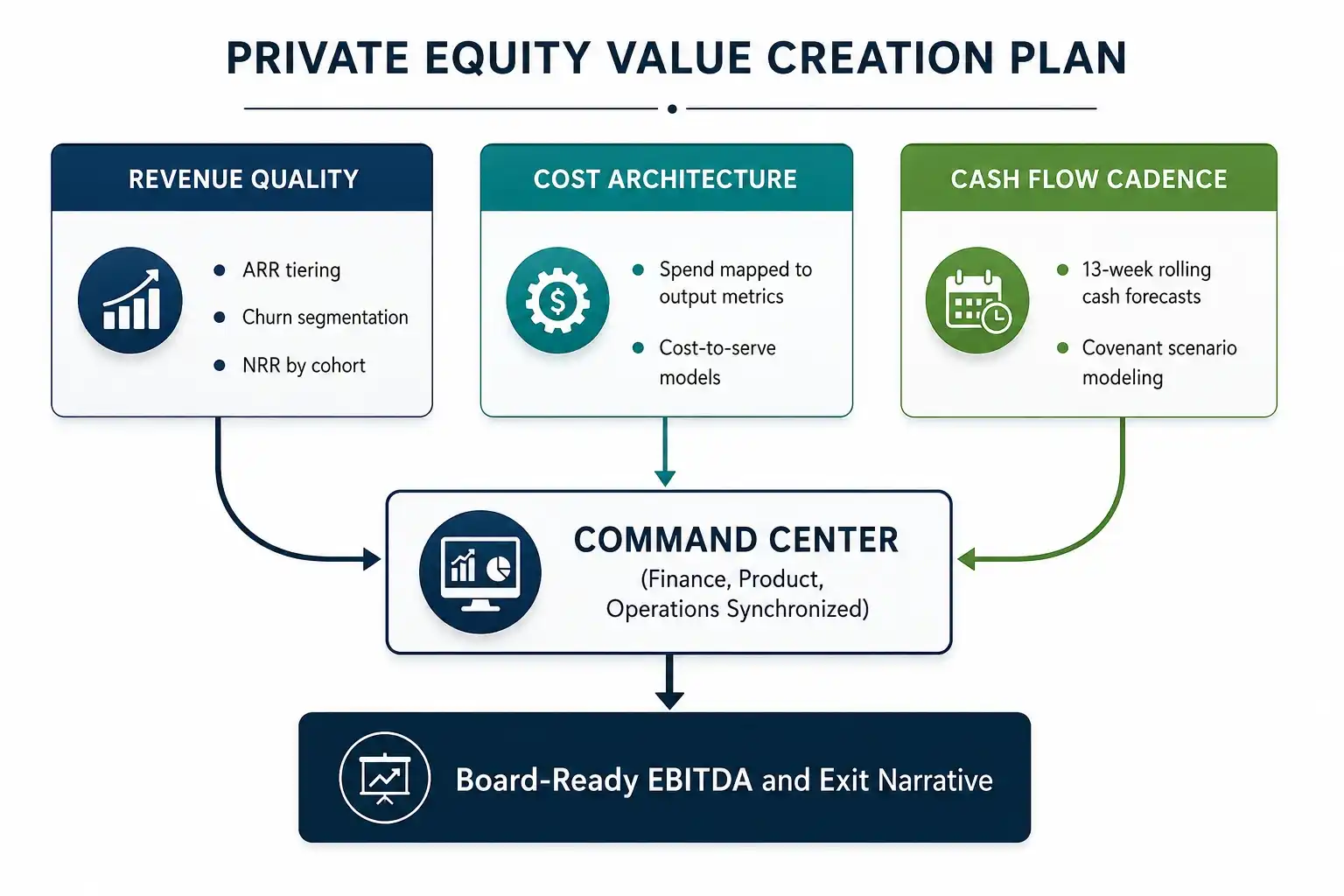
Three Levers of the Operating Model
- Revenue quality separates durable annual recurring revenue from trial-based or non-renewable contracts, so that the business understands which customers genuinely fund growth.
- Cost architecture maps spend to output, so every category, from sales dollars per representative to tickets per support employee, carries a metric rather than a habit.
- Cash flow cadence looks forward rather than backward, using rolling thirteen-week forecasts and covenant modeling to stay ahead of liquidity needs.
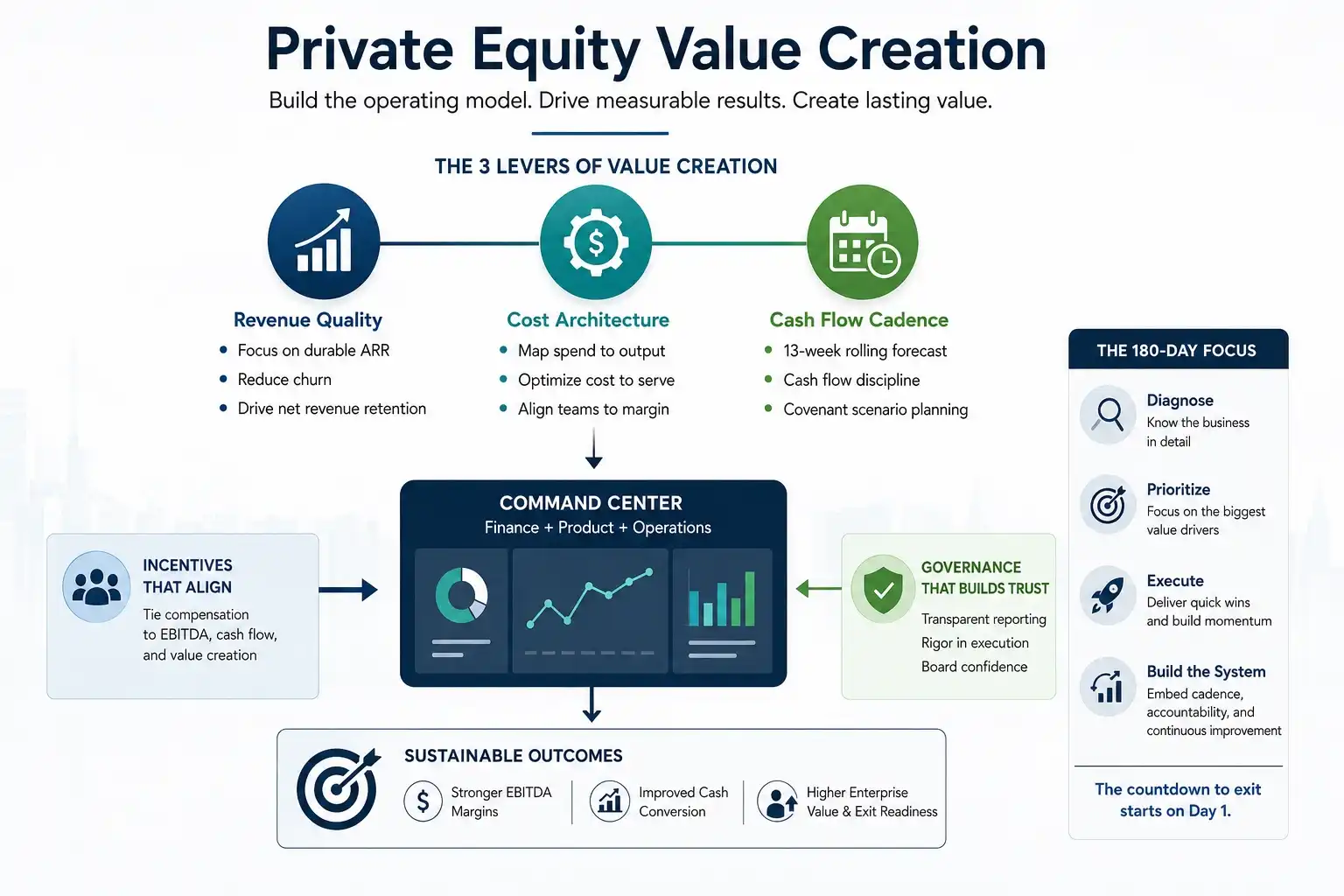
Together these levers replace intuition with a command center that integrates product, finance, and operations, not to suppress them but to synchronize them. Incentives must then be engineered to match. I have built dashboards for every functional leader. Each dashboard shows their own impact on margin. Marketing tracks customer acquisition cost. Customer success tracks net retention. When a marketing team sees that tightening cost per lead moves EBITDA, something shifts. They begin to see themselves as margin contributors rather than cost centers. Entrepreneurial energy is channeled rather than suppressed.
Protecting the Soul of the Company While Serving the Spreadsheet
A common trap in private equity ownership is to treat customer experience as a line item to be trimmed. My experience across logistics, digital marketing, and cybersecurity organizations suggests the opposite is true. When mapped correctly, customer experience drives both revenue and margin. In one turnaround, we tracked every post-sale touch alongside churn risk. Unresolved support issues in the first thirty days stood out. They carried a dramatically higher probability of churn. Rather than cutting support headcount, we redesigned onboarding to front-load early wins. This produced a meaningful increase in net retention. It also delivered real EBITDA margin improvement within a matter of months. A sound value creation plan does not require eliminating touchpoints. It requires engineering them for outcome.
Not every recommendation that arrives with a private equity sponsor deserves adoption. I have, on more than one occasion, pushed back against a proposal that looked attractive on paper but would have eroded the deep account trust that drives enterprise upsell. In its place, a hybrid staffing model paired with process automation delivered meaningful savings without eroding the customer relationship. Strong operators learn to defend strategic integrity, not with emotion, but with data, modeling, and a credible alternative path.
Scaling Innovation and Governance Under a Value Creation Plan
Innovation does not disappear under private equity ownership. It changes cadence. Across gaming and software organizations I have helped scale, including one where I oversaw acquisitions exceeding one hundred million dollars, the ideas that survived were those that could clear three gates:
- Whether they improved net retention or reduced churn
- Whether they were accretive to contribution margin
- Whether they could demonstrate return within two quarters
This discipline sharpened creativity rather than dulling it, and features once framed only as enhancements began to be framed as investments.
Private equity firms rely on dashboards because data is their currency of control, but in the hands of an operator, data is also the fuel of transformation. Building closed-loop reporting across finance, sales, product, and operations, layering predictive analytics over support data to flag churn risk weeks earlier than a traditional survey would allow, unlocks profit pools that were previously invisible. Governance follows the same logic. Board meetings under founder ownership often resemble storytelling. Under private equity ownership, the tone sharpens, and rightly so. In one portfolio company, moving to a monthly operating rhythm where each function presented a short deck of metrics, initiatives, and blockers aligned management with the board and removed ambiguity. The board stopped asking what is happening and started asking how it could help. That is the difference between reporting and governing.
Exit Readiness: The Long Arc of Private Equity Value Creation
From the moment a transaction closes, the countdown to exit begins. Private equity firms operate within fund cycles, and a typical hold period runs from three to seven years, which means exit planning is not a late-stage project but a parallel workstream from day one. Modeling exit scenarios on a regular cadence, tracking valuation levers such as annual recurring revenue growth and margin expansion, and aligning compensation to those levers ensures that the profit and loss statement becomes a narrative to future buyers rather than merely a record of the past. Having led capital raises exceeding one hundred and twenty million dollars and merger and acquisition transactions exceeding one hundred and fifty million dollars, including a forty eight million dollar raise at a mission-driven education institution, I have seen that the companies best positioned for exit are the ones that built readiness into their culture long before any banker arrived.
Conclusion
The move from founder-led vision to private equity performance is a profound shift, but it need not be a loss of soul. Across cybersecurity, software, gaming, logistics, digital marketing, and nonprofit organizations, I have watched companies balance freedom with rigor, invention with discipline, and ambition with deliverables. A well-built value creation plan does not kill creativity. It gives creativity purpose. Governance does not slow agility. It ensures the business can sustain its own momentum. When private equity value creation is embraced with clarity rather than resistance, it does not suppress what made a company distinctive. It reveals what makes that company durable. In the end, strategy under private equity ownership is not about abandoning the original mission. It is about proving that mission works at scale, under real constraint, and with full financial accountability. Companies that internalize this do more than survive the transition. They compound value long after the sponsor’s clock has started running, turning what once felt like an external constraint into the very discipline that carries them toward a stronger exit.
Disclaimer: This blog is intended for informational purposes only and does not constitute legal, tax, or accounting advice. You should consult your own tax advisor or counsel for advice tailored to your specific situation.
Hindol Datta is a seasoned finance executive with over 25 years of leadership experience across SaaS, cybersecurity, logistics, and digital marketing industries. He has served as CFO and VP of Finance in both public and private companies, leading $120M+ in fundraising and $150M+ in M&A transactions while driving predictive analytics and ERP transformations. Known for blending strategic foresight with operational discipline, he builds high-performing global finance organizations that enable scalable growth and data-driven decision-making.
AI-assisted insights, supplemented by 25 years of finance leadership experience.