
Executive Summary
Deferred commissions under ASC 606 sales commissions rules often begin as an accounting requirement and end up as something far more powerful. Drawing on three decades at the intersection of finance, operations, and systems design, this article summarizes how deferral mechanics can become a lever for behavior, trust, and margin discipline rather than a source of tension between sales and finance. It walks through how deferral schedules were engineered to reward contract quality, how automation handled the process at scale, and how analytics linked deferral patterns to long-term customer value. It also covers what happens when deferral crosses borders, where local labor law, tax treatment, and compensation culture complicate a single global standard. The lesson throughout stays consistent. When deferral is designed with intent rather than bolted on after the fact, it becomes a diagnostic for how a company actually thinks about growth.
Why Deferred Sales Commissions Create Tension Between Sales and Finance
A familiar scene plays out in many SaaS boardrooms. Sales celebrates record bookings. Finance quietly tracks a growing liability it cannot yet recognize. That tension is not really about competing priorities. It comes from a mismatch in timing. Revenue recognition and commission payout move on different clocks. Treating sales commissions under ASC 606 exists precisely to close that gap. Incremental commissions must be deferred and amortized over the related revenue period.
An engineering management background shapes how this problem tends to get solved. Simulations built early in a career, testing incentive delays and their systemic consequences, point to one lesson again and again. Incentives must match the rhythm of value realization. When a rep earns a commission long before revenue actually flows, the system quietly rewards urgency over quality. Fixing that requires more than a policy memo. It requires engineering the deferral mechanics themselves, and it requires treating compensation design as a systems problem rather than a compliance afterthought.
This framing matters because compensation touches almost every function in the business. Sales leadership cares about it because it shapes closing behavior. Finance cares because it drives balance sheet accuracy and cash forecasting. Even marketing eventually cares, because attribution models depend on knowing which deals actually held up over time. Treating deferral purely as an accounting mechanic misses how deeply it threads through the rest of the organization.
Designing Deferral Mechanics That Reward Quality Over Speed
The starting point is usually a grid that maps contract length and margin to a deferral schedule. A three-year contract with strong gross margin earns a faster payout. A short, heavily discounted deal pushes commission out until revenue actually arrives. This structure turns deferral from something punitive into something purposeful. Reps begin favoring quality deals, not just closed deals, because the compensation math itself rewards patience.
That shift is rarely painless at first. One rep once raised a grievance after a payout landed nearly a year later than expected. He had closed the deal, and he felt entitled to be paid immediately. Explaining that aligning earnings with recognition builds trust rather than eroding it changed the conversation. Visible commission curves helped even more. Linking every payout milestone to a defined revenue-recognition trigger changed how reps saw deferred pay. It became a signal that the company had delivered on its promise to the client. It stopped feeling like a punishment aimed at them personally.
A workable deferral grid usually accounts for a small set of deal attributes:
- Contract length and renewal probability
- Gross margin on the deal
- Discount depth and payment terms
- Whether the deal includes non-standard clauses that need review
Over time, these attributes stop feeling like bureaucratic checkboxes. Reps start using them as a mental model for what a good deal actually looks like, well before a contract reaches a signature stage.
Building the Systems Architecture Behind Sales Commission Deferral
Deferred commissions sit on the balance sheet as a hidden liability until revenue recognition releases them. That adds real complexity to liquidity planning. SQL-driven dashboards that extract commission triggers from a CRM and overlay them against revenue-recognition schedules solve much of this problem. They let finance model exactly how many commissions will require payout in a future quarter. That level of detail gives both cash planning and margin forecasting far more clarity than a manual spreadsheet ever could.
The diagram below reflects the flow that made this repeatable across thousands of deals.
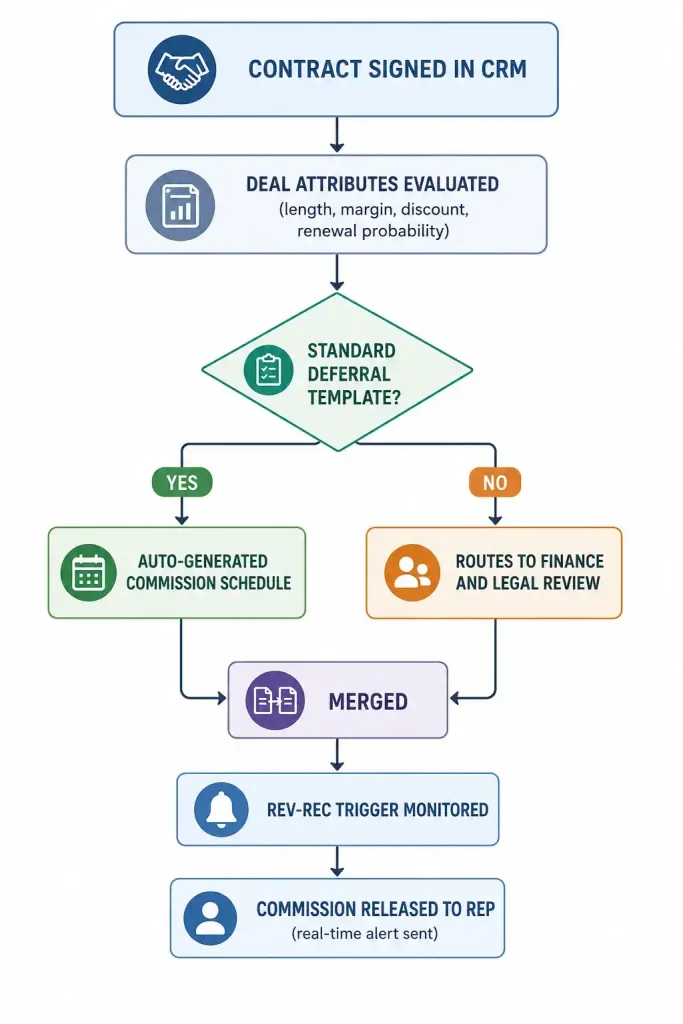
How Exceptions Move Through Review
Deals that carry non-standard terms, such as prepayment clauses or unusual contract lengths, route through a review step that includes finance sign-off. Everything else moves automatically once the standard template applies. Reps see their commission schedule from day one, and an alert fires the moment revenue recognition triggers a release. That transparency reduces confusion and normalizes deferral as standard practice rather than a surprise buried in a policy document nobody reads.
The Behavioral and Cultural Ripple Effects
Once deferral is tied to deal attributes such as contract length, margin, and renewal probability, sales behavior starts to shift on its own. Reps begin optimizing for closable value, not just a fast signature. They coach each other on pricing discipline and contract design. The result tends to be cleaner bookings, healthier margins, and a gradual move away from purely transactional selling toward something closer to account stewardship.
The cultural effect runs deeper than the numbers suggest. Deferred compensation, tied to career progression, tells reps that the company values sustained performance over quarterly fireworks. Many reps choose to stay once they see that long-term contribution carries the same weight as front-loaded numbers. That retention effect matters more than it might first appear, since replacing an experienced enterprise rep is expensive and slow.
Marketing benefits too, in a way that is easy to overlook. When a lead feeds into a deal carrying deferral flags, campaign attribution can show which channels drove durable, high-margin revenue rather than just fast closes. That shift gives marketing a clearer basis for allocating spend, since a campaign that produces short-lived, heavily discounted deals looks very different once its long-term payoff is visible.
Analytics eventually closes the loop. Dashboards tracking deferral per rep, per deal type, and per cohort can reveal patterns that would otherwise stay invisible. In one multi-year analysis, cohorts of reps operating under margin-aligned deferral rules showed a five percent uptick in lifetime value. Leadership used that finding to reinforce a narrative built around quality and longevity rather than raw velocity. Over time, this data became part of how the company talked about itself internally.
Scaling Commission Deferral Across Borders
The underlying logic is simple enough inside a single country. Scale is what stresses the system. The moment a company operates sales teams across several regions, deferral logic becomes vulnerable to fragmentation. A country head may ask whether deferral logic violates local labor rules. Currency swings might worry a regional finance controller tracking commission liability across markets. Payout timing on cross-border deals can raise real questions for reps working international accounts. These are not edge cases. They are recurring signals that a company needs an actual framework, not a spreadsheet stitched together after the fact.
Most countries do not mirror the treatment of commissions used under U.S. accounting standards. Some jurisdictions require payout within a fixed window regardless of revenue recognition. Others treat commissions as an operating cost rather than a capitalizable contract cost. Mapping the statutory treatment across every operating entity helps here. Tagging which countries align with standard deferral logic, versus which need localized exceptions, turns this complexity into something manageable rather than something improvised country by country.
A few real adjustments illustrate how this plays out in practice:
- Where employment law dictates firm payout schedules, commissions can be paid in cash while still booked internally as a deferred expense.
- Where commissions are treated as variable pay rather than incentive contracts, comp structures can shift eligibility windows instead of deferral timing.
- Where deferral is permitted but closely scrutinized, detailed contract-level documentation can substantiate the amortization logic for auditors.
Currency risk adds another layer to this picture. Commissions earned in one currency but paid in another need constant monitoring. Building FX buffers into accrual schedules helps manage this risk. Revaluation entries triggered past a defined threshold prevent income statement shocks, while keeping payout expectations steady for reps regardless of market volatility.
None of this works without genuine enablement on the ground. Compensation customs vary widely by region, from monthly payout expectations in parts of Asia to annual bonus culture in parts of Europe. A global enablement program built around explanation rather than enforcement, including live dashboards showing earned versus deferred balances, turns policy into something closer to partnership. Country managers who champion the logic locally, translating it into terms that resonate culturally, tend to succeed where a headquarters mandate alone would fall flat.
A recurring review keeps the system honest as it scales. Bringing finance, legal, HR, and revenue operations together to examine overrides and payout pacing surfaces friction early, rather than letting it accumulate quietly until it becomes a larger problem.
What Global Deferral Design Reveals About a Company
Commission deferral, approached at global scale, becomes something closer to a diagnostic. It shows how a company actually pays people, not just how its policy documents describe payment. It reveals whether systems reflect genuine intent, and whether policy survives translation into different regulatory and cultural contexts. A company that treats scale as a capability to master, rather than a complexity to merely manage, tends to get this right more often than not.
Resistance still shows up along the way, even in a well-designed system. A newly hired rep may walk away after learning about deferral timelines. A legal team may flag a classification risk in a specific market. These moments are not signs that the system has failed. They are signals that the system has visibility, and that the appropriate response is documentation and revision rather than confusion or improvisation.
Conclusion
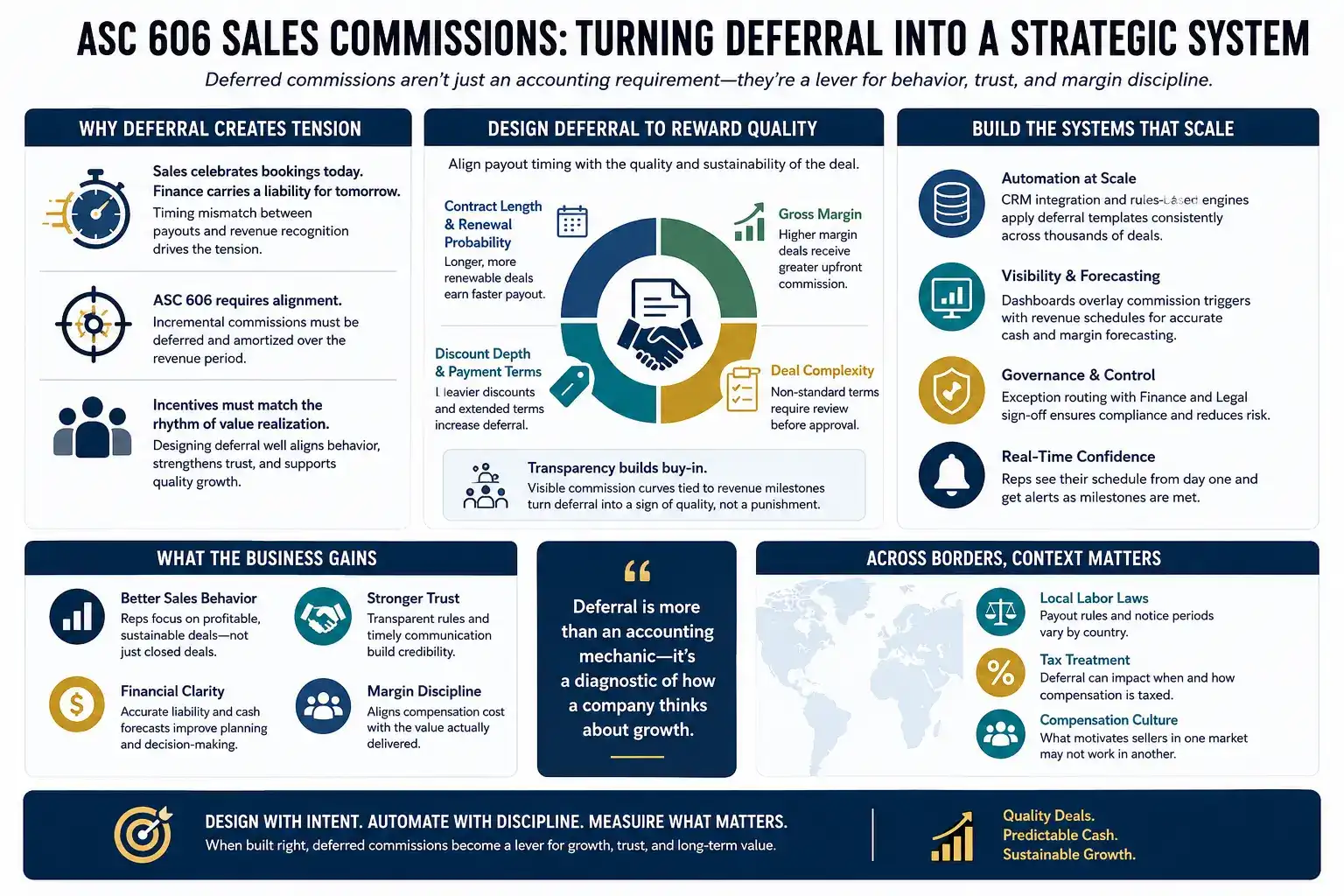
Deferred commissions can either create friction or build alignment, and the difference comes down to design. Treated as an afterthought, deferral breeds skepticism among reps who feel punished for closing deals. Integrated into a broader performance philosophy, it becomes a lever for durability, one that protects margin, preserves cash, and rewards the kind of selling that holds up over time. The same logic that works inside one country needs real engineering to survive global scale, where labor law, tax treatment, and compensation culture all pull in different directions. What emerges from doing this well is not just a compliant policy. It is a shared architecture that sales, finance, and leadership all experience as clarity rather than control. Commission deferral, handled with intent, ends up saying something honest about a company. It signals whether the business values long-term outcomes over short-term applause, and whether its systems can scale in integrity as much as in revenue.
Disclaimer: This blog is intended for informational purposes only and does not constitute legal, tax, or accounting advice. You should consult your own tax advisor or counsel for advice tailored to your specific situation.
Hindol Datta is a seasoned finance executive with over 25 years of leadership experience across SaaS, cybersecurity, logistics, and digital marketing industries. He has served as CFO and VP of Finance in both public and private companies, leading $120M+ in fundraising and $150M+ in M&A transactions while driving predictive analytics and ERP transformations. Known for blending strategic foresight with operational discipline, he builds high-performing global finance organizations that enable scalable growth and data-driven decision-making.
AI-assisted insights, supplemented by 25 years of finance leadership experience.