
Executive Summary
Marketing teams often treat lead attribution as a dashboard exercise, yet its real value surfaces when finance treats it as a governance instrument. Early in a finance career built across cybersecurity, SaaS, gaming, logistics, and nonprofit sectors, leaders approved marketing spend without question, and the customer remained an abstract figure in a forecast. That distance proved costly. Over time, first touch and last touch models gave way to journey integrity mapping, a practice that traced every interaction between awareness and opportunity. This shift transformed marketing spend into a capital allocation decision, informed territory and quota planning, and embedded attribution scores directly into deal desk approvals. It also revealed that a single global model cannot measure regional buying behavior. The result was a finance function that treated growth not merely as a volume outcome, but as a signal it could understand, trust, and repeat.
From Click to Cash: Why Simple Models Fall Short
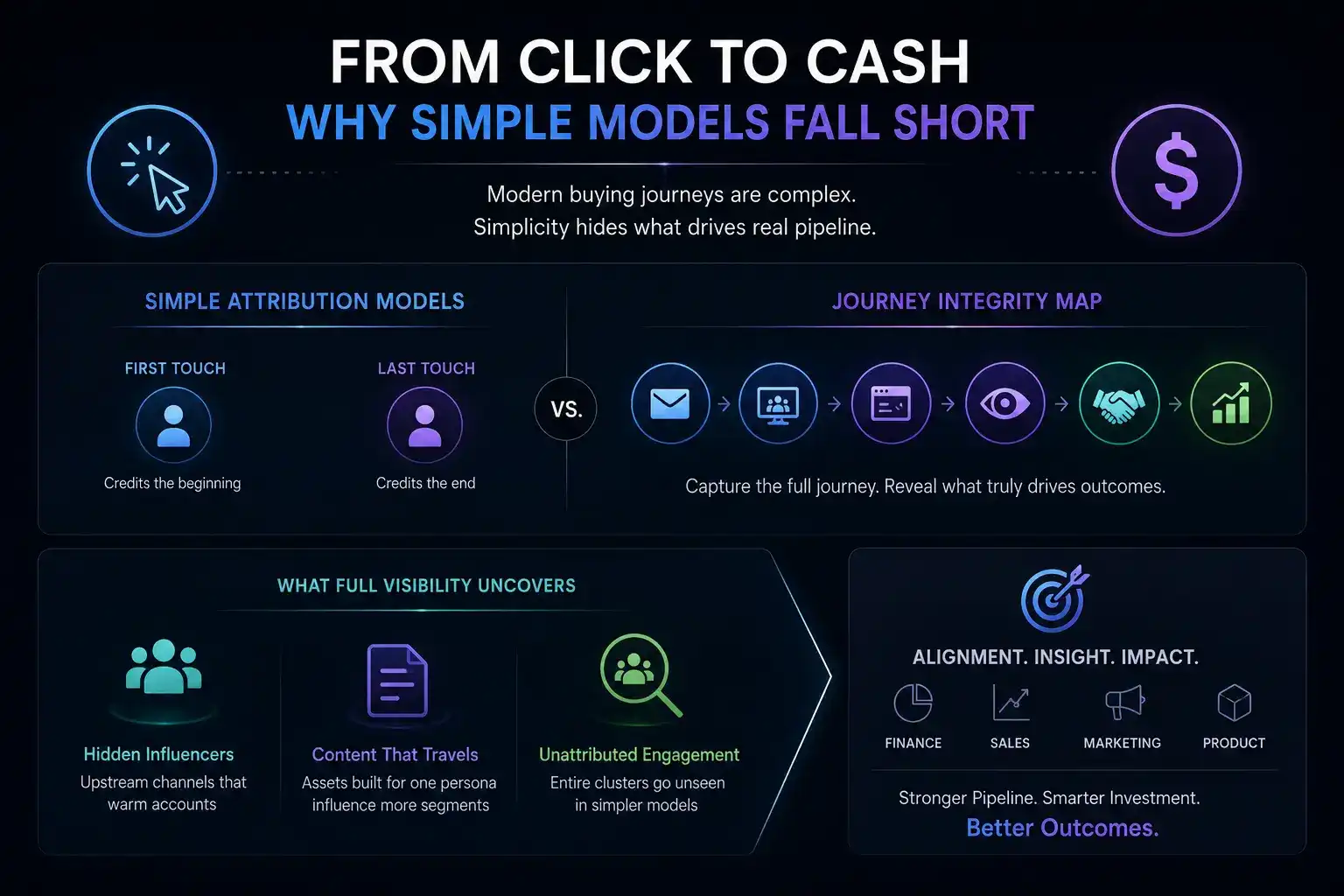
Early in a finance career spanning cybersecurity, software, gaming, logistics, and nonprofit sectors, leaders approved marketing budgets much like capital projects, allocating them once and rarely interrogating them afterward, with little thought given to lead attribution. The customer existed mostly as a line item in a forecast model, distant and abstract. That distance turned out to be an expensive blind spot, one that took years of pattern recognition across quarterly reviews and pipeline post mortems to fully understand.
Most organizations still rely on first touch or last touch attribution, largely because these models are simple to configure inside a CRM rather than because they are genuinely insightful. In a world of elongated, multi-threaded buying journeys, that simplicity hides the very complexity that explains pipeline quality.
The Journey Integrity Map
Rather than accepting the CRM default, a more useful approach captures the entire sequence of interactions that move a lead toward opportunity. This includes email opens, webinar registrations, pricing tool visits, competitive page views, and return frequency. Each of these becomes a decision point once attribution models correlate them with forecasted win probability, margin contribution, and renewal likelihood.
This deeper view of the funnel routinely uncovers value hiding in plain sight:
- Channels once considered unproductive turn out to be upstream influencers that quietly warm accounts before they convert
- Content assets originally built for one persona often influence deals in adjacent segments
- Entire clusters of engagement, such as procurement teams reviewing implementation pages anonymously, go unattributed under simpler models
Once visibility replaces simplification, attribution becomes the source of alignment across finance, sales, marketing, and product, rather than a point of friction between them.
Treating Marketing Spend as Capital Allocation
A useful discipline for any CFO is to treat marketing budgets the way finance teams treat capital expenditures, tracking not just output but yield. Some campaigns generate immediate returns while quietly eroding brand perception. Others build credibility slowly and convert only after several quarters. The common mistake many companies make is optimizing for attribution clarity in the short term at the expense of long term value creation. They shift spend toward channels that are easy to measure and away from those that build category leadership.
A weighted capital map addresses this challenge. It ties marketing programs to projected lifetime value by cohort, adjusted for sales cycle complexity and retention probability. This requires finance and marketing to build a new operating rhythm. Together, they meet regularly to interrogate journey shape, velocity by persona, and cross channel influence. Marketing wants room for experimentation. Finance wants measurable return. That tension tends to dissolve once both functions share the same model. Finance then funds campaigns based on probabilistic return. Sales, in turn, gains confidence that leads arriving from marketing genuinely intend to buy.
Lead Attribution as a Revenue Governance Instrument
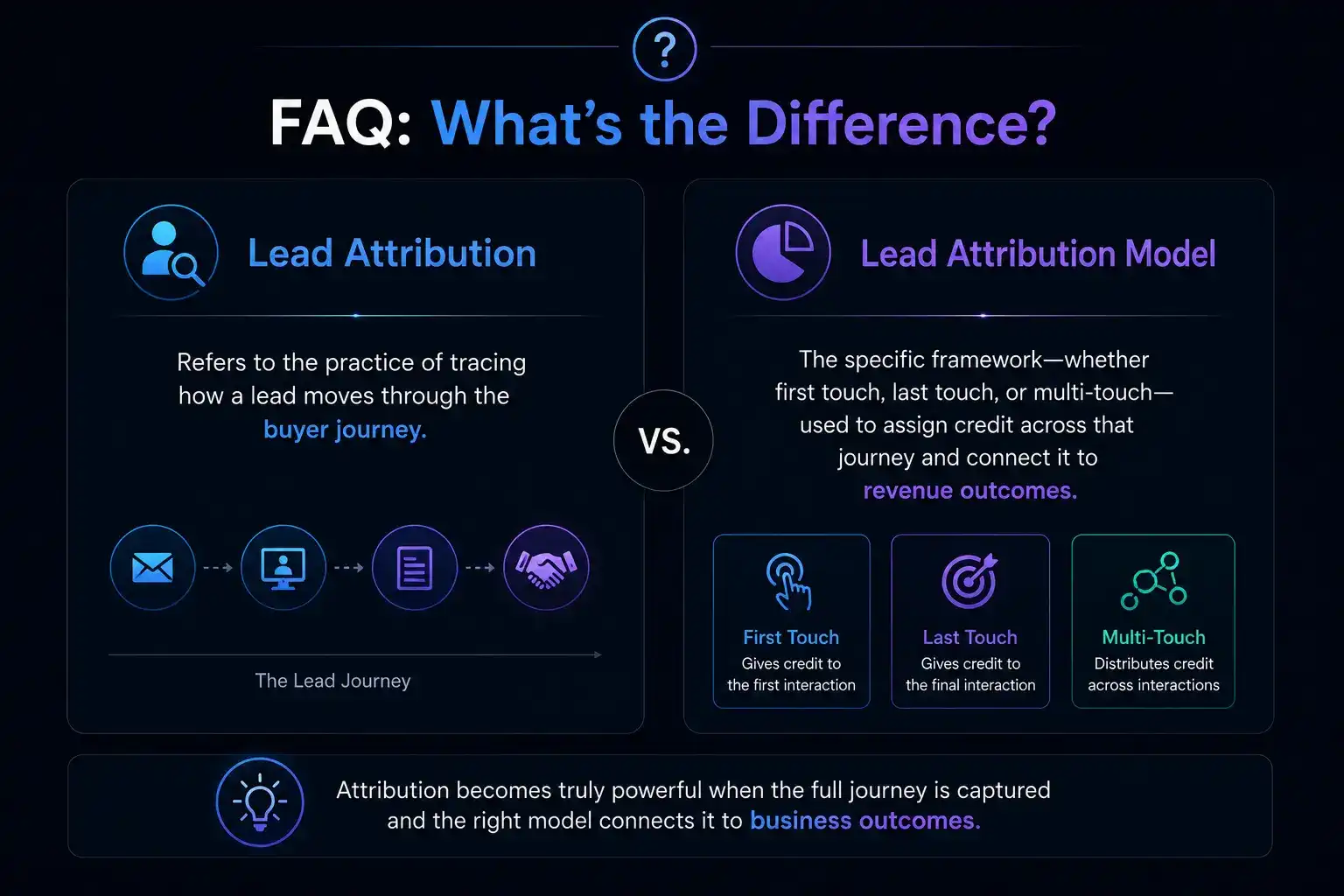
A well built lead attribution model belongs as much in the office of the CFO as it does within marketing operations. Its purpose is not to control marketing but to contextualize it. This matters most in global organizations, where regions, personas, and buying behaviors intersect in ways no single dashboard can capture.
Attribution modeling can influence three critical financial levers. The first is territory planning. When certain personas convert more effectively through high touch events rather than digital advertising, finance shifts headcount toward field marketing. The second is quota deployment. When journey velocity slows in regions with weak pre-sales coverage, finance rebalances investment toward solution consulting. The third is support investment. When low attribution channels contribute disproportionately to high support accounts, finance tightens qualification gates.
The value of attribution, applied this way, is that it turns narrative into signal, allowing finance to participate in pipeline design rather than simply approving budgets after the fact.
Making Attribution Actionable Inside the Deal Desk
Attribution confined to dashboards tends to remain ornamental, admired by executives and refined endlessly by analysts, but rarely translated into action. Its most underleveraged application often lives inside the quoting and approval process itself.
A recurring pattern illustrates this well. Deals sourced from certain channels showed longer time to close and a higher likelihood of triggering pricing exceptions. What first appeared to be a sales coaching issue turned out, once teams matched attribution data against approval workflows, to be a structural pattern, with content syndication deals carrying a meaningfully higher rate of contract negotiation despite strong early engagement, while webinar leads closed faster and renewed more reliably.
Embedding attribution scores directly into the quoting environment gives deal desk analysts a context layer before a deal reaches final review. They can see how the buyer entered the funnel and how quickly they progressed. This also gives finance a new dimension for risk scoring. Deals from high churn segments with weak attribution lineage get flagged for closer scrutiny. Deals showing strong multi channel influence move through approval faster. Controls of this kind meaningfully improve deal velocity. That is not because deals move faster on their own, but because approvals rest on journey health rather than terms alone.
Localization Without Fragmentation
Running revenue operations across regions introduces a genuine tension between adapting to local nuance and preserving a consistent measurement system, and lead attribution is where this tension shows up most clearly. In some regions, buyers engage early and often through webinars, whitepapers, and sales development outreach. In others, they surface late in the cycle through private referrals or partner ecosystems, leaving little digital footprint.
Standard models, left unchecked, tend to reward activity rich behavior and penalize markets where buyers are naturally more discreet. A useful corrective is a regional attribution layer, where each region develops its own channel weightings based on historical conversion and retention data while the underlying logic remains centralized. This preserves systemic accountability while giving local go to market leaders the freedom to reflect genuine cultural buying behavior, and it brings visibility to influence based motions that standard models would otherwise ignore entirely.
Attribution as Strategic Control
From a CFO’s vantage point, a lead attribution model is not merely a performance measure. It is a strategic control that reveals where value originates, how efficiently it moves, and how reliably it repeats. A Lead Efficiency Index, calculating revenue per attributed lead and adjusted for sales cycle duration and gross margin by cohort, can sit alongside customer acquisition cost and lifetime value in board reporting as a leading indicator of growth quality.
Overlaying attribution data onto customer segmentation often reveals a clear pattern. High value segments tend to follow distinct, clean engagement paths, while low retention segments show more erratic journeys that frequently begin with incentivized clicks or outsourced lead generation. The cleaner the journey, the stickier the customer tends to be, and this insight can reshape how campaigns are funded, how pipeline is scored, and how territory design is approached in new markets.
Conclusion
Lead attribution, understood properly, is not a marketing convenience but a discipline that belongs in the finance function. It reveals how a company genuinely acquires, converts, and retains revenue, replacing guesswork with a defensible narrative for spend, territory design, and deal approval. Across sectors ranging from cybersecurity and software to gaming, logistics, and nonprofit organizations, the pattern holds consistently. Companies that treat marketing spend as capital allocation, embed attribution into deal desk workflows, and localize their models without fragmenting their systems tend to build revenue engines that are both efficient and honest. The cleaner the journey a customer takes, the stickier that customer becomes, and the more confidently a board can trust the growth story behind the numbers. Attribution, when it sits inside finance, stops chasing vanity metrics and starts serving the truth. That shift is what ultimately separates companies that merely track growth from those that genuinely understand it.
Disclaimer: This blog is intended for informational purposes only and does not constitute legal, tax, or accounting advice. You should consult your own tax advisor or counsel for advice tailored to your specific situation.
Hindol Datta is a seasoned finance executive with over 25 years of leadership experience across SaaS, cybersecurity, logistics, and digital marketing industries. He has served as CFO and VP of Finance in both public and private companies, leading $120M+ in fundraising and $150M+ in M&A transactions while driving predictive analytics and ERP transformations. Known for blending strategic foresight with operational discipline, he builds high-performing global finance organizations that enable scalable growth and data-driven decision-making.
AI-assisted insights, supplemented by 25 years of finance leadership experience.