
Executive Summary
Financial competitive intelligence is not a scoreboard exercise. It is a disciplined form of self-examination conducted through the lens of a carefully chosen peer group. A benchmark reveals more about a company’s own choices than about the companies it stands beside, provided the peer set is selected with genuine rigor rather than convenience. Ratios such as gross margin, revenue growth, and free cash flow do not speak for themselves. They require interpretation. A superior metric can reflect a strength or simply a shortcut, and an inferior one can reveal a weakness or a deliberate trade-off. The real value of this work emerges when insight becomes dialogue, shaping capital allocation and functional accountability without turning into a cudgel. Applied with patience, financial competitive intelligence also becomes a form of foresight. It helps a CFO anticipate the trajectories her own company is likely to follow.
The Benchmark as a Mirror, Not a Scoreboard
A seasoned CFO studies a peer group the way a careful reader studies a familiar text, not with envy or arrogance, but with quiet, structured curiosity. The benchmark functions less like a scoreboard and more like a mirror, and like most mirrors, it reveals more about the observer than about the subject being compared. Financial competitive intelligence, done well, forces a company to submit its own narrative to a broader context. It is the difference between believing a company is efficient and actually knowing it, between assuming pricing power exists and discovering that margins simply reflect a different cost of capital.
This work carries real risk when practiced carelessly. Peer sets can be too broad, too narrow, or too idiosyncratic, and a company that looks like an outlier may simply be living a different truth, shaped by a different lifecycle stage, capital structure, or regulatory exposure. Proximity is not the same as comparability, and benchmarking should never become a tool for internal politics or a blunt instrument for forcing convergence where genuine differentiation is the better strategy.
Choosing the Right Peer Set
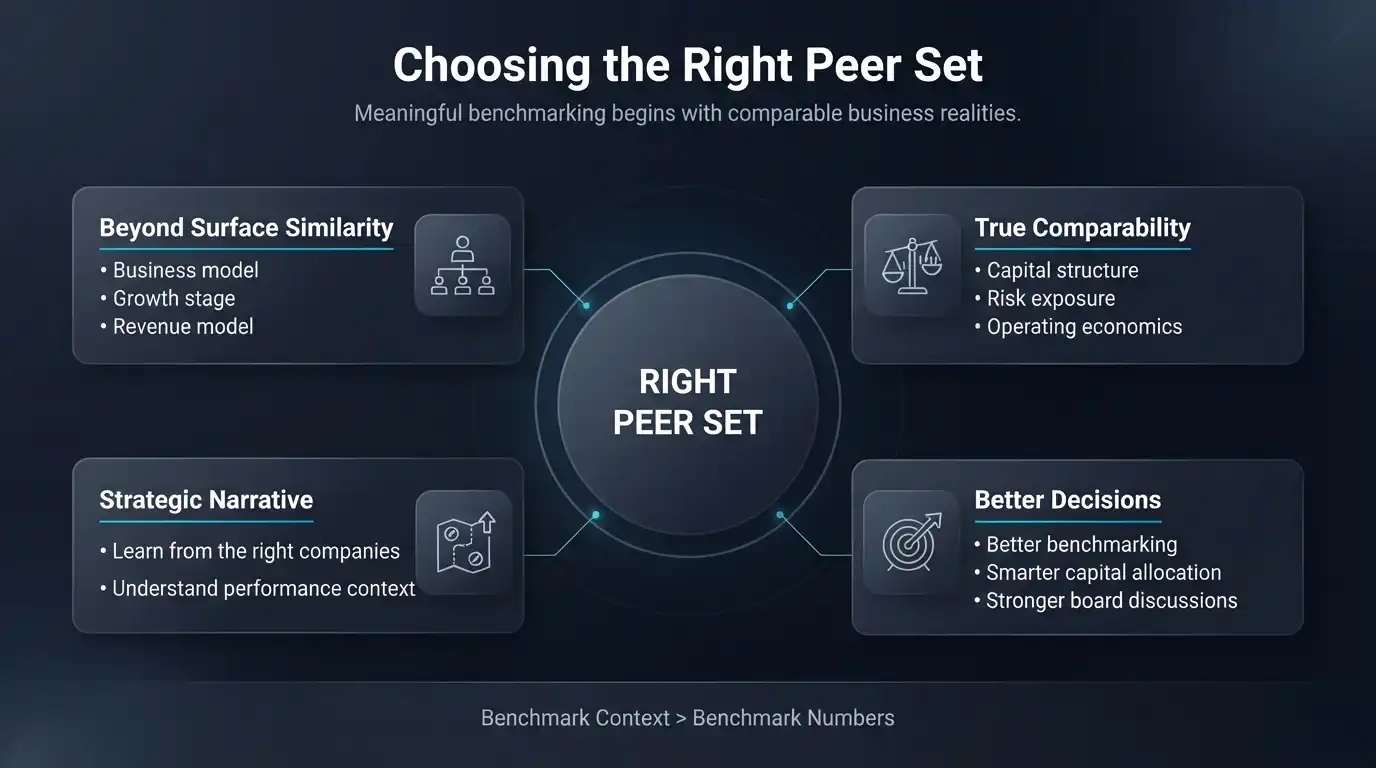
Selecting the wrong peer group is not simply unhelpful. It actively misleads. The first discipline in financial competitive intelligence lies in deciding who to watch, who to learn from, and who to set aside, and this decision deserves as much strategic sensibility as any capital allocation choice.
Why Surface Similarity Misleads
At first glance, peer selection looks straightforward: choose companies of similar size, industry, geography, and business model. True comparability, however, lives deeper than these surface traits. A CFO should ask whether prospective peers sit at the same stage of maturity, pursue similar monetization logic, and carry comparable exposure to customer concentration, regulation, or seasonality. A subscription company billing monthly cannot be benchmarked meaningfully against one billing annually unless revenue recognition is normalized. An asset-heavy logistics operator in a volatile region cannot be compared fairly with an asset-light platform that owns no vehicles and bears no fuel cost, even if both report similar EBITDA margins on paper.
Capital structure adds another layer of nuance. A company financed primarily through debt may show a lower cost of capital while carrying embedded risk that clouds its operational metrics. A business with high ROIC built on large intangibles and low depreciation may simply be underinvesting rather than genuinely efficient. A benchmark alone cannot resolve this ambiguity. Only context can.
Peer Selection as Narrative Construction
Rather than treating peer selection as a purely quantitative filter, a CFO benefits from approaching it as an act of narrative construction, asking a few grounding questions:
- Whose trajectory genuinely mirrors our own business model and stage of maturity?
- Whose path offers a credible glimpse of what our own future might look like?
- Whose trajectory do we deliberately want to diverge from, and why?
This framing matters internally as well. A board may ask why gross margin trails a headline competitor. The honest answer often lies in business model variance rather than underperformance. A CFO needs fluency in both the numbers and the narrative behind them, enough to make that case analytically rather than defensively.
Interpreting Ratios as Signals, Not Verdicts
A benchmark is not a verdict. It behaves more like a voice, and that voice requires patient listening rather than quick compilation into a scorecard. The task is to hear what a ratio implies about business model choices, capital discipline, and strategic tempo, not merely to declare a winner.
Gross Margin and Revenue Growth
Gross margin looks like a clean signal of pricing power and cost control, yet a high margin can also point to underinvestment in customer support, while a declining margin can reflect deliberate pricing strategy rather than commoditization. Revenue growth carries similar ambiguity. Year-over-year deltas mean little without understanding the composition behind them. How much growth is organic versus acquired? Does it demand disproportionate marketing spend or incentive-driven customer acquisition? A peer growing faster may simply be running hotter, burning cash at an unsustainable pace, or inflating receivables to hit a number.
Operating Margin and Free Cash Flow
The gap between gross and operating margin often reveals a story of scale and operating leverage. But it can just as easily mask a deferred R&D decision, one that shows up as weakened innovation two years later. Free cash flow, often treated as the most trustworthy metric of all, is shaped heavily by payment timing, tax strategy, and working capital management. A company reporting negative cash flow may be investing in genuine future capacity rather than failing. A peer with strong cash flow may simply be underinvesting in its own growth. The most valuable insight tends to come not from a single snapshot. It comes from how these ratios trend across product cycles and market conditions.
Turning Insight Into Strategic Alignment
In careless hands, a benchmark becomes a cudgel that bruises rather than guides. In more capable hands, it becomes an instrument of strategic alignment, grounded in curiosity rather than critique.
From Spreadsheet to Dialogue
The goal of financial competitive intelligence is not to copy a peer’s playbook but to sharpen internal thinking. A CFO who notices that peers allocate a larger share of revenue to R&D, or that their customer acquisition cost sits meaningfully lower despite a similar channel mix, should bring that observation into the room as a question rather than an accusation. Functional leaders tend to recoil from public comparisons framed as judgment, so the tone matters as much as the data. The aim is clarity about trade-offs, not conformity to someone else’s numbers.
Aligning Capital Allocation With Benchmark Patterns
This alignment work eventually reaches capital allocation itself. If a cohort of high-growth peers is shifting spend from field sales toward digital channels and seeing better returns, that pattern deserves genuine attention. If peers are capitalizing fewer development costs under a similar regulatory regime, the difference may reflect conservatism that earns market trust rather than inefficiency. A well-benchmarked CFO brings these patterns to the board as context rather than isolated performance figures. She shows where the company is stretching, where it is pacing evenly, and where it is intentionally diverging from the pack.
Benchmarking as Strategic Foresight
The most valuable use of financial competitive intelligence looks forward rather than backward. Every ratio, tracked across time and across a peer set, begins to show motion rather than a static position. Gross margins tend to expand as product-market fit deepens, fixed cost leverage tends to improve as scale grows, and free cash flow tends to inflect once customer retention stabilizes. A CFO who learns to read these trajectories moves from comparison into genuine anticipation.
This forward-looking discipline proves especially valuable during moments of transformation, such as entering a new business model, scaling rapidly, or expanding internationally, when internal historical metrics stop predicting the future reliably. Precedent from a well-chosen peer group restores orientation in exactly these moments, offering a picture of what the transition might look like rather than pure theory. The framework below illustrates how this discipline moves in a continuous loop rather than a single linear exercise.
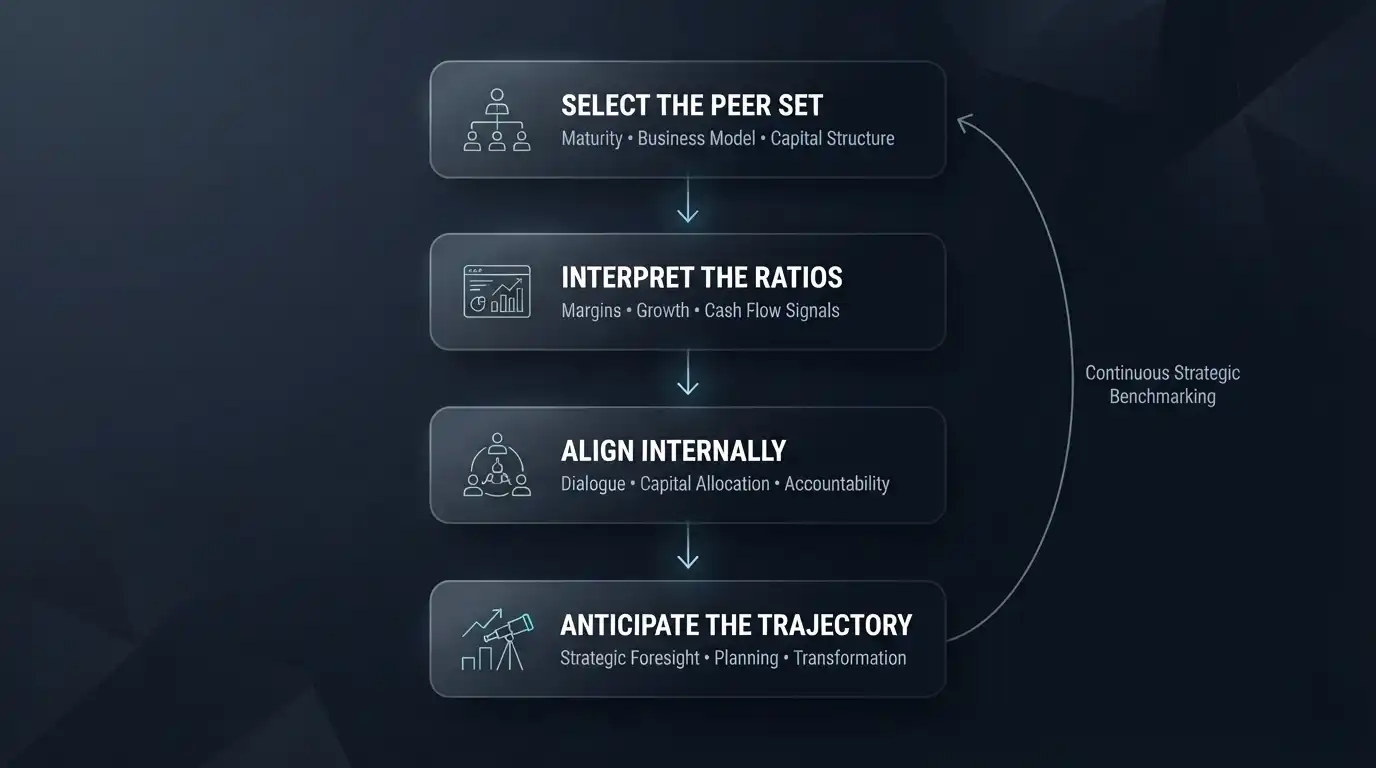
Even with this discipline in place, benchmarks remain guides rather than mandates. A CFO must be willing to say her company is not average. It does not occupy the same position as its peer set. Sometimes conviction demands divergence, when the underlying business logic supports it. The greatest risk in this work is treating benchmarking as performance for its own sake. That means optimizing for a ratio rather than for genuine value creation. Held properly, benchmarking remains a mirror rather than a judge. It shows where a company is strong, where it is exposed, and where it might go next.
Conclusion
Financial competitive intelligence, practiced with rigor, is closer to a discipline of self-examination than a competitive sport. Selecting the right peer set requires genuine discernment rather than convenient sorting by industry or size. True comparability depends on maturity, capital structure, and business model logic rather than surface resemblance. Interpreting ratios demands patience. A strong metric can reflect either a genuine strength or a shortcut, and a weak one can reveal either a failure or a deliberate trade-off. The real payoff arrives when this insight becomes internal dialogue, shaping capital allocation and functional accountability without turning into blame. Finally, benchmarking earns its highest value as a form of foresight. It helps a CFO anticipate how her company’s own trajectory is likely to unfold as it scales, transforms, or enters new territory. Held with the right balance of curiosity and conviction, financial competitive intelligence becomes less about winning a race. It becomes more about understanding the landscape a company is actually running through.
Disclaimer: This blog is intended for informational purposes only and does not constitute legal, tax, or accounting advice. You should consult your own tax advisor or counsel for advice tailored to your specific situation.
Hindol Datta is a seasoned finance executive with over 25 years of leadership experience across SaaS, cybersecurity, logistics, and digital marketing industries. He has served as CFO and VP of Finance in both public and private companies, leading $120M+ in fundraising and $150M+ in M&A transactions while driving predictive analytics and ERP transformations. Known for blending strategic foresight with operational discipline, he builds high-performing global finance organizations that enable scalable growth and data-driven decision-making.
AI-assisted insights, supplemented by 25 years of finance leadership experience.