
Executive Summary
A private equity acquisition marks a stark inflection point in a company’s trajectory, and the earliest weeks after closing set the tone for everything that follows. The shift from founder-led autonomy to a PE-backed model is not simply a change of shareholder. It is a transformation of measurement, governance, and urgency, and the private equity 100 day plan is where that transformation gets built. New sponsors typically demand structured dashboards covering cash, unit economics, labor productivity, and pipeline health within the first weeks of ownership. New sponsors reconstitute boards, tighten reporting cadences from monthly to weekly, and push founders through a psychological shift from informal intuition to fact-based accountability. Three real transformations, spanning furniture manufacturing, adtech, and IT services, show how this period plays out in practice. Handled well, the plan does not strangle entrepreneurial spirit. It repurposes that spirit for scale.
Why the First 100 Days Set the Tone
The transition from founder-led autonomy to PE ownership represents far more than a change of shareholder. It is a shift from narrative-led leadership to fact-forward accountability. Dashboards demand answers, and governance leaves no assumption unchecked. Much of that shift concentrates into the earliest window after closing. New sponsors move quickly here, establishing the measurement systems and reporting cadence that will define the company going forward.
Board member and PE advisor Lee McCabe has described five dashboards that typically land on a CEO’s desk every Monday morning under new ownership: topline funnel progression, cash and working capital flows, unit economics, labor productivity, and customer feedback. These frameworks shift leadership conversations from aspiration to execution almost overnight. Questions that once invited a general impression now expect a specific answer, such as the cash burn trajectory against forecast, the number of qualified leads generated by each channel, and the payback period on sales and marketing investment.
What a Private Equity 100 Day Plan Typically Demands
Data That Can Withstand Scrutiny
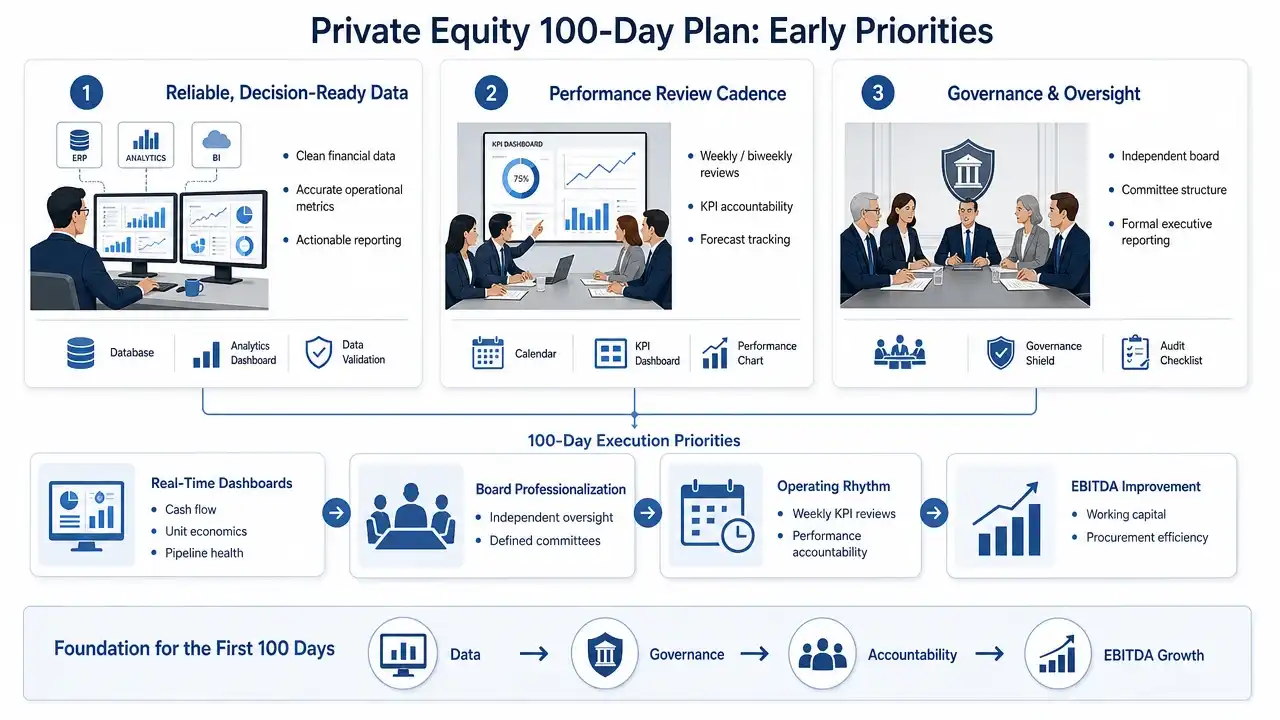
In finance and operations work involving ERP and analytics transformation, leadership teams often flounder in these early weeks. Data is often incomplete or inconsistent. PE firms tend to remedy this quickly. They require clean, timely data and hold CEOs and CFOs directly accountable for it. The expectation is straightforward: if data does not exist, build it; if it is not accurate, fix it; if it is not actionable, iterate until it becomes so.
A New Reporting Cadence
Informal monthly check-ins typically give way to formal weekly or biweekly operational reviews. Each dashboard gets discussed, probed, and challenged rather than simply reported. A revenue forecast miss cannot be waved away as seasonal variance. Working capital targets must be met on schedule, and labor productivity gets measured as hard output per head rather than narrative context. Trust between founder and investor must be earned weekly rather than assumed at the moment of acquisition.
Governance That Separates Oversight from Management
Founder-led boards, while often dynamic and visionary, tend to lack the separation between oversight and management that scale requires. Under new ownership, the board typically expands to include operating partners or independent directors, board charters get redefined, and audit, compensation, or ESG committees begin holding scheduled quarterly presentations. Reporting stops being discretionary and becomes mandated as part of the plan itself.
A private equity 100 day plan built around these three pillars tends to include a consistent set of early priorities:
- Standing up real-time dashboards for cash, unit economics, and pipeline health
- Reconstituting the board with independent oversight and clear committee structures
- Establishing a weekly or biweekly review cadence tied to hard performance metrics
- Identifying the first wave of EBITDA levers, including working capital and procurement
The Cultural Shift Behind the Numbers
Founders often view PE firms as bold but effective, if occasionally ruthless. The cultural transition tends to be the steepest slope in the entire process. Research on founder-investor partnerships suggests that firms placing genuine trust in founders through structured transparency tend to outperform those that simply impose control. That requires a real psychological shift. Founders must move from seeking board buy-in toward genuine board enablement, and from comfort with intuition toward comfort with dashboards as the new currency of credibility.
Succession and role clarity often surface as a related challenge during this same window. When a founder remains CEO, reporting lines can become dual hatted, requiring real self-awareness and openness to structured input. In several engagements, founders have moved into an executive chairman role, balancing their vision with a new CFO’s data-backed control. Handled well, this arrangement sustains exactly what private equity seeks most, a combination of founder vision and scalable discipline.
Systems and EBITDA Levers Inside the Plan
The PE ownership model frequently triggers enterprise-wide upgrades to ERP, business intelligence, and governance tooling within the same early period. Value creation platforms across the industry emphasize finance transformation, integrated dashboards, and real-time insight as core levers. Building these platforms often means setting up data lakes, automating risk reporting, and embedding operational KPIs directly into board packs.
EBITDA optimization accelerates in parallel. Working capital reduction, margin expansion, and procurement renegotiation shift from back-burner items into active levers with sponsor-level attention. Founders must reconcile long-horizon innovation work with short-horizon margin mandates. Combined ROI and IRR forecasts for cost initiatives often help, letting leaders balance runway, growth, and margin expansion at the same time.
Three Transformations in Practice
The Furniture Manufacturer and Working Capital Discipline
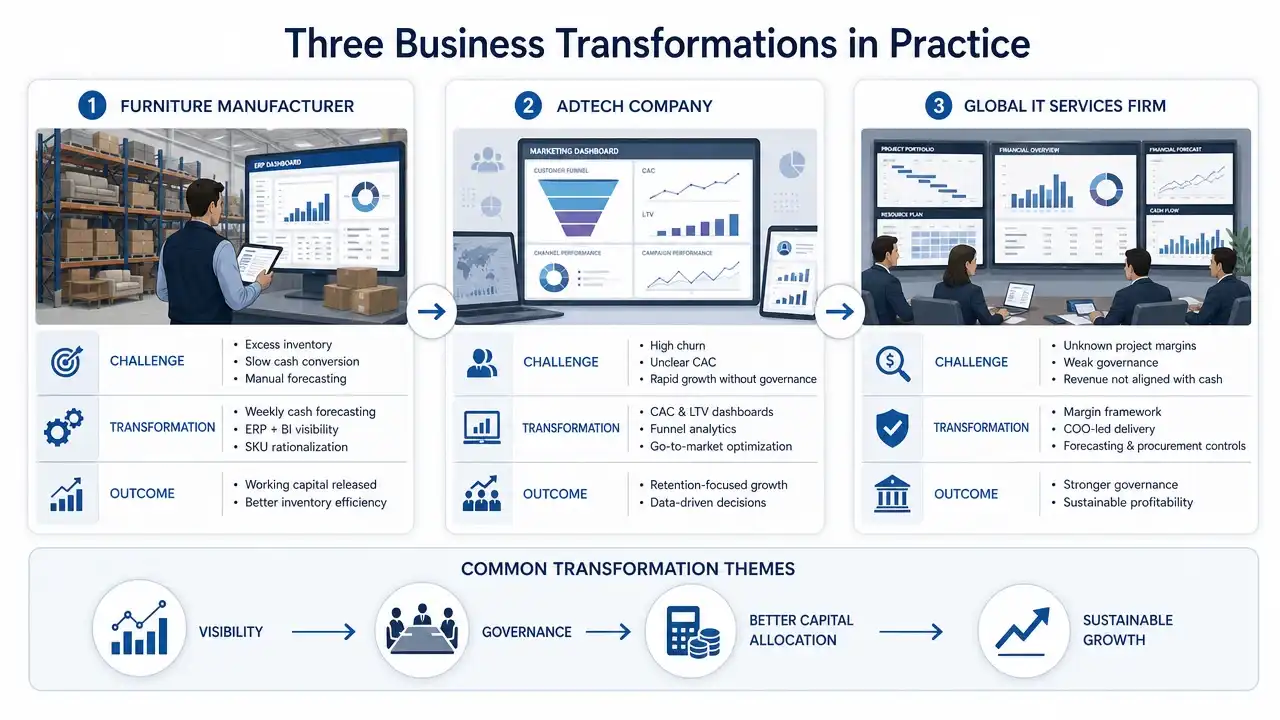
A legacy furniture company with a proud family lineage and steady but stalled growth offers a clear illustration. Margins were respectable, but cash conversion was sluggish, inventory sat in excess, and forecasting remained largely manual. Once new ownership took hold, a formal board was constituted, SKU rationalization targets were introduced, and cash flow forecasting moved from quarterly to weekly. ERP and BI tools were integrated to show real-time SKU performance by region and margin tier. The turning point arrived through insight rather than pressure. The founder saw that roughly 30 percent of warehouse space supported less than 7 percent of revenue. Trimming those lines freed working capital for marketing and e-commerce, and the narrative shifted from fear of control to genuine pride in progress.
The Adtech Firm and Unit Economics
A fast-growing adtech company presented a different challenge. Revenue had doubled over three years, yet churn ran high and customer acquisition cost remained opaque, with no real governance structure in place. After acquisition, the company faced a 120-day window to present a full operating model, including CAC, LTV by segment, and margin contribution per channel. Dashboards traced each lead’s source, cost, and conversion, and post-mortem reviews covered lost renewals. By month three, the company had a clear view of its funnel math and a refocused go-to-market strategy. The founder moved into a Chief Innovation Officer role and thrived once freed from day-to-day reporting, while the company’s message shifted from growth at all costs to growth with retention.
The IT Services Firm and Governance Professionalization
A third transformation involved a global IT services firm built largely through hustle and relationship sales, with unclear project margins and no CFO in place. A margin framework revealed that nearly 25 percent of projects operated below breakeven, masked by revenue recognition that did not match cash collection. Rather than remove the founder, the new board elevated him into a client development role and hired a COO to oversee delivery optimization. Monthly cohort analysis, improved staffing forecasts, and centralized procurement followed. The culture shifted toward something still entrepreneurial but firmly grounded in metrics.
Conclusion
Across furniture manufacturing, adtech, and IT services, the same pattern holds. A private equity 100 day plan does not exist to strip away entrepreneurial spirit. It exists to repurpose that spirit for scale, forcing data into the conversation and bringing discipline to the reporting cadence. It also institutionalizes what may once have lived only as founder intuition. The earliest weeks after acquisition tend to feel disorienting. Informal judgment gives way to dashboards, board charters, and weekly accountability. But for founders willing to learn and adapt, this same period offers something valuable. It provides the operational scaffolding needed to build not just a strong product, but a genuinely lasting company. The plan asks leaders to become metrics-first and governance-ready almost overnight. That shift feels uncomfortable at first, yet it often makes the difference between a business that merely survives new ownership and one that compounds value under it.
Disclaimer: This blog is intended for informational purposes only and does not constitute legal, tax, or accounting advice. You should consult your own tax advisor or counsel for advice tailored to your specific situation.
Hindol Datta is a seasoned finance executive with over 25 years of leadership experience across SaaS, cybersecurity, logistics, and digital marketing industries. He has served as CFO and VP of Finance in both public and private companies, leading $120M+ in fundraising and $150M+ in M&A transactions while driving predictive analytics and ERP transformations. Known for blending strategic foresight with operational discipline, he builds high-performing global finance organizations that enable scalable growth and data-driven decision-making.
AI-assisted insights, supplemented by 25 years of finance leadership experience.