Executive Summary
Founder-led growth carries extraordinary energy, but energy alone does not survive the scrutiny of institutional capital. This article examines how private equity partnership converts entrepreneurial instinct into repeatable performance without erasing the spirit that built the company. Drawing on more than twenty-five years leading finance across cybersecurity, SaaS, gaming, logistics, digital marketing, medical devices, and nonprofit organizations, I explore how ERP adoption, cash flow discipline, sales forecasting rigor, and governance cadence work together to professionalize a business. I also examine the second phase of this journey, where leadership benches deepen, culture matures, and exit readiness becomes a daily habit rather than a last-minute scramble. The goal throughout is simple. Structure should never compete with ambition. When designed with intention, it becomes the very mechanism that allows ambition to scale.
Part I: Where Founder Instinct Meets Institutional Discipline
Every transition from founder-led improvisation to institutional order carries a certain alchemy. Purpose meets process, and something durable is formed. Over three decades spent probing the intersections of finance, strategy, and systems thinking, I have come to see this friction as productive rather than destructive. Private equity does not enter a company to extinguish founder energy. It enters to channel it into something that can compound over time. Organizational scaling, done well, preserves the fire while giving it a chimney.
Private equity sponsors typically arrive with a clear mandate: build a repeatable engine. That usually means standardized ERP systems, cash flow discipline, structured sales forecasting, and rigorous reporting. To a founder accustomed to moving on instinct, this can feel like bureaucracy arriving uninvited. I have sat across the table from a founder who resisted a global ERP rollout because the team believed it moved too fast for layers of process. The counterargument was straightforward. Without consistent data, leadership was flying blind. We resolved the tension by staging the rollout across product lines and regions, supported by weekly dashboard reviews. The speed the team prized did not disappear. It became sustainable.
The Quiet Power of an ERP
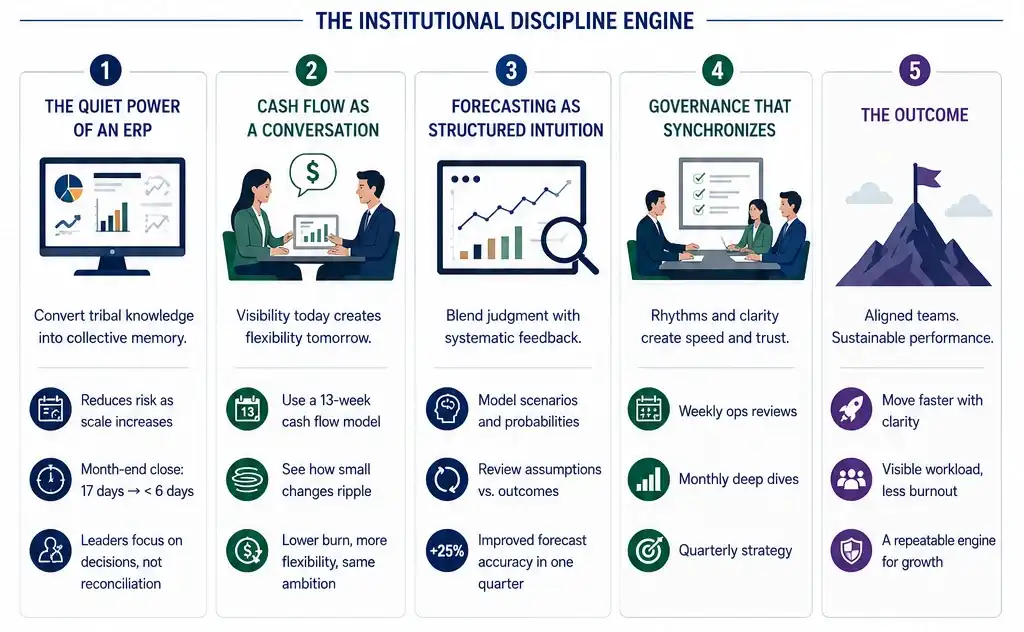
An ERP implementation can look mundane on paper, yet it performs a foundational act of shared trust. It converts tribal knowledge into collective memory. Early in a company’s life, rapid and inexpensive experimentation makes sense. As scale increases, however, the cost of a wrong turn grows sharply, and a well-implemented ERP absorbs much of that risk. Having led multi-entity finance architecture across a cybersecurity and identity access management company spanning the United States, India, and Nepal, I saw firsthand how a properly sequenced systems rollout brought month-end close down from seventeen days to under six, freeing leadership to focus on decisions rather than reconciliation.
Cash Flow as a Conversation, Not a Constraint
Founders instinctively chase growth, and that instinct is essential. Growth funded by an opaque burn rate, however, is fragile. I often introduce a thirteen-week cash flow model early in a private equity relationship. This simple system reveals how small changes ripple through an entire organization. A short slip in receivables can trigger a reforecast. A hiring delay can free up flexibility elsewhere. Early in my career, while serving as director of finance for a digital marketing and email technology company, I helped reduce monthly burn from eight hundred thousand dollars to two hundred thousand dollars. That experience taught me that cash discipline is rarely a constraint on ambition. It is the conversation that makes ambition affordable.
Forecasting as Structured Intuition
Sales forecasting has always fascinated me because it sits at the intersection of art and system. A reliable forecast depends on tight feedback loops between assumptions and outcomes. In one founder-led software company, leadership feared that a formal forecasting cadence would suppress creativity. We reframed it instead as structured intuition. Leaders estimated probabilities, modeled scenarios, and debated assumptions in dedicated working sessions. The shift improved forecast accuracy by twenty-five percent within a single quarter, and more importantly, it gave the team a shared instrument for thinking about the future rather than a compliance exercise imposed from outside.
Governance That Synchronizes Rather Than Restricts
Under informal leadership, decisions often center on quick calls and personal bandwidth. Institutional ownership shines a light on governance. Boards expect agendas, pre-reads, dashboards, and minutes. Implementing a structured operating cadence, including weekly operations reviews, monthly performance deep dives, and quarterly strategic planning, does not limit autonomy. It synchronizes it. Teams move faster because expectations are aligned, and burnout eases because workload becomes visible and shared rather than carried silently by a few.
A few practices consistently accelerate this transition:
- Staging system rollouts by product line or region rather than forcing a single company-wide switch
- Treating forecasting cadences as learning tools, with explicit review of what was learned when deals slipped or closed early
- Mapping the informal network of champions and skeptics before introducing new operating rhythms, then engaging each group deliberately
Part II: Leadership, Culture, and the Path to Exit Readiness
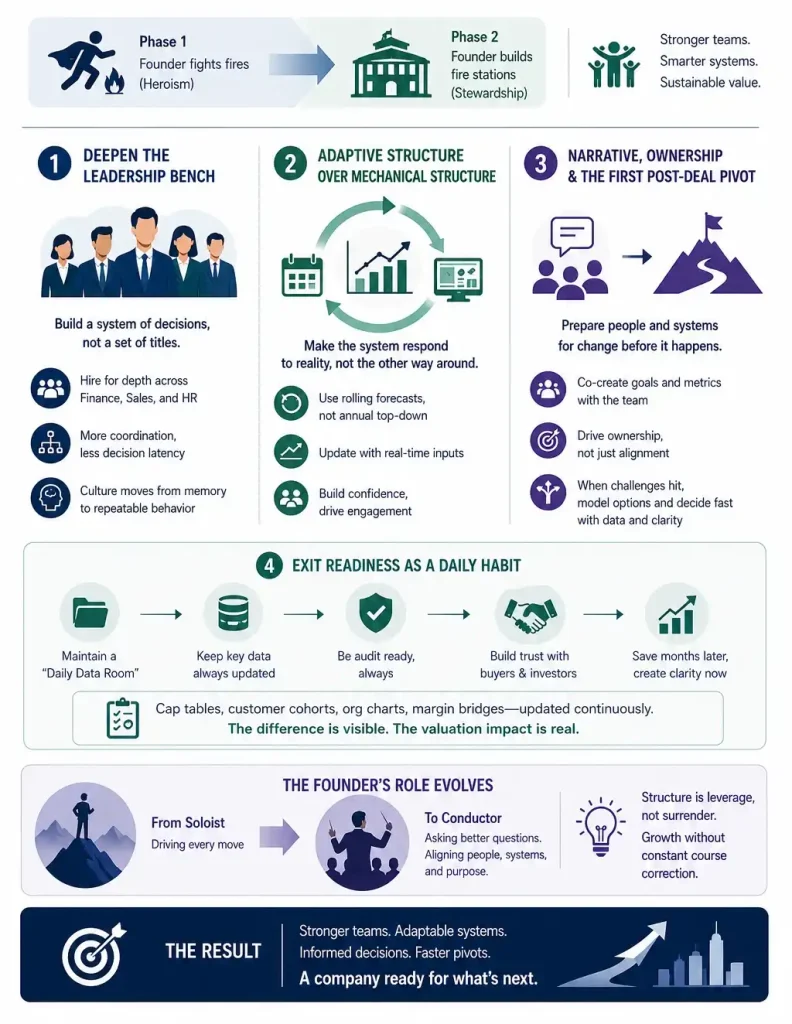
As operational systems settle, a second and quieter phase of professionalization begins. This is where the founder evolves the team, the culture, and their own role. I often describe it as the shift from heroism to system stewardship. In the first phase, the founder fights fires. In this one, the founder builds fire stations.
Deepening the Leadership Bench
Companies that scale well under institutional ownership share a common pattern. The leadership bench deepens deliberately rather than by accident. Having overseen more than one hundred million dollars in gaming sector acquisitions and post-merger integration, I have watched founders recruit finance leaders with capital markets depth, sales leaders with quota-building experience, and human resources leaders who understand organizational design. This team becomes a system of decisions rather than a set of titles. Coordination increases, decision latency decreases, and culture stops relying on memory and starts operating as repeatable behavior.
Adaptive Structure Over Mechanical Structure
Structure can suppress energy if it is applied too rigidly. The balance between rigidity and adaptability matters enormously here. Shifting budgeting from an annual top-down exercise to rolling forecasts, updated monthly against real-time inputs, turns forecasting into an agile discipline rather than a punitive one. When teams see that the system responds to reality, their confidence in it grows, and engagement follows naturally.
Narrative, Ownership, and the First Post-Deal Pivot
Cultural shifts require careful framing. When institutional sponsors introduce process, teams often brace for austerity. That anxiety fades when founders stay visibly involved, explain the reasoning, and co-create the metrics with their teams rather than imposing them. I have watched a company-wide objectives and key results framework, built with team-proposed metrics refined for clarity, produce ownership rather than mere alignment.
That ownership matters most when a company faces its first post-deal pivot. A sales motion stalls, acquisition costs creep upward, or a product assumption breaks. Companies with genuine institutional maturity respond differently in these moments. Having led a forty-eight million dollar capital raise for a mission-driven education institution, I have sat through board discussions where a sharp revenue decline emerged mid-year. Because the organization had built a rolling cash forecast and maintained weekly sales analytics, the response was calm rather than reactive. Two recovery paths were modeled against margin and burn, and a decision was reached within seventy-two hours. Professionalization buys speed with context, which is a very different thing from speed alone.
Exit Readiness as a Daily Habit
All of this feeds into exit readiness, which does not mean a company is for sale. It means a company can tell its story cleanly at any moment. I encourage what I call the daily data room, where cap tables, customer cohorts, organizational charts, and margin bridges remain continuously updated and audit ready. This habit takes discipline, yet it saves months later and forces ongoing clarity in the present. Having led capital raises exceeding one hundred and twenty million dollars and M&A transactions exceeding one hundred and fifty million dollars, I can say with confidence that buyers and investors notice the difference between a company that scrambles to explain its history and one that has been documenting it all along.
The founder’s role evolves again in this phase, moving from soloist to conductor. Strategic input shifts from directing action to asking better questions. This evolution is deeply personal and requires humility, yet founders who treat structure as leverage rather than surrender consistently find that their companies grow without constant course correction.
Conclusion
Founder-led growth and institutional discipline are often framed as opposing forces, yet the most successful transformations treat them as complementary. ERP systems, cash flow models, forecasting cadences, and governance rhythms do not exist to slow a company down. They exist to make its speed sustainable. Across more than twenty-five years working alongside founders and boards in cybersecurity, SaaS, gaming, logistics, digital marketing, medical devices, and nonprofit organizations, I have watched the same pattern repeat. Structure enables scale. Discipline creates options. Process sustains performance, and none of it requires losing the company’s soul. When founders lead this transformation rather than resist it, the result reaches beyond operations. It becomes strategic, cultural, and enduring, carrying the company confidently toward whatever future its leaders choose to build.
Disclaimer: This blog is intended for informational purposes only and does not constitute legal, tax, or accounting advice. You should consult your own tax advisor or counsel for advice tailored to your specific situation.
Hindol Datta is a seasoned finance executive with over 25 years of leadership experience across SaaS, cybersecurity, logistics, and digital marketing industries. He has served as CFO and VP of Finance in both public and private companies, leading $120M+ in fundraising and $150M+ in M&A transactions while driving predictive analytics and ERP transformations. Known for blending strategic foresight with operational discipline, he builds high-performing global finance organizations that enable scalable growth and data-driven decision-making.
AI-assisted insights, supplemented by 25 years of finance leadership experience.