
Executive Summary
Static budgets and annual planning cycles no longer serve organizations that must adapt weekly, sometimes daily, to shifting market conditions. This article examines how finance leaders can move beyond the traditional role of budget keeper. It explores how they move into the role of growth enabler. They do this by adopting rolling forecasts, scenario-based decision trees, and cross-functional partnership models. The discussion draws on more than twenty-five years of executive finance leadership. This leadership spans cybersecurity, SaaS, gaming, logistics, digital marketing, medical devices, and nonprofit sectors. It explores how capital allocation, revenue forecasting, and quota modeling improve. These improve when finance treats planning as an ongoing dialogue rather than a quarterly ritual. The result is a finance function that does not merely report on the past. It actively shapes what comes next. This gives executives, investors, and boards the clarity needed to make faster, better-informed decisions.
From Budget Keeper to Growth Enabler
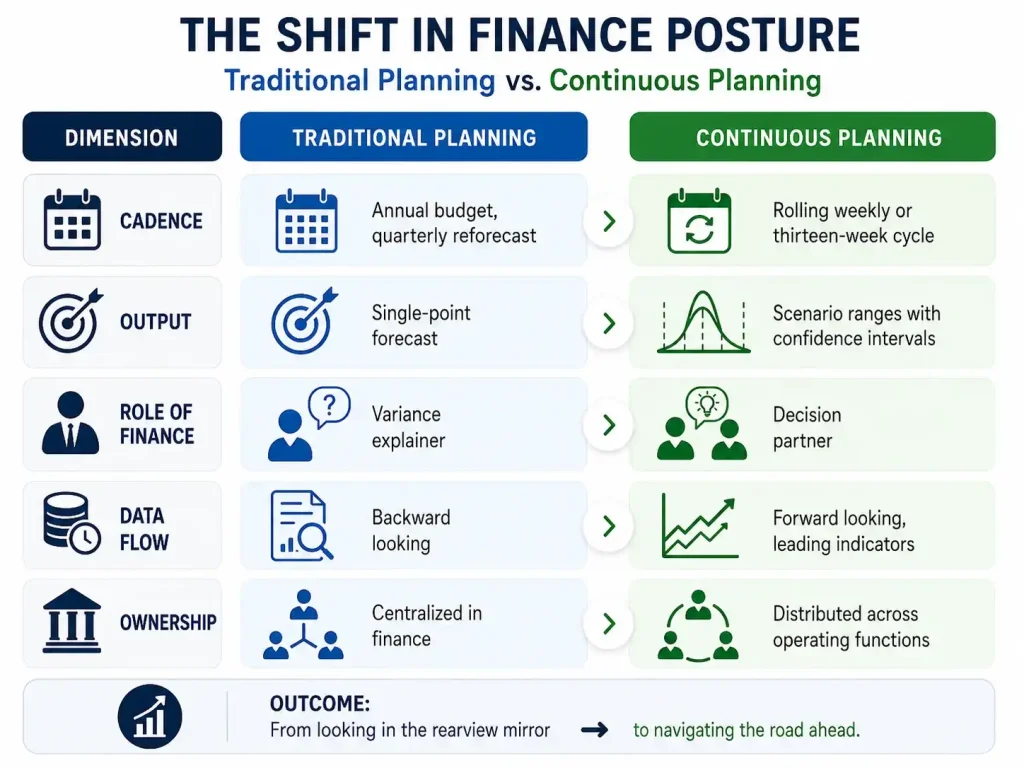
For much of my career, finance operated as a control room. Budgets were fixed at the start of the year, reforecasts existed mainly to explain variance, and planning cycles moved at a pace far slower than the business itself. Finance was respected for its precision, yet precision without foresight offers limited strategic value. Over three decades, I led finance across public and private companies. This included capital raises exceeding one hundred and twenty million dollars. It also included mergers and acquisitions exceeding one hundred and fifty million dollars. Through this experience, I came to see an important pattern. The organizations that grew fastest were the ones where finance stopped locking assumptions. Instead, these organizations started testing assumptions continuously.
This is the essence of continuous planning. Rather than treating the budget as a fixed contract, continuous planning treats it as a living model that updates as new information arrives. It replaces the annual ritual with an ongoing conversation between finance and every operating function, so that decisions are informed by current reality rather than assumptions set months earlier.
Building the Architecture of Continuous Planning
Continuous planning is not simply forecasting more often. It requires a different architecture, one built on cadence, scenario thinking, and a willingness to treat uncertainty as something to be managed rather than eliminated.
Rolling Forecasts as a Discipline
At one high-growth digital marketing organization, where I helped scale revenue from nine million to one hundred and eighty million dollars, we installed a rolling thirteen-week forecast cadence. Rather than a monthly exercise, forecasting became a continuous dialogue between finance and every operating function. Marketing reviewed lead velocity and customer acquisition cost weekly. Sales operations reported quota coverage and attainment on the same rhythm. Product shared adoption telemetry linked directly to expansion revenue. These inputs continuously refreshed our forecast scenarios, which in turn guided hiring triggers, campaign funding, and product investment decisions in near real time.
The discipline mattered as much as the tools. A rolling forecast that is updated infrequently is simply a slower version of the old annual budget. Continuous planning only delivers value when the cadence matches the speed at which the business actually moves.
Scenario Trees Over Single-Point Forecasts
Linear extrapolation rarely survives contact with a complex business. During a revenue forecast re-architecture, our team replaced single-point projections with decision trees that mapped the likelihood of pipeline segments converting based on cycle time variability, discount pressure, competitive intensity, and sales representative tenure. The output was not one number but a set of scenarios, each carrying its own confidence interval. Go-to-market leadership could then adjust resource allocation week to week, improving close rates while protecting margin.
Continuous Planning Across the Organization
The real test of continuous planning is whether it changes behavior beyond the finance function itself.
Product and Engineering
In one organization, finance embedded directly into the product roadmap process rather than reviewing spend after the fact. Each major initiative carried a business case updated with real-time data on customer impact, monetization pathway, and cost of delay. When a product team requested additional funding to accelerate a feature release, the model quantified the implied revenue unlock of shipping one quarter earlier by integrating usage indicators, pipeline dependencies, and customer satisfaction trends. The decision was grounded in predictive return rather than persuasion.
Marketing and Customer Acquisition
Across digital marketing and SaaS environments, continuous planning changed how measurement worked. It moved beyond simple channel attribution and into marginal customer acquisition cost by segment. Understanding how message resonance varied by audience mattered. Understanding how campaign saturation affected conversion decay mattered too. Together, these gave marketing leadership the ability to argue for reallocation with expected value, not anecdote.
Sales and Revenue Operations
Quota models built on stochastic assumptions, accounting for cycle time variability, seasonality, and deal complexity, allowed revenue leadership to set targets that were ambitious yet grounded in reality. This also helped avoid overhiring in underperforming segments, turning finance into a validator of strategy rather than a simple provider of headcount targets.
Risk, Compliance, and Regulated Environments
Continuous planning takes a different shape in regulated or risk-sensitive environments, yet the underlying discipline holds. In cybersecurity, customer trust and contract renewal cycles are tightly linked to product reliability. Forecasts benefit from continuous visibility into churn risk signals. This is better than relying on a static annual view.In medical devices, regulatory timelines and reimbursement cycles introduce real uncertainty. Continuous planning allows finance to model multiple approval and launch scenarios side by side. This is better than committing to a single timeline months in advance.
Logistics operations are shaped by volatile fuel costs, capacity constraints, and seasonal demand swings. They benefit from the same rolling cadence that governs sales forecasting. A monthly view is often too slow to capture shifts in freight cost or route utilization.Nonprofit and mission-driven organizations have funding sources that can include grants, donations, and program revenue with different timing patterns. These organizations gain similar value from continuous cash visibility. This matters particularly when leadership must balance mission delivery against runway.
Across each of these sectors, the tools differ, but the posture is consistent. Finance stays close enough to operating reality that assumptions can be revised before they become liabilities.
Capital Allocation Under Continuous Planning
Nowhere does continuous planning matter more than in capital allocation, particularly for growth-stage companies where every dollar carries opportunity cost.Leading a forty-eight million dollar capital raise for a mission-driven education institution reinforced an important lesson. It is essential to model funding decisions against multiple scenarios. This is better than relying on a single approved plan.
In another instance, reducing monthly burn from eight hundred thousand to two hundred thousand dollars required continuous visibility into cash conversion. A once-a-quarter review was not enough.
Similarly, overseeing more than one hundred million dollars in gaming sector acquisitions demanded planning models that could absorb new information quickly. Integration timelines and synergy assumptions shifted often in the months following each transaction.
Continuous planning gives capital allocation a rhythm that matches the pace of the underlying business, whether the context is a cybersecurity firm scaling its go-to-market motion, a logistics operator managing volatile demand, or a medical device company navigating regulatory timelines.
Culture, Trust, and the New Finance Posture
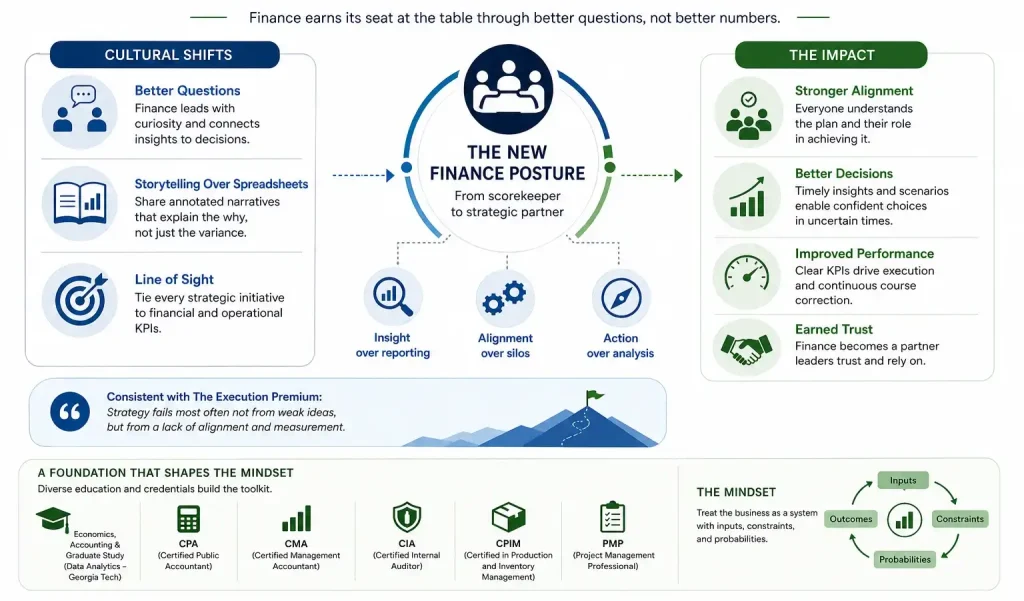
None of this works without cultural change. Finance earns its seat at the table not through better numbers alone but through better questions. Training analysts in storytelling as much as spreadsheet mechanics, sharing annotated narratives instead of variance-only decks, and tying every strategic initiative to financial and operational key performance indicators created a clear line of sight from the boardroom to daily execution. This is consistent with the broader lesson of The Execution Premium, that strategy fails most often not from weak ideas but from a lack of alignment and measurement.
A background spanning economics, accounting, and later graduate study in data analytics at Georgia Tech, alongside CPA, CMA, CIA, CPIM, and PMP credentials, shaped my own approach to this problem. Regression models, cluster analysis, and simulation techniques are not always deployed directly inside FP&A, but the underlying mindset, treating the business as a system with inputs, constraints, and probabilities, transforms how planning conversations unfold.
Conclusion
Continuous planning is not a technology upgrade or a scheduling change. It is a shift in how finance understands its purpose. When planning becomes an ongoing dialogue rather than an annual event, finance stops functioning as a rear-view mirror and becomes a forward-looking partner to every operating function. Across cybersecurity, SaaS, gaming, logistics, digital marketing, medical devices, and nonprofit organizations, the same pattern holds true: when finance treats forecasts as living models and capital allocation as a continuous exercise, the business gains speed, resource decisions improve, and executive teams gain the confidence to act before a window closes rather than after. This is the deeper promise of continuous planning. It does not simply make forecasts more accurate. It makes the entire organization more coherent, aligning intention with action across every function, and positioning the CFO not as the keeper of constraints but as the architect of what the company can become.
Disclaimer: This blog is intended for informational purposes only and does not constitute legal, tax, or accounting advice. You should consult your own tax advisor or counsel for advice tailored to your specific situation.
Hindol Datta is a seasoned finance executive with over 25 years of leadership experience across SaaS, cybersecurity, logistics, and digital marketing industries. He has served as CFO and VP of Finance in both public and private companies, leading $120M+ in fundraising and $150M+ in M&A transactions while driving predictive analytics and ERP transformations. Known for blending strategic foresight with operational discipline, he builds high-performing global finance organizations that enable scalable growth and data-driven decision-making.
AI-assisted insights, supplemented by 25 years of finance leadership experience.