Executive Summary
Board governance was built for a slower era of printed reports and annual audits, yet the modern enterprise moves in real time. This article examines why static, backward-looking board packets no longer serve directors who must evaluate risk, strategy, capital allocation, culture, and shareholder sentiment under compressed timelines. It introduces digital governance through the lens of a dynamic dashboard, a living interface spanning real-time risk indices, strategic progression tracking, capital allocation visibility, culture health signals, and shareholder pulse. Drawing on experience across capital raises, mergers, and finance transformations spanning cybersecurity, SaaS, gaming, logistics, and nonprofit organizations, the piece argues that dashboards sharpen judgment rather than replace it, letting directors ask sharper questions and act with better timing. Boards that see clearly govern faithfully, and clarity, not more paper, remains the true instrument of stewardship.
The Boardroom’s Old Instruments
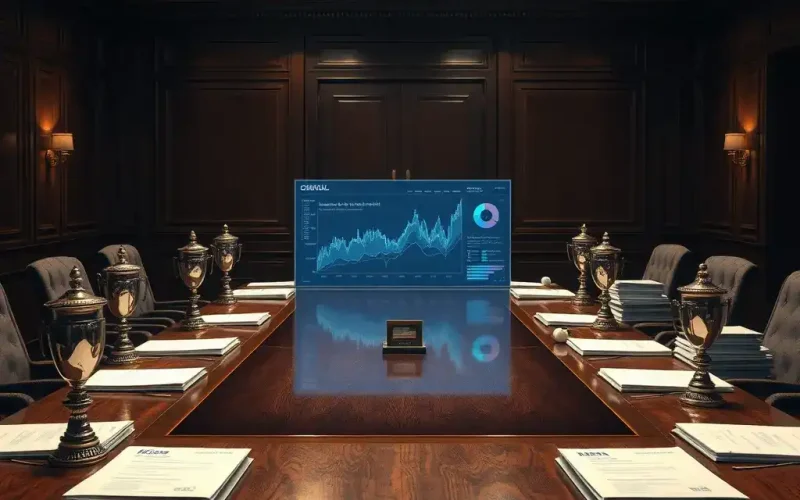
There is a certain theatre to the boardroom, the hush before the meeting, the stacks of papers few will finish reading, the sense that power speaks in complete sentences. Beneath that ceremony sits a harder truth. Directors are asked to govern enterprises that move by the hour using instruments built for an age when strategy changed by the decade. This is the essence of digital governance: replacing static, after-the-fact reporting with a living view of the business that lets directors see risk, strategy, and culture as they unfold rather than after they have already hardened into outcomes.
The board’s mandate has grown considerably even as its available time has not. Directors are expected to evaluate leadership, assess enterprise risk, scrutinize capital allocation, anticipate market disruption, and oversee cybersecurity exposure, all within a handful of meetings each year. That mismatch between expectation and instrumentation is not a failure of any single board. It is a structural inheritance from an era when information moved more slowly and businesses changed shape less often.
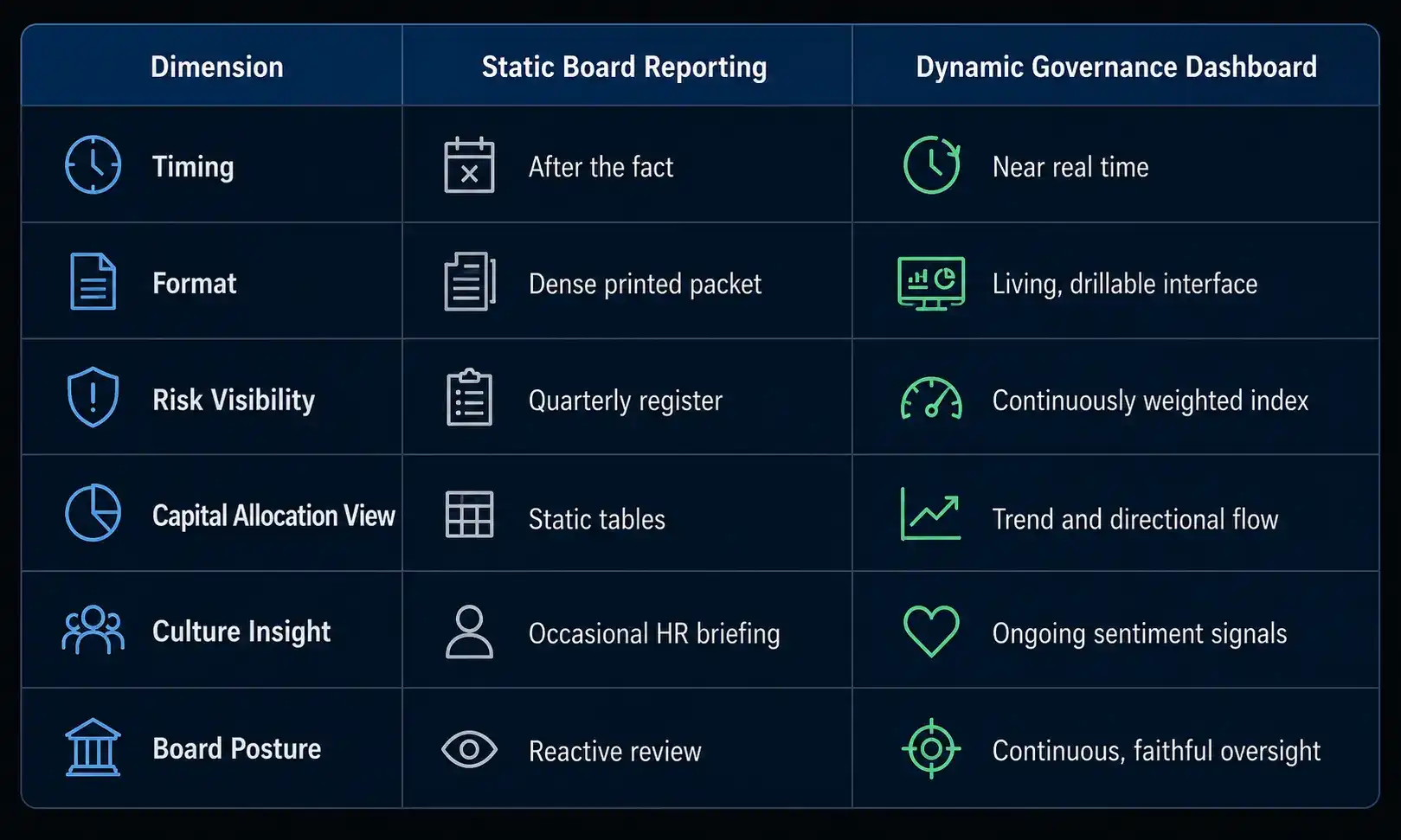
Most board materials still follow a familiar shape, a dense pre-read packet arriving days before the meeting, thick with charts, risk registers, and narrative summaries. Each page is defensible on its own. Together, they overwhelm rather than clarify. The deeper issue is timing. These reports are written after events have already happened, which makes them closer to a record of last quarter than a guide to the next one.
Having worked across finance transformations in logistics and medical devices, sectors where supply conditions and regulatory exposure can shift within weeks, I have seen how quickly a printed packet becomes outdated between its preparation and the meeting itself. The information is not wrong. It is simply late, and lateness in governance carries its own quiet cost.
The Cost of Static Reporting
Having sat on boards and led finance functions across cybersecurity, SaaS, logistics, and medical devices, I have watched the same pattern recur regardless of sector. Directors receive abundant data and still feel a persistent unease about what they might be missing. The gap is not intelligence. It is visibility. A board meeting six or eight times a year cannot substitute for continuous awareness, and no amount of additional paper closes that gap. What closes it is a different kind of instrument entirely.
Anatomy of a Modern Governance Dashboard
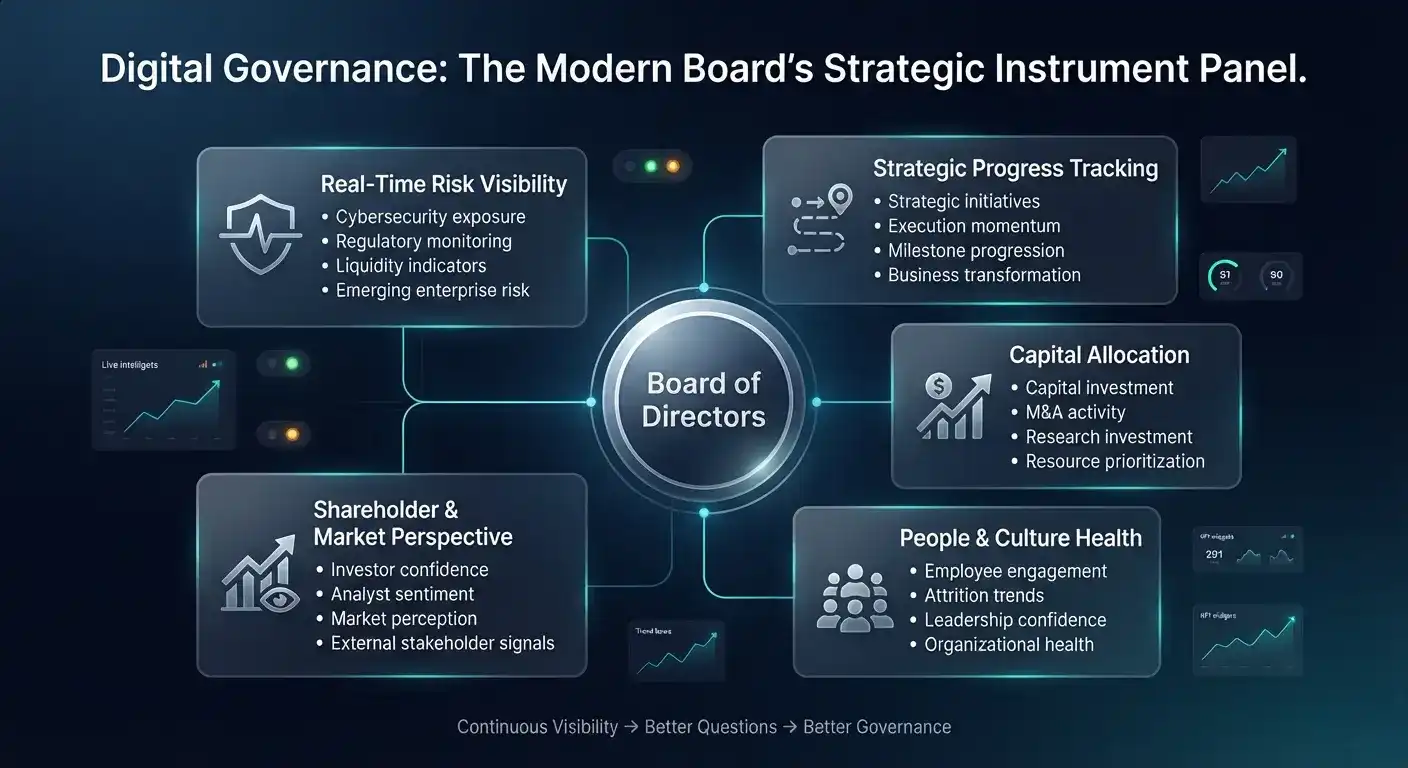
A governance dashboard is not a spreadsheet with better formatting. It is a shift in how the board apprehends the enterprise, built for stewardship rather than daily operations. A few components tend to matter most.
Real-Time Risk Visibility
Rather than a static risk register reviewed once a quarter, a dynamically weighted risk view draws on external cyber scanning, regulatory exposure, sentiment analysis, and liquidity indicators. In cybersecurity environments especially, where exposure can shift within days, this kind of continuous visibility is not a luxury. It is table stakes for informed oversight.
Strategic Progression and Capital Allocation
A second panel tracks strategic initiatives, not through verbose project updates but through simple indicators of momentum, materiality, and shifting execution risk. Paired with this is a clear view of capital allocation, showing how capital expenditure, research investment, and mergers align with long-term strategy. Having overseen more than one hundred fifty million dollars in merger and acquisition transactions and over one hundred million dollars in gaming sector acquisitions, I have seen how easily capital can drift quietly back toward legacy priorities unless the board has a direct line of sight into where money is actually moving.
Human Capital and Culture Signals
Reputational and operational risk increasingly originates in culture rather than the balance sheet. A dashboard that tracks attrition, engagement sentiment, and related signals gives the board a live read on organizational health rather than a delayed briefing from a single executive. In a mission-driven education institution where I led a forty-eight million dollar capital raise, culture metrics proved just as material to the board’s confidence as the financial model itself.
Shareholder Sentiment
The final layer looks outward, capturing analyst sentiment, proxy advisory positioning, and shifts in investor behavior. Boards that see this directly, rather than through a filtered summary, are better positioned to anticipate rather than react.
Comparing Static Reports and Dynamic Dashboards
Navigating Board Dynamics with Better Vision
Navigating board dynamics well depends less on the volume of information directors receive and more on how clearly that information is framed. A dashboard, done properly, does not demand attention. It earns it, showing the board where to look and, just as importantly, where not to spend limited time.
Lessons From Capital Raises and Transformations
Across more than one hundred twenty million dollars in capital raised and finance transformations spanning digital marketing, logistics, and nonprofit organizations, one lesson has repeated itself. Boards that intervene early do so because they saw a signal before it became a crisis, not because they read more pages. In one digital marketing enterprise I helped scale from nine million to one hundred eighty million dollars in revenue, the moments that mattered most to the board were small, early signals, a shift in customer onboarding time, a quiet change in margin trajectory, long before either appeared in a quarterly report. The same discipline that reduced monthly burn from eight hundred thousand to two hundred thousand dollars in another organization depended on visibility that updated continuously rather than periodically.
Why Boards Resist, and Why They Should Not
Some directors worry that dashboards push the board toward operational involvement rather than governance. The concern is understandable but misplaced. A pilot does not need to build the engine to benefit from an instrument panel. A well-designed governance dashboard does not ask the board to manage the business. It asks the board to see it clearly enough to ask sharper questions and to act with better timing.
There is also a temptation to equate more data with better oversight. In practice, the opposite is often true. A governance dashboard earns its value by filtering, not by accumulating, and the discipline of choosing what belongs on it, drawn from the same rigor applied to any finance transformation, matters as much as the technology behind it.
Conclusion
Governance has always been about stewardship, holding something in trust on behalf of investors, employees, and customers, and holding it well. That responsibility becomes harder, not easier, when the instruments available to the board are built for a slower world of printed reports and annual reviews. Digital governance, expressed through a thoughtfully designed dashboard, offers directors a living view of risk, strategy, capital, and culture as they actually unfold. It does not replace judgment. It sharpens it, giving boards back the time they lose to dense packets and the clarity they lose to delayed information. Across sectors as varied as cybersecurity, SaaS, gaming, and nonprofit governance, the pattern holds. Boards that see clearly govern faithfully, and in a business environment that no longer moves at a quarterly pace, clarity itself has become the board’s most essential instrument.
Disclaimer: This blog is intended for informational purposes only and does not constitute legal, tax, or accounting advice. You should consult your own tax advisor or counsel for advice tailored to your specific situation.
Hindol Datta is a seasoned finance executive with over 25 years of leadership experience across SaaS, cybersecurity, logistics, and digital marketing industries. He has served as CFO and VP of Finance in both public and private companies, leading $120M+ in fundraising and $150M+ in M&A transactions while driving predictive analytics and ERP transformations. Known for blending strategic foresight with operational discipline, he builds high-performing global finance organizations that enable scalable growth and data-driven decision-making.
AI-assisted insights, supplemented by 25 years of finance leadership experience.