
Executive Summary
Audit readiness is not a season. It is a discipline built quarter after quarter, long before an auditor ever reviews a ledger. Across cybersecurity, SaaS, gaming, logistics, and nonprofit organizations, the pattern is consistent. Auditors do not expect perfection. They expect a reasonable, well documented process that reflects economic reality. Founders who understand this shift their focus from fear to preparation, treating documentation, materiality, and predictability as operational assets rather than compliance burdens. The finance leaders who build monthly reconciliation habits, contemporaneous documentation, and transparent board communication find that audits become confirmations of discipline rather than disruptions to the calendar. This article outlines what auditors genuinely evaluate, how founders can build a culture that supports it, and why treating the audit as a continuous function, rather than an annual event, compounds into lasting financial credibility.
Founders often approach an audit with a mixture of dread and resignation, as though the process exists to catch them in an error. Having guided companies across cybersecurity, software, gaming, logistics, and nonprofit sectors through audits of every complexity, the reality of audit readiness is far less adversarial than most executives assume. Auditors serve the interests of shareholders, current and future, and their role is to confirm that financial statements reflect economic reality and rest on systems capable of withstanding scrutiny. Once that mindset is understood, the entire relationship changes.
The best auditors function less like examiners and more like collaborators who help a growing organization see its own blind spots. This shift in perspective matters most in the earliest audits, when systems are new, teams are lean, and every process still carries a degree of improvisation. A mindset built around audit readiness, cultivated early, tends to compound into a durable advantage as the company scales toward its next funding round, acquisition, or public offering.
Understanding What Auditors Actually Want
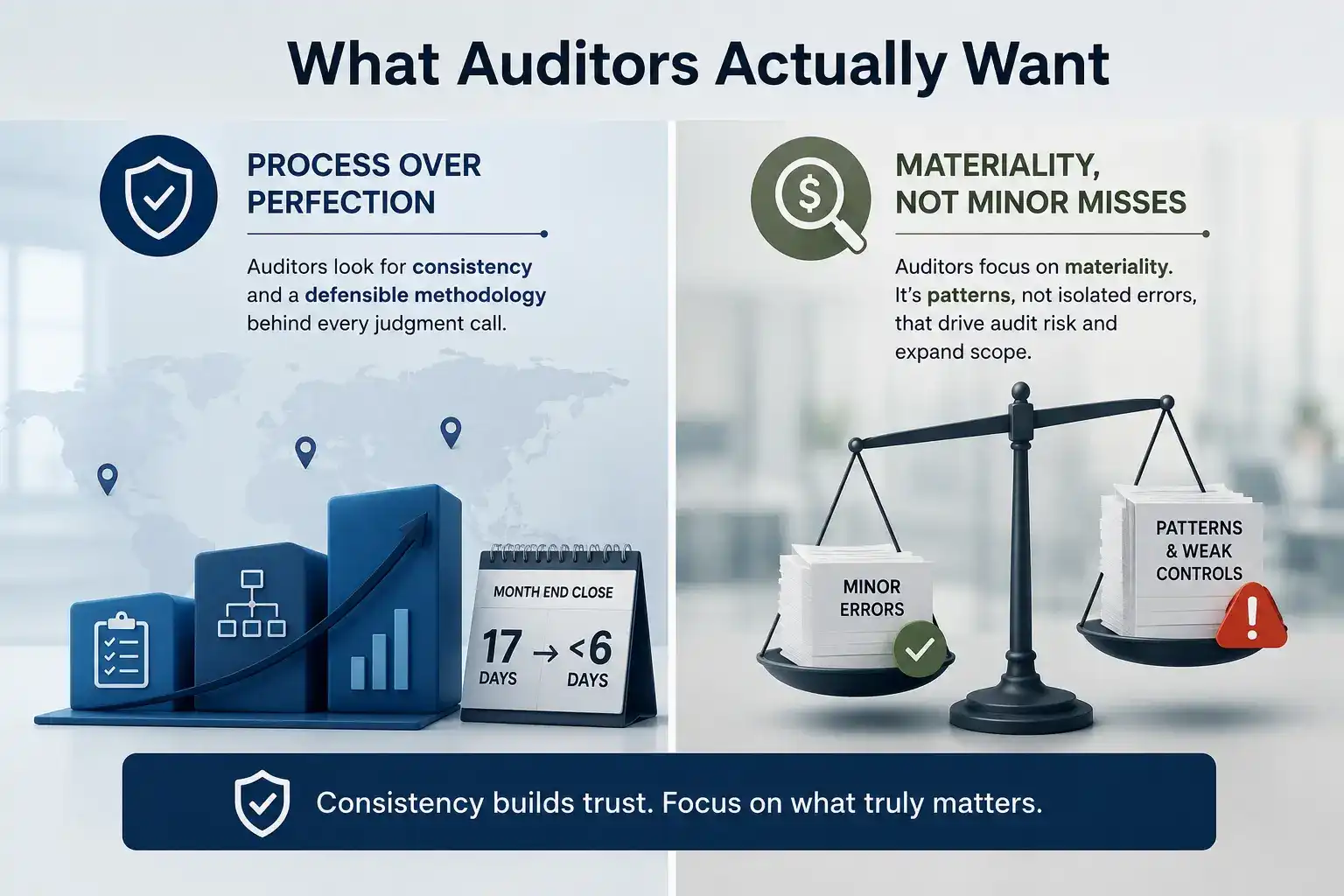
Process Over Perfection
Auditors do not arrive expecting flawless books. They look for consistency and a defensible methodology behind every judgment call. When leading finance for a fast growing identity and access management company, redesigning the multi-entity architecture across three countries and reducing the month end close from seventeen days to under six days did more for audit confidence than any single correct journal entry. Consistency, not perfection, is the true currency of trust.
Materiality, Not Minor Misses
Auditors focus on materiality, generally measured against net income, total assets, or equity. A small accrual error rarely threatens an audit opinion. What draws scrutiny is a pattern, several unrelated errors suggesting a weaker control environment. That expansion of scope, more than the dollar figure itself, is what slows an audit and distracts management. Founders who understand this distinction stop treating every discrepancy as a crisis and instead focus energy on the patterns that genuinely matter.
Building an Audit Ready Organization
Documentation as an Operational Asset
Signed contracts, board resolutions, cap table records, and revenue recognition memos are not filing cabinet relics. They are the evidence that connects management intent to ledger entries. In organizations spanning logistics, digital marketing, and gaming, the finance teams that could immediately produce supporting documents moved through audits with far less friction than those relying on memory or scattered email threads.
The Power of Predictability
The strongest audits contain no surprises, not because problems never arise, but because they were disclosed early. A misapplied revenue policy, an unbooked liability, or a cap table inconsistency should surface in the kickoff meeting rather than mid-fieldwork. When a consistent narrative is reinforced by documentation and board minutes, auditor confidence builds. When that narrative shifts, confidence erodes quickly.
From Audit Readiness to Audit Maturity
Founders do not build audit maturity in the final quarter before fieldwork begins. They build it continuously, through monthly reconciliations, real time policy tracking, and contemporaneous documentation of judgment calls. The following cycle illustrates how mature finance organizations sustain readiness throughout the year rather than compressing it into a single stressful sprint.
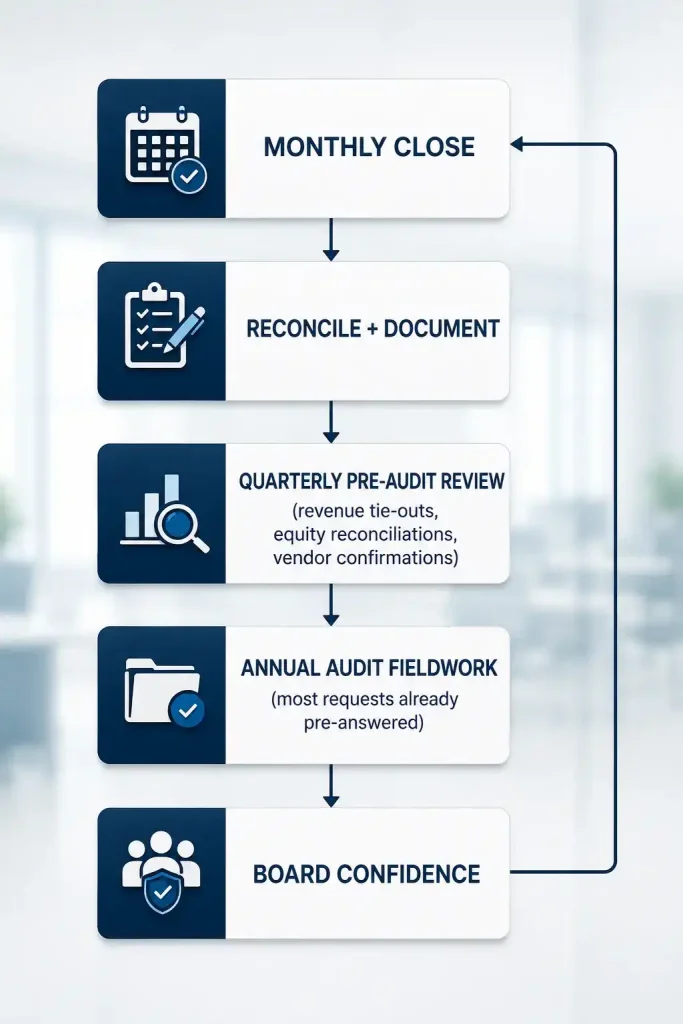
This cadence, applied consistently in organizations ranging from early stage SaaS ventures to a mission driven education institution during a forty eight million dollar capital raise, answers the majority of audit requests before fieldwork even begins.
The Founder’s Role
Founders do not need to manage the audit day to day. That responsibility belongs to the CFO and controller. Founders do need to understand the business model, support the finance function, and treat compliance as a habit rather than a hurdle. That tone, visible in how issues are surfaced and resolved, shapes how much trust an auditor extends to the entire organization.
A few habits consistently separate organizations that are truly audit ready from those still catching up:
- Reconciling key accounts monthly rather than at year end
- Documenting revenue recognition and cost policies as decisions happen, not after the fact
- Disclosing known risks or anomalies to auditors during the kickoff meeting
- Keeping signed contracts, board resolutions, and cap table records centrally organized and accessible
None of these habits require significant investment. They require discipline, and discipline is the trait auditors notice first.
Conclusion
Audit readiness is ultimately a leadership discipline rather than a technical exercise. Auditors are not adversaries searching for reasons to disrupt a company. They are evaluators of whether a financial narrative is grounded in fact, supported by process, and repeatable over time. Founders who invest in documentation, transparency, and monthly discipline transform the audit from an annual ordeal into a routine confirmation of what the organization already knows about itself. Across cybersecurity, SaaS, gaming, logistics, and nonprofit environments, the companies that treat readiness as continuous rather than seasonal consistently experience shorter audit cycles, fewer surprises, and stronger board confidence. The lesson holds regardless of industry or growth stage. Build the habits early, document judgments as they happen, and communicate openly with auditors from the first kickoff meeting. The result is not merely a clean audit opinion. It is a finance organization capable of scaling with credibility intact.
Disclaimer: This blog is intended for informational purposes only and does not constitute legal, tax, or accounting advice. You should consult your own tax advisor or counsel for advice tailored to your specific situation.
Hindol Datta is a seasoned finance executive with over 25 years of leadership experience across SaaS, cybersecurity, logistics, and digital marketing industries. He has served as CFO and VP of Finance in both public and private companies, leading $120M+ in fundraising and $150M+ in M&A transactions while driving predictive analytics and ERP transformations. Known for blending strategic foresight with operational discipline, he builds high-performing global finance organizations that enable scalable growth and data-driven decision-making.
AI-assisted insights, supplemented by 25 years of finance leadership experience.