
Executive Summary
This article summarizes a four part reflection on building an enduring enterprise. The themes are digital transformation, disciplined capital allocation, scalable leadership, and crisis tested resilience. Part one argues that clarity of pattern matters more than reaction speed. The invisible balance sheet, culture, morale, and judgment, often predicts performance better than the visible one. Part two reframes capital as five distinct resources rather than cash alone. Every major investment becomes an allocation decision with a defined cost and a defined return. Part three shows how trust and culture must be engineered deliberately. This matters once an organization scales beyond the reach of informal proximity. Part four examines how the first hours of a crisis set the tone for everything that follows. Liquidity, transparency, and protected priorities separate enterprises that merely survive from those that emerge stronger. Together the four parts argue that lasting value comes from compounded discipline rather than singular brilliance.
Why Clarity Precedes Strategy
The old tools of austerity rarely work once a company has already trimmed contracts and squeezed margins. Growth still demands faster decisions and deeper value. What follows draws that shift down to four practical layers, each building on the one before it.
Every finance leader eventually learns that numbers carry weight. They also carry blind spots. The most reliable insight rarely comes from a forecast deck. It comes from walking the floor, reading a vendor contract closely, and asking questions a spreadsheet cannot answer.
The Invisible Balance Sheet
Most organizations obsess over the visible balance sheet. Assets, liabilities, and equity reconcile to the last figure. What often goes unmeasured sits underneath that ledger. Institutional memory, the quality of leadership, and the resilience of culture rarely appear in a GAAP filing. Their consequences still show up in earnings. Companies with pristine financials can crumble under executive dysfunction. Others with messier ledgers can recover through sheer cultural cohesion. What separates the two is rarely cash on hand. It is clarity in the room where decisions actually get made.
Patterns Over Panic
Markets move every second, but meaning moves far slower. Most executives respond to volatility the way passengers respond to turbulence. They grip the seat rather than reading the pattern underneath it. Three questions tend to surface more insight than an entire forecast deck:
- What changed, both quantitatively and structurally
- What stayed the same, even under stress
- What assumption did reality just disprove
One recurring pattern shows up across cybersecurity, SaaS, and logistics engagements. A routine review of the cash conversion cycle once exposed a bottleneck that had nothing to do with collections. The real constraint sat inside an overlooked vendor term. That single clause had quietly strangled working capital for months. No forensic accounting was required. The fix only needed the discipline of asking the right question.
The Myth of the Single Answer
Every function in a growing company wants a different kind of certainty. Operations wants a playbook. Marketing wants a story. Finance simply wants to know none of it will bankrupt the business. Sustainable enterprises rarely run on a single brilliant idea. They run on unsexy consistency instead. That means cash flow forecasting, unit economics, gross margin management, and cost control practiced like professional habits rather than occasional heroics.
An Empirical Approach To Growth
A useful posture for any finance leader is closer to an empiricist than a storyteller. The better question is rarely what the vision should be. It is what the data actually allows anyone to believe, and where that same data might be quietly misleading. Growth without retention is a vanity metric. This holds just as true for a digital rollout as it does for a sales pipeline. A fast scaling software business once celebrated ballooning recurring revenue. Churn data, once stratified by cohort, told a different story entirely. Customers acquired through aggressive discounting dropped off within months of signing. That single realization reframed how every future investment decision got evaluated. It is rarely the first sale that matters most. It is the second and the third.
The Discipline of Capital Behind Every Investment
If the first layer of leadership is seeing clearly, the second is choosing wisely. Clarity is a virtue. Judgment is a harder skill to build. It sharpens only through the discipline of prioritizing delta over drama, and permanence over short lived attention.
The Cost of the Wrong Yes
Organizations are conditioned to celebrate a bold yes. The new launch, the headline partnership, the acquisition that makes news, all draw applause. A wrong yes is frequently more damaging than a hundred cautious declines. The direct hit to the income statement is painful enough on its own. The larger cost is organizational distortion. Teams get stretched in the wrong direction, and execution gets diluted the way an untreated injury compounds over time. One expansion into a secondary market shows the pattern clearly. It was greenlit on a macro thesis that sat two steps removed from the core business. The unwind took a year and a half. It also required a significant write down before the team involved could rebuild its footing.
Capital in Five Forms
Cash on hand is only one form of capital. A complete view treats capital as five distinct resources, each carrying its own cost and return.
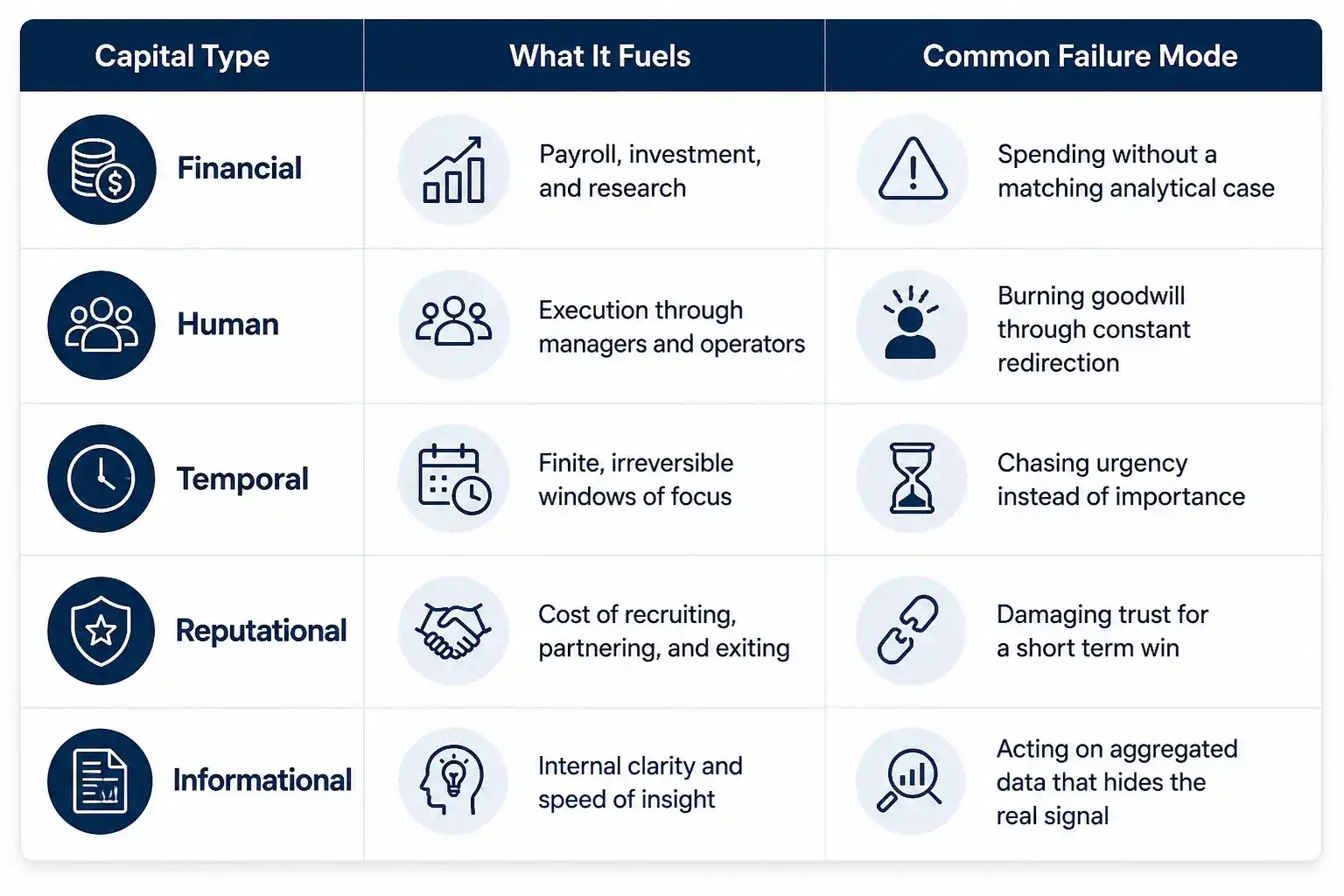
Every strategic move draws on more than one of these five forms at once. This holds true from a flashy acquisition down to a routine system upgrade. The wisest leaders evaluate the full profile. They do not just chase the return on a single line item.
The Operating Levers That Actually Matter
Executive presentations often reduce growth to a slide of clichés. Real operating leverage tends to come down to fewer, more elemental drivers instead:
- Gross margin discipline, since pricing power is the first integrity test of any business model
- Revenue quality, because recurring and contracted revenue behave differently than one time dollars
- Unit economics by segment, since aggregate numbers frequently hide the real story
- Cash conversion efficiency, because earnings are not the same thing as cash
- A flexible ratio of fixed to variable cost, which buys time in downturns and multiplies impact in upturns
In one transformation, a business reduced its breakeven point by more than a quarter. It did this without a single layoff. The lever was mundane. Renegotiated freight contracts, consolidated software licenses, and variable bonus triggers did the work instead. Real leverage often hides in the unglamorous details of a cost structure. That is exactly where digital transformation earns its keep, provided it targets structural cost rather than surface automation.
Forecasting As A Moral Act
A forecast is rarely just a mathematical exercise. The moment a number reaches paper, it becomes a commitment. Investors, employees, and the arc of effort behind it all depend on that commitment holding. Forecasts drawn to please a board, rather than to prepare an organization, quietly erode culture over time. People eventually lose faith not in leadership’s optimism, but in its judgment. A useful discipline is a simple reality filter applied to every forecast. What sits within the team’s actual control matters most. A modest assumption error could materially change the story if left unchecked. Something may have been left out simply because including it felt politically inconvenient.
Reading Inflection Points
Every company faces inflection points. These are moments when the rules of the game change, either gradually or all at once. A company earning five million dollars cannot run on the same cadence as one earning fifty million. The leaders who navigate this well recognize the shift early. They act before it strains the organization. One useful signal is decision lag, the time between spotting an issue and acting on it. When that lag grows meaningfully as a company scales, it says more about organizational readiness than any productivity dashboard could.
Leadership That Scales Without Losing Trust
Every company begins as a tight circle where trust needs no explanation. As the company grows, that informal trust must be systematized rather than assumed. Leadership at scale rests on a simple principle. Decentralized judgment pairs with centralized values, so managers can act independently without diluting what the organization stands for.
Trust Is Grown, Not Given
One five hundred person organization illustrates this well. A simple decision rights framework defined who could decide what, and when, across a handful of categories. The framework did not reduce flexibility. It created it instead. People finally knew where their authority began, and where escalation counted as a strength rather than a weakness.
Culture Is What Gets Funded
A culture rarely survives on slogans alone. It survives on reinforcement. The clearest test of a company’s real culture is not its values deck. It is what actually gets funded during a budget cut, and whose voice carries the most weight in a room. A stated value like collaboration can sit beside bonus structures that reward only individual wins. That gap becomes its own quiet form of contradiction. A handful of measurable indicators tend to keep culture honest. These include the share of cross functional projects with shared accountability, and the ratio of internal promotions to external hires in leadership roles.
Leadership As A Force Multiplier
At scale, a leader’s role shifts. Making every decision matters less than multiplying good judgment without needing to be in the room. That shift depends on two things. People must understand the reasoning behind a direction, and people must feel safe enough to act even while some uncertainty remains. In one fast growing organization, quarterly planning changed its starting point. Instead of top down targets, each team drafted a short intent document outlining its own priorities and tradeoffs. Alignment improved, rework fell, and cross team dependencies surfaced before they became roadblocks.
The Cadence That Creates Coherence
Organizations need rhythm as much as they need strategy. A dependable cadence tends to look like this:
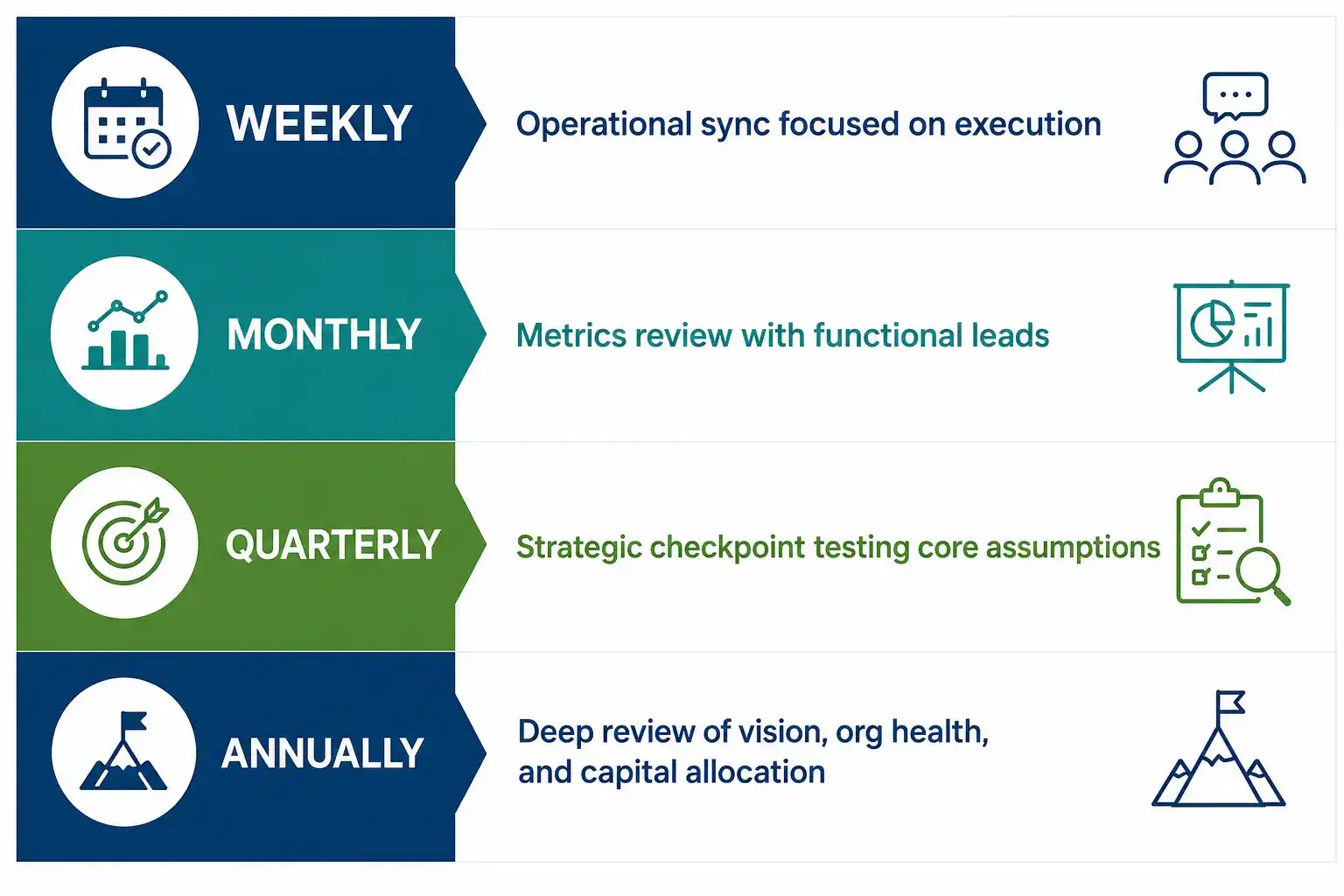
The goal of that rhythm is never to add meetings. It is to create moments of alignment. Think of a conductor checking in with different sections of an orchestra, without controlling every note they play.
Rebuilding A Trust Deficit
Not all trust is earned. Some of it erodes through rapid growth, missed expectations, or plain fatigue. When it breaks down, metrics drift and risk appetite quietly shrinks. A steady response tends to follow a consistent order. Acknowledge what went wrong plainly. Share what the new arrangement will look like. Then create a fast feedback loop through regular town halls and open questions. Rebuilding trust rarely requires perfection. It requires being predictably fair, which remains the highest currency inside any human system.
Crisis as the Stress Test of Resilience
A crisis does not create weakness. It reveals whatever was already fragile or already misaligned. The first seventy two hours of any acute crisis set the tone for everything that follows. Three principles tend to guide a steady response. Stabilize the facts before reacting to speculation. Sequence decisions by urgency and irreversibility rather than by volume of noise. Signal strength through transparency, because employees need honesty far more than they need heroics.
Cash Is Courage
Cash buys time, and time buys options. In a downturn, those options are the only real oxygen a business has left. A disciplined crisis cash playbook includes weekly reforecasting rather than monthly. A dynamic near term cash view reveals the bends in the road long before the cliff appears. Every outgoing dollar gets triangulated as necessary, strategic, or legacy. Anything in that last bucket gets paused without hesitation. Renegotiation, approached with empathy rather than desperation, has extended runway by months. It has done so without a single layoff or a single share of dilution.
Protect the Core, Preserve the Option
The instinct in a downturn is often to do more. That instinct tends to accelerate the damage instead of slowing it. A steadier response protects whatever is truly non negotiable. That means the product line or customer segment that anchors long term value. Speculative bets get trimmed, but optionality does not disappear altogether. One organization facing a downturn cut five initiatives and paused two more. It focused entirely on the two that were both revenue generating and scalable. The result was a leaner business. Its surviving product line came to represent the majority of its revenue within a year.
The People Equation
Numbers stay visible during a crisis. Emotions rarely do. Yet the emotional ledger often carries the longest tail of all. Bad news delivered secondhand erodes trust faster than the bad news itself. Leaders who communicate early and repeatedly tend to hold their teams together. They explain the why and the timeline behind every move, even when the news is difficult. Identifying the people who carry institutional memory matters too. Prioritizing them deliberately during retention efforts protects continuity long after the crisis has passed.
Preparing For The Next One
Crisis preparation is prudence rather than paranoia. Quarterly scenario planning, run alongside ordinary forecasting, hardens an organization’s reflexes. This holds even when the specific scenario never plays out as modeled. Practical readiness depends on resilience levers built well before they are needed. These include flexible systems, decentralized decision rights, contractual flexibility, and adequate cash reserves. Warren Buffett once observed that a receding tide reveals who was swimming without a suit. The more useful lesson sits one step further. What matters is not only the exposure a downturn reveals. It is how deliberately an organization responds once it does.
A Practical Framework For Reducing Cost Through Digital Transformation
Every digital investment eventually answers the same underlying question. Does it reduce structural cost, or does it simply automate an inefficiency that should have been removed instead. A simple decision flow keeps that question in view before capital moves.
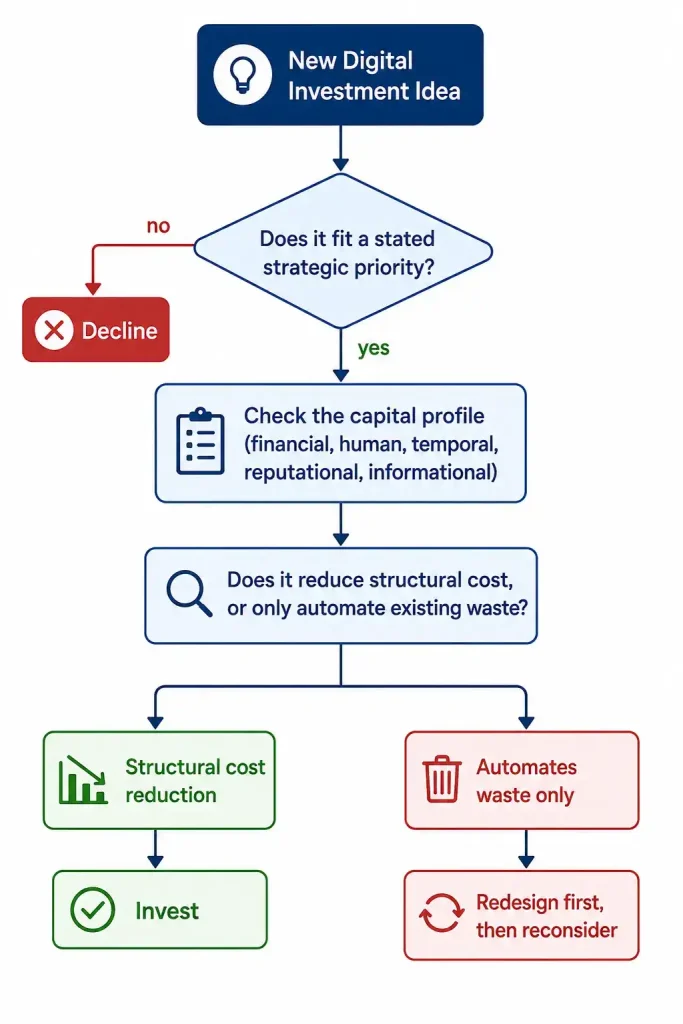
Digital transformation earns its strategic label only when the intent behind it is this deliberate. Tools deployed without that discipline become expensive distractions rather than accelerators of insight. This holds true no matter how current the platform looks, or how compelling the sales pitch behind it sounds.
Conclusion
Across pattern recognition, capital discipline, scalable leadership, and crisis response, one truth keeps repeating itself. Enduring enterprises are built through compounded discipline rather than a single burst of brilliance. Digital transformation succeeds when it targets structural cost rather than surface automation. It also depends on evaluating capital across all five of its forms. Leadership must systematize trust instead of assuming it will hold on its own. A crisis does not invent these habits overnight. It only reveals whether they were already in place. Talent will fluctuate and markets will cycle. Organizations that align intent, behavior, and allocation still tend to prevail regardless of the terrain. The practical takeaway is simple to state and harder to practice. When the noise gets loud, return to signal. If options multiply, choose based on clarity. Should a crisis hit, revert to principle. That discipline, repeated quietly over years, is what actually reduces cost and builds an enterprise that lasts.
Disclaimer: This blog is intended for informational purposes only and does not constitute legal, tax, or accounting advice. You should consult your own tax advisor or counsel for advice tailored to your specific situation.
Hindol Datta is a seasoned finance executive with over 25 years of leadership experience across SaaS, cybersecurity, logistics, and digital marketing industries. He has served as CFO and VP of Finance in both public and private companies, leading $120M+ in fundraising and $150M+ in M&A transactions while driving predictive analytics and ERP transformations. Known for blending strategic foresight with operational discipline, he builds high-performing global finance organizations that enable scalable growth and data-driven decision-making.
AI-assisted insights, supplemented by 25 years of finance leadership experience.