
Executive Summary
Finance change management succeeds or fails on a truth that spreadsheets cannot measure. Systems do not resist transformation. People do, and usually only when they feel unseen or unheard. This article summarizes a two part reflection on leading financial transformation across global finance functions. It draws on work spanning cybersecurity, SaaS, and other operating environments. Part one explores the undercurrents of change. It looks at the quiet resistance that surfaces when legacy tools and processes give way to something new. Part two examines the architecture of endurance. It studies the discipline required to sustain momentum once the early wins fade and fatigue sets in. Together they argue that finance change management is not a phase teams bolt onto a project plan. It is a relationship people build one honest conversation at a time. That relationship is the difference between a transformation that stalls and one that lasts.
Why Finance Change Management Begins With People, Not Systems
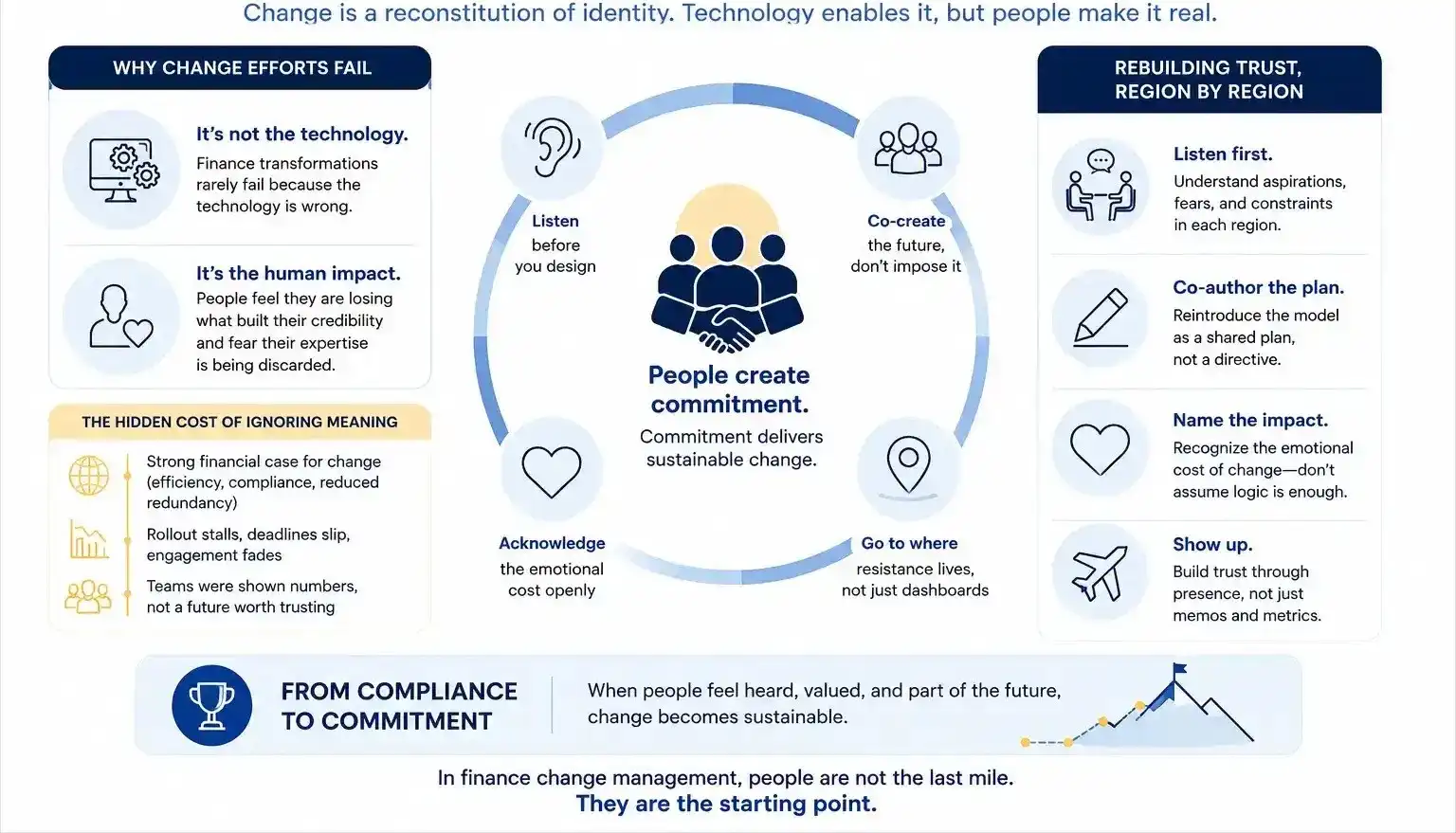
Change rarely announces itself with fanfare inside a finance organization. It arrives quietly, then gathers force as it touches every process it passes. Finance change management often gets treated as a technical exercise. People assume it is only a matter of new systems and updated reporting lines. In practice, it is something closer to a reconstitution of identity. It touches the people who built and trusted the old way of working.
A finance transformation rarely fails because the technology is wrong. It fails because the people asked to give up familiar tools feel something deeper is being discarded. Their expertise feels tied to the spreadsheet, not separate from it. In one global finance rebuild spanning entities across multiple countries, the hardest resistance never came from the new planning platform. It came from a quiet sense of loss among people who had built their credibility inside the old model.
The Hidden Cost of Ignoring Meaning
A shared services consolidation across international markets illustrates the same pattern from another angle. The financial case for centralizing functions was sound. Efficiency gains were real, compliance stood to improve, and redundancy would fall. Yet the rollout stalled. Deadlines slipped and engagement faded. The metrics were not wrong. Leaders had simply shown regional teams numbers instead of meaning. They had taken away autonomy without offering a future worth trusting.
What Rebuilding Trust Region by Region Looks Like
The fix was not a better deck. It was time spent listening region by region. Leaders asked about aspirations and doubts before reintroducing the plan. That plan then returned as something co-authored rather than imposed. This shift, from compliance to commitment, sits at the center of finance change management. A few practices consistently mattered in that process:
- Sitting with the people who built the legacy process before replacing it, and treating their knowledge as a creation rather than an artifact to retire
- Reintroducing any redesigned model as a shared plan rather than a finished directive
- Naming the emotional cost of change openly, instead of assuming logic alone will carry people through it
- Traveling to where the resistance lives, rather than managing it only through dashboards and memos
The Middle Stretch: Building the Architecture of Endurance
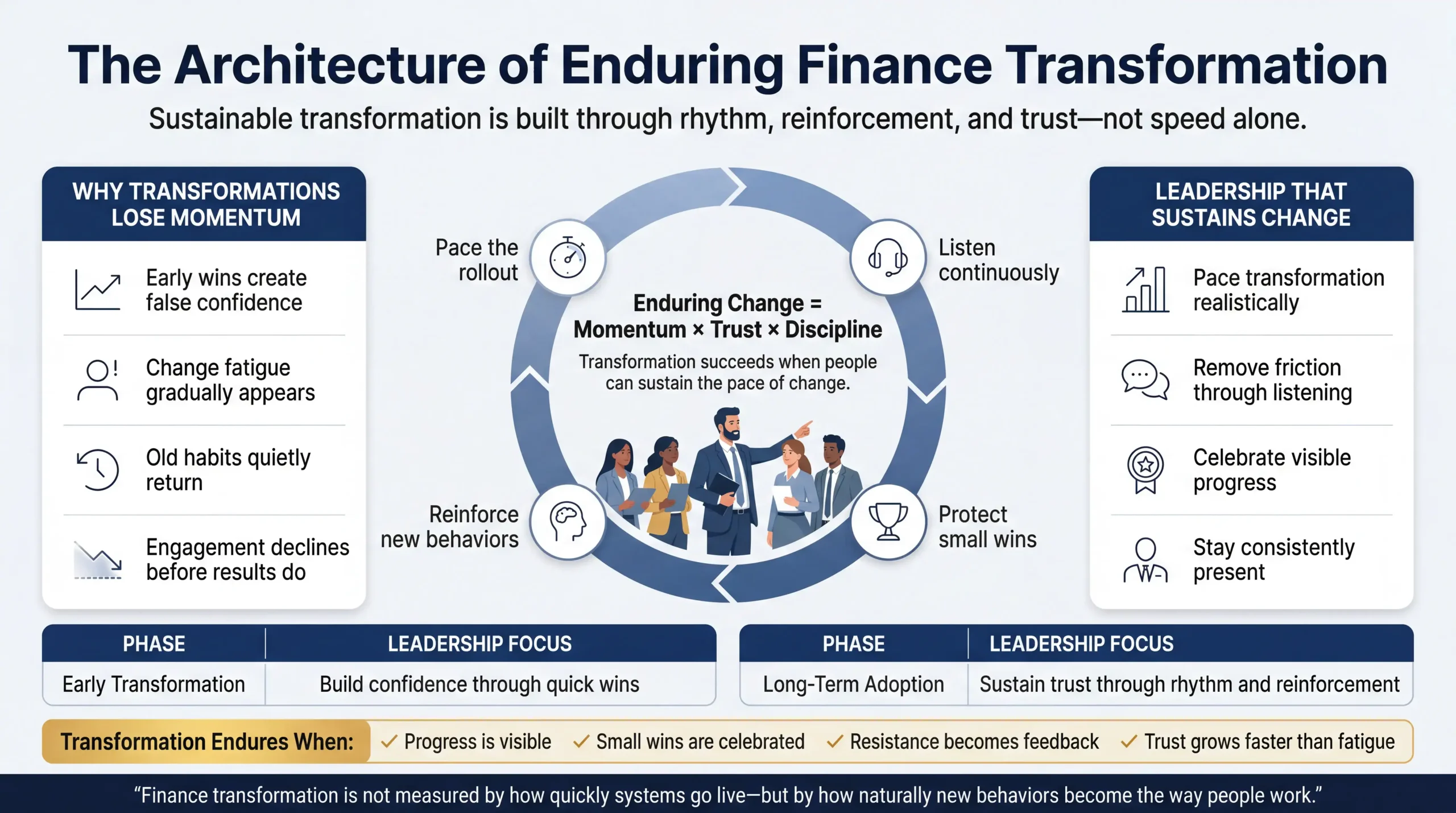
Every transformation has an early phase where the wins come easily. Automated reports go live. Planning cycles shorten. Dashboards begin replacing manual spreadsheets. The harder test comes later. It arrives in the stretch where enthusiasm has faded but old habits still linger beneath the new system.
Why Momentum Fades After the Early Wins
A company wide effort to unify reporting structures across global units shows this clearly. Every intention was right, and every tool was in place. Even so, the rollout hit friction. Deadlines slid. Feedback thinned. Some leaders nodded along without truly committing. The gap was not a lack of alignment on paper. It was an underestimation of how much sustained adaptation quietly exhausts people.
Pacing Change Instead of Accelerating It
The turning point came through a simple adjustment. It meant trading a push for more metrics for a return to listening. Fewer questions were asked about compliance. More were asked about where the process still hurt. Momentum returned gradually, through small signals rather than sweeping announcements. A once reluctant regional lead began submitting data early. A skeptical stakeholder volunteered to pilot a new module. Endurance in finance change management is less about speed and more about rhythm. It means matching the pace of change to the capacity of the people carrying it.
Protecting Small Wins and Celebrating Progress
Discipline still matters throughout this stretch. Deadlines must hold, and leaders must address slippage directly. What changes is the tone in which they deliver that discipline. Recognizing small moments keeps momentum alive during the least glamorous part of any transformation. The first clean automated close counts. An analyst’s first dashboard, once adopted by leadership, counts just as much.
A Practical Framework for Finance Change Management
Viewed together, the two phases of this journey map cleanly onto two different leadership responses. The table below summarizes the pattern.
| Phase | Core Risk | Leadership Response |
| Undercurrents of Change | Legacy tools feel like identity, and their removal feels like erasure | Listen first, involve builders in the redesign, retell the reason for change |
| Architecture of Endurance | Early wins fade and sustained adaptation exhausts people | Pace the rollout, protect small wins, keep showing up with patience |
This pattern holds across sectors. It showed up while redesigning multi entity finance architecture for a cybersecurity organization spanning several countries. The same pattern appeared again while rebuilding GAAP and IFRS reporting for a fast scaling software business. A third instance surfaced while shortening a month end close from seventeen days to under six. The tools differed each time. The underlying lesson did not. A few reminders tend to hold true across every one of these transformations:
- Systems only move as fast as the trust behind them
- Resistance is information about where meaning has not yet been rebuilt, not a signal to push harder
- Endurance is protected through pacing and small recognitions, not through pressure alone
Conclusion
Finance change management is often described as a project with a start date and an end date. The more accurate description is a relationship. It is built through proximity, patience, and honest conversation rather than mandates alone. The undercurrents of resistance are not signs of failure. They are signals pointing to where meaning has not yet been rebuilt. The architecture of endurance is not a schedule either. It is the discipline of pacing transformation to match what people can actually carry. Across finance functions in cybersecurity, SaaS, logistics, digital marketing, gaming, and nonprofit organizations, the pattern repeats. Systems catch up once trust is in place, not before. Leaders who retell the reason for change tend to finish stronger. Leaders who protect small wins and treat resistance as information, rather than obstruction, tend to finish stronger too. Most finish later than planned. Nearly all finish with a team that trusts them more than when they started. That is the quiet architecture worth mastering, and it outlasts any single system or rollout.
Disclaimer: This blog is intended for informational purposes only and does not constitute legal, tax, or accounting advice. You should consult your own tax advisor or counsel for advice tailored to your specific situation.
Hindol Datta is a seasoned finance executive with over 25 years of leadership experience across SaaS, cybersecurity, logistics, and digital marketing industries. He has served as CFO and VP of Finance in both public and private companies, leading $120M+ in fundraising and $150M+ in M&A transactions while driving predictive analytics and ERP transformations. Known for blending strategic foresight with operational discipline, he builds high-performing global finance organizations that enable scalable growth and data-driven decision-making.
AI-assisted insights, supplemented by 25 years of finance leadership experience.