
Executive Summary
A strong investor relations strategy is no longer a reporting obligation confined to earnings calls and press releases. It is a leadership capability. It shapes how capital markets understand a company, price its risk, and extend it patience through volatility. This article examines how executive teams can move from reactive disclosure to proactive narrative building.It also examines why financial storytelling depends on clarity and credibility rather than polish. The chapter examines how live forums such as earnings calls, roadshows, and investor days test that narrative in real time. Finally, it explores what it takes to institutionalize investor relations as a structural asset. That asset must be resourced properly and connected directly to the CFO and CEO. This piece draws on lessons from finance leadership across cybersecurity, SaaS, gaming, logistics, and mission driven organizations. It offers a practical framework for executives. These executives want their communication to build conviction rather than simply satisfy compliance.
Reframing Investor Relations as a Leadership Function
For many organizations, investor relations remains a compliance exercise built around scripted calls and carefully reviewed press releases. That framing undersells its potential. A deliberate investor relations strategy, treated as a genuine leadership capability rather than a reporting cadence, becomes one of the most effective tools an executive team has. It helps lower the cost of capital, attract patient shareholders, and earn credibility with analysts, regulators, and employees alike.
Across more than twenty five years leading finance functions in cybersecurity, SaaS, gaming, logistics, digital marketing, medical devices, and nonprofit organizations, one pattern holds constant. Companies that communicate with discipline and candor are rewarded with trust that outlasts any single quarter. Those that treat communication as an afterthought pay for it in valuation friction and shareholder turnover.
This pattern is not confined to any single industry. A cybersecurity company must explain technical risk in terms a generalist investor can absorb. A medical device manufacturer must connect regulatory milestones to commercial timelines without overstating certainty. A nonprofit or mission driven institution must translate impact into terms that satisfy both donors and lenders. The mechanics differ, but the underlying discipline, explaining complexity honestly and consistently, remains the same across every sector.
From Disclosure to Dialogue
The first step in building an effective investor communication strategy is resisting the temptation to reduce every interaction to formulaic disclosure. A credible investment narrative connects near term results to a multi year value creation logic. It explains, in terms specific to the business, how capital becomes earnings, how investments become growth, and how scale becomes advantage. A SaaS company should speak in terms of retention curves and customer lifetime value. A logistics organization should speak in terms of cost per unit and utilization. Investors are rarely persuaded by assurances that a company is growing. They want to understand the mechanism behind that growth, and they reward leadership teams who are willing to explain it plainly.
This same discipline applies to capital allocation. When leadership can clearly articulate how it chooses among reinvestment, debt reduction, shareholder returns, and opportunistic acquisitions, it signals intentional resource deployment. It signals that resources are deployed with intent rather than reaction.
Having led capital raises exceeding one hundred and twenty million dollars and overseen mergers and acquisitions exceeding one hundred and fifty million dollars, I have seen this firsthand. This includes more than one hundred million dollars in acquisitions within the gaming sector. A well reasoned capital allocation narrative shortens the distance between management and the market. Investors do not need certainty. They need a framework they can trust.
Financial Storytelling as a Leadership Discipline
Numbers alone rarely persuade. A well constructed IR strategy depends on the ability to interpret financial results precisely, contextually, and honestly. It addresses both strengths and constraints.
Clarity begins with structure. Every earnings script or investor letter should answer four questions in sequence. What happened, why it happened, what it means, and what comes next. Vague language about strong performance or continued momentum adds little value. Margin expansion should be tied to specific operational levers. Revenue growth should be broken down by segment, geography, or channel wherever that breakdown illuminates strategic direction.
Context Turns Data Into Insight
Numbers gain meaning only in comparison. A modest revenue decline can look very different set against a steeper industry contraction. Flat earnings can conceal disciplined investment in a platform that will pay off over several years. This is where financial storytelling separates itself from simple reporting. It is not about presenting results favorably. It is about giving investors the frame within which results should be understood, and doing so consistently enough that the frame itself becomes a source of trust.
Credibility compounds over time through what might be called a bridge narrative. It creates a clear line connecting prior guidance to actual results and the reasoning behind any variance.
Leadership teams that consistently close this loop build a reservoir of trust that carries them through difficult quarters. They acknowledge both shortfalls and successes with the same candor.
In my experience reducing monthly burn from eight hundred thousand dollars to two hundred thousand dollars at an early stage SaaS company, honest communication mattered most. Later, I led a forty eight million dollar capital raise at a mission driven education institution. The willingness to explain difficult numbers honestly was consistently more valuable to stakeholders than any effort to soften them.
The CFO as Narrator in Chief
The CFO occupies a distinct position in this discipline. Their command of detail, their ability to explain complexity simply, and the consistency of their tone provide ballast to the entire organization’s message. A CFO who clarifies elevates the credibility of the whole enterprise. A CFO who hedges or obscures, even inadvertently, undermines it. This responsibility extends well beyond the earnings call itself. It includes the quieter work of aligning finance, strategy, and communications teams. What is said externally should reflect what is actually happening inside the business.
Having built enterprise KPI frameworks and multi entity finance architectures across global organizations, I have found this consistently. The CFOs who earn the most trust from the market are the same ones who insist on precision internally. They do so long before a single word reaches an investor.
The Proving Grounds: Calls, Roadshows, and Investor Days
Strategic narrative is tested most directly in live forums. Each venue serves a distinct purpose, and understanding those differences is central to any effective investor communication strategy.
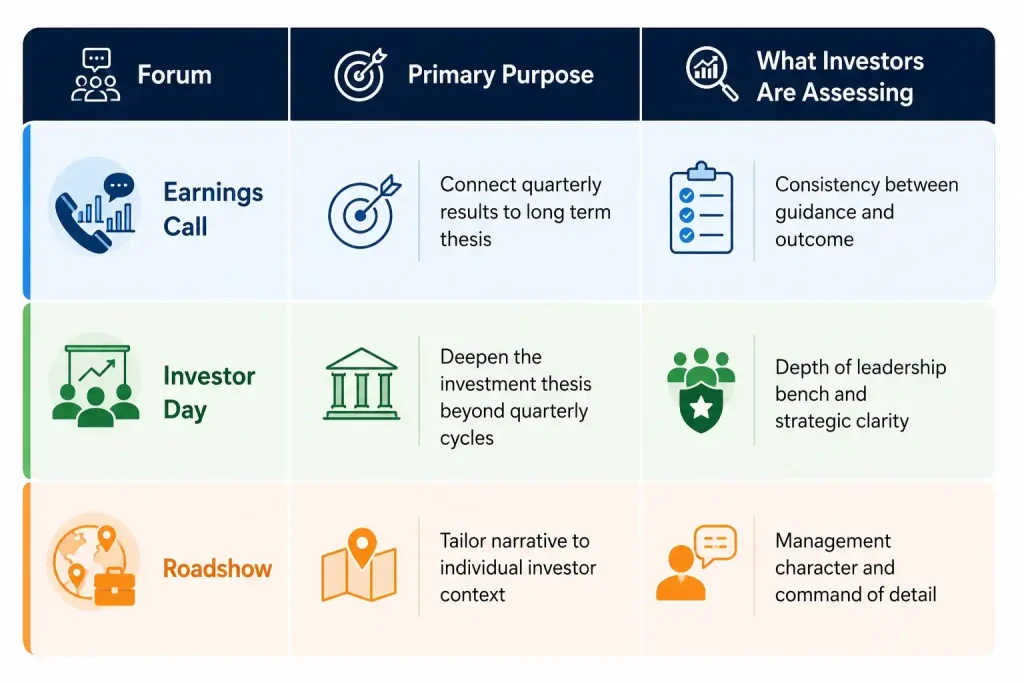
The earnings call remains the most consistent test. The opening remarks should do more than restate the press release. They should connect quarterly performance to the broader thesis, addressing directly whether headwinds or tailwinds have shifted the company’s trajectory. The Q&A session that follows is often the most revealing part of the call, since it shows how well leadership knows its own business and how willing it is to engage candidly once the prepared remarks end.
Investor days operate on a different rhythm. Freed from the pressure of quarterly results, they offer a rare opportunity to showcase management depth and preview initiatives across a three to five year horizon. The strongest investor days feature voices beyond the CFO and CEO, including operational and technical leaders who demonstrate the maturity of execution. Roadshows, by contrast, are more intimate. They are not the place to reinvent the story but to reinforce it with nuance suited to each investor’s sector familiarity and style.
Institutionalizing Investor Relations as a Strategic Asset
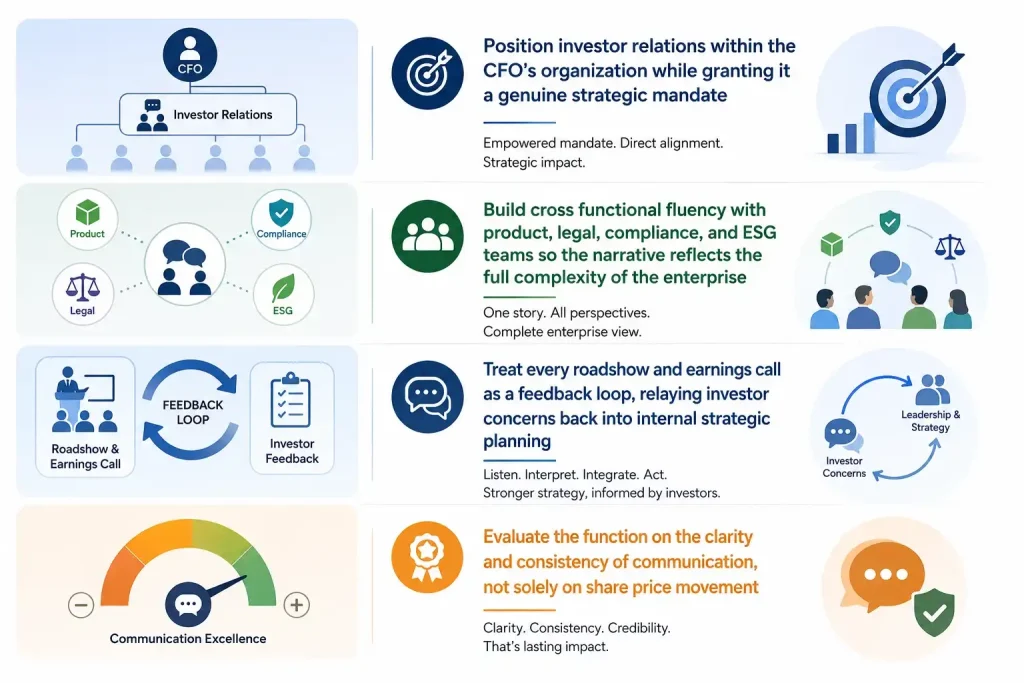
None of this narrative discipline is sustainable without proper organizational design. Investor relations functions best when positioned close to the CFO, with direct access to real time performance data and capital allocation decisions, yet empowered with a mandate that extends beyond translation into genuine strategic interpretation.
Structure, Staffing, and Governance
A mature investor relations strategy requires investment in people, not just process. The function should be staffed with enough depth to model financials, track investor sentiment, and monitor peer performance, rather than resting on a single individual managing logistics reactively. Governance matters just as much. The head of investor relations should have recurring, direct access to the CFO and CEO, and pre earnings messaging sessions should be institutionalized rather than improvised. Boards, too, benefit from regular updates on how the company is perceived in the market, including analyst consensus and emerging valuation gaps.
This kind of structure does not happen by accident. It requires the same discipline used to design any resilient finance organization, including clear ownership, defined escalation paths, and technology that supports rather than replaces judgment. Investor CRM systems, transcript analysis tools, and peer benchmarking platforms can sharpen situational awareness, but they are only enablers. The differentiator is always whether the organization can translate that intelligence into decisions the executive team actually acts on. Having designed multi entity finance architectures spanning several countries and reduced month end close cycles by more than half in a fast growing cybersecurity company, I have seen how the same operational rigor that shortens a close cycle can be applied to shorten the distance between what the market wants to know and what leadership is prepared to say.
A Training Ground for Future Finance Leaders
The organizations that get this right treat investor relations not as a standalone department but as a training ground for future CFOs.
Rotating finance professionals through investor relations builds external fluency. Giving high potential IR professionals a pathway into broader finance leadership strengthens the bench on both sides.
Having worked across FP&A, controllership, and strategic finance roles spanning nine industries, I have found this consistently. The discipline required to explain a business clearly to outside investors sharpens the same judgment needed to lead that business internally.
Conclusion
An effective investor relations strategy is not a byproduct of strong quarterly results. It is a deliberate leadership capability that connects financial performance to a coherent, honest narrative about value creation. The companies that earn lasting trust are not those that avoid difficult quarters, but those that explain them with clarity and consistency across every forum, from the earnings call to the investor day to the one on one roadshow meeting. Building that capability requires structural commitment, including proper staffing, direct executive access, and a governance rhythm that treats communication as a continuous discipline rather than an occasional event.
Across cybersecurity, SaaS, gaming, logistics, and mission driven organizations, the pattern is consistent. Clarity lowers the cost of capital, strengthens board confidence, and transforms investor relations from a reporting function into a genuine source of enterprise resilience. In markets defined by volatility and short attention spans, the leadership teams that rise are those whose narrative is disciplined enough to be trusted and honest enough to be believed.
Disclaimer: This blog is intended for informational purposes only and does not constitute legal, tax, or accounting advice. You should consult your own tax advisor or counsel for advice tailored to your specific situation.
Hindol Datta is a seasoned finance executive with over 25 years of leadership experience across SaaS, cybersecurity, logistics, and digital marketing industries. He has served as CFO and VP of Finance in both public and private companies, leading $120M+ in fundraising and $150M+ in M&A transactions while driving predictive analytics and ERP transformations. Known for blending strategic foresight with operational discipline, he builds high-performing global finance organizations that enable scalable growth and data-driven decision-making.
AI-assisted insights, supplemented by 25 years of finance leadership experience.