Executive Summary
Strategy does not begin with a vision statement. It begins with constraints, capital availability, margin expectations, and cash cycles. This article examines how a strategic CFO turns classic frameworks into living financial models rather than academic exercises. These include Porter’s five forces, complexity theory, Deming’s continuous improvement, and the Balanced Scorecard. It explores how CFO leadership shapes optionality through scenario modeling, search theory, and disciplined stopping rules. It also looks at how numbers become a shared narrative that aligns sales, product, and operations. The article closes with a look at financial metrics as leading indicators of organizational health rather than lagging scorekeeping. The consistent theme is that CFO strategic planning does not follow the strategy deck. It writes the first draft of the strategy itself.
Strategy Begins With Financial Constraints, Not Slides
Executives often assume strategy is authored in offsites and slide decks. In practice, a strategic CFO is usually writing the first draft long before that meeting begins, translating ambition into what the business can actually afford to attempt.
Michael Porter taught that industries are shaped by five competitive forces, rivalry, entry, substitutes, supplier power, and buyer power. Few practitioners treat these forces as financial dialects, yet that is exactly what they are.
- When a competitor lowers price, it becomes a fight for margin.
- When a supplier restricts access, it strains working capital.
- When a substitute gains ground, it quietly erodes expected lifetime value.
Applying this lens to a market expansion decision means modeling how rising rivalry affects discounting, cash conversion, and days sales outstanding. The output is not a simple go or no go verdict. It becomes a capital pacing plan. It clarifies when to invest in sales and marketing, when to hold back, and when to tighten approval guardrails. The guardrails protect margin. Even in routine pipeline reviews, the sharper question is not only whether the business is winning. It is under what competitive force structure it is winning.
Finance as a Systems Designer
Porter’s tools describe static structures well, but markets today shift faster than most analysis cycles can keep pace with. This is where complexity theory becomes useful, treating the business as a set of emergent patterns and feedback loops rather than a fixed diagram.
From Linear Forecasting to Systems Simulation
Moving from linear forecasting to systems simulation means building models where one input change ripples across several outcomes at once. In one case, reducing onboarding time by twenty percent produced a five percent lift in net revenue retention, which translated into two million dollars of prevented churn across two hundred accounts. Finance stops functioning as a lagging indicator here. It becomes a systems designer, identifying which constraints, once eased, produce compounding returns elsewhere in the business.
Continuous Improvement in the Numbers
W. Edwards Deming argued that quality is a process and that measurement should drive improvement, not simply record it. Applied to finance, this means treating forecast variance as a feedback loop rather than a scoreboard. Each month, gaps between plan and actual get unpacked using a plan, do, check, act cycle. Recurring deviations are traced back to system dysfunction in go-to-market logic or operational flow, not written off as error. When a pattern repeats across a quarter, the response is to freeze decision criteria, close out unproductive deals, and reset incentive alignment.
The CFO as Architect of Optionality
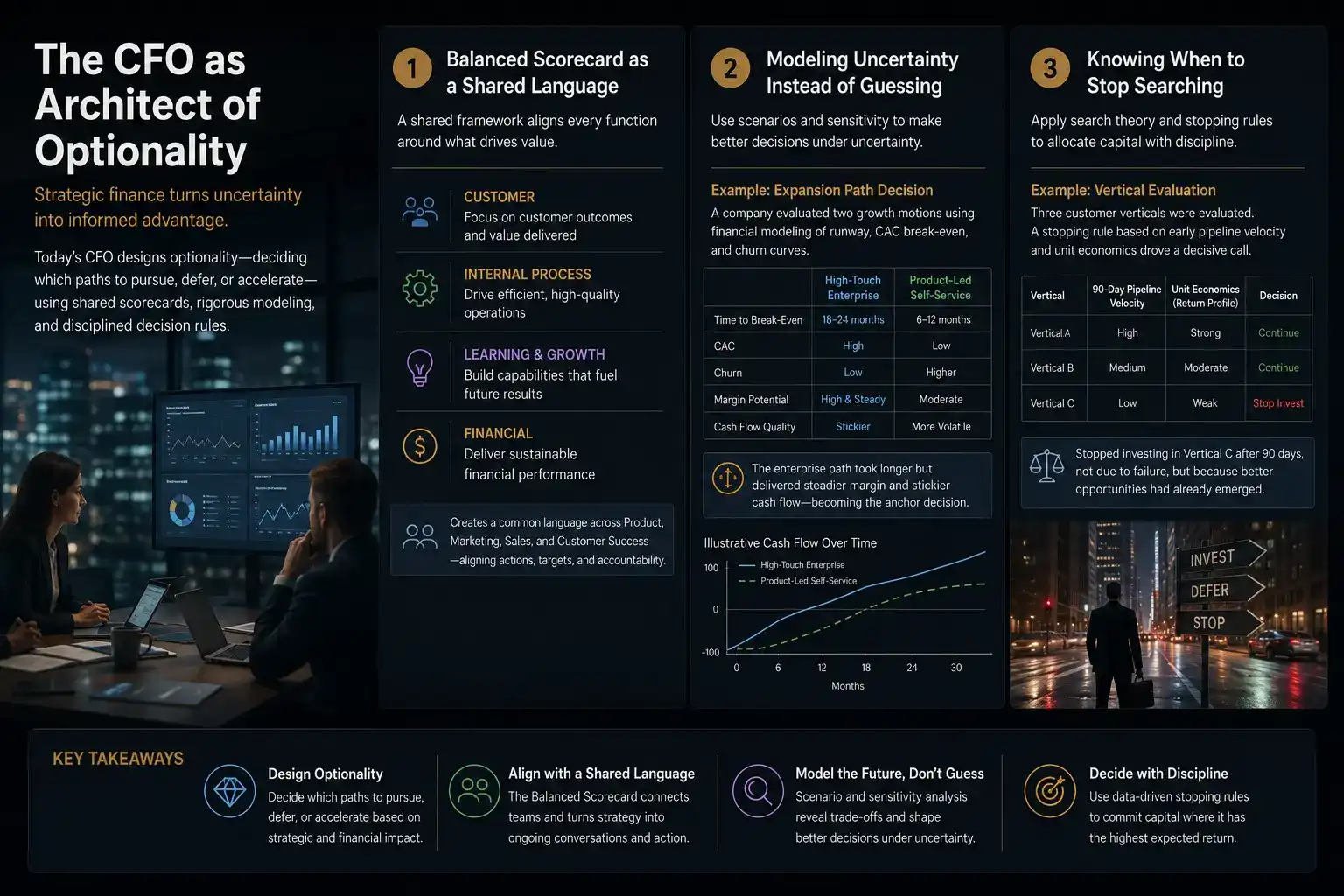
A strategic CFO does more than manage cash. The role increasingly involves designing optionality, determining which paths the business can afford now, which should be deferred, and which deserve acceleration.
Balanced Scorecard as a Shared Language
Robert Kaplan and David Norton’s Balanced Scorecard asked leaders to look beyond financial results toward customer, internal process, and learning perspectives. In cross-functional reviews, the Balanced Scorecard becomes the shared language that lets Product speak in margin contribution, Marketing think in customer acquisition cost recovery time, and Customer Success link retention to cost efficiency. Strategy stops being a chart on a wall and becomes an ongoing conversation with shared accountability for hitting targets or correcting course.
Modeling Uncertainty Instead of Guessing
Decisions rarely unfold in perfect markets. They occur under bounded rationality, incomplete data, and shifting stakeholder demands, echoing the work of economists such as Kenneth Arrow and Amartya Sen on choice under uncertainty. A scenario analysis or sensitivity table is never only about variance. It gives shape to uncertainty itself, exploring how the business would perform under different cost structures, demand environments, or costs of capital. In one instance, a company weighing a high-touch enterprise expansion against a product-led self-service motion found its answer through financial modeling of runway, customer acquisition cost break-even, and churn curves. The enterprise path took longer but delivered steadier margin and stickier cash flow, and that became the anchor decision.
Knowing When to Stop Searching
Search theory, the study of how agents pursue optimal outcomes under cost and time constraints, is directly relevant to allocation decisions. Fast-growing organizations cannot test every strategy at once, so the real question becomes when to stop searching and start committing. In one case, three customer verticals were under evaluation. Rather than run parallel campaigns indefinitely, a modified stopping rule based on early pipeline velocity and unit economics ended investment in one vertical after ninety days, not because it had failed outright, but because another vertical had already exceeded its expected return profile. That decision came from signal discipline, not instinct.
Turning Numbers Into a Strategic Narrative
Finance builds the spine of strategy, but a strategic CFO also shapes its story. Numbers alone do not create alignment. Revenue curves, margin expansion, working capital, and churn dynamics need to be woven into a coherent explanation of how the company creates and sustains value. In one operating review, tension between a sales team pushing for faster territory expansion and a product team warning of slipping roadmaps was resolved not through compromise, but by anchoring the conversation on a capital efficiency ratio, how each incremental dollar of spend would perform given current burn velocity and expected contribution. Re-centering the narrative on sustainable return on effort produced consensus that a simple negotiation never could.
Financial Metrics as Leading Indicators
Systems thinking treats metrics as related rather than isolated, recognizing that a pricing change can quietly erode brand equity or a compensation tweak can reshape pipeline behavior without warning. Days sales outstanding, in this light, becomes more than a billing metric. It signals customer satisfaction and operational cadence. Gross margin becomes more than a cost discipline. It reflects pricing power and product-market fit. In one company, a slow erosion in mid-market gross margin was first blamed on rising support costs, but deeper analysis revealed bundling complexity and inconsistent deal desk exceptions. The fix was not a price adjustment. It was a redefinition, across finance, product, and go-to-market, of what was actually being sold.
Conclusion
Great CFO leadership draws on thinkers who fuse logic, narrative, and systems, Herbert Simon on bounded rationality, Daniel Kahneman on cognitive bias in planning, and Richard Rumelt on strategy that survives contact with execution. Their shared lesson is that strategy is not what fits neatly on a slide. It is what holds up once implementation begins, and finance is often the only function with visibility across every layer of execution, capital, time, velocity, and variance. CFO strategic planning frames trade-offs, clarifies constraints, and projects consequences long before a strategy document exists. It embeds feedback loops and translates qualitative ambition into quantitative action, not only in spreadsheets but across the daily rhythm of the business. The strategic CFO does not wait for vision to arrive from elsewhere. This function reveals what is actually possible, moving finance from a record of the past to an architect of what comes next.
Disclaimer: This blog is intended for informational purposes only and does not constitute legal, tax, or accounting advice. You should consult your own tax advisor or counsel for advice tailored to your specific situation.
Hindol Datta is a seasoned finance executive with over 25 years of leadership experience across SaaS, cybersecurity, logistics, and digital marketing industries. He has served as CFO and VP of Finance in both public and private companies, leading $120M+ in fundraising and $150M+ in M&A transactions while driving predictive analytics and ERP transformations. Known for blending strategic foresight with operational discipline, he builds high-performing global finance organizations that enable scalable growth and data-driven decision-making.
AI-assisted insights, supplemented by 25 years of finance leadership experience.