
Executive Summary
The CFO role has moved through a quiet but decisive transformation. Where finance leaders once served as gatekeepers of compliance and accuracy, the function is increasingly asked to shape strategy, technology adoption, and organizational learning. This article traces that shift from controller to change agent, showing how systems thinking, digital fluency, and narrative skill have become as central to finance as ledger integrity once was. It examines how forecasting evolved from a static exercise into a living signal, how go-to-market investment models turned finance into a partner rather than a gatekeeper, and how scenario planning and real options thinking now guide capital decisions under real uncertainty. The consistent theme is that finance change is no longer optional. Modern finance leaders are asked to translate constraint into strategy and information into action.
From Controller to Change Agent
Finance leaders once operated primarily as the final gatekeeper of the organization, rooted in rigor and exacting about accuracy. That controller archetype protected the business from risk. It rarely initiated change. As capital became more abundant, product cycles compressed, and data turned into a strategic asset, the role demanded something more dynamic than ledger integrity alone. Today’s finance leader must translate ambiguity into clarity, partner deeply with the business, and use data to forecast and influence rather than simply explain what already happened.
This shift did not arrive overnight. It unfolded gradually, shaped by a refusal to stay confined within a single discipline. Early exposure to both neoclassical and Austrian economic thinking, alongside a genuine interest in literature and systems, created a habit of looking for coherence across seemingly unrelated domains. That habit eventually became a leadership approach, drawing finance away from narrow reporting and toward broader systems thinking.
The two eras of the CFO role can be described almost as different genres of story. The controller era was cautious and methodical, navigating by known reference points. The change-agent era is far more experimental, marked by risk and a search for growth in less charted territory.
| Dimension | Controller Era CFO | Change-Agent Finance Leader |
| Primary Posture | Gatekeeper of risk | Partner in strategy |
| Core Tool | Ledger accuracy | Systems and scenario models |
| Forecasting Style | Static, backward-looking | Probabilistic, continuously updated |
| Relationship to Teams | Reviews and approves | Co-designs and enables |
| Measure of Success | Compliance and precision | Enterprise learning and speed |
Systems Thinking as a Compass
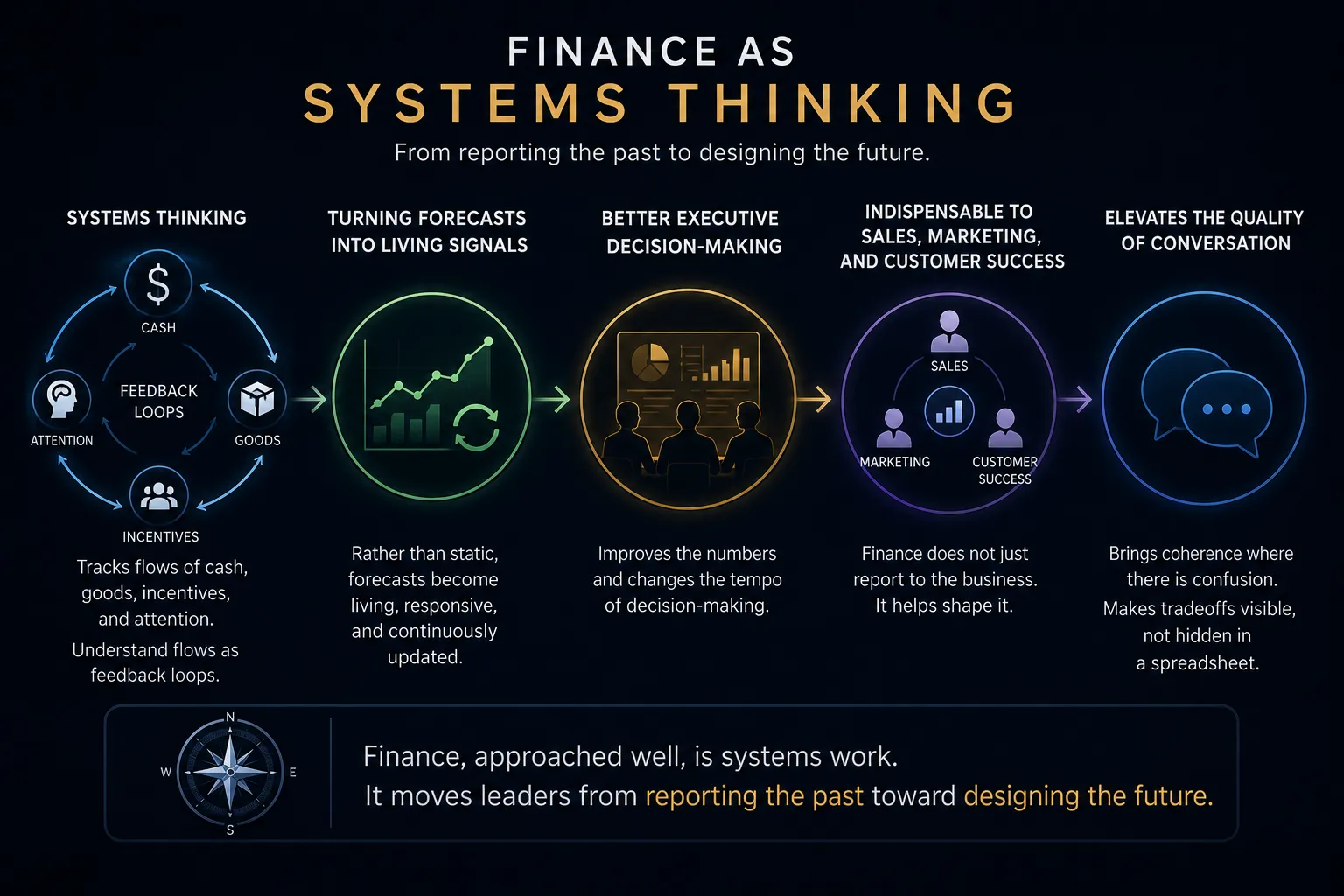
Finance, approached well, is systems work. It tracks flows of cash, goods, incentives, and attention, and when those flows are understood as feedback loops rather than static reports, leverage points become visible. This reframing moves finance leaders from reporting the past toward designing the future, a change that is operational rather than purely philosophical.
Turning Forecasts Into Living Signals
One of the more meaningful shifts in this direction involved rethinking revenue forecasting itself. Rather than treating forecast accuracy as an exercise in precision, it became a living signal, responsive and continuously updated. This change did more than improve the numbers. It altered the tempo of executive decision-making and made the finance team indispensable to sales, marketing, and customer success. Modern finance leaders do not simply report to the business. They help shape it.
Functional mastery alone does not define the most effective finance leaders. Their ability to elevate the quality of conversation across the company defines them instead. They bring coherence where confusion exists and make tradeoffs visible instead of burying them inside a spreadsheet.
Building Trust Through Narrative and Data
Technology and modeling matter, but neither replaces narrative. Finance leaders must be able to speak both spreadsheet and story, explaining uncertainty without sounding evasive and challenging assumptions without alienating partners. Recommendations mean little outside the system in which they operate, so context has to travel with every number.
A go-to-market investment model illustrates this well. Rather than structuring the model as a simple budget, it was built as a strategic map, linking each program to lead generation assumptions, conversion rates, and payback periods. There was resistance at first. People preferred the comfort of top-down allocations. Over time, though, the model reframed the debate. Sales leaders began asking sharper questions, marketing began experimenting with new attribution logic, and finance stopped being the department of no. It became the function that illuminated how.
This points to the most important pivot for any finance leader seeking real influence. Models, forecasts, and variance reports must work as springboards rather than scorecards. They should accelerate learning and catalyze iteration, not simply confirm what already happened.
A few practices tend to separate finance leaders who achieve this shift from those who remain stuck in a purely reporting posture:
- Building feedback-rich environments rather than one-directional reporting chains
- Embedding financial metrics directly into shared objectives so teams speak one language
- Treating planning as a rolling conversation rather than an annual event
Technology, Digital Fluency, and Orchestration
Data science, statistical modeling, and machine learning increasingly empower finance teams to ask better questions. Demand forecasting models, customer retention simulations, and clustering techniques used to detect customer segments are not side projects. They represent where finance is heading, helping identify where revenue plateaus emerge, what signals predict churn, and which territories underperform relative to product usage.
Even so, technology by itself accomplishes little without orchestration. Automation and dashboards are often treated as endpoints when they are really enablers. What matters is how they free finance from reconciliation work and channel that time into decision support. With the right architecture, including APIs, workflow automation, and audit trails, finance stops patching data and starts constructing insight. Rebuilding a business model around recurring revenue and simplified pricing, for instance, required close work with sales, customer success, and legal to rewrite incentive logic, supported by cohort analysis and systems that embedded these behaviors directly into daily workflows.
Trust remains the real currency of leadership in this domain. It comes from clarity, from explaining the why behind a policy, inviting debate on modeling assumptions, and openly sharing where a forecast might fail. In an environment flooded with data, interpretation matters more than precision alone, and finance leaders increasingly serve as curators of meaning rather than mere producers of reports.
Scenario Architects for an Uncertain World
Execution speed often separates strong operators from the rest, and that speed depends on clarity. Finance must clarify what matters through dialogue as much as through dashboards, and through rationale as much as through ratios. A marginal return on investment framework applied to product initiatives illustrates this shift well. Every new investment had to declare its assumptions, expected outcomes, and fallback scenarios. The exercise was not punitive. It was liberating, giving teams a shared language to define success and acceptable risk, and turning finance into a translator of possibility rather than a guardian of cost.
This pivot from controller to enabler happens through behavior rather than titles. When finance leaders join sprint reviews, walk the sales floor, or sit in on customer calls, culture shifts. Waiting for an invitation is no longer enough. Understanding pricing elasticity, customer segmentation, and partner dynamics becomes part of supporting the business rather than meddling in it.
In a volatile environment shaped by macroeconomic shifts, geopolitical friction, and rapid technological change, finance leaders are also asked to act as scenario architects. Real options thinking, long present in corporate finance literature, has become essential to pricing uncertainty, not only in earnings guidance but in capital allocation itself. Debating a new market entry or acquisition now requires mapping upside, downside, and optionality together, asking what changes if interest rates remain elevated or if a core workflow becomes commoditized by new technology. This is not speculation. It is stewardship applied to genuine uncertainty.
Conclusion
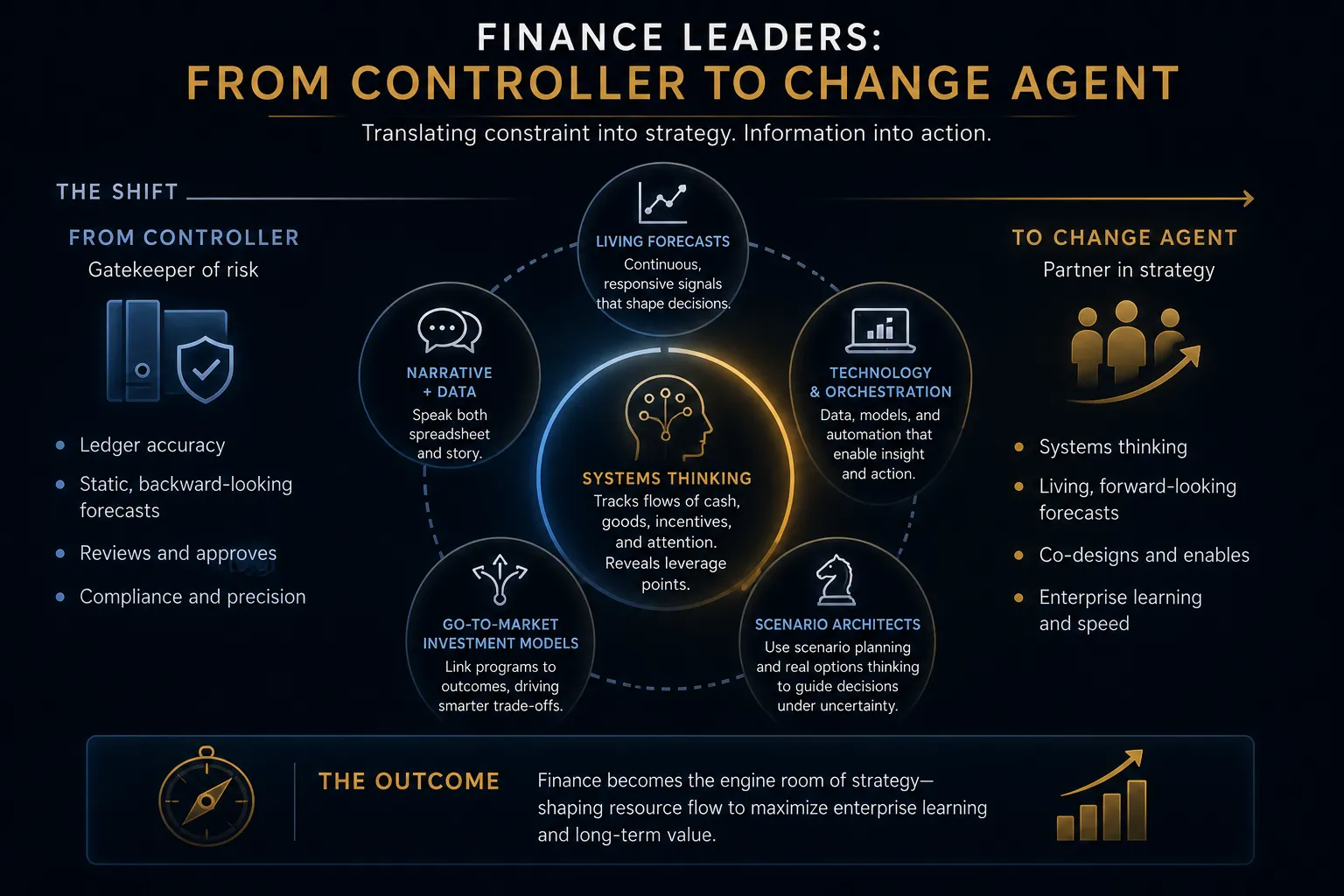
If the modern mandate for finance leaders can be distilled into one idea, it is this: shape resource flow to maximize enterprise learning. Budgets function as hypotheses rather than fixed constraints, and headcount becomes an experiment in capability building rather than a static metric. Every plan benefits from an escape hatch and a feedback loop built in from the start. This represents a shift in mindset more than a new job description or a technology upgrade, moving finance from cost police to strategy architect and from bookkeeper to growth multiplier. The work remains unfinished, with new questions arriving through simulation modeling, predictive analytics, and game theory applied to incentive design. For companies navigating real scale and capital efficiency pressures, finance change is no longer optional. Finance must lead as much as it reports, and in doing so, it becomes what it was always capable of being, not simply the back office, but the engine room of strategy itself.
Disclaimer: This blog is intended for informational purposes only and does not constitute legal, tax, or accounting advice. You should consult your own tax advisor or counsel for advice tailored to your specific situation.
Hindol Datta is a seasoned finance executive with over 25 years of leadership experience across SaaS, cybersecurity, logistics, and digital marketing industries. He has served as CFO and VP of Finance in both public and private companies, leading $120M+ in fundraising and $150M+ in M&A transactions while driving predictive analytics and ERP transformations. Known for blending strategic foresight with operational discipline, he builds high-performing global finance organizations that enable scalable growth and data-driven decision-making.
AI-assisted insights, supplemented by 25 years of finance leadership experience.