Executive Summary
Stepping away from a full-time seat to become a fractional CFO is no longer a fallback position. It is a deliberate career strategy for finance leaders who want broader impact without sacrificing rigor. This article outlines the practical and psychological groundwork required to make that transition well, from legal setup and service packaging to the mindset shift from operator to advisor. Drawing on more than twenty five years of executive finance experience across cybersecurity, SaaS, gaming, logistics, digital marketing, medical devices, and nonprofit organizations, it explores how capital raises, M&A transactions, and finance transformations translate into a repeatable, scalable advisory practice. Readers will come away with a clear framework for structuring their exit, positioning their offering, and building the operating discipline that separates a thriving practice from a stalled one.
Redefining the CFO Career Path
For many finance executives, the idea of leaving a full-time chief financial officer role can feel unsettling. The title, the team, the seat at the leadership table, these are markers earned over years of disciplined execution. Yet the calculus has shifted. Capital efficiency is now a design principle rather than an afterthought, and companies increasingly want senior finance judgment without the cost of a permanent hire. That shift has made the fractional model a serious, strategic path rather than a compromise.
Having led finance functions across sectors as varied as cybersecurity, gaming, logistics, and medical devices, I have come to see this transition less as a departure from executive leadership and more as its natural extension. The skills that matter, capital raising, cost discipline, transformation, translate cleanly across companies. What changes is the container in which you deliver them.
Know Your Why Before You Leap
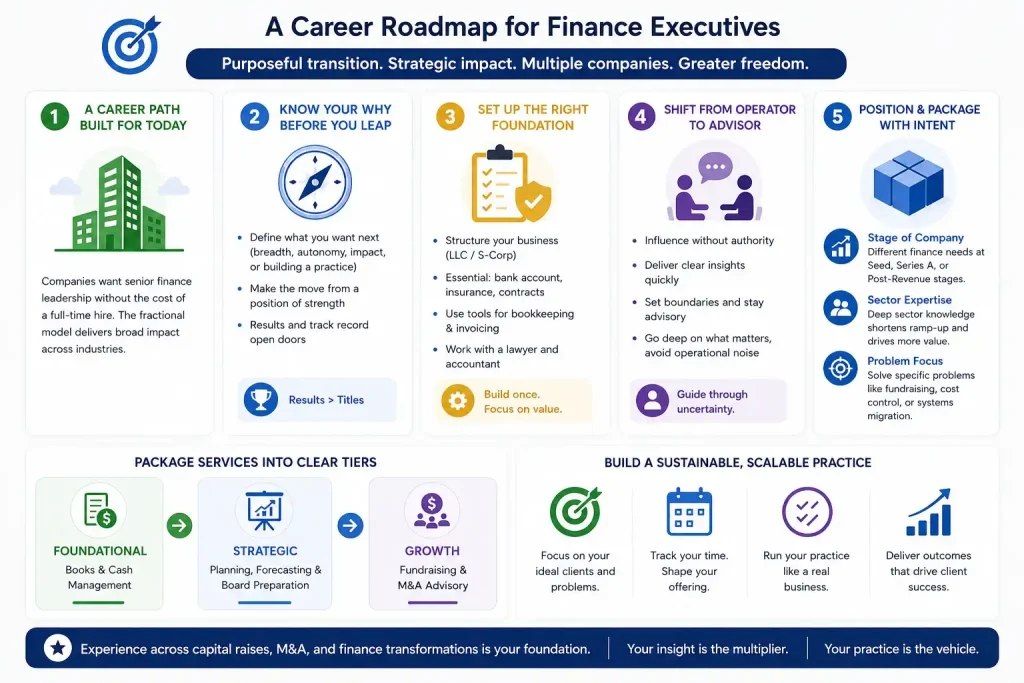
Leaving a full-time role should never be a reaction to burnout or frustration. It should be a considered decision grounded in clarity about what you want next. Are you seeking broader exposure across industries? Greater autonomy over your calendar? A bridge toward building your own advisory practice? Each answer shapes how you select clients and structure your offering.
The strongest transitions happen from a position of strength. If you are still delivering measurable results, whether that is a capital raise, a cost reduction program, or a system transformation, your credibility travels with you. In my own experience, having led raises exceeding one hundred and twenty million dollars and overseen mergers and acquisitions activity above one hundred and fifty million dollars, that track record became the foundation for every subsequent conversation with prospective clients. Results, not titles, are what open doors in this model.
Setting Up Legally and Financially
Before taking on a single client, establish the infrastructure that supports a professional fractional practice. Most executives incorporate as an LLC or S-Corp, depending on their tax jurisdiction, both for liability protection and tax efficiency.
At minimum, you will need:
- A dedicated business bank account
- Professional liability insurance
- Contracts with clearly defined scopes of work and termination terms
- Bookkeeping and invoicing tools such as QuickBooks, Bench, or Xero
Engage a lawyer to draft a standard master services agreement and non-disclosure agreements, and work with an accountant to set up quarterly estimated tax payments. This groundwork frees you to focus on delivering value rather than administering your own business reactively.
The Mindset Shift From Executive to Advisor
As a full-time CFO, authority came with the role. Teams reported to you. Decisions carried institutional weight. As a fractional CFO, influence must be earned in every engagement. That requires learning to:
- Work through others without direct reports
- Deliver clear insight quickly, often from incomplete data
- Set boundaries so the engagement remains advisory rather than transactional
This is not a diminishment of impact. It is a redefinition of it. You are no longer setting quarterly targets from the inside. You are guiding leadership teams through uncertainty, which demands discernment about when to go deep and when to stay above the operational noise. When I reduced monthly burn from eight hundred thousand dollars to two hundred thousand dollars at one organization, the work required exactly this kind of judgment, knowing which levers to pull decisively and which to leave to the operating team.
Positioning and Packaging Your Fractional CFO Services
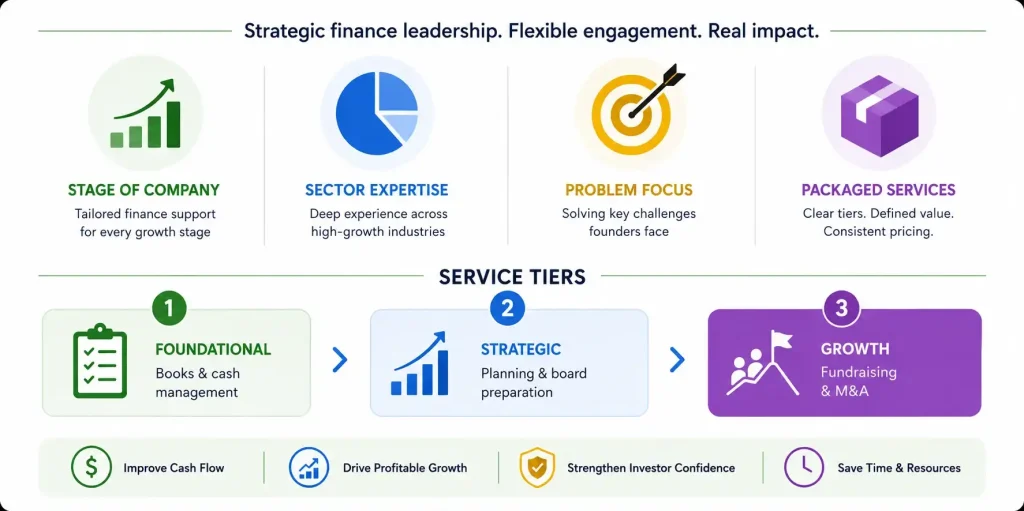
New entrants to this space often make the same mistake: staying too generic. Specialization builds trust faster and commands better pricing. Consider defining your practice by:
Stage of Company
Seed, Series A, or post-revenue companies each require a different finance posture. Early stage founders often need cash discipline and investor readiness, while post-revenue companies may need forecasting rigor and board-level reporting.
Sector Expertise
SaaS, consumer products, marketplaces, gaming, and cybersecurity companies all carry distinct financial dynamics. Having worked across gaming sector acquisitions exceeding one hundred million dollars and led finance transformation within cybersecurity and medical device organizations, I have found that sector fluency shortens the ramp-up time a client would otherwise pay for.
Problem Focus
Fundraising, cost control, and systems migration are common entry points. A founder searching for what a fractional CFO actually does is usually looking for someone who has solved their specific problem before, not a generalist.
Packaging services into tiers, such as a foundational tier covering books and cash management, a strategic tier covering planning and board preparation, and a growth tier covering fundraising and M&A, makes your value legible to founders and easier to price consistently.
Managing the Exit and the First Clients
If you are departing a full-time role, do so with integrity. Offer a structured transition plan, honor existing confidentiality obligations, and leave the door open for a consulting retainer. Many fractional practices begin with exactly this kind of arrangement, where a former employer becomes the first client.
Your earliest engagements will most likely come through your existing network. Be explicit about availability, scope, and timeline from the outset, and resist the temptation to overcommit in the first thirty days. Underpromising and overdelivering early builds the referral flywheel that will sustain the practice for years.
Building a Repeatable Operating Rhythm
A fractional practice without structure becomes reactive and unsustainable. Establishing a predictable rhythm protects both your time and your quality of delivery.
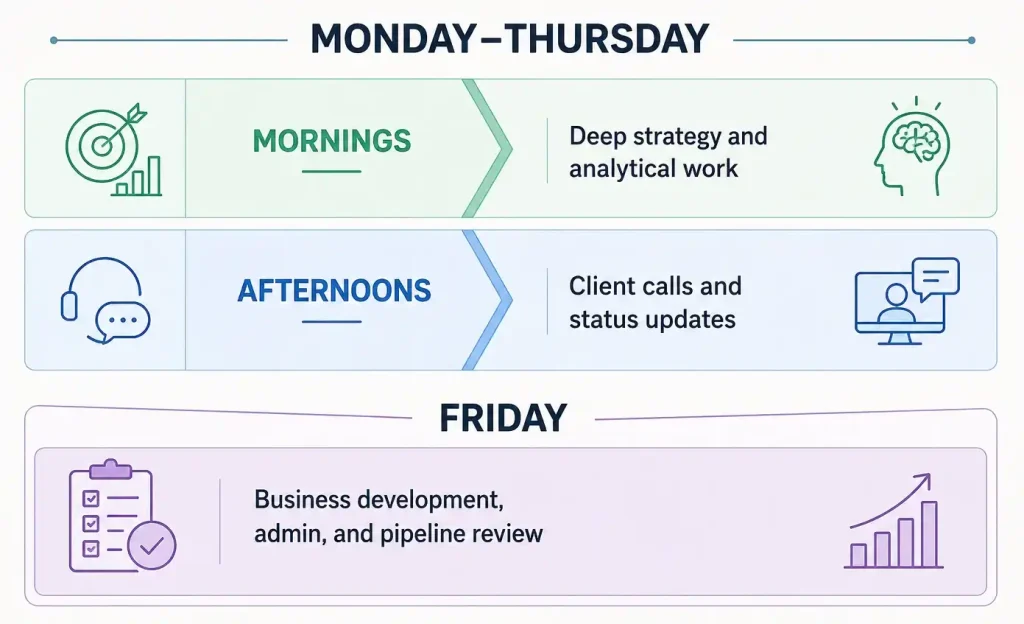
Project management tools such as Notion, Trello, or Asana help track deliverables across multiple clients without losing continuity. Equally important is a consistent weekly cadence for reporting and check-ins, which signals professionalism and reduces the ambiguity that often erodes trust in advisory relationships.
What Separates Thriving Practices From Stalled Ones
Having supported this transition in others and reflected on how these principles applied across my own career, from scaling a digital marketing firm from nine million to one hundred and eighty million dollars in revenue to leading a forty eight million dollar capital raise at a mission driven education institution, a few patterns consistently separate those who thrive from those who stall.
The first is clarity of purpose. The strongest fractional CFOs are moving toward a more diversified model of work, trading depth in one company for breadth across several, and doing so intentionally rather than as an escape from a difficult chapter.
The second is discipline in the first few months. Your first client is not your practice. Your first five are. Tracking where your time actually goes, whether in strategic modeling, board preparation, or process triage, reveals the shape of the offering you should be building. That insight becomes the product itself.
The third is operational rigor. The most durable practices run like real businesses, with clean invoicing, standard engagement documents, and a repeatable onboarding process. That consistency tells clients they are working with a firm, not hiring a freelancer.
Conclusion
The move from full-time executive to fractional CFO is not a step down. It is a deliberate reinvention of how finance leadership is delivered. Success depends on clarity of purpose, disciplined positioning, and the operational rigor to treat the practice as a real business rather than a series of individual engagements. Drawing on experience across capital raises, M&A transactions, and finance transformations spanning multiple sectors, the pattern is consistent: those who succeed specialize deliberately, protect their time, and build systems that scale beyond any single client relationship. For companies, this model delivers senior financial judgment without long-term overhead. For finance executives, it offers control, deeper impact, and genuine optionality over the arc of a career. In a market that increasingly values flexible, high-leverage expertise, the fractional CFO path is not a compromise. It is a competitive advantage for those prepared to build it with intention.
Disclaimer: This blog is intended for informational purposes only and does not constitute legal, tax, or accounting advice. You should consult your own tax advisor or counsel for advice tailored to your specific situation.
Hindol Datta is a seasoned finance executive with over 25 years of leadership experience across SaaS, cybersecurity, logistics, and digital marketing industries. He has served as CFO and VP of Finance in both public and private companies, leading $120M+ in fundraising and $150M+ in M&A transactions while driving predictive analytics and ERP transformations. Known for blending strategic foresight with operational discipline, he builds high-performing global finance organizations that enable scalable growth and data-driven decision-making.
AI-assisted insights, supplemented by 25 years of finance leadership experience.