Executive Summary
Change-in-control provisions rarely draw attention until a deal closes. At that point, they can reshape the entire economics and talent trajectory of a transaction. These clauses sit buried inside employment agreements, equity plans, and bonus structures. Yet they determine whether a workforce stays intact through integration or scatters within months. They also carry the golden handcuffs meaning that finance and human resources leaders invoke when designing retention around a deal. Accelerated vesting, retention pools, and Section 280G exposure are not administrative footnotes. They are deal levers that shape dilution and cash flow. They also shape cultural cohesion at the exact moment a company can least afford surprises.
This article walks through how single-trigger and double-trigger vesting affect deal economics. It also covers how well-designed golden handcuffs protect critical talent without breeding resentment. And it explains how the 280G excise tax trap catches companies that treat change-in-control compensation as boilerplate. Drawing on experience across cybersecurity, gaming, consumer products, and education transactions, this discussion equips CFOs, general counsel, and HR leaders. It helps them model these provisions with confidence. The goal is to do so long before signing a term sheet.
What Change-in-Control Provisions and Golden Handcuffs Actually Mean
Golden handcuffs remain one of the most misunderstood tools in the change-in-control toolkit. People often apply the term loosely to almost any form of deferred pay.
At its simplest, the golden handcuffs meaning refers to financial arrangements designed to make leaving costly for a valued employee. In the change-in-control context, these arrangements sit alongside accelerated vesting clauses, and the two often work in opposite directions. Accelerated vesting can release an employee from any further obligation to stay. A properly structured retention package, the golden handcuffs proper, works differently. It ties future value to continued service after the transaction closes. Confusing the two, or failing to model how they interact, is where many acquirers get into trouble.
A cybersecurity and identity access management company generating roughly $30M in annual recurring revenue offers a useful illustration. During a due diligence process on that scale of business, the equity cap table revealed a pattern that repeats across many venture-backed technology companies: leaders build a workforce around promises of long-term upside, but rarely stress-test the mechanics of those promises against a change-in-control event until diligence forces the question.
Accelerated Vesting: Equity’s Hidden Fuse
Accelerated vesting clauses generally take one of two forms. Single-trigger vesting accelerates equity the moment a transaction closes, regardless of what happens to the employee’s job afterward. Double-trigger vesting requires both the closing of a deal and a subsequent termination without cause, or a resignation for good reason, before acceleration applies. The distinction sounds technical, but it determines whether an acquirer inherits a stable team or a departure wave.
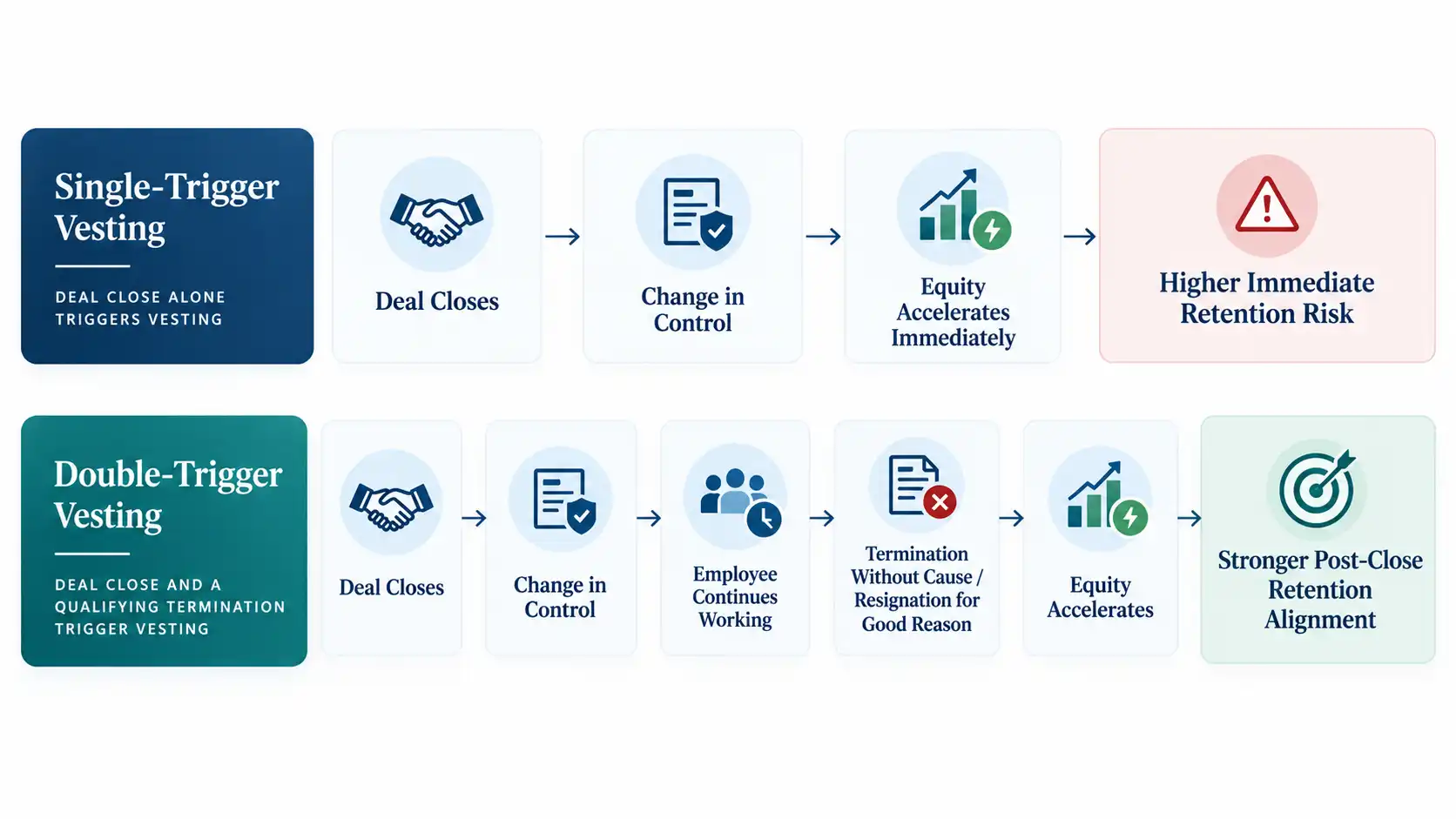
In one Series D acquisition, close to 70 percent of the engineering leadership team held single-trigger RSUs. At close, this converted $22M of unvested equity into immediately realized compensation. For several of those leaders, the payout was substantial enough to remove any financial reason to stay through integration. Within six weeks, five of ten critical engineering leaders had resigned, and the acquiring organization spent the following quarter backfilling roles it had expected to be scaling instead. The financial exposure ran alongside the talent exposure: ASC 718 required accelerated expense recognition, and coordination gaps between payroll and equity administration produced withholding penalties that earlier planning could have avoided.
What Diligence Must Quantify
Legal and finance teams should model the equity impact of both trigger types before signing a letter of intent, not after. That modeling needs to answer several questions with precision:
- How many shares vest immediately under each trigger scenario, and what does that do to the fully diluted share count.
- What tax withholding obligations fall on the company at the moment of acceleration.
- How ASC 718 expense recognition timing affects reported earnings in the closing quarter.
- Whether the resulting payouts approach the Section 280G threshold, discussed below.
Retention Plans and the Real Golden Handcuffs
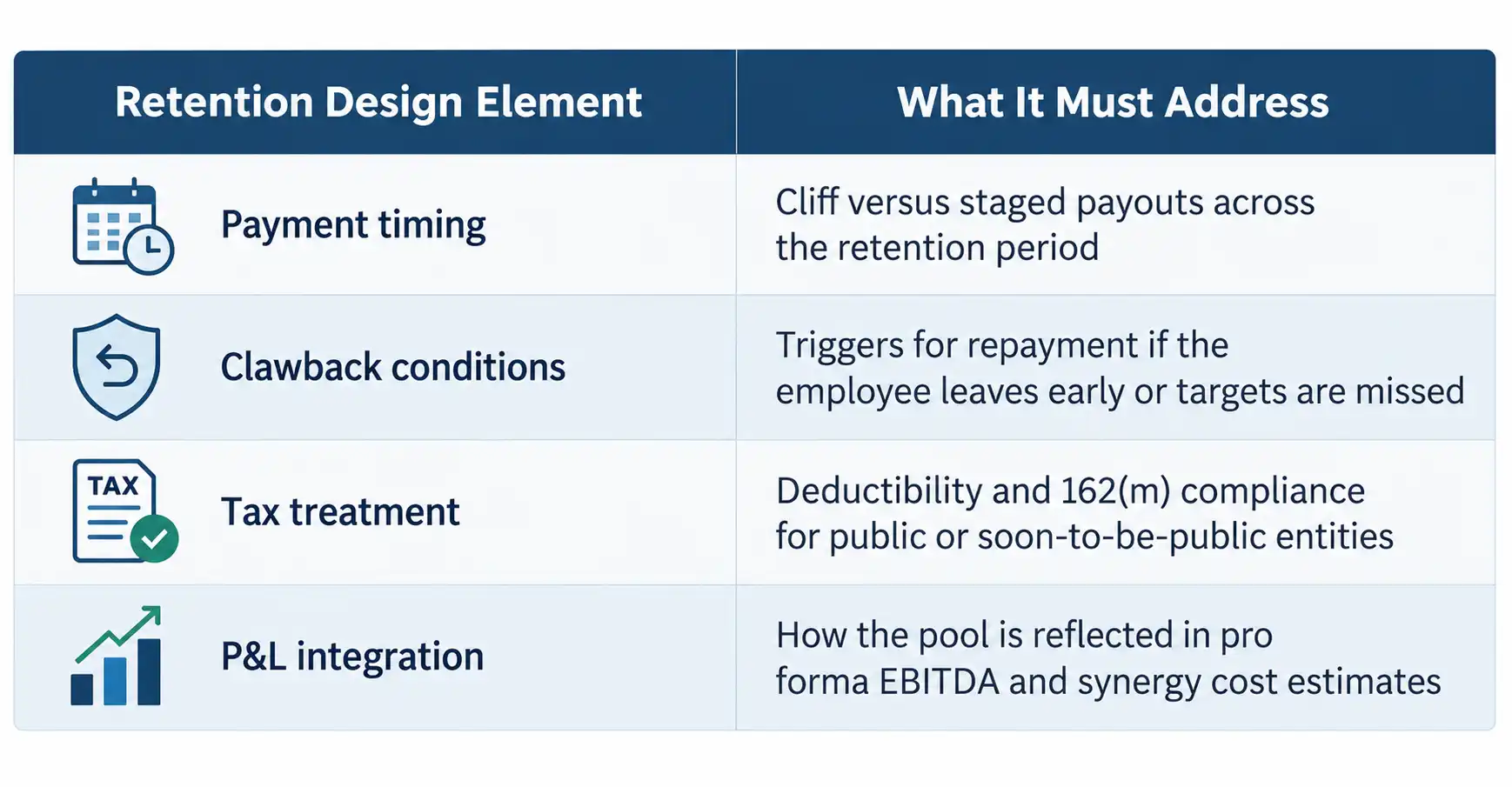
Where accelerated vesting can unintentionally release talent, a deliberately designed golden handcuffs program does the opposite. In a later SaaS transaction, a $5M retention pool was structured for 20 mission-critical employees, funded through a seller carve-out so that both sides had a stake in the outcome. Payouts were tied to performance milestones and tenure over an 18-month period and included clawback conditions if targets were missed. The result was 95 percent retention through the full integration window, and the product roadmap did not merely survive the transition; it accelerated.
Designing golden handcuffs well is closer to an art than a formula. The goal is to reward loyalty without entrenching mediocrity, which means layering immediate cash bonuses, equity refresh grants, and performance-linked milestones rather than relying on a single blunt instrument.
A professional services firm scaling from $12M to $63M in revenue within eight months offers a related lesson, though not one built around change-in-control clauses directly. Building engagement-level profitability analytics from scratch during that scale-up made it clear how quickly leadership can lose visibility into where value, and therefore retention risk, is actually concentrated. The same discipline applies to golden handcuffs design: retention pools should be aimed at the people whose departure would measurably damage revenue or delivery capability, not distributed evenly as a morale gesture, since golden handcuffs that feel arbitrary tend to demotivate the very people they were meant to secure.
Section 280G and the Excise Tax Trap
Section 280G of the Internal Revenue Code disallows tax deductions on excess parachute payments and imposes a 20 percent excise tax on the recipient once change-in-control payouts exceed a threshold generally set at three times the employee’s base amount. The rule catches companies that have not aggregated every source of change-in-control compensation into a single calculation.
In a healthtech transaction, C-level exit packages combined with RSU acceleration pushed total payouts above the 280G threshold. The issue surfaced late in diligence, which left little room to negotiate cleanly. Because no safe harbor exemption applied, the company faced a choice between absorbing a nondeductible compensation cost or seeking a shareholder vote to waive the excess parachute payments, the so-called 280G vote. The near miss on an $8M deduction loss illustrated why this analysis belongs early in the deal timeline rather than as a closing-week discovery.
The 280G Diligence Checklist
- Aggregate total change-in-control compensation across cash, equity, and benefits for every affected employee.
- Run a safe harbor analysis to determine whether existing waivers apply.
- Determine whether a 280G shareholder vote is required, and build the communication timeline around it.
- Model whether purchase price adjustments are warranted to absorb any 280G fallout.
Cultural and Strategic Considerations
The economics of change-in-control provisions are only half the story. Teams notice when payouts appear disconnected from contribution, and resentment can undo the stability these clauses are meant to protect. In one company, exit packages for two founders eclipsed what an entire 50-person sales team received in aggregate. The optics were poor, the acquirer’s sales culture absorbed a visible hit, and a revenue miss followed in the first year after close.
At a Euronext Paris-listed gaming and digital entertainment company operating across five countries, cross-border M&A execution exceeding $100M made clear that consolidated, transparent reporting was not a nicety but a precondition for board confidence during periods of organizational change. The same principle applies here: transparency about how change-in-control packages were determined, and why certain roles carry outsized retention value, tends to preserve trust even when the outcomes are unequal.
CFOs and CHROs should align, well before a transaction is announced, on which roles are genuinely critical to retain, what mix of cash and equity will motivate each group, and how legacy compensation structures will be reconciled with the acquirer’s own philosophy.
Three Key Takeaways
- Model accelerated vesting under both single-trigger and double-trigger scenarios before signing a letter of intent, since the difference between the two can determine whether a critical team stays through integration or departs within weeks of close.
- Treat golden handcuffs as a deliberate design exercise rather than a standard template, layering cash, equity, and performance conditions so that a golden handcuffs program rewards the employees whose departure would genuinely damage the business.
- Aggregate every source of change-in-control compensation early enough to run a proper Section 280G analysis, since a threshold breach discovered during closing week leaves little room to negotiate waivers, safe harbor exemptions, or purchase price adjustments.
Golden handcuffs, used well, are not a cynical retention trick. They are a statement of what the business genuinely values, made in a currency that only matters if the recipient stays long enough to collect it.
Disclaimer: This article is intended for informational purposes only and does not constitute legal, tax, or accounting advice. You should consult your own tax advisor or counsel for advice tailored to your specific situation.
Hindol Datta is a four-time CFO and senior finance executive with over 25 years of leadership experience across cybersecurity, SaaS, gaming, logistics, digital marketing, medical devices, consumer products, and nonprofit organizations. He has led more than $120M in fundraising and over $150M in M&A transactions while building the financial and operational systems that let complex businesses scale with confidence. He is the author of seven books in the Systems CFO Series and holds active CPA, CMA, and CIA credentials.
AI-assisted insights, supplemented by 25 years of finance leadership experience.