Executive Summary
Fundraising is rarely the six-week sprint founders imagine when they first open a pitch deck template. It is a three- to six-month process. It tests narrative discipline, financial hygiene, and a founder’s ability to withstand sustained scrutiny. Effective fundraising strategies for founders begin long before the first investor call. The capital plan should tie to milestones rather than to a round number. That discipline extends well past the wire transfer, into the operating rhythm that follows.
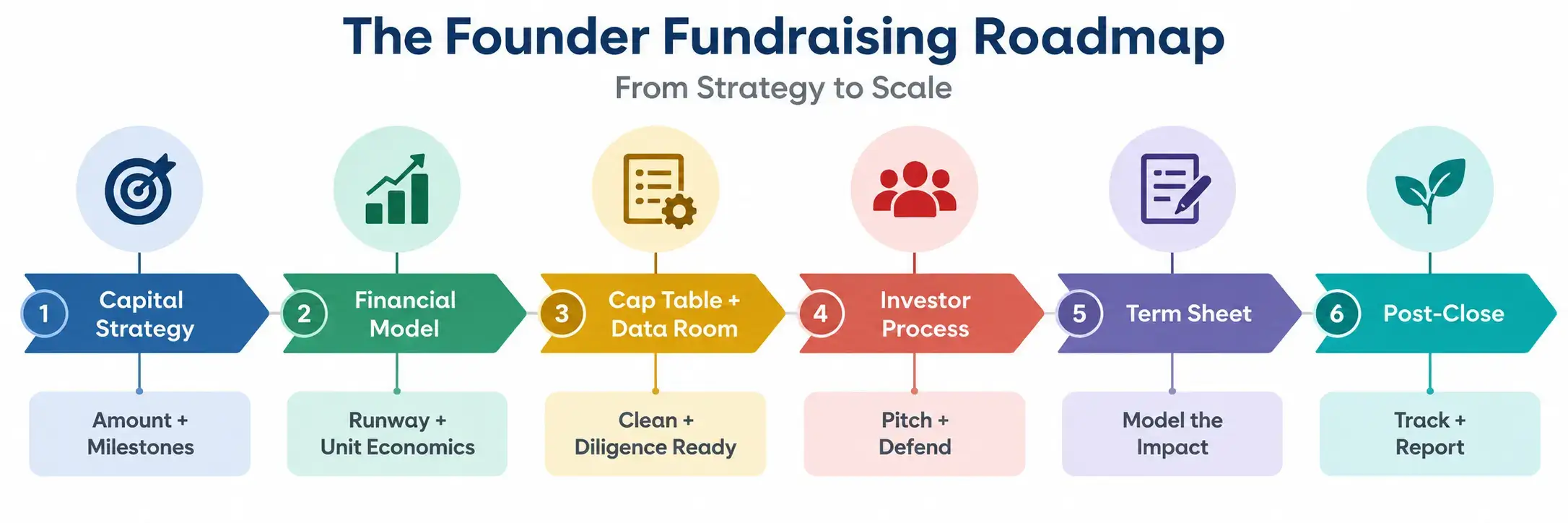
This playbook lays out the sequence that separates a credible raise from a chaotic one: capital strategy before the deck, a dynamic model instead of a static forecast, a defensible cap table, an organized data room, founder readiness, disciplined investor calls, a term sheet read through a strategic lens, and a post-close plan that treats closing the round as a beginning rather than an end.
Start With the Capital Strategy, Not the Pitch Deck
Before a single slide gets built, the capital strategy needs to answer four questions: how much is actually needed, what milestones that capital will unlock, which investor profile fits the company’s stage and sector, and what timing constraints shape the process. Founders who skip this step tend to anchor on a round number that sounds ambitious rather than one that traces back to operational reality, and investors notice the gap immediately.
At a $30M ARR cybersecurity and identity access management company operating across five countries, a founder’s original instinct was to raise against a vague growth narrative. Reframing the ask around annual recurring revenue growth, sales team expansion, and a specific burn runway turned a soft story into a credible one, because every dollar requested now mapped to a milestone an investor could verify. That same discipline shows up at earlier stages too. Building the capital strategy and investor narrative from scratch for a pre-Series A AI governance and assurance platform meant the ask had to be defensible before the model even existed in full, which forced milestone clarity from day one rather than after the first round of investor questions.
Build a Dynamic Model, Not a Static Forecast
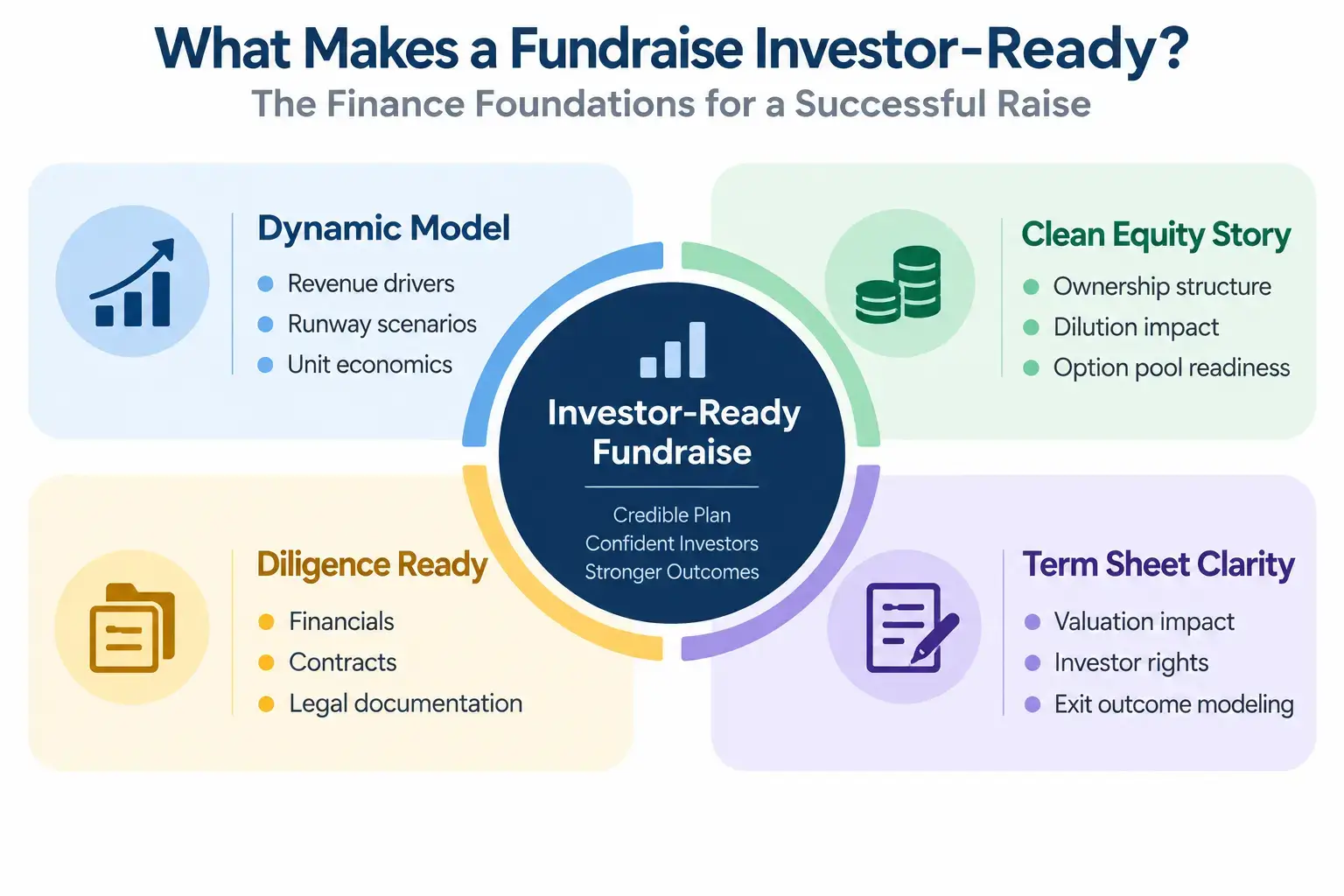
Investors evaluate four things inside a model: revenue drivers such as volume, pricing, and churn; expense structure split between fixed and variable costs; cash runway under multiple scenarios; and unit economics, particularly LTV to CAC and payback period. A static spreadsheet with hardcoded numbers signals that the founder has not stress-tested the business. A dynamic model, with clear tabs, version control, and driver-based logic, signals control and maturity.
Toggles matter more than founders expect. Building models with adjustable growth pace and hiring assumptions turns the forecast from a one-time deliverable into a decision engine the founder can actually use between board meetings. The cohort analysis and unit economics work built for a marketplace SaaS company’s $20M Series B round is a useful reference point here: the model withstood diligence not because it was elaborate, but because every assumption tied cleanly back to an observable driver.
Core Model Components Investors Expect to See
- Revenue drivers segmented by volume, pricing, and churn
- Fixed versus variable expense structure
- Multi-scenario cash runway analysis
- LTV to CAC ratio and payback period
Pressure-Test the Cap Table and Equity Story
Founders consistently underestimate how much equity leaves the table across rounds and how dilution compounds. The finance function’s job is to model pre- and post-money ownership, the impact of an option pool refresh, investor participation rights, and, where relevant, the exit waterfall. A cap table tool or a carefully built spreadsheet can simulate these outcomes before a term sheet arrives, not after.
An equity review conducted within the first ten days of fundraising preparation tends to surface problems early enough to fix them. SAFE rounds with inconsistent terms, option pools that were never refreshed, and pro forma ownership that nobody has modeled recently are common, and they become expensive surprises when an investor’s counsel finds them first.
Prepare the Data Room Early
The data room is a signal to the market before a single number gets discussed. A chaotic folder structure tells investors the company is disorganized regardless of how strong the underlying business is.
A Well-Built Data Room Should Include
- Historical profit and loss statements and balance sheets
- Bank statements and material contracts
- Cap table documentation, including SAFEs and convertibles
- The forecast model with assumptions documented
- Legal documents covering incorporation, intellectual property, and employment
A shared, version-controlled folder in a platform such as Dropbox, Google Drive, or DocSend prevents the kind of mistake that erodes investor trust quickly, such as three different cap table versions circulating among investors at once.
Coach the Founder and Support Investor Calls Strategically
The founder is the face of the raise, and investors fund people as much as they fund plans. Preparation should include sharpening the pitch narrative, rehearsing the financial questions investors ask most often, and building a consistent story across the slides and the numbers behind them. Mock investor sessions, where the finance team asks hard questions and challenges assumptions, build the kind of composure that shows up in real diligence calls.
The finance leader’s role on investor calls should be selective rather than constant: joining for deep financial or operational questions, for moments where modeling clarity matters, and for credibility building, without overshadowing the founder. Brevity and data fluency carry more weight in these calls than enthusiasm does.
Read the Term Sheet With a Strategic Lens
Valuation is the number founders fixate on, but liquidation preferences, participation rights, board composition, major investor rights, and milestone-based tranches often matter more to the eventual outcome. A founder focused on a small valuation delta while ignoring participating preferred rights can give away more value than the valuation gap ever represented.
Modeling the term sheet’s impact on exit outcomes at multiple valuations, such as $50M, $100M, and $200M scenarios, translates legal language into financial consequences the founder can actually weigh. This is where the IPO-readiness discipline learned taking a Euronext Paris-listed gaming and digital entertainment company through its S-1 process becomes relevant even at the seed and Series A stage: understanding exactly how capital structure decisions echo forward into later financing events prevents founders from solving today’s problem by creating tomorrow’s.
Plan for Post-Close Execution
Closing a round raises expectations rather than settling them. The forecast needs to be updated with the actual raise amount, KPIs tied to funding milestones need tracking, and a board reporting cadence needs to be in place before the first post-raise board meeting arrives.
Post-Close Priorities in the First Quarter
- Update the forecast with actual proceeds and revised runway
- Track KPIs explicitly tied to the milestones promised to investors
- Establish or refresh the board reporting cadence
- Begin the next round’s capital strategy conversation early, rather than waiting for the runway to compress
Three Key Takeaways
- A fundraising round becomes credible the moment the capital ask is tied to specific, verifiable milestones rather than a round number chosen for its optics, and that discipline should shape the model, the deck, and the founder’s answers in the room.
- The mechanics that most often derail a raise, a stale cap table, a disorganized data room, and a term sheet read only for its valuation, are all preventable with early preparation, and the finance function exists precisely to catch them before an investor does.
- Closing the round is the beginning of a higher scrutiny period, not the end of the process, and founders who update their forecast, track milestone-linked KPIs, and establish board reporting discipline in the first weeks after close set up the next raise long before they need it.
Disclaimer: This article is intended for informational purposes only and does not constitute legal, tax, or accounting advice. You should consult your own tax advisor or counsel for advice tailored to your specific situation.
Hindol Datta is a four-time CFO and senior finance executive with over 25 years of leadership experience across cybersecurity, SaaS, gaming, logistics, digital marketing, medical devices, consumer products, and nonprofit organizations. He has led more than $120M in fundraising and over $150M in M&A transactions while building the financial and operational systems that let complex businesses scale with confidence. He is the author of seven books in the Systems CFO Series and holds active CPA, CMA, and CIA credentials.
AI-assisted insights, supplemented by 25 years of finance leadership experience.