Executive Summary
A fractional CFO does not sell hours. A fractional chief financial officer sells judgment, and judgment only scales when the routine work around it runs on rails. The right fractional CFO tech stack is what separates a finance professional juggling three clients from a firm capable of serving ten without sacrificing quality, and this distinction has become the defining constraint on growth for fractional CFOs entering an increasingly crowded market.
This guide maps the essential categories of tools that fractional CFOs should evaluate, organized by function rather than by brand loyalty. It is not an argument for chasing every new platform. It is a case for building a lean, standardized stack that automates the predictable and protects bandwidth for the strategic modeling, capital decisions, and board conversations that actually justify the engagement.
Why the Fractional CFO Tech Stack Determines Capacity, Not Just Convenience
Fractional CFOs operate under a structural constraint that in-house finance leaders do not face: time is split across multiple organizations, each with its own systems, cadences, and blind spots. A tool that saves ninety minutes per client per week becomes several reclaimed workdays per month once multiplied across a typical roster. That reclaimed time is what gets reinvested into the parts of the role that cannot be automated, including scenario planning under uncertainty, pricing strategy, and the difficult conversations that come with board-level accountability.
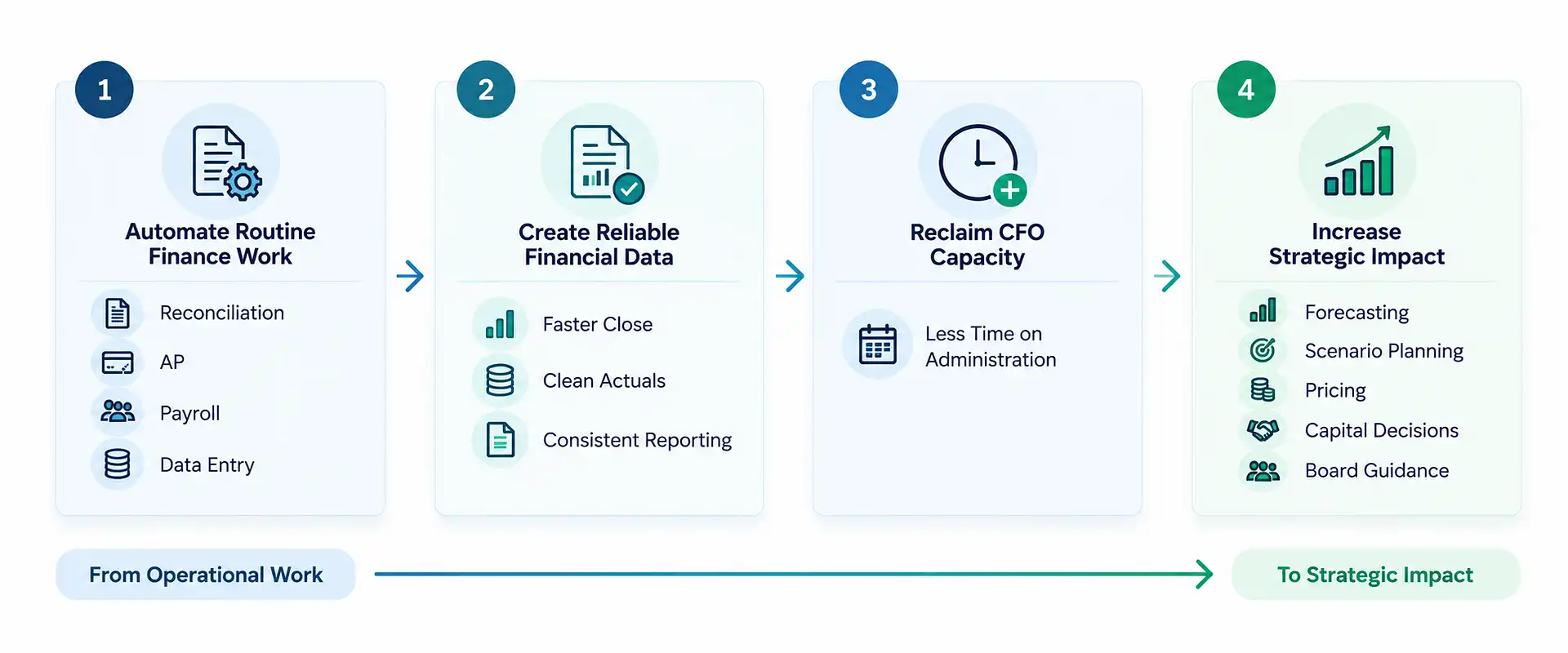
The experience of building a driver-based forecasting engine and capacity model from scratch for a high-growth cybersecurity and identity access management company, one that scaled to approximately $30M in annual recurring revenue across five countries, illustrates the point directly. Holding actuals within five percent of forecast for eight consecutive quarters was not the product of forecasting talent alone. It came from implementing NetSuite end to end across five country entities, which compressed the monthly close from eighteen days to ten and gave the finance function a common data spine to forecast against.
Core Finance and Accounting Infrastructure
Every engagement begins with the ledger, and the ledger determines how much manual reconciliation a fractional CFO inherits.
- QuickBooks Online or Xero – QuickBooks remains dominant among United States clients, while Xero holds stronger footing internationally. Both support bank feeds, automation rules, and a wide ecosystem of app integrations that reduce manual entry.
- Bill.com or Ramp – Ramp brings spend controls, corporate cards, and real-time visibility into discretionary spend, while Bill.com remains a dependable standard for payables workflows and approval chains.
- Gusto or Rippling – Gusto is faster to launch for a lean team, while Rippling extends further into IT provisioning and compliance, which matters once headcount and geographic complexity grow.
Forecasting and Cash Flow Management for the Fractional CFO
Forecasting infrastructure is where a fractional chief financial officer earns the retainer, because founders can review a bank balance on their own but cannot build a defensible thirteen-week rolling forecast without help.
Lightweight FP&A Built for Multi-Client Practices
- Float or Runway – Float connects to QuickBooks to visualize cash over time, while Runway is purpose-built for startups, including hiring plans and burn modeling.
- Jirav or LivePlan – Both support rolling forecasts, headcount planning, and scenario modeling. Jirav in particular suits practices managing forecasts across several clients at once.
An engagement with a marketplace SaaS platform during its Series B raise reinforced how much a forecasting layer changes the outcome of a fundraise. Building the consolidated United States and Polish reporting framework, alongside the cohort and unit economics models that underpinned that $20M round, meant the difference between investors accepting the numbers on faith and investors interrogating them line by line. Separately, in an AI governance and assurance platform at the pre-Series A stage, rebuilding the entire finance workflow around AI-first tooling for modeling, reporting, and diligence compressed the time from question to decision in a way that no spreadsheet template could replicate.
Board and Investor Reporting Tools That Build Trust
Boards do not remember every number presented to them, but they remember whether the reporting felt credible.
- Fathom or Spotlight Reporting – Fathom handles multi-entity rollups well, while Spotlight leans toward visual storytelling for KPIs and commentary.
- Canva or Beautiful.ai – For fractional CFOs assembling their own board decks, these tools produce polished output quickly, without requiring design skill.
Board reporting discipline mattered most in a mission-driven education and research institution, where the finance function sat inside the executive team and reported directly to an active audit committee while a $37M capital raise across equity and venture debt was underway. The reporting cadence built there, oriented toward what an audit committee actually needs to see rather than what is easiest to produce, transferred directly into later work with a publicly traded gaming and digital entertainment company, where a unified definition of revenue across every subsidiary had to hold up under both IFRS and United States GAAP.
Equity, Documentation, and Practice Management
Cap Table Accuracy Is Non-Negotiable
- Carta – Still the default for most venture-backed clients. Spreadsheet-based cap tables become a liability the moment a company raises outside capital.
- Pulley – A growing alternative for early-stage companies, with a cleaner interface and startup-oriented pricing.
Knowledge Management, Contracts, Time, and Pipeline
- Notion or Google Workspace – Notion tracks client SOPs, close checklists, and process playbooks, while Google Workspace remains the default for collaboration.
- DocuSign or HelloSign – Contract execution should be frictionless, particularly for engagement letters and vendor agreements.
- Harvest or Toggl for hourly billing, or QuickBooks Time or FreshBooks depending on the base accounting system.
- HubSpot or Streak for CRM at scale, and Pipedrive for consultants who prefer a visual pipeline.
An early-stage digital marketing and community technology company offers a useful contrast here. Serving as the first finance hire and reducing monthly burn from $800K to $200K required financial infrastructure and reporting discipline, not documentation for its own sake. But the lesson that traveled forward, later applied while scaling a venture-backed digital marketing organization from $9M to $180M in revenue over twenty-four months, was that a documented playbook is what allows a finance function to be rebuilt quickly when growth outpaces the systems supporting it.
A Framework for Choosing and Sequencing the Fractional CFO Tech Stack
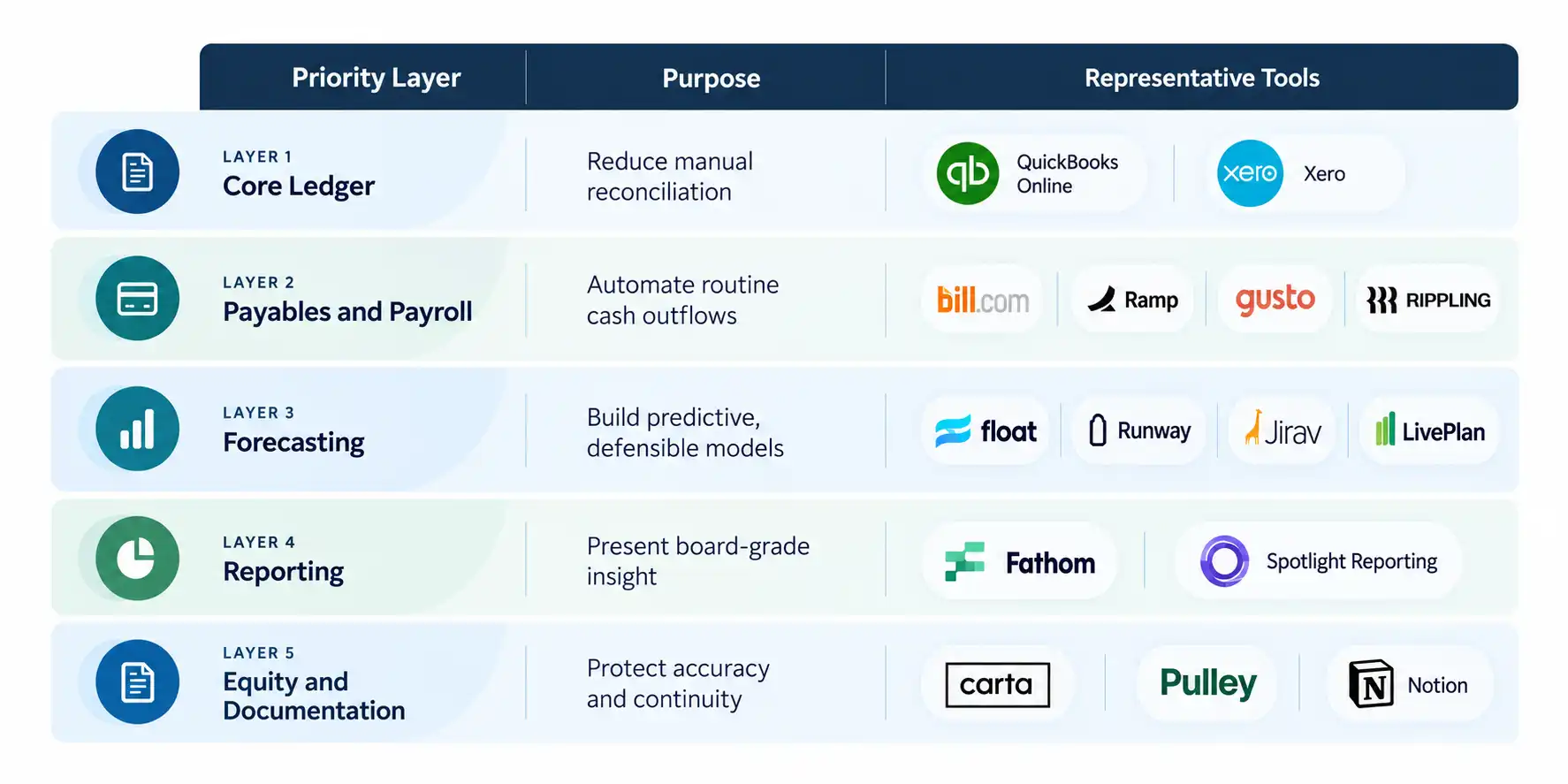
The sequencing matters because a fractional CFO who tries to implement all five layers simultaneously across a new client typically delivers none of them well. The ledger and payables layer comes first, since those tools reduce manual tasks immediately and establish a trustworthy data foundation. Forecasting and reporting layer in once that foundation holds, and cap table and documentation tools tend to follow only after the engagement stabilizes into a recurring cadence rather than a cleanup project.
Three Key Takeaways
- A fractional CFO tech stack should be judged by how much manual work it removes from the close and forecast cycle, since every hour reclaimed from data wrangling is an hour available for the strategic judgment clients are actually paying for.
- Standardizing the same core tools across multiple clients, rather than adapting to whatever each client happens to already use, makes onboarding, training, and troubleshooting dramatically more efficient across a growing roster of fractional chief financial officer engagements.
- Cap table accuracy and board-grade reporting are not optional refinements for fractional CFOs serving venture-backed companies; a single dilution or revenue-recognition error at the wrong moment can cost a client millions and cost the advisor the relationship.
Disclaimer: This article is intended for informational purposes only and does not constitute legal, tax, or accounting advice. You should consult your own tax advisor or counsel for advice tailored to your specific situation.
Hindol Datta is a four-time CFO and senior finance executive with over 25 years of leadership experience across cybersecurity, SaaS, gaming, logistics, digital marketing, medical devices, consumer products, and nonprofit organizations. He has led more than $120M in fundraising and over $150M in M&A transactions while building the financial and operational systems that let complex businesses scale with confidence. He is the author of seven books in the Systems CFO Series and holds active CPA, CMA, and CIA credentials.
AI-assisted insights, supplemented by 25 years of finance leadership experience.